

What is the difference between tax credits and tax deductions?
Last reviewed: July 2026
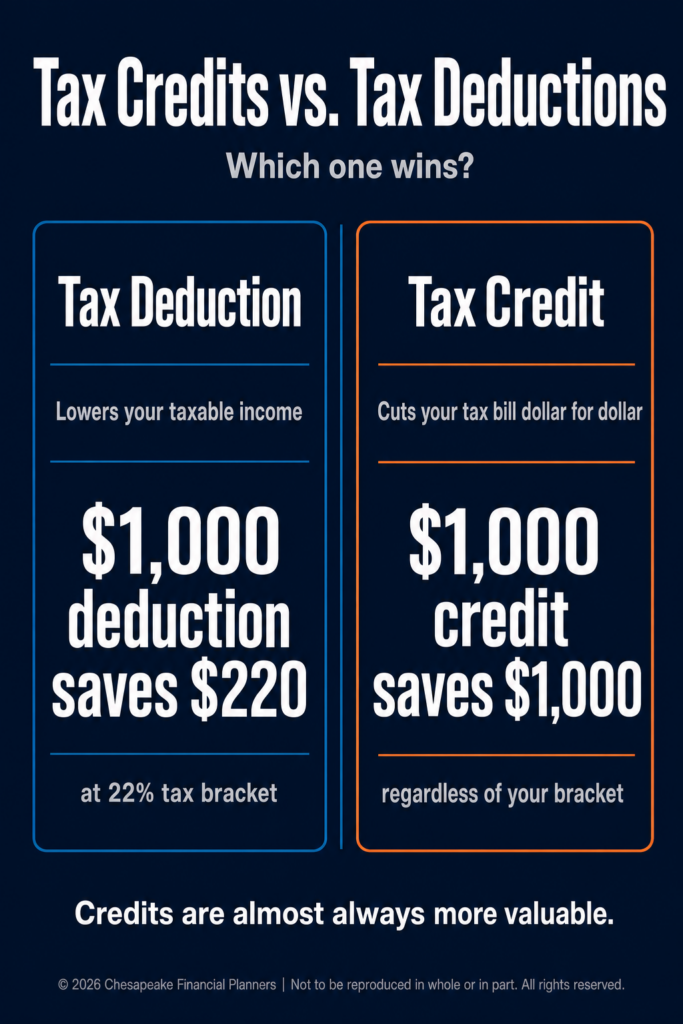
A tax deduction lowers your taxable income, while a tax credit lowers your tax bill directly, dollar for dollar, which makes credits almost always more valuable. A $1,000 deduction saves you only your tax rate on that amount, somewhere between $100 and $370 depending on your bracket, but a $1,000 credit cuts your tax owed by the full $1,000 regardless of bracket. You do not actually choose between them; you claim every deduction and credit you qualify for. The real win is understanding what you are eligible for so you do not leave money on the table.
On This Page
- Key Takeaways
- How do tax deductions work?
- How do tax credits work, and why are they more valuable?
- How much difference can a credit make versus a deduction?
- What planning moves and misconceptions should you know?
- Related Topics Worth Reading
- Frequently Asked Questions
- Don't leave tax savings on the table
- Disclosures
Key Takeaways
- A deduction reduces taxable income; a credit reduces your tax bill dollar for dollar, so credits are usually worth more.
- A $1,000 deduction saves $100 to $370 depending on your bracket; a $1,000 credit saves the full $1,000.
- Refundable credits can pay you back even if they exceed your tax owed; nonrefundable credits only reduce tax to zero.
- The 2026 standard deduction is $16,100 for single filers and $32,200 for married couples filing jointly.
About the Author: Jeff Judge, CFP®, AEP®, ChFC®, CLU® is Managing Partner of Chesapeake Financial Planners in Forest Hill, Maryland. He has helped Harford County and Baltimore-area households plan around the tax code since earning his CFP® certification in 2013, by using Chesapeake Financial Planners’ signature process, the R.U.D.D.E.R. method™. As Jeff puts it: "Most people treat credits and deductions as interchangeable jargon, but knowing that a credit is worth several times a deduction of the same size changes which opportunities you chase, and that difference is real money every April."
How do tax deductions work?
A tax deduction works by reducing your taxable income, so its value depends on your tax bracket, the higher your bracket, the more a deduction is worth. It lowers the amount of income that gets taxed rather than the tax itself.
The mechanics are simple. If you are in the 22% bracket and you have a $1,000 deduction, it reduces your taxable income by $1,000 and saves you $220 in tax. That same $1,000 deduction saves someone in the 37% bracket $370, and someone in the 10% bracket only $100. So a deduction is a discount applied before the tax is calculated, and its real value scales with your rate.
Common deductions include the standard deduction, which for 2026 is $16,100 for single filers and $32,200 for married couples filing jointly, and which most people take instead of itemizing; traditional 401(k) and IRA contributions, which reduce taxable income (the 2026 401(k) elective deferral limit is $24,500); up to $2,500 of student loan interest; and Health Savings Account contributions. If your itemized deductions, mortgage interest, state and local taxes (capped at $40,400), charitable gifts, and medical expenses above 7.5% of adjusted gross income, exceed the standard deduction, you itemize instead. Notably, even people who take the standard deduction still get certain above-the-line deductions like retirement contributions and student loan interest.
How do tax credits work, and why are they more valuable?
A tax credit works by reducing your tax bill directly, dollar for dollar, which is why it is more valuable than a deduction of the same size. The credit comes off the tax you owe, not off your income, and it does not depend on your bracket.
As the IRS puts it, "Credits can reduce the amount of tax due," while "Deductions can reduce the amount of taxable income," a distinction laid out on the IRS credits and deductions page. If you owe $5,000 in tax and have a $1,000 credit, you now owe $4,000, full stop.
| Feature | Tax deduction | Tax credit |
|---|---|---|
| What it lowers | Your taxable income | Your tax bill directly |
| Value of a $1,000 item | $100 to $370 (depends on bracket) | The full $1,000 |
| Depends on bracket | Yes | No |
| Can it refund you | No | Only refundable credits |
That is the key contrast: a $1,000 credit saves you $1,000, while a $1,000 deduction saves only your tax rate on that amount. Credits also come in three flavors that matter a great deal. Refundable credits pay you the difference if the credit exceeds your tax owed, making them the most valuable. Nonrefundable credits can reduce your tax to zero but no further, with any excess lost. Partially refundable credits refund some portion and not the rest.
Common credits span a wide range of households. The Child Tax Credit is worth up to $2,200 per qualifying child under 17 for 2026, with up to $1,700 refundable, phasing out at higher incomes. The Earned Income Tax Credit, fully refundable, can be worth several thousand dollars for lower-to-moderate-income workers. The American Opportunity Tax Credit provides up to $2,500 per student for the first four years of college (40% refundable), and the Lifetime Learning Credit up to $2,000 per return. The Saver's Credit, the Child and Dependent Care Credit, the Premium Tax Credit for marketplace health coverage, the Adoption Credit (up to $17,670 for 2026), and residential clean energy credits round out the common list. Because these interact with income phase-outs, coordinating them is exactly the kind of work the R.U.D.D.E.R. Method™ handles. The R.U.D.D.E.R. Method™ is Chesapeake Financial Planners' six-step planning process: Review and Recognize, Uncover and Understand, Design and Develop, Discuss and Decide, Execute and Empower, and Reassess and Refine, and tax-opportunity planning lives in Design and Develop, working alongside your CPA.
How much difference can a credit make versus a deduction?
A credit can easily save more than a larger deduction, because it reduces tax directly rather than just reducing taxable income. A simple comparison makes the gap concrete.
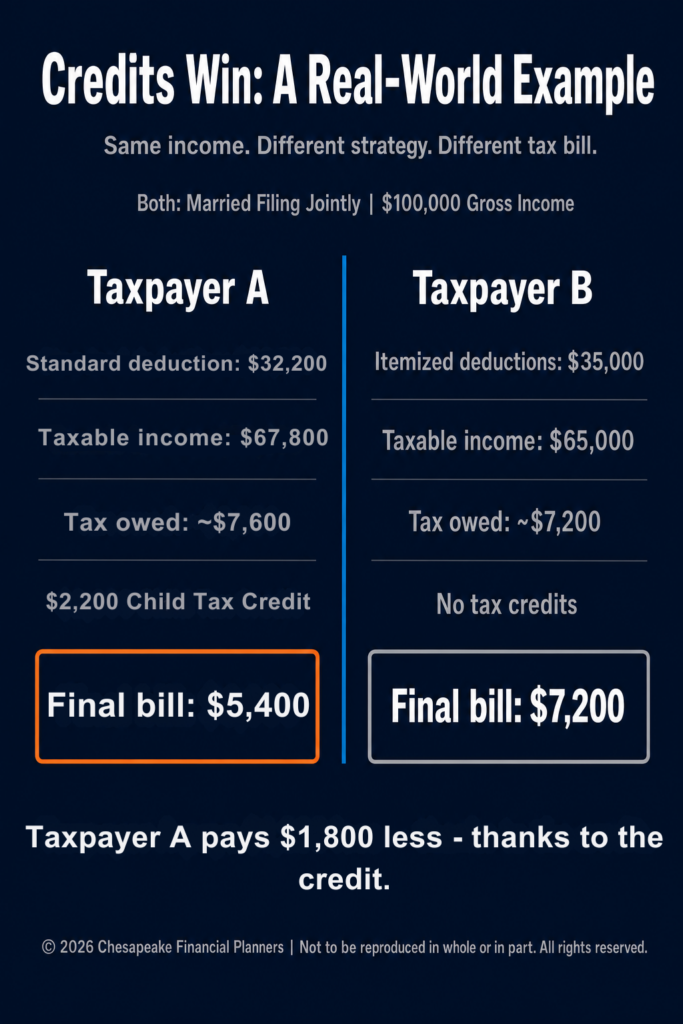
Consider two married couples, each with $100,000 of gross income, in a simplified illustration. The first takes the 2026 standard deduction of $32,200, leaving $67,800 of taxable income, owes roughly $8,000 in tax, then applies a $2,000 child-related credit, ending around $6,000. The second itemizes $35,000 in deductions, a larger deduction, leaving $65,000 of taxable income and owing roughly $7,200, but has no credits, ending at about $7,200. The couple with the smaller deduction but a credit pays less, because the credit came straight off the tax owed while the extra deduction only shaved a bit of taxable income. (These figures are simplified for illustration and ignore other variables.)
The lesson is not that deductions are bad, they are valuable, but that a dollar of credit is worth far more than a dollar of deduction. When you are deciding where to focus, whether to chase an additional deduction or to make sure you have claimed every credit you qualify for, the credits deserve first priority.
What planning moves and misconceptions should you know?
The smart moves are to maximize deductions and credits together, watch income phase-outs, and never miss refundable credits, while avoiding a few common misconceptions. A little planning captures money that is otherwise routinely left unclaimed.
Useful strategies include maximizing retirement contributions, which reduce taxable income and, for lower-to-moderate earners, can also trigger the Saver's Credit, a double benefit; bunching charitable donations into alternating years to clear the standard deduction; managing income near phase-out thresholds, since increasing retirement contributions can preserve eligibility for credits that fade out at higher incomes; and keeping documentation for medical, charitable, education, and childcare costs, because you cannot claim what you cannot prove. With education credits, remember you cannot claim both the American Opportunity and Lifetime Learning credits for the same student in the same year, so pick the larger benefit.
Three misconceptions cost people money. "I don't itemize, so I get no deductions" is false: the standard deduction is itself a large deduction, and above-the-line deductions apply regardless. "Credits are only for low-income people" is false: the Child Tax Credit, education credits, and energy credits reach middle and even higher earners. And "a big refund means I did well" is misleading: a refund just means you over-withheld during the year. The goal is to minimize your actual tax liability through deductions and credits, then set withholding so you neither owe a lot nor lend the government money interest-free.
Related Topics Worth Reading
Understanding credits and deductions connects to broader tax planning. These related topics go deeper.
- Advanced tax strategy for higher earners. What Are the Best Tax Strategies for High Net Worth Individuals?
- Why high earners lose the education credits, and what to do instead. What are my college funding options when my income disqualifies us from financial aid?
- A year-by-year calendar for tax moves. What is a year-round tax planning calendar for retirees and pre-retirees?
- Using a donor-advised fund to make charitable deductions count. How Do Donor-Advised Funds Work for Tax Savings?
- How retirement contributions cut your taxable income. Solo 401(k) vs SEP IRA: Which Is Right for You?
Frequently Asked Questions
What is the difference between a tax credit and a tax deduction?
A tax deduction reduces your taxable income, so its value depends on your tax bracket, while a tax credit reduces your tax bill directly, dollar for dollar, regardless of bracket. A $1,000 deduction saves you between $100 and $370 depending on your rate, but a $1,000 credit saves the full $1,000. Credits are therefore almost always more valuable than deductions of the same size, though you claim every one you qualify for.
Are tax credits better than tax deductions?
Yes, dollar for dollar, tax credits are better than deductions because they reduce your actual tax owed rather than just your taxable income. A $1,000 credit cuts your tax bill by $1,000, while a $1,000 deduction only saves you your marginal tax rate on that amount. Refundable credits are the most valuable of all, since they can pay you back even if they exceed the tax you owe. You should still claim both wherever you qualify.
What is the standard deduction for 2026?
For tax year 2026, the standard deduction is $16,100 for single filers and married individuals filing separately, $32,200 for married couples filing jointly, and $24,150 for heads of household. Most taxpayers take the standard deduction rather than itemizing. You would itemize only if your deductible expenses, such as mortgage interest, state and local taxes, and charitable gifts, add up to more than the standard deduction for your filing status.
What is a refundable tax credit?
A refundable tax credit is one that can pay you the difference if the credit is larger than the tax you owe, meaning it can generate a refund rather than just zeroing out your bill. The Earned Income Tax Credit is fully refundable, and the Child Tax Credit is partially refundable (up to $1,700 per child for 2026). Nonrefundable credits, by contrast, can reduce your tax to zero but any excess is lost rather than refunded.
Can I claim both tax credits and tax deductions?
Yes, you claim both credits and deductions on the same return wherever you qualify; they are not mutually exclusive. Your deductions reduce your taxable income to determine the tax you owe, and then your credits reduce that tax directly. The only common either-or situations are within a category, such as choosing the standard deduction versus itemizing, or choosing between the American Opportunity and Lifetime Learning credits for the same student in the same year.
Don't leave tax savings on the table
The difference between a credit and a deduction looks like a technicality, but it is worth real money: credits cut your tax bill dollar for dollar, while deductions only shave your taxable income. Knowing that distinction helps you prioritize, claim every refundable credit you qualify for, manage income around phase-outs, and keep the documentation that lets you claim what you are owed. If your situation is more complex, self-employment, investments, children in college, a CPA or financial planner usually pays for itself. Jeff Judge and the Chesapeake Financial Planners team help households across Harford County and the Baltimore metro plan around the tax code year-round, alongside their CPAs. Schedule a free fit call at chesapeakefp.com.
Want to go deeper? Our Tax-Smart Financial Plan walks through this step by step.
Disclosures
The information provided is for educational purposes only and should not be construed as investment advice. Investment strategies should be tailored to individual circumstances, risk tolerance, and goals. Past performance doesn't guarantee future results. Consult with qualified financial professionals regarding your specific situation.
This information is not intended to be a substitute for specific individualized tax, investment or legal advice. We suggest that you discuss your specific situation with a qualified tax, legal or financial advisor.
Advisors associated with Chesapeake Financial Planners may be either (1) LPL Financial Registered Representatives offering securities through LPL Financial, Member FINRA and SIPC, and investment advisor representatives offering investment advice through Great Valley Advisor Group; or (2) solely investment advisor representatives offering investment advice through Great Valley Advisor Group and not affiliated with LPL Financial. Great Valley Advisor Group, and Chesapeake Financial Planners are separate entities from LPL Financial.


