

When should single people claim Social Security benefits?
Last reviewed: July 2026
For most healthy single people with some retirement savings, delaying Social Security toward age 70 is often the strongest choice, because it maximizes lifetime income and acts as insurance against outliving your money. As a single person you cannot coordinate two benefits the way couples do, so you get one decision, made between ages 62 and 70, that shapes your income for the next two or three decades. The right age depends on your health, savings, income needs, and how you weigh the risk of dying early against the risk of living a very long time.
On This Page
- Key Takeaways
- How much does your claiming age change your benefit?
- When does claiming early make sense for a single person?
- When does delaying make sense, and how do you bridge the gap?
- Why is delayed claiming "longevity insurance" for singles?
- Related Topics Worth Reading
- Frequently Asked Questions
- Making the one decision count
- Disclosures
Key Takeaways
- You can claim as early as 62 or as late as 70; each year of delay raises your benefit by roughly 7 to 8%.
- Claiming at 62 pays about 70% of your full benefit, while waiting until 70 pays up to about 124 to 132%.
- For singles, delayed Social Security works like longevity insurance, the protection matters most if you live a long time.
- If you claim before full retirement age while working, the 2026 earnings test withholds $1 for every $2 earned over $24,480.
About the Author: Jeff Judge, CFP®, AEP®, ChFC®, CLU® is Managing Partner of Chesapeake Financial Planners in Forest Hill, Maryland. He has helped single retirees across Harford County and the Baltimore area time their Social Security since earning his CFP® certification in 2013, by using Chesapeake Financial Planners’ signature process, the R.U.D.D.E.R. method™. Jeff's view: for a single person the claiming decision is really a question about which risk you would rather carry, and most people, once they see it framed that way, realize running out of money at 90 frightens them more than leaving some on the table at 75.
How much does your claiming age change your benefit?
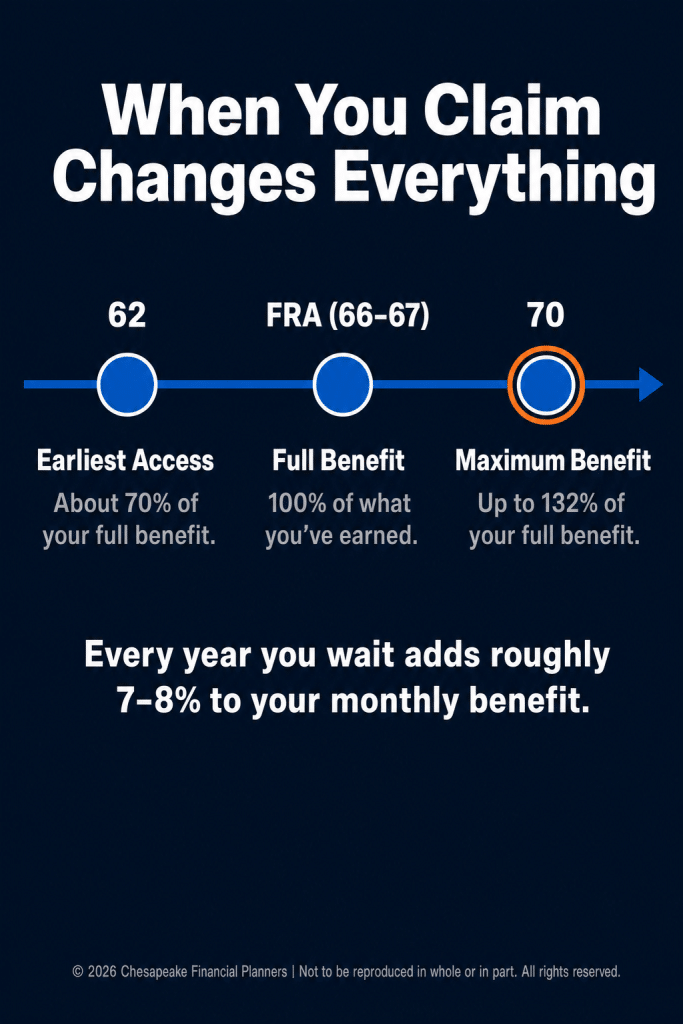
Your claiming age changes your monthly benefit dramatically, by roughly 7 to 8% for every year you wait between 62 and 70. That range, from earliest to latest, is the entire decision space, and the differences compound for life.
The three reference points are straightforward. Claiming at 62, the earliest age, pays approximately 70% of your full retirement age benefit, a permanent reduction. Claiming at your full retirement age, which is 66 to 67 depending on your birth year, pays 100% of what you earned. Waiting until 70 pays up to roughly 124 to 132% of your full benefit, the maximum, after which there is no further increase for waiting. As the Social Security Administration explains, "Social Security retirement benefits are increased by a certain percentage for each month you delay starting your benefits beyond full retirement age," and for anyone born in 1943 or later that works out to 8% for each full year of delay.
That increase is effectively a guaranteed, inflation-adjusted return that is hard to match elsewhere, which is why the timing decision carries so much weight. A useful starting frame is break-even analysis: claiming early versus waiting to full retirement age typically breaks even around age 78 to 79, and full retirement age versus waiting to 70 breaks even around 80 to 82. If you expect to live past those ages, delaying produces more lifetime income, but break-even math is only the starting point, not the whole answer.
When does claiming early make sense for a single person?
Claiming early makes sense for a single person when health is poor, when income is genuinely needed now, or when there is little savings and a strong aversion to market risk. Early claiming is not wrong; it is right for specific situations.
If you have serious health issues that meaningfully shorten your life expectancy, claiming at 62 or at full retirement age can be the better choice, taking the benefit you are more likely to actually collect rather than waiting for a larger one you may not reach. If you are unemployed or underemployed at 62 with savings exhausted and no other income, claiming early may simply be necessary, because financial theory does not pay the rent, though it is worth first checking whether part-time work or a measured drawdown from retirement accounts could bridge you to a higher later benefit. And if you have little retirement savings and Social Security will be your primary income, claiming early can let you preserve what savings you do have, especially if market volatility makes you uneasy.
The common thread is that early claiming answers a real, present need or a genuinely shortened horizon. What it should not be is a default chosen out of habit or fear. Age 62 is the earliest claiming age, not automatically the optimal one, and eligibility does not equal recommendation.
When does delaying make sense, and how do you bridge the gap?
Delaying makes sense when you are healthy, have some savings to live on in the meantime, and want maximum lifetime income and inflation protection, and you bridge the gap by drawing on other resources from 62 to 70. For many singles, this is the stronger path.
Delaying is well-suited to several situations. If you are in good health with family longevity, your odds of living past the break-even ages are good, so waiting maximizes lifetime benefits. If you have a 401(k), IRA, or other savings, you can spend those from 62 to 70 while your benefit grows about 8% a year, which is often tax-efficient because you draw down pre-tax accounts at lower brackets before Social Security begins, potentially reducing future required distributions. And because Social Security includes cost-of-living adjustments, a higher starting benefit produces larger dollar increases every year, giving better inflation protection across a long retirement. One caution: if you claim before full retirement age while still working, the 2026 earnings test withholds $1 for every $2 you earn above $24,480, which makes claiming early while working a poor strategy for most people; after full retirement age there is no earnings penalty.
Bridging the gap to 70 is the practical art here, and there are several approaches: use taxable accounts, traditional IRAs, or a 401(k) to cover expenses while the benefit grows; work part-time, even 15 to 20 hours a week, to supplement savings; temporarily reduce expenses by downsizing or relocating; or, if you are divorced after a marriage of at least 10 years, claim divorced-spouse benefits at 62 while letting your own benefit grow to 70, then switch. This is exactly the kind of sequenced, multi-account decision the R.U.D.D.E.R. Method™ is built to handle. The R.U.D.D.E.R. Method™ is Chesapeake Financial Planners' six-step planning process: Review and Recognize, Uncover and Understand, Design and Develop, Discuss and Decide, Execute and Empower, and Reassess and Refine, and a claiming-and-bridging plan lives in Design and Develop, where the timing and the withdrawal sequence are built together.

Why is delayed claiming "longevity insurance" for singles?
Delayed claiming functions as longevity insurance for singles because, with no spouse's income or benefit to fall back on, the larger guaranteed check is what protects you if you live longer than expected. Singles carry the highest longevity risk, which reframes the whole decision.
The logic is a comparison of two risks. If you delay and then die early, you "lost" by waiting, leaving some benefits uncollected. But if you delay and live into your 90s, that higher monthly benefit can be the difference between financial security and running short late in life. For most single people, the second risk, living long and struggling, is the more serious one to protect against, and a larger lifelong benefit is the cleanest protection available. Longevity is not a remote scenario either: many 65-year-olds today will live well into their late 80s and beyond, so a retirement plan needs to cover 25 to 30 years, not 10 or 15.
A few common mistakes work against singles here. Claiming at 62 out of fear that Social Security will "go bankrupt" trades a large, lasting benefit for a worry that, even in worst-case projections, involves reductions rather than elimination. Ignoring longevity leads people to plan for too short a retirement. Failing to coordinate claiming with retirement-account withdrawals leaves tax efficiency on the table. The better approach is deliberate: weigh your health and family history, your ability to bridge with other income, and your honest answer to which you fear more, dying early or running out of money late.
Related Topics Worth Reading
A single person's claiming decision connects to income, taxes, and Medicare. These related topics go deeper.
- How claiming interacts with required distributions and any pension. How do I coordinate all my retirement income sources to minimize taxes and maximize income?
- Using savings to fund a delay to 70. How do I bridge my income to delay Social Security to 70?
- How your income affects Medicare premiums. How does my Social Security claiming decision affect my Medicare premiums?
- The order to draw from your accounts in retirement. What is the best order to withdraw from my 401k, Roth IRA, and taxable accounts in retirement?
- Survivor and divorced-spouse benefits explained. How do Social Security survivor benefits work for a widow?
Frequently Asked Questions
When should a single person claim Social Security?
For most healthy single people with some retirement savings, delaying toward age 70 is often the optimal choice because it maximizes lifetime income and protects against outliving your money. Claiming earlier makes sense if you are in poor health, need the income immediately, or have little savings and strong aversion to market risk. Full retirement age is a reasonable middle ground. The right age depends on your health, savings, income needs, and risk tolerance.
How much more do I get if I wait until 70 to claim Social Security?
Waiting until 70 pays up to roughly 124 to 132% of your full retirement age benefit, compared with 100% at full retirement age and about 70% if you claim at 62. Each year you delay between 62 and 70 adds roughly 7 to 8% to your monthly benefit, a guaranteed, inflation-adjusted increase. There is no additional benefit for waiting beyond age 70, so 70 is the latest age worth delaying to.
What is the Social Security earnings limit in 2026?
In 2026, if you are under full retirement age for the full year and claiming benefits while working, Social Security withholds $1 in benefits for every $2 you earn above $24,480. A higher limit applies in the year you reach full retirement age, and once you reach full retirement age there is no earnings penalty at all, you can work and collect your full benefit. Withheld benefits are effectively credited back later through a higher benefit.
Are Social Security benefits taxable for single filers?
Yes, Social Security benefits can be taxable based on your combined income, which is your adjusted gross income plus tax-exempt interest plus half of your benefit. For single filers, up to 50% of benefits are taxable when combined income is between $25,000 and $34,000, and up to 85% above $34,000. Claiming earlier or later does not change this taxation formula once benefits begin; only your overall income level does.
Is it better to claim Social Security early if I am single with no children?
Not necessarily; being single with no heirs does not by itself favor claiming early. The core question is still longevity: if you are healthy and may live a long time, delaying provides a larger guaranteed benefit that protects you if you outlive your savings, which matters more when there is no spouse to fall back on. Claiming early makes sense mainly when health is poor or income is needed now, not simply because you have no one to leave benefits to.
Making the one decision count
As a single person, your Social Security claiming decision is simpler than a couple's, no spousal coordination, but the stakes are higher because there is no second income to lean on. For most healthy singles with some savings, delaying toward 70 delivers the most lifetime income, the best inflation protection, and the strongest longevity insurance. But the right answer is genuinely personal, hinging on your health, your resources, and which risk you would rather carry. Run the numbers before you decide. Jeff Judge and the Chesapeake Financial Planners team help single retirees across Harford County and the Baltimore metro time this decision with confidence. Schedule a free fit call at chesapeakefp.com.
Want to go deeper? Our Medicare and Social Security Guide walks through this step by step.
Disclosures
The information provided is for educational purposes only and should not be construed as investment advice. Investment strategies should be tailored to individual circumstances, risk tolerance, and goals. Past performance doesn't guarantee future results. Consult with qualified financial professionals regarding your specific situation.
CFP Board owns the marks CFP®, CERTIFIED FINANCIAL PLANNER®, and CFP® (with plaque design) in the U.S.
Certified Financial Planner Board of Standards Center for Financial Planning, Inc. owns and licenses the certification marks CFP®, CERTIFIED FINANCIAL PLANNER®, and CFP® (with plaque design) in the United States to Certified Financial Planner Board of Standards, Inc., which authorizes individuals who successfully complete the organization’s initial and ongoing certification requirements to use the certification marks.
Advisors associated with Chesapeake Financial Planners may be either (1) LPL Financial Registered Representatives offering securities through LPL Financial, Member FINRA and SIPC, and investment advisor representatives offering investment advice through Great Valley Advisor Group; or (2) solely investment advisor representatives offering investment advice through Great Valley Advisor Group and not affiliated with LPL Financial. Great Valley Advisor Group, and Chesapeake Financial Planners are separate entities from LPL Financial.


