

How Should I Allocate My Investment Portfolio by Age?
Last reviewed: July 2026
Your asset allocation by age should start aggressive and grow more conservative as you approach retirement, but age alone is only half the answer. A common starting framework holds 80% to 90% stocks in your 20s and 30s, stepping down toward 40% to 60% stocks by retirement. The other half is your risk tolerance: the mix you can actually live with through a bad market matters more than any formula, because the best allocation is the one you won't abandon at the bottom.
On This Page
- Key Takeaways
- What is asset allocation, and why does it drive your returns?
- How should your asset allocation change by age?
- Why does risk tolerance matter as much as your age?
- How do you keep your allocation on track with rebalancing?
- Related Topics Worth Reading
- Frequently Asked Questions
- Building an allocation you can actually hold
- Disclosures
Key Takeaways
- Asset allocation by age means shifting from a stock-heavy mix when young toward more bonds as retirement nears, but risk tolerance matters just as much.
- A rough age framework runs 80% to 90% stocks in your 20s and 30s, easing to 40% to 60% stocks in retirement.
- You can shelter up to $24,500 in a 401(k) in 2026, the account where rebalancing triggers no tax.
- The right allocation is the one you can hold through a 30% drop without selling, not the one with the highest projected return.
About the Author: Jeff Judge, CFP®, AEP®, ChFC®, CLU® is Managing Partner of Chesapeake Financial Planners in Forest Hill, Maryland. He has been helping families and business owners in Harford County and the Baltimore metro area set investment allocations since earning his CFP® certification in 2013, by using Chesapeake Financial Planners’ signature process, the R.U.D.D.E.R. method™. Jeff's view: most people obsess over which funds to pick when the allocation decision behind those funds drives far more of their long-term result.
What is asset allocation, and why does it drive your returns?
Asset allocation is how you split your portfolio across asset classes, mainly stocks, bonds, and cash. As the SEC's investor guide puts it, "Asset allocation involves dividing an investment portfolio among different asset categories, such as stocks, bonds, and cash." It is the single biggest lever you control, and it determines both your expected return and how much your account value swings along the way. More stocks means more growth potential and bigger drops. More bonds means steadier values and slower growth.
Stocks are the growth engine and the source of most volatility; they can fall sharply in a single year and take time to recover. Bonds add income and stability and usually move less than stocks, which is why they cushion a portfolio as you near the point of needing the money. Cash and short-term instruments protect principal but tend to lose ground to inflation over time, so they work for near-term needs, not long-term growth.
Here is the part people miss. The choice between, say, a 60/40 and an 80/20 mix shapes your results far more than picking this fund over that one. Get the allocation right for your situation and the fund selection becomes a detail. Get it wrong and no fund choice rescues you.
How should your asset allocation change by age?
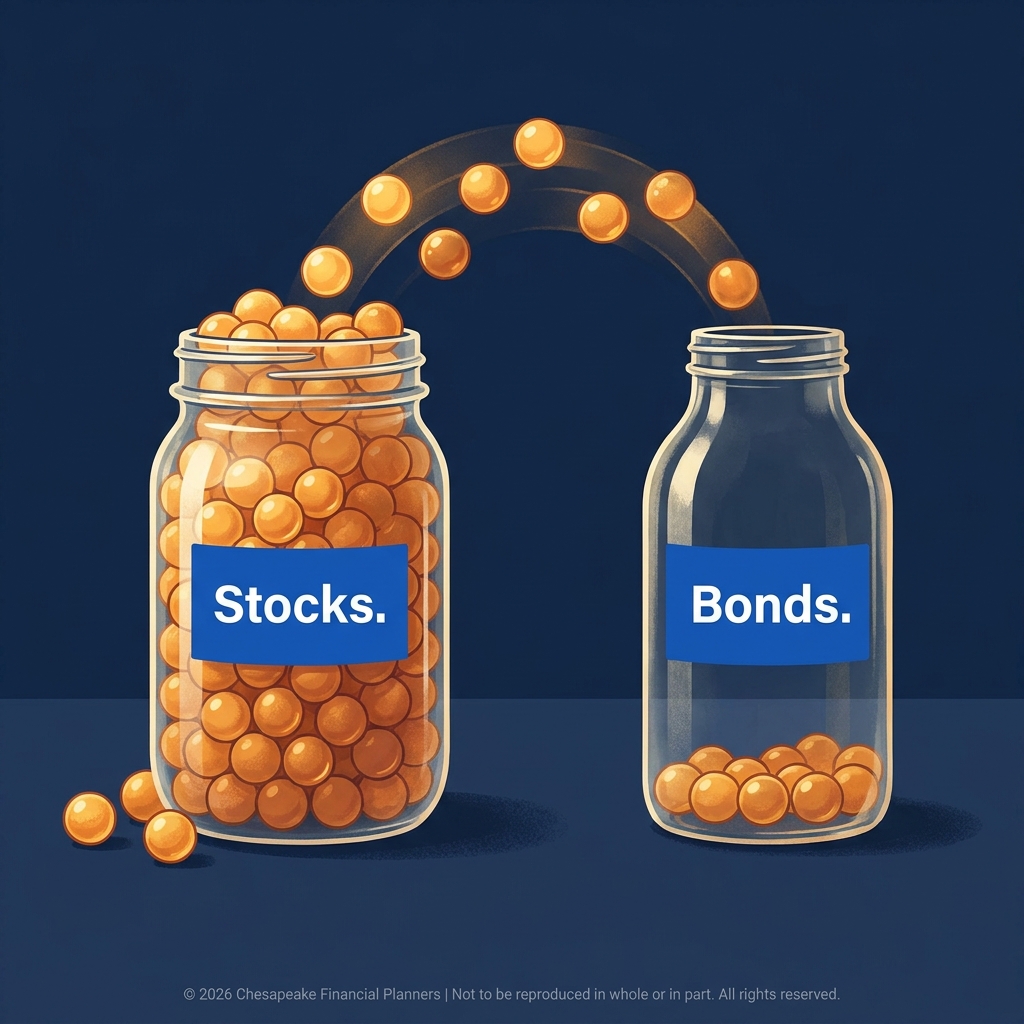
Your allocation should hold more stocks when your time horizon is long and shift toward bonds as that horizon shortens, because a younger investor has decades to recover from a downturn and a retiree does not. The old shorthand was to subtract your age from 110 to get your stock percentage. It is a starting point, not a rule, because it ignores your wealth, your income needs, and the fact that retirements now stretch 25 to 30 years.
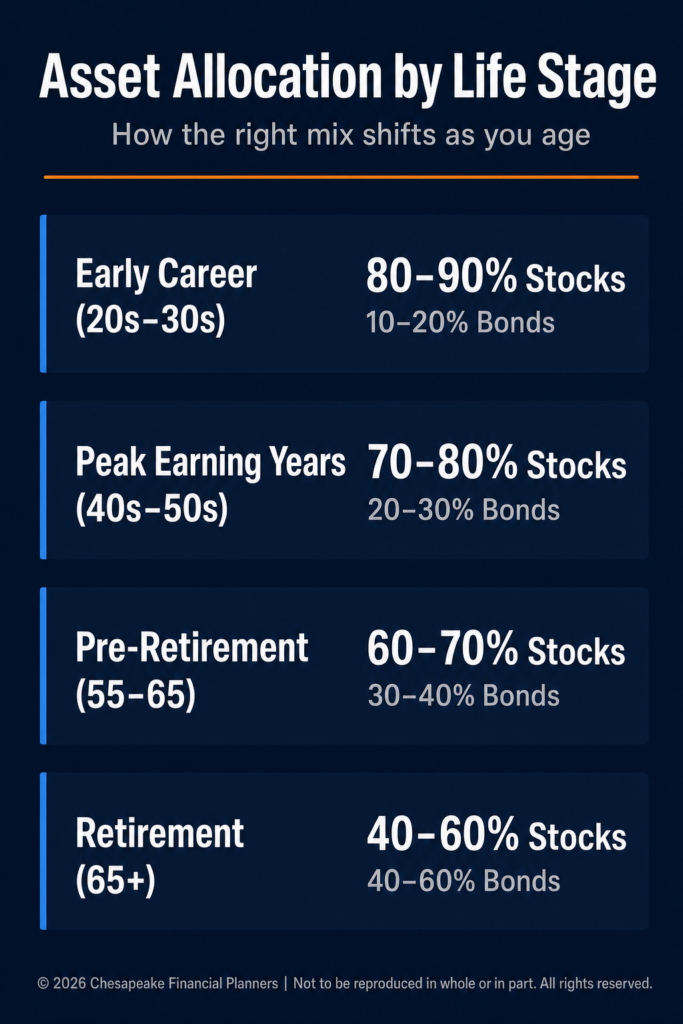
A more useful way to think about it is by life stage. The table below shows general frameworks, not prescriptions, and your own risk tolerance should pull these numbers up or down.
| Life stage | Typical stock range | Why |
|---|---|---|
| Early career (20s-30s) | 80% to 90% | Decades to ride out volatility; growth matters most |
| Peak earning years (40s-50s) | 70% to 80% | Larger balances, but still 15-25 years to recover |
| Pre-retirement (55-65) | 60% to 70% | Protecting against a loss right before you need the money |
| Retirement (65+) | 40% to 60% | Income plus enough growth to outpace a long retirement |
During your peak earning years, the priority is funding the accounts that compound for decades. In 2026 you can contribute up to $24,500 to a 401(k), and if you are 50 or older you can add another $8,000, or $11,250 if you are between 60 and 63 under the higher catch-up. The 2026 IRA limit rises to $7,500, with an extra $1,100 catch-up at 50 and older. Filling those buckets while you set the right allocation does more for your retirement than chasing a hot fund ever will.
Why does risk tolerance matter as much as your age?
Risk tolerance matters as much as age because age tells you how much risk you can take while risk tolerance tells you how much you should. A 32-year-old with decades ahead can theoretically hold 90% stocks, but if a 30% drop will make that person sell in a panic, the theoretical allocation is the wrong one. Selling at the bottom locks in losses and misses the recovery, which does more damage than holding a slightly more conservative mix the whole way through.
Ask yourself a few honest questions. If your balance fell 30% in a year, would you hold or sell? Do you check the account daily or ignore it for months? Is your income steady, and do you have an emergency fund so you are never forced to sell investments to pay bills? Your answers should move the framework numbers. A nervous 35-year-old may be better at 65% stocks they can hold than at 90% they will dump. A confident, well-funded 58-year-old with a pension may sit comfortably at 75%.
This is where I spend a lot of client conversations. As Jeff Judge puts it, "The most expensive mistake I see is not a bad fund pick; it is a good allocation abandoned in a panic." The fix is to build a mix you can actually stomach before the storm, not during it.
How do you keep your allocation on track with rebalancing?
You keep your allocation on track by rebalancing, which means periodically selling what has grown and buying what has lagged to restore your target mix. Markets push your allocation out of line on their own: a strong stock run can drift a 70/30 portfolio to 80/20, quietly leaving you with more risk than you chose. As FINRA explains, rebalancing means making regular adjustments so your portfolio does not drift away from the risk level you set. It forces a disciplined version of buying low and selling high.
Most investors do well rebalancing once a year, or whenever their stock allocation drifts more than 5 to 10 percentage points off target. The tax treatment matters, though. Selling appreciated holdings in a taxable account can trigger capital gains, so rebalancing is cleanest inside tax-advantaged accounts like IRAs and 401(k)s, where the 2026 contribution limit is $24,500 for the 401(k) and trades create no current tax. In a taxable account, you can often rebalance by directing new contributions toward the underweight asset class instead of selling.
Running this through a repeatable process keeps emotion out of it. The R.U.D.D.E.R. Method™ is Chesapeake Financial Planners' six-step planning process: Review and Recognize, Uncover and Understand, Design and Develop, Discuss and Decide, Execute and Empower, and Reassess and Refine. The final step, Reassess and Refine, is exactly where rebalancing lives: a scheduled check that pulls the portfolio back to plan rather than to whatever the market made it.
Related Topics Worth Reading
Your allocation connects to nearly every other investment decision you make. These related topics build on the framework above.
- Why diversifying within your stock and bond mix reduces risk without sacrificing much return. What Does Diversification Mean in Investment Portfolio Management?
- How the order of market returns can punish a too-aggressive mix right at retirement. What is sequence of returns risk, and why do the first years of retirement matter most?
- When a guaranteed income floor lets you hold more stocks elsewhere in the plan. When does buying an annuity make sense for retirement income?
- How index funds keep the cost of your allocation low. What Is the Difference Between Index Funds and Actively Managed Funds?
- Turning your allocation into sustainable income once you retire. What is the best retirement income planning strategy?
Frequently Asked Questions
What is the best asset allocation by age?
The best asset allocation by age is a general framework of roughly 80% to 90% stocks in your 20s and 30s, 70% to 80% in your 40s and 50s, 60% to 70% in the years just before retirement, and 40% to 60% in retirement. Treat these as starting points and adjust for your personal risk tolerance, income needs, and other guaranteed income sources.
Is the "100 minus your age" rule still accurate?
The "100 minus your age" rule is outdated because it was built for shorter retirements and ignores rising life expectancy. Many advisors now use 110 or 120 minus your age to set the stock percentage, reflecting retirements that can last 25 to 30 years. Either version is only a starting point, since your risk tolerance and total financial picture should adjust the result.
How often should I rebalance my portfolio?
You should rebalance about once a year or whenever your allocation drifts more than 5 to 10 percentage points from your target. Rebalancing restores your intended risk level and enforces a disciplined buy-low, sell-high pattern. Do it inside tax-advantaged accounts when possible to avoid capital gains, or rebalance in taxable accounts by steering new contributions toward the underweighted asset class.
Should retirees still own stocks?
Yes, retirees should still own stocks, typically 40% to 60% of the portfolio, because a retirement lasting 25 to 30 years needs growth to outpace inflation. An all-bond portfolio feels safe but risks losing purchasing power over time. The right stock level balances enough growth to sustain decades of withdrawals against enough stability to weather downturns without forced selling.
Does my 401(k) and IRA allocation need to match?
Your 401(k) and IRA allocations do not each need to match; what matters is your combined allocation across every account. Many investors hold bonds in tax-deferred accounts and stocks in taxable or Roth accounts for tax efficiency, a strategy called asset location. View all your accounts as one portfolio when setting and rebalancing your target mix.
Building an allocation you can actually hold
The right asset allocation by age is less about hitting a precise stock percentage and more about building a mix that matches both your time horizon and your stomach for volatility. Nail that, and you capture the returns you actually stay invested to earn, which beats a higher-octane portfolio you bail on at the worst moment. If you want a second set of eyes on whether your allocation fits your age and risk tolerance, our team at Chesapeake Financial Planners can help. Visit chesapeakefp.com to learn more about building a portfolio you can hold with confidence.
Diversification and asset allocation do not ensure a profit or protect against a loss.
Want to go deeper? Our R.U.D.D.E.R Audit for DIY Investors walks through this step by step.
Disclosures
The information provided is for educational purposes only and should not be construed as investment advice. Investment strategies should be tailored to individual circumstances, risk tolerance, and goals. Past performance doesn't guarantee future results. Consult with qualified financial professionals regarding your specific situation.
Asset allocation does not ensure a profit or protect against loss.
Advisors associated with Chesapeake Financial Planners may be either (1) LPL Financial Registered Representatives offering securities through LPL Financial, Member FINRA and SIPC, and investment advisor representatives offering investment advice through Great Valley Advisor Group; or (2) solely investment advisor representatives offering investment advice through Great Valley Advisor Group and not affiliated with LPL Financial. Great Valley Advisor Group, and Chesapeake Financial Planners are separate entities from LPL Financial.


