

What Is the Difference Between Index Funds and Actively Managed Funds?
Last reviewed: July 2026
The difference between index funds and actively managed funds comes down to one thing: who picks the investments. An index fund mechanically tracks a market benchmark like the S&P 500 and charges very little to do it. An actively managed fund pays a manager to pick stocks and try to beat that benchmark, and it charges you far more for the attempt. Over long stretches, the low-cost approach wins for most investors, and the math behind why is not close.
On This Page
- Key Takeaways
- What Are Index Funds and How Do They Work?
- What Are Actively Managed Funds and How Do They Work?
- Which Performs Better Over Time?
- How Much Do Fees Actually Cost You?
- When Does Active Management Make Sense?
- How Do Index Funds and Active Funds Differ on Taxes?
- How Should You Choose Between Them?
- Frequently Asked Questions
- Disclosures
Key Takeaways
- Index funds track a market benchmark at low cost; actively managed funds pay a manager to try to beat it.
- Over 15 years, 89% of U.S. large-cap active funds underperformed the S&P 500, according to S&P's SPIVA scorecard.
- Index fund expense ratios commonly run 0.01% to 0.20%; active funds often charge 0.50% to 1.50%.
- A 1% annual fee gap can cost a six-figure portfolio over $200,000 across a 30-year horizon.
- The choice is less about beating the market and more about controlling cost, taxes, and behavior.
About the Author: Jeff Judge, CFP®, AEP®, ChFC®, CLU® is Managing Partner of Chesapeake Financial Planners in Forest Hill, Maryland. He has been helping families and business owners in Harford County and the Baltimore metro area navigate investment costs and portfolio construction since earning his CFP® certification in 2013, by using Chesapeake Financial Planners’ signature process, the R.U.D.D.E.R. method™. Jeff has reviewed hundreds of client statements, and the single most common drag on long-term returns he finds isn't a bad stock pick. It's fees nobody noticed they were paying.
What Are Index Funds and How Do They Work?
An index fund is a mutual fund or ETF built to mirror the performance of a specific market index, such as the S&P 500, the total U.S. stock market, or international developed markets. It is the purest form of passive investing: the fund buys the holdings in the index and keeps them in roughly the same proportions, with no manager trying to outguess the market.
How does an index fund actually track the market?
The mechanics are simple, which is the point. The fund purchases all the securities in a target index, or a representative sample of them, and holds them in the index's weightings. When the index adds or drops a company, the fund follows automatically. There is no analyst forecasting earnings and no manager placing bets. The goal isn't to beat the market. It's to capture the market's return at the lowest possible cost.
That low cost is the defining feature. Index fund expense ratios commonly fall between 0.01% and 0.20% per year. On a $100,000 portfolio, that's roughly $10 to $200 annually. According to FINRA, expense ratios are deducted directly from fund assets, so a lower ratio leaves more of every dollar working for you. Well-known examples include broad total-market and S&P 500 index funds offered by Vanguard, Fidelity, and Schwab, several of which now charge expense ratios at or below 0.04%.
Jeff Judge often tells clients that index funds win on the boring stuff. There's no story to tell at a dinner party. But the absence of a story is exactly why they tend to compound so well over decades. The fund isn't trying to be clever, so it rarely gives back gains chasing a thesis that didn't pan out.
How Do Investment Fees Impact My Long-Term Returns?
What Are Actively Managed Funds and How Do They Work?
An actively managed fund employs a portfolio manager or team that researches companies, analyzes data, and decides which securities to buy, sell, and hold. The explicit goal is to outperform a benchmark index. You are paying for the manager's judgment, the research staff, and the trading activity that judgment generates.
What are you actually paying for with an active fund?
You're paying for an attempt. The manager selects investments based on research, forecasts, and sometimes market timing, then trades the portfolio to capitalize on perceived opportunities. The fund's success depends entirely on whether those decisions add enough value to overcome their cost. That cost is meaningfully higher: actively managed equity funds commonly carry expense ratios between 0.50% and 1.50% per year. On a $100,000 portfolio, that's $500 to $1,500 annually, before any trading costs or tax drag.
Want to go deeper? Our R.U.D.D.E.R Audit for DIY Investors walks through this step by step.
The SEC notes that a fund's past performance does not predict future results, a caution that matters more for active funds than passive ones because their entire value proposition rests on repeatable skill. Some active managers genuinely outperform for a stretch. The hard part, which the data below makes clear, is identifying those managers in advance and holding them through the years when they lag.
In Jeff's experience reviewing client portfolios, the people who own expensive active funds rarely chose them on purpose. They inherited them inside a 401(k) lineup, a rollover, or an old advisor relationship, and nobody ever flagged what the fund was costing relative to a comparable index option.
How do financial advisors choose investments for my portfolio?
Which Performs Better Over Time?
For most investors over long periods, low-cost index funds outperform the majority of actively managed funds in the same category. This isn't an opinion or a marketing claim. It's one of the most consistently documented findings in investing, and it holds across decades and across markets.
What does the research say about active versus passive?
The S&P Indices Versus Active (SPIVA) scorecard is the standard reference. According to S&P Dow Jones Indices, roughly 89% of U.S. large-cap active funds underperformed the S&P 500 over the 15-year period measured in its most recent scorecards, and the underperformance rate climbs further over 20 years. The small slice of active funds that do beat their benchmark in a given window rarely repeat the feat consistently.
"Index-based investing has gained popularity in part because the data repeatedly show how difficult it is for active managers to outperform their benchmarks over long horizons." — S&P Dow Jones Indices, SPIVA research
There are four structural reasons active funds underperform so reliably.
Fees erode returns. A 1% annual fee sounds small until you compound it. We'll quantify it in the next section, but the short version is that a fee gap of one percentage point can cost a six-figure portfolio more than $200,000 over a working lifetime.
Trading costs and taxes. Active funds trade frequently, generating transaction costs and, in taxable accounts, capital gains distributions. Index funds trade minimally, keeping both low.
Market efficiency. In highly efficient markets like U.S. large-cap stocks, mispricings get arbitraged away quickly. By the time a manager spots an edge, the market has often already priced it in. According to Morningstar, active success rates are consistently higher in less-efficient corners of the market, such as small-cap and certain bond categories, than in U.S. large-cap.
Survivorship bias. Poorly performing active funds often close or merge away. When you look at the active funds still standing today, you're seeing the survivors. The losers quietly disappeared, which flatters the average and makes active management look better than it actually performed.
How can I reduce investment fees and keep more returns?
How Much Do Fees Actually Cost You?
Fees are the single biggest controllable variable in your investment results. You can't control the market's return, but you can control how much of it you keep. A one-percentage-point fee difference, compounded over a multi-decade horizon, can erase a substantial fraction of your final balance.
How big is the fee difference over 30 years?
Consider a $100,000 investment growing at 8% annually for 30 years, with no additional contributions:
| Scenario | Annual fee | Approximate ending balance | Lost to fees |
|---|---|---|---|
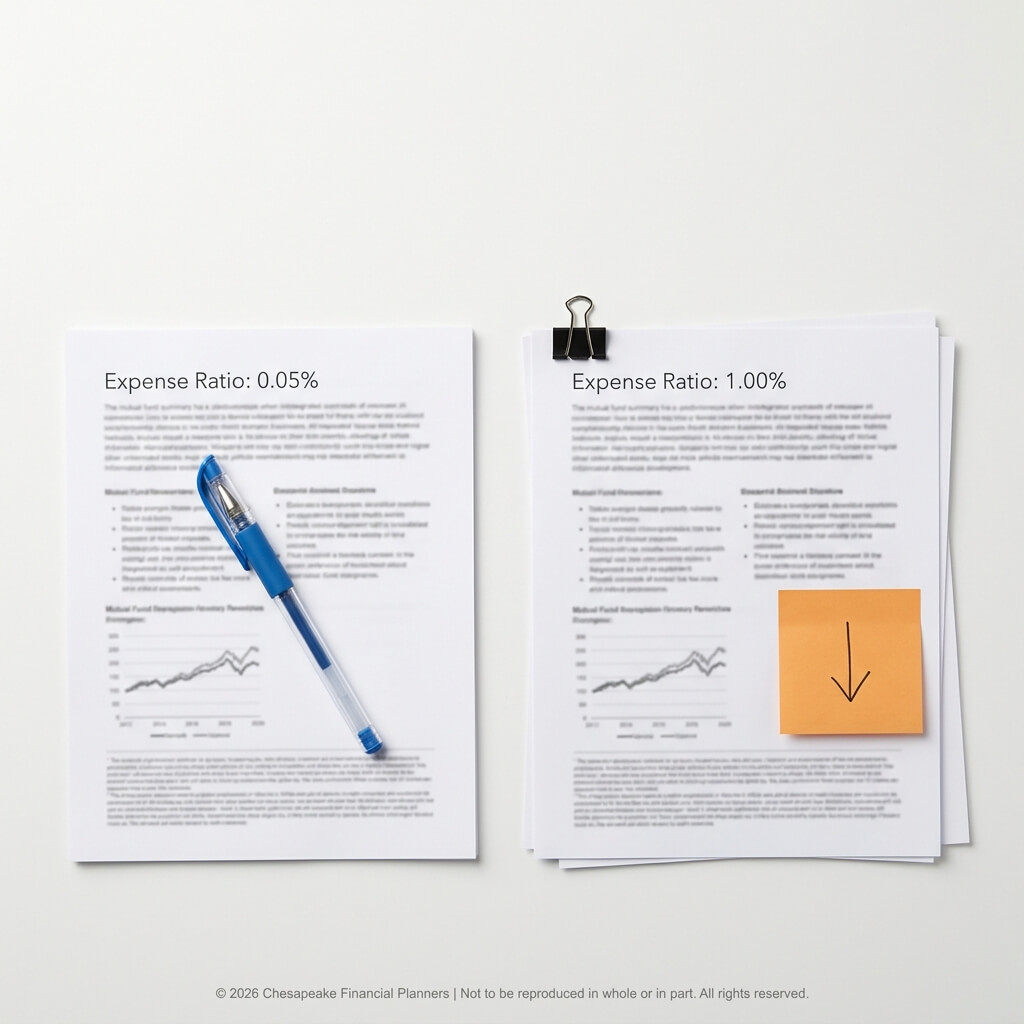
| Low-cost index fund | 0.05% | ~$992,000 | — |
| Actively managed fund | 1.00% | ~$761,000 | ~$231,000 |
The gap is roughly $231,000, and that's purely the fee drag, before accounting for the fact that the active fund also has a high probability of underperforming the benchmark on a pre-fee basis. The fee is the certain cost. The underperformance is the likely additional cost on top of it.
This is where the math gets emotional for people. Jeff Judge has watched clients spend hours agonizing over which individual stock to buy while ignoring a fund fee quietly removing six figures from their retirement over the years. The lever that matters most is rarely the one that feels exciting. It's the expense ratio line you have to dig through a prospectus to find.
The FINRA Fund Analyzer lets you compare the long-term cost of two funds side by side, and running your own holdings through it is one of the fastest ways to see what you're actually paying. Lower costs don't guarantee higher returns in any single year, but across decades they tilt the odds heavily in your favor.

How Do Investment Fees Impact My Long-Term Returns?
When Does Active Management Make Sense?
Active management isn't always the wrong answer. There are specific situations and market segments where paying for active selection can be defensible, and a blanket "index everything" rule oversimplifies a real decision. The key is knowing where active has a fighting chance and where it almost never does.
Where can active funds actually add value?
Active management has the best odds in less-efficient parts of the market, where information is harder to come by and mispricings persist longer. According to Morningstar, active success rates tend to be higher in categories like small-cap stocks, emerging markets, and certain fixed-income segments than in U.S. large-cap, where efficiency is brutal. In those niches, a skilled manager has more room to add value relative to a passive benchmark.
There are also non-performance reasons some investors choose active strategies: a desire to manage downside risk in retirement, exposure to a specialized strategy an index doesn't capture, or values-based screening. Even ESG and sustainable mandates often lean on active or rules-based selection rather than a plain-vanilla index.
That said, the burden of proof is on the active fund. It has to beat its benchmark by enough to cover its higher fee every single year, and it has to do so consistently enough to overcome the years it lags. Most don't. Jeff's rule of thumb with clients is straightforward: index the efficient core of the portfolio, and only consider active management at the edges, where the data says it has a real shot and where the higher fee buys something the index genuinely can't.
The R.U.D.D.E.R. Method™ is Chesapeake Financial Planners' six-step planning process: Review and Recognize, Uncover and Understand, Design and Develop, Discuss and Decide, Execute and Empower, and Reassess and Refine. The active-versus-passive decision lives in the Design and Develop stage, where we map specific fund choices to the cost and tax realities of each account.
What is ESG investing and how does it work?
How Do Index Funds and Active Funds Differ on Taxes?
Index funds are generally more tax-efficient than actively managed funds in taxable accounts, because they trade less and therefore generate fewer taxable capital gains distributions. This tax difference is a real, recurring cost that many investors overlook entirely when comparing the two.
Why are index funds more tax-efficient?
It comes down to turnover. Active funds buy and sell frequently to act on their thesis, and every sale of an appreciated holding can trigger a capital gain that gets distributed to shareholders, who owe tax on it even if they never sold a share themselves. Index funds trade only when the underlying index changes, so they realize gains far less often. The IRS taxes long-term capital gains at preferential rates of 0%, 15%, or 20% depending on income, but a fund handing you unexpected distributions every December still erodes your after-tax return and complicates planning.
This tax gap only matters in taxable brokerage accounts. Inside a 401(k), traditional IRA, or Roth IRA, fund turnover doesn't generate a current tax bill, so the active fund's tax disadvantage largely disappears. That's why a sensible approach often places more tax-inefficient holdings inside tax-advantaged accounts, a technique called asset location.
Tax-loss harvesting also pairs naturally with low-turnover index funds, because their broad, transparent structure makes it easier to swap one holding for a similar one without disrupting your allocation. In Jeff's experience, clients are frequently surprised to learn that their "underperforming" active fund also handed them a tax bill in a year it lost money, a double penalty that index funds rarely impose.
How can I reduce investment fees and keep more returns?
How Should You Choose Between Them?
For most investors building long-term wealth, a portfolio anchored by low-cost index funds is the stronger default, with active management used selectively, if at all, in the places where it has a documented edge. The decision should rest on cost, tax efficiency, your own behavior, and the specific account the money lives in, not on a fund's recent hot streak.
What's the practical decision framework?
Start with cost, because it's the variable you can control and the one most correlated with long-term results. Pull the expense ratio on every fund you own and ask whether you're paying for something the index doesn't provide. If you can't articulate what the higher fee is buying, that's usually your answer.
Next, account for taxes. In a taxable account, lean harder toward index funds for their lower turnover. In a tax-advantaged account, the tax argument weakens, though the fee argument still stands.
Then consider your own behavior, which is the factor spreadsheets ignore. The best fund is one you'll actually hold through a downturn. According to data referenced by Morningstar, investors routinely earn less than the funds they own because they buy high and sell low. A simple, low-cost index portfolio is easier to stick with precisely because there's no manager story to second-guess when markets get rough.
Finally, match the choice to your overall plan. This is where working through your full picture matters, because a fund decision made in isolation can quietly undermine your asset allocation or tax strategy. We use the R.U.D.D.E.R. Method™ to make sure each fund choice serves the broader plan rather than sitting as an orphaned decision.

How should my investment mix change as I get closer to retirement?
Should I manage my own investments or hire a financial advisor?
How Can I Avoid Making Emotional Investment Decisions?
Frequently Asked Questions
Are index funds always cheaper than actively managed funds?
In nearly all cases, yes. Index funds commonly charge expense ratios between 0.01% and 0.20% per year, while actively managed equity funds typically charge 0.50% to 1.50%. The cost gap exists because index funds require no research team and trade infrequently, while active funds pay for managers, analysts, and frequent trading that the investor ultimately funds.
Do index funds ever beat actively managed funds?
Index funds beat the majority of comparable active funds over long periods. According to S&P Dow Jones Indices SPIVA research, roughly 89% of U.S. large-cap active funds underperformed the S&P 500 over 15 years. An index fund won't beat a top-performing active fund in a single hot year, but identifying that winning fund in advance, and holding it through its lean years, is extraordinarily difficult.
Is an index fund the same as an ETF?
Not exactly, though they overlap. An index fund is any fund that tracks a benchmark, and it can be structured as either a traditional mutual fund or an exchange-traded fund (ETF). Most ETFs are index funds, but not all. The main practical differences are how they trade and, in some cases, tax efficiency, with ETFs often having a slight edge in taxable accounts.
Why do people still buy actively managed funds?
Many investors hold active funds without choosing them deliberately, having inherited them through a 401(k) lineup, a rollover, or an old advisor relationship. Others are drawn to the promise of beating the market or believe a skilled manager can protect them in downturns. The marketing emphasizes past winners, which creates an impression of skill that the long-term data rarely supports.
Can I lose money in an index fund?
Yes. An index fund will fall when the market it tracks falls, and there is no manager attempting to cushion the decline. Index funds eliminate manager risk and reduce cost, but they do not eliminate market risk. The trade-off is that you capture the market's full recovery as well, and historically broad markets have recovered and reached new highs over long horizons.
How do I find out what fees I'm paying?
Check each fund's expense ratio, listed in the prospectus and on most brokerage platforms as a percentage. You can also run your holdings through the FINRA Fund Analyzer to see long-term costs side by side. A fund charging 1% on a $250,000 balance costs you roughly $2,500 a year, which compounds into a significant sum over decades.
Should my entire portfolio be in index funds?
Not necessarily, but a low-cost index core is a sound foundation for most investors. Active management can make sense in less-efficient market segments like small-cap or emerging markets, or for specialized strategies an index doesn't capture. The guiding principle is to index the efficient core and only pay for active management where the data shows it has a genuine chance to add value.
If you found this helpful, our investing fundamentals guide breaks down expense ratios, asset allocation, and account structure in plain language, and it's free to download. The choice between index and active funds is one of the highest-leverage decisions you'll make as an investor, and getting it right early pays off for decades. Download the guide at chesapeakefp.com to put these ideas to work in your own portfolio.
Disclosures
The information provided is for educational purposes only and should not be construed as investment advice. Investment strategies should be tailored to individual circumstances, risk tolerance, and goals. Past performance doesn't guarantee future results. Consult with qualified financial professionals regarding your specific situation.
All performance referenced is historical and is no guarantee of future results. All indices are unmanaged and may not be invested into directly.
R-squared indicates what percentage of a manager's movement in performance is explained by movement in performance in its benchmark. R-squared ranges from 0 to 100 and a score of 100 suggests that all movements of a manager's performance are completely explained by movements in the index.
All indices are unmanaged and may not be invested into directly.
Advisors associated with Chesapeake Financial Planners may be either (1) LPL Financial Registered Representatives offering securities through LPL Financial, Member FINRA and SIPC, and investment advisor representatives offering investment advice through Great Valley Advisor Group; or (2) solely investment advisor representatives offering investment advice through Great Valley Advisor Group and not affiliated with LPL Financial. Great Valley Advisor Group, and Chesapeake Financial Planners are separate entities from LPL Financial.


