
Published: | Last reviewed: July 2026 by Jeff Judge, CFP®
Part of our guide: What does a financial planner actually do, and do I need one?
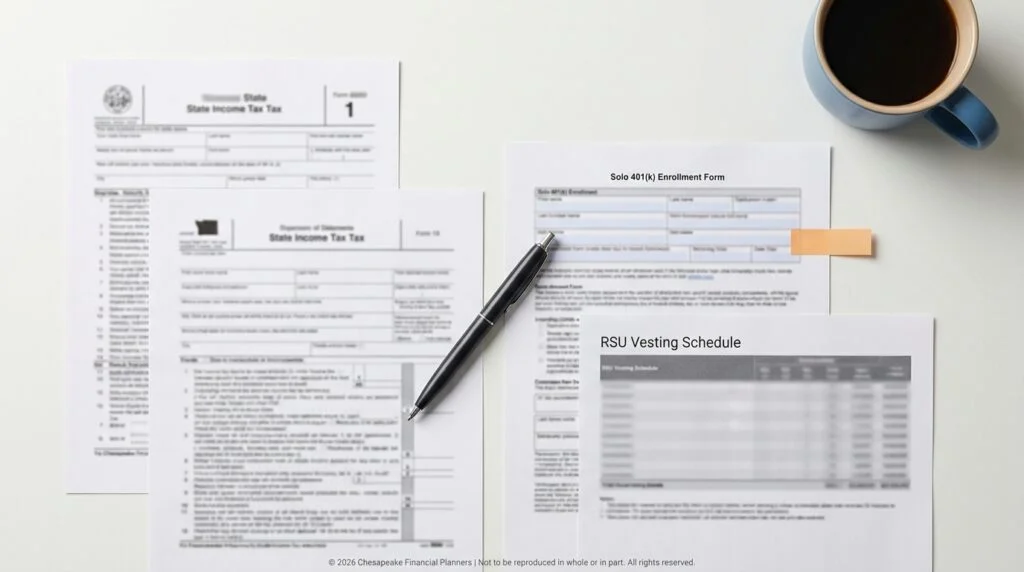
A financial planner for remote workers handles multi-state taxation, equity compensation, self-employed retirement account selection, and variable-income cash flow as a baseline part of the plan, not as a specialty add-on. Remote work changed where people earn money and which states get to tax it, and those changes surface years later, usually at tax time. The job is to get ahead of those issues before they cost you.
Key Takeaways
- A financial planner for remote workers treats multi-state taxation as a core planning issue, not an afterthought handled by your CPA.
- The 2026 Solo 401(k) limit is $72,000 for those under 50, versus $7,500 for an IRA.
- Roughly one in four U.S. workers held remote or hybrid roles, far above the pre-2020 share, per Pew Research.
- Equity compensation, variable income, and home-state changes create planning gaps generic online tools miss entirely.
About the Author: Jeff Judge, CFP®, AEP®, ChFC®, CLU® is Managing Partner of Chesapeake Financial Planners in Forest Hill, Maryland. He has been helping families and business owners in Harford County and the Baltimore metro area navigate remote-work tax and retirement decisions since earning his CFP® certification in 2013, by using Chesapeake Financial Planners’ signature process, the R.U.D.D.E.R. method™. Jeff sees the same pattern every spring: smart, high-earning remote workers who made good decisions all year and still got a surprise tax bill because no one looked at the whole picture in advance.
Remote work didn't just change where people sit. It changed the financial terrain in ways most advisors have limited experience with. According to Pew Research, a large share of workers who can do their jobs from home now do so most or all of the time, a dramatic jump from the pre-pandemic norm. That's a meaningful slice of the workforce dealing with issues a traditional financial plan was never built to address.
What Makes Remote Worker Financial Planning Different?
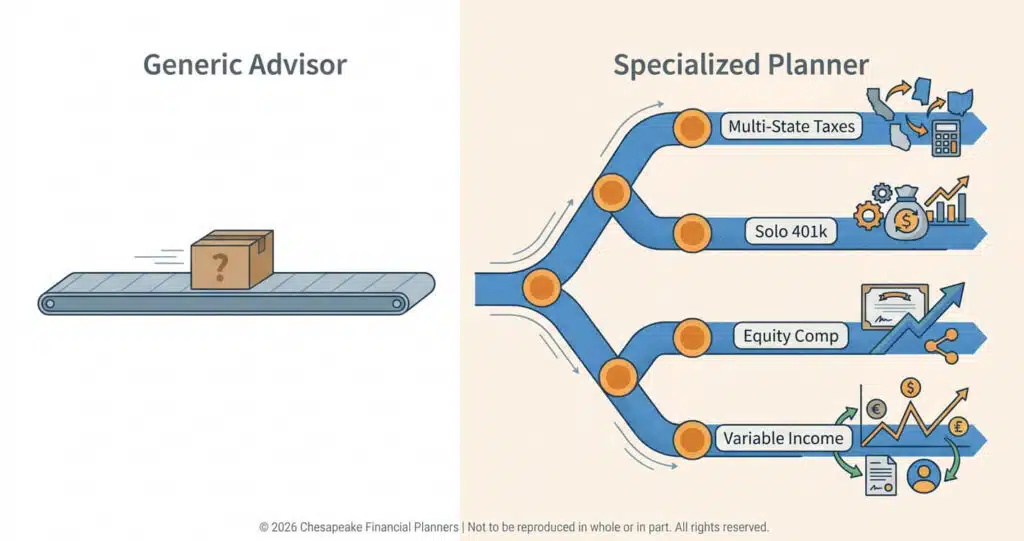
The difference comes down to four problems that show up together for remote workers and rarely show up for someone in a single-state office job: multi-state tax exposure, retirement account selection, equity compensation, and variable income. A financial planner for remote workers builds the plan around these from day one.
How does multi-state taxation affect a remote worker?
Multi-state taxation determines which states can tax your income based on where you live, where your employer is located, and where you physically perform the work. This is the issue that surprises remote workers most often, because state payroll records and your actual residence can drift out of sync without anyone noticing.
"I have clients who moved from one state to another and didn't update their employer's payroll records for a year," Jeff Judge says. "They owed money they weren't expecting to owe, and they'd made decisions during that year, Roth contributions, bonuses, equity sales, without knowing what state they'd be taxed in." Some states use a "convenience of the employer" rule that taxes you based on the employer's location even when you never set foot there. The plan has to account for all of it before you make a single year-end move.
How does a CFP differ from a financial advisor?
Contractors also owe quarterly estimated taxes. According to the IRS, individuals generally have to make estimated tax payments if they expect to owe tax of $1,000 or more. Newly remote workers who moved states or shifted to contractor status often learn this in April, with a penalty attached.
How is virtual financial planning different from a generic online advisor?
Not all virtual financial planning is the same. Automated services return algorithm-driven asset allocations, while a human planner can account for context an algorithm cannot capture: stock options from a company that might go public, a pension from a prior employer most people forget, an aging parent who may need support in five years. According to CFP Board, CFP® professionals have pledged to act as a fiduciary when providing financial advice to a client.
Which Retirement Account Is Right for a Self-Employed Remote Worker?
For a self-employed remote worker or independent contractor, the right retirement account is usually a Solo 401(k) or SEP IRA, because both allow far higher contributions than a traditional or Roth IRAA retirement account funded with after-tax dollars where your money grows completely tax-free and qualified withdrawals in retirement are also tax-free — including all the gains. There are no Required Minimum Distributions during your lifetime, making the Roth one of the most flexible and powerful long-term savings tools available.. The catch is that you have to choose the account type yourself, and the wrong choice quietly costs you for years.
A full-time W-2 employee with a company 401(k) has one real decision: how much to contribute. A contractor has to pick the vehicle entirely. Solo 401(k), SEP IRA, SIMPLE IRA, traditional IRA, Roth IRA: each carries different contribution limits, different tax treatment, and different deadlines.
| Account Type | 2026 Contribution Limit (Under 50) | Best Fit |
|---|---|---|
| Solo 401(k) | Up to $72,000 | Self-employed with no employees, wants max savings |
| SEP IRA | Up to $72,000 / 25% of comp | Simple setup, variable income |
| Traditional / Roth IRA | $7,500 | Supplemental savings, lower income years |
The gap matters. Choosing an IRA when a Solo 401(k) fits your situation can leave tens of thousands of dollars of tax-advantaged space unused over a decade. The IRS treats the Solo 401(k) as both employee and employer contributions, which is how a single person reaches that $72,000 figure.
If you have a workplace plan, the IRS set the 2026 elective deferral limit for 401(k) plans at $24,500, with an additional $8,000 catch-up for those 50 and older.
Why does health insurance belong in a remote worker's plan?
For remote workers without an employer plan, such as freelancers, contractors, and some employees whose companies offer no benefits, health insurance is a major expense that touches the whole financial picture. Marketplace premiums under the Affordable Care Act can be offset by income-based premium tax credits, and those rules have changed in recent years, so check HealthCare.gov for current eligibility. Self-employed individuals may be able to deduct premiums from income, and Health Savings Accounts tied to high-deductible plans can offer tax advantages on contributions, growth, and qualified withdrawals (see IRS Publication 969). A planner who specializes in remote work treats coverage as part of the financial architecture instead of an afterthought.
Why Does Equity Compensation Need Its Own Plan?
Equity compensation needs its own plan because RSUs, stock options, and ESPPShort for Employee Stock Purchase Plan — a company program that lets employees buy shares at a discount through payroll deductions. The built-in discount makes it one of the most straightforward employee benefits to take advantage of, but timing your sales to maximize tax efficiency is where things get nuanced. shares are each taxed differently and depend heavily on timing. Many remote workers, especially in technology, hold all three, and the tax consequences don't show up immediately. They show up in April.
RSUs are taxed as ordinary income when they vest. Nonqualified stock options are taxed at exercise. Incentive stock optionsA type of employee stock option that, when handled correctly, lets you pay long-term capital gains rates instead of ordinary income tax on the spread between your exercise price and sale price. The catch: exercising ISOs can trigger the Alternative Minimum Tax, so timing and AMT planning are essential. follow a different set of rules again and can trigger the alternative minimum taxA parallel tax system designed to ensure high-income earners pay a minimum level of federal tax regardless of deductions. If you have significant income from stock options, depreciation, or certain other tax preferences, you may owe AMT — which is why planning ahead is essential.. Holding significant equity in a single employer also creates concentration risk, which is a planning problem distinct from the tax one. A good plan addresses both: when to sell, how much to diversify, and how to spread the tax impact across years. Jeff Judge notes: "RSUs, NQSOs, and ISOs sitting in the same account can look like one pile of wealth, but they each carry their own tax trigger and their own timing decision, and treating them as interchangeable is usually where the expensive mistakes happen."
This is also where the R.U.D.D.E.R. Method™, Chesapeake Financial Planners' six-step planning process of Review and Recognize, Uncover and Understand, Design and Develop, Discuss and Decide, Execute and Empower, and Reassess and Refine, earns its keep. The framework stays consistent; the specifics flex to a remote worker's equity, accounts, and home state.
What behavioral biases most commonly hurt investment decisions and how do you fix them?
How Do You Plan Around Variable Income?
You plan around variable income by modeling high-income and low-income years separately, structuring quarterly estimated tax payments correctly, and keeping enough reserve without leaving too much cash idle. Contractors and freelancers don't get a predictable bi-weekly paycheck, so the plan has to absorb the swings.
Jeff often points to one specific lever here. "Roth conversions are most valuable in the years your income dips," he says. "Remote and self-employed clients see those low years more often, and most of them never take advantage of them." A year with lower income can be the cheapest time to move money from pre-tax to Roth, and a plan built for variable income flags those windows before they close.
How Much Should I Have in My Emergency Fund?
What changes when your income swings widely from year to year?
A plan built on a steady salary assumes steady cash flow. A contractor or freelancer whose income swings widely year over year needs a different design. The priorities shift: build a reserve larger than the standard three months of expenses (many planners suggest six to twelve months for variable income), structure quarterly estimates so you are not chronically over- or underpaying, and make retirement contributions in a way that survives a lean year.
It can also open a door. In a low-income year, the tax rate on a Roth conversionMoving money from a traditional pre-tax IRA to a Roth IRA, paying income taxes now in exchange for tax-free growth and withdrawals in the future. Conversions make the most sense when your current tax rate is lower than what you expect in the future — making the years between retirement and RMD age a prime window for strategic action. can be more favorable, so a thin year can become a planning opportunity instead of just a problem.
Frequently Asked Questions
Do I need a financial planner if I'm a remote worker with a W-2 job?
Often yes, but for different reasons than a contractor. W-2 remote workers still face multi-state tax issues if they've moved or work across state lines, and many hold equity compensation that needs timing decisions. A generic online tool rarely captures that complexity, and the cost of getting it wrong usually exceeds the cost of advice.
What's the difference between a financial planner and a CPA for remote workers?
A CPA focuses on tax preparation and compliance, meaning what you owe and how to file. A financial planner looks forward: structuring your finances so tax events are timed well, retirement accounts are properly funded, and the plan holds together across income scenarios. The two roles work together. Jeff coordinates with clients' CPAs rather than replacing them.
Can a planner help with equity compensation from a company I no longer work for?
Yes. Unvested RSUs, ESPP shares held after separation, and stock options with a limited exercise window are common situations for remote workers who change jobs. Deciding what to hold, when to sell, and how to manage the tax impact are planning decisions, not just accounting ones, and they often have hard deadlines attached.
What if my income varies a lot from year to year?
Variable income is one of the most common situations a remote-worker planner handles. The process involves modeling different income scenarios, structuring quarterly tax payments correctly, and timing contribution and conversion decisions to fit both strong and weak years. Roth conversions in particular tend to deliver the most value in lower-income years.
Does it matter if I work internationally part of the year?
Yes, international work adds complexity: foreign earned income exclusion eligibility, potential double-taxation, and reporting requirements for foreign accounts. A financial planner handles the planning side and coordinates with tax professionals who specialize in international situations when that complexity is present, so nothing falls through the cracks between advisors.
How do I prepare for a first conversation with a remote-worker financial planner?
Bring your income sources from the last two years, a list of the accounts you currently hold, details on any equity compensation and its type, and the financial questions that have been nagging at you. You don't need it organized. You just need to be willing to talk it through honestly.
Is virtual financial planning a good fit if I have high income but few assets so far?
Often, yes. High-income professionals still building their balance sheets can get a lot from virtual planning. The planning work in your 30s and 40s, such as Roth conversions, equity compensation timing, and choosing the right retirement account, has the most years to work. Starting early matters more than account size when you have decades ahead.
How does virtual financial planning work day to day?
It runs through secure video meetings and digital document sharing. You complete intake online, review your plan on screen during scheduled sessions, and approve changes remotely. The advisor's team handles implementation behind the scenes, so your main job is making informed decisions on your own schedule.
Where to Start
Remote work gives you flexibility, but it hands you a more complicated financial picture in return. A financial planner for remote workers exists to make that complexity manageable instead of expensive. If you want a clearer view of the pieces, our free guide on building a financial planning foundation walks through how these decisions fit together. Download it at chesapeakefp.com.
What are the fundamentals of personal financial planning?
Want to go deeper? Our Why Financial Advice Isn’t Just for Retirees walks through this step by step.
Disclosures
The information provided is for educational purposes only and should not be construed as investment advice. Investment strategies should be tailored to individual circumstances, risk tolerance, and goals. Past performance doesn't guarantee future results. Consult with qualified financial professionals regarding your specific situation.
Advisors associated with Chesapeake Financial Planners may be either (1) LPL Financial Registered Representatives offering securities through LPL Financial, Member FINRA and SIPC, and investment advisor representatives offering investment advice through Great Valley Advisor Group; or (2) solely investment advisor representatives offering investment advice through Great Valley Advisor Group and not affiliated with LPL Financial. Great Valley Advisor Group, and Chesapeake Financial Planners are separate entities from LPL Financial.


