

What does a financial planner actually do, and do I need one?
Last reviewed: July 2026
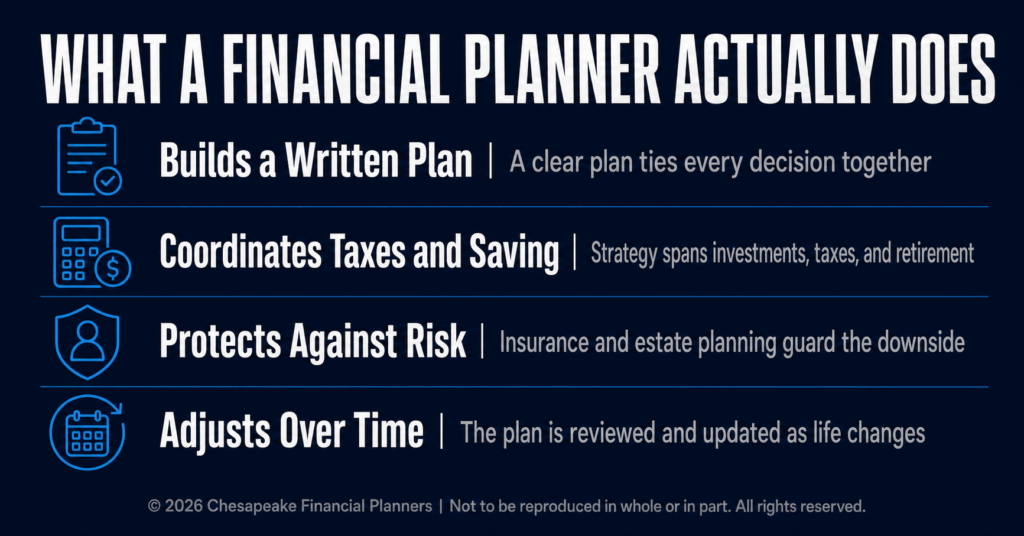
A financial planner builds and maintains a written, integrated plan around your income, taxes, retirement, investments, insurance, and estate. The job is not picking funds. It is connecting every part of your financial life so the decisions you make in one area do not blow up another. If you are wondering what does a financial planner do day to day, the short answer is this: they organize the moving pieces, run the projections, and tell you what to do next.
On This Page
- Key Takeaways
- What does a financial planner actually do day to day?
- How is a financial planner different from a financial advisor?
- When should you hire a financial planner?
- How much does a financial planner cost in 2026?
- Related Topics Worth Reading
- Frequently Asked Questions
- Ready to Take the Next Step?
- Disclosures
Key Takeaways
- Financial planners build written, integrated plans covering taxes, retirement, investments, insurance, and estate, updated as your life changes.
- The 2026 IRS 401(k) contribution limit is $24,500 and the IRA limit is $7,500, and a planner sets the strategy for how to use them.
- A CFP® professional meets stricter education, exam, ethics, and continuing-education requirements than someone using the generic title "financial advisor."
- Fee-based planning typically costs 0.5% to 1.5% of assets under management or a flat $2,500 to $10,000 planning fee.
- You likely need a planner when life changes faster than your plan can keep up: marriage, business sale, inheritance, or the five years before retirement.
About the Author: Jeff Judge, CFP®, AEP®, ChFC®, CLU® is Managing Partner of Chesapeake Financial Planners in Forest Hill, Maryland. He has been helping families and business owners in Harford County and the Baltimore metro area work through financial planning decisions since earning his CFP® certification in 2013, by using Chesapeake Financial Planners’ signature process, the R.U.D.D.E.R. method™. Jeff often tells first-time clients that the value of a planner is rarely the investment pick. It is the call made in the two years before a sale, a retirement, or an inheritance, when there is still time to change the outcome.
What does a financial planner actually do day to day?
A financial planner's job is to translate your goals into a documented plan and keep that plan honest as your life changes. The work covers cash flow, taxes, investments, retirement income, insurance, college funding, charitable giving, and estate transfer. Jeff Judge puts it this way: "Your CPA tells you what already happened. Your attorney protects what already exists. Your planner is the one running the calendar that decides what happens next." Most planners start with discovery interviews, build projections, present recommendations, and run an ongoing calendar of reviews and execution checkpoints. Four common questions about the role:
Is a financial planner the same as a wealth manager?
Not exactly. A financial planner focuses on the written plan: goals, projections, tax strategy, risk management, and the sequence of decisions across the years. A wealth manager often centers on the investment portfolio for clients above a certain asset threshold. The good planners do both, because the portfolio decisions and the planning decisions feed each other constantly. A planner who refuses to look at your portfolio is not actually planning. A wealth manager who cannot tell you when your Roth conversion window closes is not doing the planning side at all.
What does a CFP® actually do that an "advisor" might not?
A CFP® professional has completed CFP Board-required coursework, passed the comprehensive CFP® exam, logged thousands of hours of qualifying experience, and agreed to a fiduciary standard when providing financial planning. In practice, that translates to a written plan rather than a product proposal. The CFP credential signals coverage across all major planning domains: insurance, investments, retirement, tax, estate, and education planning. Many people use "financial advisor" and "financial planner" interchangeably, but the CFP designation is what verifies the person sitting across the table has the breadth to coordinate those domains.
How often will I meet with a financial planner?
Most planners hold a structured annual review and check in two to four times per year on tax moves, life changes, and market shifts. Cadence is heavier in the first six months while the initial plan is built. Expect intensive sessions during major life events: marriage, a job change with equity, a business sale, the year before retirement, the year before required minimum distributions begin. Quarterly touchpoints are common for households with active tax planning or business income.
Does a financial planner manage my taxes too?
Yes, on strategy. A planner coordinates with your CPA on filing, but the tax decisions that change retirement outcomes (Roth conversions, asset location, charitable bunching, capital gains harvesting, IRMAA management) sit inside the plan. The CPA computes the return for the year that just ended. The planner is running the year that is happening now and the next three years out.
How is a financial planner different from a financial advisor?
"Financial advisor" is the umbrella term. "Financial planner" is the narrower role that produces and maintains a comprehensive written plan. The labels overlap in everyday use, which is why the credential and compensation model matter more than the title on the business card. The financial planner vs advisor question almost always comes down to two things: what they are licensed to do, and how they get paid for doing it.
A stockbroker is an advisor. So is an insurance agent. So is an investment advisor representative working under a registered investment advisor. All three can legally print "financial advisor" on a card. A CFP® professional has met the CFP Board's education, exam, experience, and ethics requirements, and is held to a fiduciary standard when providing financial planning. That difference is what most readers want when they ask about a fee-only financial planner versus a generic advisor.
Compensation structure matters as well. Three common models:
- Fee-only: The planner is paid only by the client through planning fees, hourly rates, or AUM percentages. No product commissions. Compensation does not depend on which fund or insurance contract you select.
- Fee-based: The planner charges a planning fee or AUM fee and may also receive commissions on certain insurance or investment products. Disclosure of those commissions is required.
- Commission-only: The planner is paid by the products sold. This model is common for insurance and annuity-focused practices.
Want to go deeper? Our When and How to Hire a Financial Planner walks through this step by step.
None of these compensation models is automatically right or wrong. What matters is whether disclosure is clear, whether the recommendation matches your circumstances, and whether the planner can explain what they earn on each part of the engagement. Jeff Judge often tells clients to ask one question at the first meeting: "How do you get paid when I act on this recommendation?" The answer should take ten seconds and require no slide deck.
Before any first meeting, run the planner's name through FINRA BrokerCheck and the SEC's Investment Adviser Public Disclosure database. A clean record is the baseline. A disclosed complaint or settlement is not always a disqualifier, but it is information you want before the meeting, not after.
When should you hire a financial planner?
The cleanest answer to when to hire a financial advisor or planner: when life changes faster than your last plan can keep up. That includes marriage, divorce, the birth of a child, a job change with equity, a business sale, an inheritance, a serious illness, and especially the five years before and after retirement. Each of those events resets the math. Pretending the old plan still applies is how families miss the optimization windows that matter most.
You also need one if you are managing more than roughly $500,000 in investable assets, running a business, or coordinating three or more retirement accounts across spouses. Complexity sneaks up on people. Most clients walking into our Forest Hill office say a version of the same thing: "I probably should have done this five years ago."
There is a specific window where a planner earns the most for the least cost: the years before a major taxable event. Roth conversions before required minimum distributions begin at age 73. Pre-sale planning two to three years before a business exit. Equity rebalancing ahead of an IPO lockup expiration. Beneficiary review before any inheritance lands. The window is short, the upside is large, and the deadlines do not move.
Chesapeake's planning process for these situations uses the What is the R.U.D.D.E.R. Method™ in financial planning? to enforce a documented timeline. The R.U.D.D.E.R. Method™ is Chesapeake Financial Planners' six-step planning process: Review and Recognize, Uncover and Understand, Design and Develop, Discuss and Decide, Execute and Empower, and Reassess and Refine. The point of a written process is that it forces the conversation about timing before the deadline forces the conversation. By the time the IRS calendar makes the choice for you, the planner's window to add value has already closed.
How much does a financial planner cost in 2026?
A financial planner generally costs one of three things: a percentage of assets under management, a flat planning fee, or an hourly rate. Industry averages in 2026 break down as follows:
- AUM fees typically range from 0.5% to 1.5% per year, with 1% common for full-service planning paired with portfolio management.
- Flat planning fees range from about $2,500 for a single-issue engagement to $10,000 or more for an initial full plan with ongoing service.
- Hourly rates fall in the $250 to $500 range for credentialed planners working on a project basis.
Cost is not the only measure of value. The right question is whether the planner is saving more than they cost. For most pre-retirees, the math works easily once you add up Roth conversion savings, Social Security claiming optimization, asset location, and Medicare premium (IRMAA) management. One avoided IRMAA bracket alone runs $1,000 to $4,000 per year. Multiplied across a 25-year retirement, that single coordinated decision can outweigh decades of planning fees.
Jeff has watched clients delay this conversation for three to five years because they were not sure who to call. By the time they sit down at our Harford County office, the optimization windows for Roth conversions or pre-sale entity restructuring have already closed for several tax years. The fee they avoided in year one cost them ten or twenty times that amount in year five. That is the pattern Jeff sees most often, and it is the case for not waiting.
For context on what people are actually planning around, the average Social Security retirement benefit in 2026 is $2,071 per month. For a family relying on Social Security plus a 401(k) or 403(b), the planner's coordination across both income streams, plus the tax planning to keep both efficient, often returns more in a single year than the annual fee.

Related Topics Worth Reading
If you are deciding whether a financial planner is the right next step, these adjacent topics often come up in the same conversation. Each one expands on a specific question that surfaces during the initial meeting:
- How much does it cost to hire a financial planner in 2026? breaks down the fee structures planners use and how to evaluate them against the value delivered each year.
- How do you choose the right financial advisor and what should you look for? covers what to look for at the first meeting and what disqualifies a candidate quickly.
- What is the difference between a fee-based and fee-only financial advisor? explains the compensation models a planner can use and why disclosure matters more than the label on the card.
- How does a CFP differ from a financial advisor? explains the CFP credential, what it requires, and why it sits above the umbrella "advisor" term.
- What is the R.U.D.D.E.R. Method™ in financial planning? walks through the documented six-step process Chesapeake uses with clients.
Frequently Asked Questions
Do I need a financial planner if I already have investments?
Maybe. Owning investments is not the same as having a financial plan. A planner sets the rules for how the investments fit your goals, your tax situation, your withdrawal sequence in retirement, and your estate transfer. If you are picking funds without a written plan around them, you are answering the easy question and skipping the hard ones. Most planners will run an initial review and tell you whether you actually need ongoing service.
Can a financial planner help with taxes and estate planning?
Yes, on strategy. A planner coordinates Roth conversion timing, asset location, capital gains harvesting, charitable bunching, and beneficiary structure with your CPA and your estate attorney. The planner is the one keeping the calendar and running the projections. Filing your return and drafting your trust still belong to the specialists licensed to do that work. The handoff between planner, CPA, and attorney is part of the job.
How do I know if my financial planner is a fiduciary?
Ask in writing. A fiduciary financial planner will state the fiduciary standard in the engagement letter and on Form ADV Part 2A, which is publicly available on the SEC's Investment Adviser Public Disclosure database. A CFP® professional providing financial planning is held to fiduciary duty under CFP Board rules. If the answer comes back hedged, the hedge is the answer.
What is the difference between fee-only and fee-based?
Fee-only planners are paid only by clients, with no commissions on products sold. Fee-based planners may earn commissions on certain insurance or investment products in addition to client fees. Both models are legal. Fee-only removes one layer of compensation conflict and is the model many consumer advocates point to as cleaner. Fee-based is not automatically a problem if disclosure is clear and the commissions are explained line by line.
How often should I meet with my financial planner?
At least annually for a full plan review, plus two to four interim check-ins on tax, market, and life changes. Expect a heavier cadence during the first six months as the initial plan is built and during life events: marriage, a business sale, retirement transition, an inheritance, or a job change with equity. Clients with active tax planning, business income, or charitable strategies often hold quarterly meetings.
What does a financial planner do for business owners specifically?
For business owners, the planner coordinates exit planning, entity structure, retirement plan design (Solo 401(k), SEP-IRA, defined benefit plans), key-person insurance, buy-sell funding, and the transition of personal wealth post-sale. The personal and business plans cannot live in separate spreadsheets without cost. A planner who works regularly with owners knows the timing for valuation, equity restructuring, and pre-sale tax moves that change the after-tax sale price by meaningful percentages.
Ready to Take the Next Step?
What does a financial planner do that actually changes your outcome? The short answer is the calls made in the narrow windows around taxes, retirement transitions, and major life events. If you are weighing whether to hire one, our guide to choosing a financial advisor covers credentials, fee structures, and the red flags worth catching before the first meeting. Download it at chesapeakefp.com to see exactly what to ask in your first conversation.
This material is for educational purposes only and should not be considered tax or legal advice. Please consult with your tax advisor or attorney regarding your specific situation.
There is no guarantee that a diversified portfolio will enhance overall returns or outperform a non-diversified portfolio. Diversification does not protect against market risk.
Disclosures
The information provided is for educational purposes only and should not be construed as investment advice. Investment strategies should be tailored to individual circumstances, risk tolerance, and goals. Past performance doesn't guarantee future results. Consult with qualified financial professionals regarding your specific situation.
Advisors associated with Chesapeake Financial Planners may be either (1) LPL Financial Registered Representatives offering securities through LPL Financial, Member FINRA and SIPC, and investment advisor representatives offering investment advice through Great Valley Advisor Group; or (2) solely investment advisor representatives offering investment advice through Great Valley Advisor Group and not affiliated with LPL Financial. Great Valley Advisor Group, and Chesapeake Financial Planners are separate entities from LPL Financial.


