

Last reviewed: July 2026
Sequence of returns risk is the danger that the order of your investment returns, not just the average, decides how long your money lasts once you start withdrawing from it. Two retirees can earn the identical average return over the same years, spend the same dollars, and still finish decades apart, because one met a bad market early and the other met it late. While you are saving, order barely matters. Once you are living off the portfolio, it can be the difference between comfort and a shortfall.
Key Takeaways
- Sequence of returns risk means the order of returns, not the average, drives how long a retirement portfolio lasts once withdrawals begin.
- Order is nearly irrelevant while you are saving, but it becomes decisive the moment you start spending from the account.
- Morningstar puts a starting withdrawal rate near 3.9% for 2026, so the rate you choose sets how hard sequence risk hits.
- A 65-year-old today can expect roughly 18 to 21 more years of life, per the Social Security Administration, giving an early loss years to compound.
About the Author: Jeff Judge, CFP®, AEP®, ChFC®, CLU® is Managing Partner of Chesapeake Financial Planners in Forest Hill, Maryland. He has spent years helping families and business owners across Harford County and the Baltimore metro plan the handoff from paycheck to portfolio, using Chesapeake's signature process, the R.U.D.D.E.R. Method™. "The clients who sail through a rough first year are not the ones who guessed the market right," Jeff says. "They are the ones who decided, in advance, that they would never have to sell stocks at the bottom to buy groceries."
Why does the average return in a retirement projection mislead you?
Here is the assumption baked into the tidy chart your 401(k) provider shows you: the portfolio earns some average percentage every year, forever. Smooth line, gentle slope, happy ending. While you are still saving, that shortcut is mostly harmless. If you are not touching the money, the order of returns does not change the result. A portfolio that gains 20 percent and then loses 20 percent lands in the same place as one that loses 20 percent and then gains 20 percent. Start with $1 million, take those two years in either order, and you finish with $960,000 both times.
Now add withdrawals and the symmetry breaks. Take that same $1 million and pull $50,000 at the start of each year. If the up year comes first, you end with about $872,000. If the down year comes first, you end with about $852,000. Same average, same withdrawals, and a $20,000 gap opened in 24 months from one variable: order. Stretch that mechanic across a 15-year retirement and it stops being a rounding error.
Does the order of returns matter while you are still saving? No, and that surprises people. During the accumulation years, a rough early market is arguably a gift, because your contributions buy shares at lower prices and the recovery compounds on a larger share count. Sequence risk is a spending-phase problem. That is exactly why it deserves attention in the years right before retirement, not the twenty years before.
How can two retirees with the same average return end up $2 million apart?
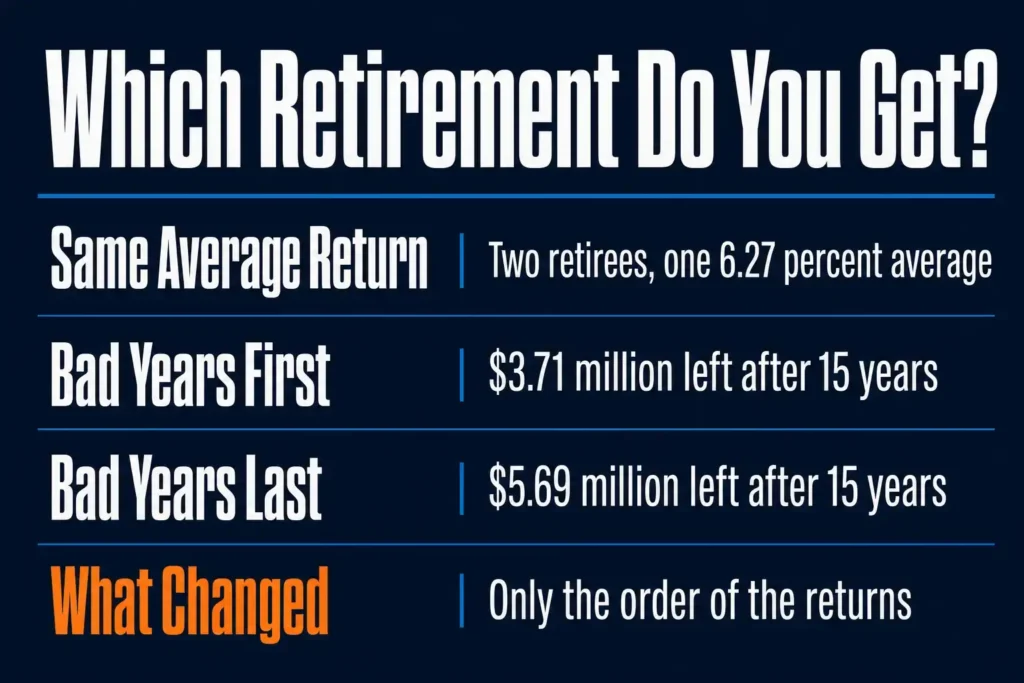
Picture two retirees, $4 million each, both drawing $160,000 in year one. That is a 4 percent starting withdrawal rate, and both give themselves a 2.5 percent raise each year for inflation. Both live through the same 15 annual returns, averaging 6.27 percent. The only difference is timing. Retiree A meets a bear market immediately, down 18 percent in year one and down 8 percent in year two. Retiree B gets those same two bad years at the very end.
Fifteen years later, Retiree B has roughly $5.69 million. Retiree A has about $3.71 million. That is nearly a $2 million spread between two people who earned the same average return and spent the same dollars. Neither picked worse funds. One simply drew the short straw on timing. Here is the detail worth sitting with: if neither had withdrawn a dime, both would have finished at the same figure, around $9.46 million, regardless of order. The withdrawals are what turn an irrelevant difference into a seven-figure one.
"I push back when someone tells me they have hit their number. Two people with identical balances, retiring twelve months apart, can inherit completely different retirements, and the plan behind the number matters more than the figure on top of it." – Jeff Judge, CFP®
The withdrawal rate is the volume knob on the whole effect. The table below runs the same two sequences at three different starting rates. Spend more, and the gap between the lucky and the unlucky retiree widens.
| Starting withdrawal rate | Approximate gap after 15 years | Unlucky retiree's ending balance |
|---|---|---|
| 3 percent ($120,000) | about $1.49 million | higher, still slowly declining |
| 4 percent ($160,000) | about $1.98 million | about $3.71 million |
| 5 percent ($200,000) | about $2.48 million | about $2.27 million and falling |
Hypothetical illustration for educational purposes only. It assumes the same 15 annual returns averaging 6.27 percent with a 2.5 percent annual inflation raise, does not represent any actual investment, and actual results will vary.
The arithmetic drags behavior along with it. Retiree A is two years in, watching the balance fall while the withdrawals keep going, and every instinct says sell the stocks and stop the bleeding. Acting on that instinct at the bottom is what converts a bad sequence into a lasting one. The math opens the wound; behavior decides whether it scars. I dig into that trap in Behavioral Traps in the First Years of Retirement.
Why do the first five years of retirement carry the most weight?
The damage comes from a simple, ugly interaction. Withdrawing from a portfolio that is down means selling more shares to raise the same dollars, and those shares are gone. When the recovery arrives, it works on a smaller base. No rally refunds the shares you already liquidated at depressed prices.
The recovery math is unforgiving on its own. A portfolio that falls 25 percent needs a 33 percent gain just to return to even, and ongoing withdrawals push that required rebound higher. Early years also sit at the top of the longest compounding runway. A weak year 14 dents money that has already grown for a decade. A weak year one taxes every year that follows it. That is why the first five years of retirement, the stretch some planners call the retirement red zone, carry weight the later years do not. I lay out the full mechanics in Sequence of Returns Risk: Why the First Five Years of Retirement Matter Most.
How much does a portfolio have to gain to recover a 25 percent loss? About 33 percent, because the gain works on the smaller base left after the loss. Add withdrawals during the drawdown and the required rebound climbs further, since every distribution shrinks the base that is supposed to do the recovering. Longevity raises the stakes. A 65-year-old today can expect roughly 18 to 21 more years of life, according to the Social Security Administration, so an early loss has decades to compound against a retiree who reacts badly to it.
How can you prepare for sequence of returns risk before you retire?
You cannot control which sequence you get. You can manage how much a bad one costs you. This is where a real retirement withdrawal strategy earns its keep, and where the R.U.D.D.E.R. Method™, Chesapeake Financial Planners' six-step planning process (Review and Recognize, Uncover and Understand, Design and Develop, Discuss and Decide, Execute and Empower, and Reassess and Refine), does its most useful work: pressure-testing the plan before the market does.
Five moves I would rather see in place before the first withdrawal than after the first drawdown:
- Fund the early years from something you will not have to sell at a loss. Two to three years of planned withdrawals held in short-term Treasuries, CDs, or a money market fund means a 30 percent equity drop in year two does not decide where your grocery money comes from. This is the logic behind the bucket strategy for retirement income. Holding that reserve has historically meant giving up some return, and that is the price of not being a forced seller.
- Refill the reserve on your terms. In years the portfolio is up, top it off from gains. In years it is down, let it run low and give the equities room to recover. The mechanics are boring on purpose.
- Write down spending rules before you need them. Decide now what happens after a down year: skip the inflation raise, trim discretionary spending by 10 percent, whatever fits your life. Small cuts made early do outsized work, because every dollar not withdrawn keeps compounding through the recovery.
- Stress-test the sequence, not the average. When someone shows you a projection, ask what happens if the first two years look like 2008 and 2009. A plan that survives with adjustments is a plan. A reassurance about long-term averages is not an answer.
- Revisit the allocation around the retirement date, not just after it. Some researchers make the case for a lower equity allocation in the years surrounding retirement, then letting it drift back up as the danger window passes. You do not have to adopt that wholesale to take the point: treating your allocation at 58 the way you treated it at 45 ignores the one thing that changed.
This is also my problem with how Monte Carlo results get presented. You get handed a single number, a 90 percent success rate, and everyone nods. Flip it over. One in ten simulated retirements failed, and those failures are not random. They cluster around one profile: bad returns early, steady withdrawals throughout. You do not get to live the average path. You get one draw. If you sit through a Monte Carlo presentation, ask to see the 10th percentile path, ask at what age the failing scenarios run out of money, and ask how big the shortfall is when they miss.

How does sequence of returns risk affect Maryland and federal retirees?
The mechanics are national, but the timing corridor is local. Around Bel Air and Forest Hill, a large share of the people five years from retirement are federal and defense workers tied to Aberdeen Proving Ground. A FERS pension and Social Security cover part of the spending, which is a genuine cushion, but the Thrift Savings Plan still faces the same order-of-returns problem the moment withdrawals start. The gap years between a federal retirement in your late 50s and the start of Social Security and Medicare are prime sequence-risk territory, because the portfolio is doing the heaviest lifting exactly when a rough market would hurt most. I cover that group in How Aberdeen Proving Ground Retirement Works With FERS and TSP.
Maryland's tax rules shape the drawdown too. The state's pension exclusion reaches $40,600 for residents 65 and older in 2026, per the Maryland Comptroller, and it phases down against Social Security income. That makes the same gap years a window worth planning around, since how much you pull, and from which account, changes both your tax bill and how exposed you are to a rough sequence. I break the numbers down in what the $40,600 pension exclusion really means for Harford County retirees.
This one is close to home for us. Chesapeake Financial Planners is based in Forest Hill, and most of the households we sit with are in Harford County and the northern Baltimore metro, weighing a retirement date against a market nobody can schedule. We work virtually by default with in-person available, and the plan looks the same whether a client is around the corner in Bel Air or across the country: decide in advance how the first five years get funded, so a bad sequence becomes an inconvenience rather than a crisis.
Frequently Asked Questions
What is sequence of returns risk in retirement?
Sequence of returns risk is the danger that the order of your investment returns, not the average, determines how long your savings last once you begin withdrawing. Two retirees with the same average return and the same withdrawals can finish far apart if one meets a bad market early. It matters most in the years right around your retirement date.
Does sequence of returns risk matter while you are still working?
Not in a way that hurts you. Before withdrawals begin, the order of returns barely affects the ending balance, and a rough early market can even help by letting your contributions buy shares at lower prices. The risk switches on when you stop adding money and start taking it out, which is why the transition years deserve the attention.
How much of my savings should sit in a reserve against sequence risk?
Many planners point to two to three years of planned withdrawals held in short-term Treasuries, CDs, or a money market fund. The idea is simple: a reserve lets you cover spending during a downturn without selling equities at depressed prices. The right amount depends on your other income, such as a pension or Social Security, and your comfort with market volatility in retirement.
What is a reasonable starting withdrawal rate for 2026?
Morningstar's 2026 research points to a starting withdrawal rate near 3.9% for a balanced portfolio. That is a starting point, not a promise. A lower rate leaves more room for a bad early sequence, while a higher rate raises how hard sequence risk can hit, so the figure should flex with your plan and your other income sources.
Can you make sequence of returns risk go away completely?
No, because you cannot choose the market you retire into. What you can do is manage how much a bad sequence costs you: hold a spending reserve, set withdrawal rules in advance, revisit your allocation near the retirement date, and keep some flexibility to trim spending. The goal is a plan that works without needing lucky timing.
How does sequence risk affect retirees in Maryland and Harford County?
The math is the same everywhere, but Maryland retirees juggle it alongside state tax rules, including a pension exclusion of $40,600 for residents 65 and older in 2026. For Aberdeen Proving Ground and other federal workers near Bel Air, the gap years between an early federal retirement and Social Security are peak sequence-risk years, since the Thrift Savings Plan carries more of the load then.
Would Your Plan Survive a 2008 and 2009 Start?
The sequence you draw is luck. Retiring into 2010 was a tailwind; retiring into 2008 was a stress test nobody signed up for. Since you cannot schedule the next downturn, the useful move is a plan that holds up either way. Here is the homework: if your first two years of retirement had been 2008 and 2009, would your plan have survived without a fire sale or a panicked spending cut? If you are not sure, that is worth answering before you retire, not after. Jeff Judge and the Chesapeake Financial Planners team work with families and federal retirees across Harford County and the Baltimore metro on exactly this question. Schedule a free fit call to pressure-test your own sequence of returns risk.
A version of this article was originally published on Jeff Judge's LinkedIn.
Disclosures
The information provided is for educational purposes only and should not be construed as investment advice. Investment strategies should be tailored to individual circumstances, risk tolerance, and goals. Past performance doesn't guarantee future results. Consult with qualified financial professionals regarding your specific situation.
The examples in this article are hypothetical illustrations intended solely to demonstrate the mechanics of sequence of returns risk. They do not represent any actual investment, the figures are assumed, and actual results will vary. Any simulation or probability figures referenced are hypothetical, rely on assumptions, and do not guarantee future outcomes.
All investing involves risk including loss of principal. No strategy assures success or protects against loss.
All performance referenced is historical and is no guarantee of future results. All indices are unmanaged and may not be invested into directly.
Stock investing includes risks, including fluctuating prices and loss of principal.
Bonds are subject to credit, market, and interest rate risk if sold prior to maturity. Bond values will decline as interest rates rise and bonds are subject to availability and change in price.
Government bonds and Treasury bills are guaranteed by the US government as to the timely payment of principal and interest and, if held to maturity, offer a fixed rate of return and fixed principal value.
CDs are FDIC insured to specific limits and offer a fixed rate of return if held to maturity, whereas investing in securities is subject to market risk including loss of principal.
Asset allocation does not ensure a profit or protect against loss.
Advisors associated with Chesapeake Financial Planners may be either (1) LPL Financial Registered Representatives offering securities through LPL Financial, Member FINRA and SIPC, and investment advisor representatives offering investment advice through Great Valley Advisor Group; or (2) solely investment advisor representatives offering investment advice through Great Valley Advisor Group and not affiliated with LPL Financial. Great Valley Advisor Group, and Chesapeake Financial Planners are separate entities from LPL Financial.
Chesapeake Financial Planners | 2402 Scotlon Ct, Forest Hill, MD 21050 | (410) 652-7868 | www.chesapeakefp.com
© 2026 Chesapeake Financial Planners | Not to be reproduced in whole or in part. All rights reserved.


