How Do Young Adults Build Financial Independence in Their Twenties?
Last reviewed: July 2026
Young adult financial independence starts with three moves: automate your savings, capture every dollar of employer retirement match, and build a cash buffer before you chase investment returns. The math rewards people who start early, even with small amounts. Time in the market and consistent contributions matter far more in your twenties than picking the perfect fund.
Key Takeaways
- Financial independence means covering your essential expenses from your own income without ongoing parental support or unmanageable debt.
- In 2026, you can contribute up to $7,500 to a Roth IRA if you are under 50.
- Capturing your full employer 401(k) match is the highest-return move available to most twenty-somethings.
- Automating transfers on payday removes willpower from the equation and builds wealth on autopilot.
About the Author: Jeff Judge, CFP®, AEP®, ChFC®, CLU® is Managing Partner of Chesapeake Financial Planners in Forest Hill, Maryland. He has been helping families and business owners in Harford County and the Baltimore metro area navigate wealth events and early-career financial planning since earning his CFP® certification in 2013, by using Chesapeake Financial Planners’ signature process, the R.U.D.D.E.R. method™. Jeff has watched dozens of young clients turn modest first salaries into real security simply by automating savings before lifestyle creep set in.
What Does Financial Independence Mean in Your Twenties?
Financial independence is having the systems and resources to support your life without ongoing financial help from parents, debt you cannot manage, or choices forced by short-term pressure. It is not a specific dollar figure in the bank. It is control over your own cash flow.
In practical terms, you are financially independent when you can cover your essential expenses from your own income, handle an unexpected $1,000 bill without borrowing, and still move toward future goals. The timeline looks different than it did for previous generations, and that is fine. The milestones have shifted, but the levers have not.
For young adults navigating a wealth event, a first job, an inheritance, or proceeds from a family business sale, the challenge is building independence while managing newfound complexity. More money does not automatically mean more security. Without systems, a windfall can disappear faster than a paycheck.
What should I do first after inheriting money or property?
What Three Systems Should You Set Up First?
Building wealth as a young adult comes down to three systems you can set up in an afternoon. Each removes a common point of failure.
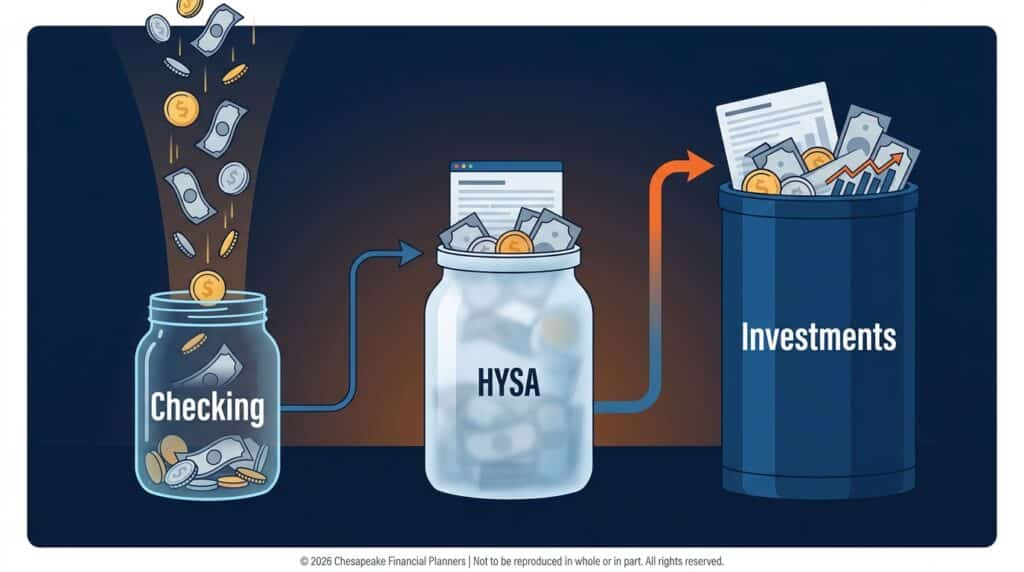
Separate accounts with clear purposes. Open a checking account for monthly bills, a high-yield savings account for your emergency fund and short-term goals, and an investment account for long-term growth. When each account has one job, you stop guessing whether you can afford something. You already know what every dollar is for.
Automated money management. Willpower is a poor strategy for building wealth in your twenties. Automation is reliable. Set up automatic transfers on payday into your emergency fund, your retirement account up to the employer match, and any short-term savings goals. Automate your bills too, so you never miss a payment.
A spending plan that reflects your priorities. This is not a punishing budget. It is a proactive decision about how you use your money. A common starting framework: roughly 50 to 60 percent for essentials, 20 to 30 percent for financial goals, and 20 to 30 percent for discretionary spending. Adjust the percentages to fit your reality. In a high-cost city, essentials may eat 65 percent. With heavy student debt, goals may temporarily take a larger share.

According to Bankrate's 2025 emergency savings research, a large share of Americans could not cover an unexpected $1,000 expense from savings. Building that buffer first is what separates people who recover from a setback from those who slide into high-interest debt. As the IRS notes in its guidance on retirement saving, contributions made early "have more time to grow"through compounding, which is the single biggest advantage you hold in your twenties. Jeff Judge notes: "The clients I have watched build the most wealth in their thirties and forties were not the ones who earned the most in their twenties, they were the ones who automated their savings early and never gave themselves the option to spend it first."
How Do You Accelerate Wealth Building in Your Twenties?
Once your systems are running, a few strategies compound quietly in the background and do the heavy lifting over decades.
Maximize tax-advantaged accounts. If you have a workplace plan like a 401(k) or 403(b), contribute at least enough to capture the full employer match. That match is an immediate, guaranteed return you will not find anywhere else. For 2026, the IRS sets the 401(k) employee contribution limit at $24,500 for workers under 50. Increase your contribution rate by one percentage point each year until you reach 15 percent of gross income, and favor low-cost index funds over individual stock picking.
If your employer offers no plan, open a Roth IRA. In 2026, you can contribute up to $7,500 if you are under 50. A Roth grows tax-free, and you can withdraw your contributions, though not the earnings, without penalty if you truly need them.
Manage debt strategically. Not all debt is equal. High-interest credit card balances should be attacked aggressively, because few investments reliably beat a 20-plus percent interest rate. Lower-rate debt like a federal student loan can be paid on schedule while you invest at the same time. Jeff Judge often reminds younger clients that paying off a 22 percent credit card is a guaranteed 22 percent return, better than any portfolio promise.
Protect your income. Your earning power is your largest asset in your twenties. Adequate health insurance and, for many, disability coverage protect the engine that funds everything else.
What should I do with money I inherited from a relative?
How Should You Handle a Windfall or Inheritance Early in Life?
A windfall in your twenties is an opportunity and a trap. The opportunity is obvious. The trap is treating a one-time sum like a permanent raise. The first move is to slow down, not speed up.
Before you spend or invest a dollar, park the money somewhere safe and give yourself time to plan. This is where a defined process matters. The R.U.D.D.E.R. Method™ is Chesapeake Financial Planners' six-step planning process: Review and Recognize, Uncover and Understand, Design and Develop, Discuss and Decide, Execute and Empower, and Reassess and Refine. For a young person with sudden money, that structure prevents the two most common mistakes: rushing into investments you do not understand, and inflating your lifestyle in ways you cannot sustain.
A sound sequence usually looks like this: shore up an emergency fund, eliminate high-interest debt, fund tax-advantaged retirement accounts, then invest the remainder according to your timeline and goals. Inheritance planning for young adults also means understanding any inherited accounts have their own distribution rules, which is worth professional review.
How Can I Protect Inherited Money from Scams and Bad Decisions?
What should you do when you suddenly receive a large sum of money?
Frequently Asked Questions
How much should young adults save each month?
Aim to save at least 15 to 20 percent of your gross income, split between an emergency fund and retirement. If you cannot hit that immediately, start with enough to capture your full employer 401(k) match, then raise your savings rate by one percentage point each year. Consistency matters more than the starting amount, because early contributions have decades to compound.
What is the best first investment for someone in their twenties?
A low-cost, broadly diversified index fund inside a tax-advantaged account is the strongest first investment for most young adults. If your employer offers a 401(k) match, that account comes first because the match is an instant return. If not, a Roth IRA invested in a total-market index fund gives you tax-free growth and decades of compounding ahead of you.
How much should I keep in an emergency fund?
Most young adults should target three to six months of essential expenses in a high-yield savings account. If your income is irregular or you support others, lean toward the higher end. The point is to handle a job loss, medical bill, or car repair without reaching for a credit card. Build this buffer before aggressively investing in non-retirement accounts.
Should I pay off debt or invest first?
It depends on the interest rate. Pay off high-interest debt, generally anything above 7 to 8 percent, before investing in taxable accounts, because few investments reliably beat that rate. Always contribute enough to capture an employer 401(k) match first, since that match outperforms paying down almost any debt. Lower-rate debt can be repaid on schedule while you invest alongside it.
Can a Roth IRA help young adults build wealth?
Yes. A Roth IRA is one of the most powerful tools for young adults because contributions grow tax-free and you can withdraw your contributions without penalty if needed. In 2026, you can contribute up to $7,500 if you are under 50. Because you likely sit in a lower tax bracket now than you will later, paying tax on contributions today is usually the smart trade.
What should I do if I receive an inheritance in my twenties?
Slow down and park the money in a safe account before making any decisions. Build or top off your emergency fund, eliminate high-interest debt, fund tax-advantaged retirement accounts, then invest the remainder for your timeline. Inherited retirement accounts carry their own distribution rules, so reviewing the situation with a financial planner protects you from costly mistakes and scams.
If you found this helpful, our guide on managing sudden money covers windfalls, inheritances, and first-job planning in greater depth. Download it free at chesapeakefp.com to keep building your young adult financial independence on a solid foundation.
Want to go deeper? Our First 90 Days After a Windfall walks through this step by step.
Disclosures
The information provided is for educational purposes only and should not be construed as investment advice. Investment strategies should be tailored to individual circumstances, risk tolerance, and goals. Past performance doesn't guarantee future results. Consult with qualified financial professionals regarding your specific situation.
CFP Board owns the marks CFP®, CERTIFIED FINANCIAL PLANNER®, and CFP® (with plaque design) in the U.S.
Certified Financial Planner Board of Standards Center for Financial Planning, Inc. owns and licenses the certification marks CFP®, CERTIFIED FINANCIAL PLANNER®, and CFP® (with plaque design) in the United States to Certified Financial Planner Board of Standards, Inc., which authorizes individuals who successfully complete the organization’s initial and ongoing certification requirements to use the certification marks.
Contributions to a traditional IRA may be tax deductible in the contribution year, with current income tax due at withdrawal. Withdrawals prior to age 59 ½ may result in a 10% IRS penalty tax in addition to current income tax.
A Roth IRA offers tax deferral on any earnings in the account. Qualified withdrawals of earnings from the account are tax-free. Withdrawals of earnings prior to age 59 ½ or prior to the account being opened for 5 years, whichever is later, may result in a 10% IRS penalty tax. Limitations and restrictions may apply.
Advisors associated with Chesapeake Financial Planners may be either (1) LPL Financial Registered Representatives offering securities through LPL Financial, Member FINRA and SIPC, and investment advisor representatives offering investment advice through Great Valley Advisor Group; or (2) solely investment advisor representatives offering investment advice through Great Valley Advisor Group and not affiliated with LPL Financial. Great Valley Advisor Group, and Chesapeake Financial Planners are separate entities from LPL Financial.


