

What Should You Do When You Suddenly Receive a Large Sum of Money?
Last reviewed: July 2026
When you suddenly receive a large sum of money, the first move is to do nothing fast. Park the funds in a high-yield savings account or money market fund, tell almost no one, and give yourself 30 to 90 days before any major decision. Sudden wealth planning is the disciplined process of protecting a windfall from taxes, lawsuits, lifestyle creep, and your own emotions before you put it to work. The people who keep their windfall are almost never the ones who acted quickly. They are the ones who built a plan first.
On This Page
- Key Takeaways
- What Is Sudden Wealth Planning and Why Does It Matter?
- What Should You Do in the First 90 Days?
- How Is a Windfall Taxed?
- How Does the R.U.D.D.E.R. Method Structure a Windfall Plan?
- What Are the Most Common Mistakes Windfall Recipients Make?
- How Do You Protect a Windfall From Lawsuits and Bad Actors?
- When Should You Assemble a Professional Team?
- Frequently Asked Questions
- Your Windfall Deserves a Plan, Not a Reaction
- Disclosures
Key Takeaways
- Do nothing irreversible for at least 30 to 90 days; park the money in cash and let the emotional spike pass.
- The federal estate and gift tax exemption rises to $15 million per individual in 2026, reshaping how large inheritances are planned.
- Roughly 70% of people who receive a windfall lose it within a few years, usually from spending and bad advice, not bad markets.
- Taxes on a windfall depend entirely on the source: inheritance, lawsuit, business sale, and lottery winnings are each taxed differently.
- A written plan built around your goals beats any single investment product when money changes everything.
About the Author: Jeff Judge, CFP®, AEP®, ChFC®, CLU® is Managing Partner of Chesapeake Financial Planners in Forest Hill, Maryland. He has been helping families and business owners in Harford County and the Baltimore metro area navigate sudden wealth planning since earning his CFP® certification in 2013, by using Chesapeake Financial Planners’ signature process, the R.U.D.D.E.R. method™. Jeff has watched more windfalls disappear from inaction-turned-panic than from any market crash, and the pattern is almost always the same: the recipient felt pressure to "do something" before they understood what they actually had.
What Is Sudden Wealth Planning and Why Does It Matter?
Sudden wealth planning is the structured process of protecting and deploying a large, unexpected sum of money so it serves your long-term goals instead of evaporating. The money can come from an inheritance, a business sale, a legal settlement, stock options that finally vested, life insurance, or a lottery prize. The source changes the tax treatment, but the human challenge is identical every time.
Here is the uncomfortable truth that most people miss. The danger to a windfall is rarely the market. It is the recipient. Research from the National Endowment for Financial Education has long pointed to the finding that a large share of windfall recipients lose the money within a few years. The cause is almost never a bad stock pick. It is a string of fast, emotional decisions made before any plan existed.
Why does receiving money feel so destabilizing?
A windfall triggers a real psychological response that financial advisors call sudden wealth syndrome: a mix of guilt, anxiety, isolation, and a strange paralysis. You feel pressure to act, pressure from family, and pressure from people who suddenly want a piece. Jeff Judge tells clients that the first job of a good plan is not to grow the money. It is to slow you down long enough to think clearly. The emotional spike fades. The decisions made during it do not.
What Is Sudden Wealth Syndrome and How Does It Affect Lottery Winners?
What Should You Do in the First 90 Days?
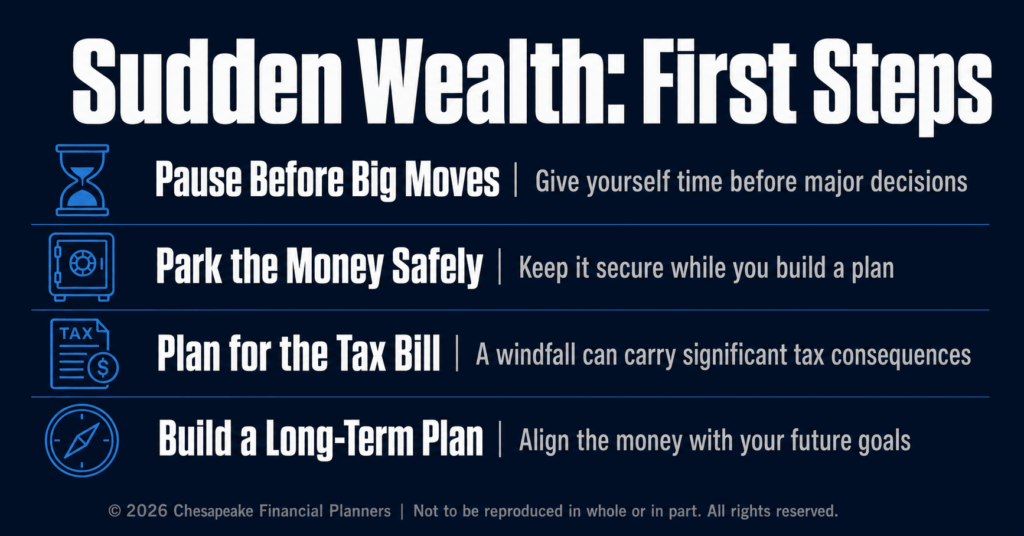
In the first 90 days, protect the money and protect yourself. Do not buy anything large, do not quit your job, do not promise money to anyone, and do not move the funds into investments yet. Park the entire sum in an FDIC-insured high-yield savings account or a money market fund and let it sit. This single decision prevents most windfall disasters.
A few specific moves matter in this window.
- Deposit the funds safely. FDIC insurance covers $250,000 per depositor, per insured bank, per ownership category, so a large windfall may need to be spread across several institutions or account titles to stay fully insured.
- Tell almost no one. The fewer people who know, the fewer requests, pitches, and pressures you will face. This is not paranoia. It is protection.
- Pause all major decisions. No home purchase, no new car, no business loan to a relative, no gifts. Write the ideas down for later. The list will be there in 90 days.
- Find out the tax bill before you spend a dollar. Different windfalls carry wildly different tax exposure, and a surprise tax bill is one of the fastest ways to destroy a windfall.
- Build a temporary holding plan. A money market fund earning a competitive yield is a perfectly good home for the money while you plan. There is no prize for investing quickly.
Should you pay off debt first?
Pay off high-interest debt almost immediately, because the guaranteed "return" from eliminating it usually beats anything you could earn investing the same money. Credit card debt carrying a rate above 20% is a clear target. Low-rate mortgage debt is a closer call and worth running through a plan first. Jeff often points out that clearing toxic debt in the first month is one of the few fast decisions that almost never backfires.
What Should I Do First With Inherited Money or a Windfall?
How Is a Windfall Taxed?
How a windfall is taxed depends entirely on its source, and getting this wrong is the most expensive mistake a recipient can make. There is no single "windfall tax." Inheritances, business sales, lawsuit settlements, and lottery winnings each follow different rules. Here is how the major categories compare.
| Windfall Source | Federal Tax Treatment | Key Point |
|---|---|---|
| Inheritance (cash, property) | Generally not taxable income to the heir | The estate may owe estate tax; heirs usually receive a stepped-up basis |
| Inherited retirement account | Distributions taxed as ordinary income | Most non-spouse heirs must empty the account within 10 years |
| Business sale | Capital gains on the gain | Long-term capital gains rates apply if held over one year |
| Lawsuit settlement | Depends on what it compensates | Physical-injury damages often excludable; punitive and interest portions usually taxable |
| Lottery / gambling | Ordinary income, fully taxable | Federal withholding applies immediately; state tax may also apply |
| Life insurance death benefit | Generally not taxable income | Interest paid on delayed payouts can be taxable |
How does the estate tax exemption affect a large inheritance?
The federal estate tax exemption rose to $15 million per individual for 2026, which means a married couple can shield up to $30 million from federal estate tax. Most heirs will owe no federal estate tax at all. But several states, including Maryland, levy their own estate or inheritance taxes at lower thresholds, so the heir's location and the deceased's location both matter. According to the IRS, the annual gift tax exclusion for 2026 is $19,000 per recipient, which shapes how a windfall recipient can pass money to family without filing a gift tax return.
How are inherited retirement accounts taxed?
Inherited traditional IRAs and 401(k)s are taxed as ordinary income when distributed, and under the SECURE Act rules enforced by the IRS, most non-spouse beneficiaries must fully distribute the account within 10 years of the original owner's death. That 10-year window is a planning opportunity. Spreading distributions across years instead of taking a lump sum can keep you out of the top tax brackets. This is exactly the kind of decision that should never be made in the first emotional weeks.
How do I protect sudden wealth from taxes?

How Does the R.U.D.D.E.R. Method™ Structure a Windfall Plan?
The R.U.D.D.E.R. Method™ is Chesapeake Financial Planners' six-step planning process: Review and Recognize, Uncover and Understand, Design and Develop, Discuss and Decide, Execute and Empower, and Reassess and Refine. It exists precisely for moments like a windfall, when the volume of decisions can overwhelm a clear head.
Applied to sudden wealth, the framework looks like this:
- Review and Recognize. Take inventory of exactly what you received, what it is worth after tax, and what your full financial picture looks like now. Most people overestimate the after-tax number.
- Uncover and Understand. Identify what actually matters to you. Retirement security? Helping your kids? Quitting a job you hate? The money is a tool, and the plan starts with the goal, not the product.
- Design and Develop. Build the tax strategy, the investment allocation, the giving plan, and the protection plan as one connected system instead of a pile of disconnected accounts.
- Discuss and Decide. Walk through the trade-offs with your advisor and family before committing. This is where most fast, bad decisions get caught.
- Execute and Empower. Put the plan in motion deliberately, in the right order, with the right account types.
- Reassess and Refine. Revisit the plan as your life and the tax code change. A windfall plan is not a one-time event.
Jeff describes the method as the difference between reacting and deciding. A windfall gives you a rare chance to design your financial life on purpose. Most people only get one shot at it.
What Are the Most Common Mistakes Windfall Recipients Make?
The most common windfall mistakes are spending before planning, telling too many people, helping family too quickly, and chasing complex investments sold by people who found you. Each one is avoidable, and each one shows up again and again.
The big spending mistake is what Jeff calls the irreversible purchase. A larger home brings larger property taxes, higher insurance, and ongoing maintenance that quietly drains the windfall for years. The car, the boat, the vacation home all carry the same hidden tail. According to the Bureau of Labor Statistics, housing is consistently the single largest category of household spending, which is exactly why upgrading it on impulse does the most lasting damage.
The family mistake is just as costly. The instinct to help is good. The execution is usually terrible. Lending money to relatives without terms, gifting amounts that trigger filing requirements, or funding a child's business on a handshake turns a windfall into a source of family conflict. A plan lets you be generous in a way that does not blow up relationships or your own security.
The advice mistake is the quiet one. When you come into money, salespeople appear. Annuities with surrender charges, private deals with no liquidity, and "exclusive" opportunities all tend to surface in the first few months. The simple defense: if someone found you with an investment, slow down and run it past a fiduciary who does not earn a commission on the sale.
What is the complete financial planning guide for selling a business?
How Do You Protect a Windfall From Lawsuits and Bad Actors?
You protect a windfall by separating your wealth from your personal liability, keeping a low profile, and putting legal structures in place before a problem appears. Once a lawsuit is filed, most protection options are gone. Protection is something you do early, not in a crisis.
Several layers matter. An adequate umbrella liability insurance policy is the cheapest first line of defense and often the most overlooked. Retirement accounts carry strong creditor protection under federal law, which is one more reason not to cash them out impulsively. For larger windfalls, properly drafted trusts and entity structures can shield assets, though these require an estate attorney and should never be assembled from internet templates.
The human side of protection matters just as much. Scammers, distant relatives, and opportunistic "friends" tend to surface around new money. Keeping the windfall private is not about being secretive for its own sake. It is the single most effective way to reduce the number of people lining up to separate you from it. Jeff has seen recipients lose more to people they trusted than to any market or lawsuit.
Do you need new insurance after a windfall?
Yes, a windfall almost always changes your insurance needs, starting with higher umbrella liability coverage to match your new net worth. More wealth makes you a more attractive lawsuit target, so coverage that protects assets becomes essential. You may also need to review property, health, and life coverage as your financial picture changes. Review all of it within the first few months.
How Do I Protect My Assets After a Major Wealth Event?
When Should You Assemble a Professional Team?
You should assemble your professional team early, ideally within the first 30 to 60 days, before you make any major financial or tax decision. A windfall touches taxes, investments, estate law, and insurance at once, and no single professional covers all four. The right team usually includes a fee-based financial planner to coordinate the whole picture, a CPA for the tax strategy, and an estate attorney for trusts and legal structures.
The order matters. Start with the planner who can see the full picture and quarterback the others, rather than hiring specialists who each optimize their own corner. According to the CFP Board, a CFP® professional is held to a fiduciary standard, meaning they are obligated to act in your best interest. That standard is exactly what you want from the person coordinating a life-changing sum.
Here is a practical question to ask any advisor: how are you paid? A fee-based or fee-only planner who does not earn commission on the products they recommend has far less incentive to push you into something that pays them. With a windfall on the table, that distinction is worth real money.

How do you choose the right financial advisor and what should you look for?
What Is the R.U.D.D.E.R. Method™?
Frequently Asked Questions
What is the first thing to do when you receive a large sum of money?
The first thing to do is park the entire amount in a safe, FDIC-insured high-yield savings or money market account and make no major decisions for at least 30 to 90 days. This cooling-off period prevents impulsive purchases and gives you time to understand your true after-tax position. There is no financial penalty for waiting, and the discipline protects you from the most common windfall mistakes.
Is inherited money taxable?
Inherited cash and most property are generally not taxable income to the person who receives them, though the estate itself may owe estate tax. The big exception is inherited retirement accounts: distributions from inherited traditional IRAs and 401(k)s are taxed as ordinary income, and most non-spouse heirs must empty those accounts within 10 years under current IRS rules. State inheritance taxes may also apply depending on where you live.
How much money is considered sudden wealth?
There is no fixed dollar amount that defines sudden wealth; it is any sum large enough to meaningfully change your financial life relative to your prior situation. For one household that may be $100,000, and for another it may be several million. The defining feature is not the number but the disruption: enough money, arriving fast enough, that it triggers new tax, investment, and emotional decisions you have never faced before.
Why do so many people lose their windfall?
Most people lose a windfall not to bad markets but to fast, emotional decisions made before any plan exists. Common causes include overspending on homes and cars, lending or gifting money to family without limits, falling for high-commission products sold by salespeople, and underestimating the tax bill. The recipients who keep their wealth are almost always the ones who slowed down and built a written plan first.
Do I have to pay taxes on lottery winnings?
Yes, lottery and gambling winnings are fully taxable as ordinary income at the federal level, and federal tax is withheld immediately when you collect a large prize. Many states also tax winnings, while a few do not tax them at all. Because a large jackpot can push you into the top tax bracket, the choice between a lump sum and an annuity payout has major tax consequences and should be modeled before you decide.
How do I protect a large inheritance from taxes?
You protect a large inheritance by understanding which parts are taxable, spreading inherited retirement account distributions across multiple years to avoid top brackets, and using the stepped-up cost basis on inherited investments and property. For very large estates, the federal exemption of $15 million per individual in 2026 shields most heirs from federal estate tax, but state-level estate and inheritance taxes may still apply. A CPA and planner should map this before you take any distribution.
Should I quit my job after a windfall?
You should not quit your job immediately after a windfall, because keeping your income gives the windfall more time to be invested rather than spent on living expenses. A common rule is to make no irreversible life changes for at least 90 days, and employment is one of the most irreversible. Once a written plan shows your windfall can sustainably replace your income, leaving work becomes a deliberate decision rather than an emotional reaction.
Who should I talk to first when I receive a large sum of money?
Talk first to a fee-based or fee-only financial planner who acts as a fiduciary, ideally within the first 30 to 60 days. A planner can see your full financial picture and coordinate the CPA and estate attorney you will likely also need. Avoid taking advice from anyone who earns a commission on what they sell you, and resist the urge to announce the windfall to friends and extended family before a plan is in place.
Your Windfall Deserves a Plan, Not a Reaction
A windfall is one of the few moments where the right first move is to slow down. The money will still be there in 90 days. The bad decisions made in week one usually will not be reversible. Sudden wealth planning is not about chasing returns; it is about protecting what you received long enough to use it well. If this guide was useful, our free windfall planning checklist walks through the first 90 days step by step. Download it at chesapeakefp.com.
Disclosures
The information provided is for educational purposes only and should not be construed as investment advice. Investment strategies should be tailored to individual circumstances, risk tolerance, and goals. Past performance doesn't guarantee future results. Consult with qualified financial professionals regarding your specific situation.
Advisors associated with Chesapeake Financial Planners may be either (1) LPL Financial Registered Representatives offering securities through LPL Financial, Member FINRA and SIPC, and investment advisor representatives offering investment advice through Great Valley Advisor Group; or (2) solely investment advisor representatives offering investment advice through Great Valley Advisor Group and not affiliated with LPL Financial. Great Valley Advisor Group, and Chesapeake Financial Planners are separate entities from LPL Financial.


