

What Does Wealth Event Decision Paralysis Actually Cost Investors?
Last reviewed: July 2026
Wealth event decision paralysis investing costs most people far more than any single bad investment ever would. When a large sum lands in your account, the instinct to wait until you feel ready can quietly drain tens of thousands of dollars through lost market growth, unnecessary taxes, and cash sitting idle against inflation. The longer the delay, the steeper the bill, and the bill is rarely visible until you add it up.
On This Page
- Key Takeaways
- Why "I'll Wait Until I'm Ready" Is the Most Expensive Sentence After a Windfall
- How Much Does Windfall Decision Paralysis Actually Cost in Real Dollars?
- Why Does the Brain Freeze When a Large Sum Arrives?
- What Is the Smarter Alternative to Rushing or Freezing?
- How Does the R.U.D.D.E.R. Method Remove the Paralysis?
- What Should You Do First in Harford County After a Windfall Lands?
- Frequently Asked Questions
- Ready to Turn Indecision Into a Plan?
- Disclosures
Key Takeaways
- Waiting to invest a windfall carries a real cost in lost growth, eroding purchasing power, and missed tax planning windows.
- A $500,000 windfall left in cash for two years can forfeit substantial compounding against the market's long-term historical return.
- Inflation steadily reduces idle cash, with the Federal Reserve targeting 2% annual inflation as its long-run goal.
- A staged investing plan beats both rushing in and freezing, letting you act without betting everything on one day's market.
- The R.U.D.D.E.R. Method™ gives windfall recipients a structured path from shock to confident decisions.
About the Author: Jeff Judge, CFP®, AEP®, ChFC®, CLU® is Managing Partner of Chesapeake Financial Planners in Forest Hill, Maryland. He has been helping families and business owners in Harford County and the Baltimore metro area navigate sudden wealth events since earning his CFP® certification in 2013, by using Chesapeake Financial Planners’ signature process, the R.U.D.D.E.R. method™. Jeff has watched more clients lose money to indecision after a windfall than to any single investment they ever chose.
Why "I'll Wait Until I'm Ready" Is the Most Expensive Sentence After a Windfall
The cost of waiting after a windfall compounds over time. Acting within 90 days, waiting 12 months, and waiting 3+ years each carry different financial and emotional consequences.
| Timeline | Opportunity Cost | Emotional Cost | Risk |
|---|---|---|---|
| Act within 90 days (organized plan) | Minimal — compounding begins; tax windows captured | Moderate — decisions require engagement before certainty feels natural | Low — plan limits impulsive choices; structure replaces emotion |
| Wait 12 months | Meaningful — one full year of foregone growth plus inflation erosion; some tax windows may close | Moderate-to-high — prolonged uncertainty; money feels unresolved | Moderate — longer exposure to drift; greater chance of lifestyle spending from idle cash |
| Wait 3+ years | Severe — compounding gap is permanent and grows each year; Roth conversion and other windows often missed | High — the "I'll deal with it" feeling becomes chronic; avoidance reinforces itself | High — IRS deadlines may pass; estate documents may go unreviewed; decisions become harder, not easier |
The phrase sounds responsible. It sounds patient. In practice, "I'll wait until I'm ready" is the single most expensive sentence I hear in my Forest Hill office after a client receives a large sum. Wealth event decision paralysis investing is not caution. It is a slow leak.
Here is the problem with waiting. The money does not pause along with your decision. Cash sitting in a checking account earns close to nothing while inflation chips away at what it can buy. Meanwhile, the markets you are afraid to enter keep moving, and over long periods they have moved up more often than down.
What does "ready" really mean for most people?
For most people, "ready" is not a financial state. It is an emotional one, and it rarely arrives on its own. Waiting for a feeling of total certainty before investing a windfall is like waiting for a perfectly calm ocean before learning to swim. The right move is a plan that works whether or not you feel calm, because the plan does the thinking your nervous system cannot do in the moment.
A windfall changes your numbers overnight. A pension lump sum, an inheritance, a business sale, a legal settlement, an insurance payout. Each one demands decisions about taxes, investing, and protection that did not exist the week before. The clock on some of those decisions starts the day the money arrives.
How Much Does Windfall Decision Paralysis Actually Cost in Real Dollars?
The cost of waiting is not abstract. It compounds. According to the U.S. Securities and Exchange Commission, compound returns mean money invested earlier grows on a larger base every year, so even a short delay removes growth you can never recover.
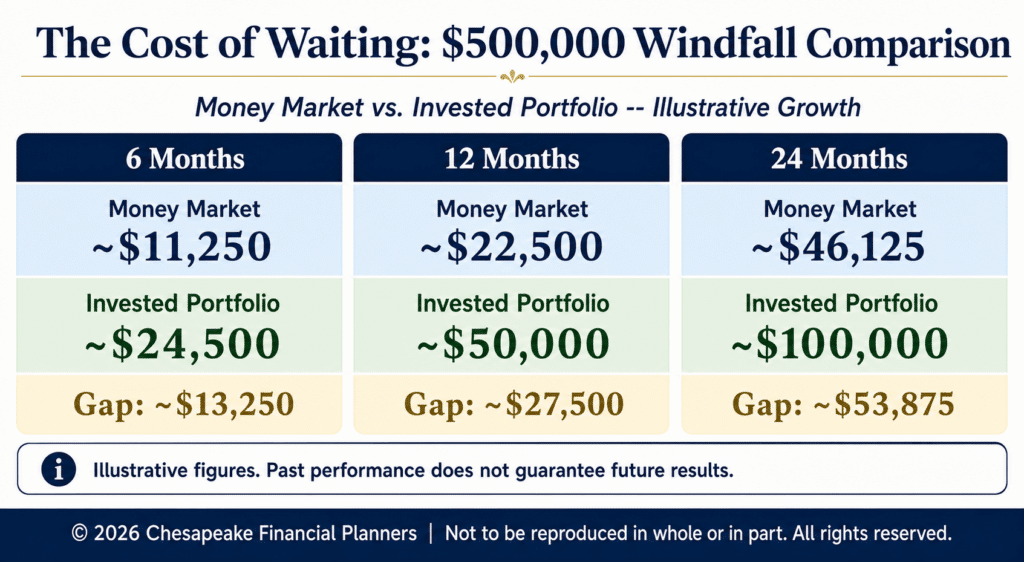
Consider a $500,000 windfall. Left entirely in cash, it earns whatever a savings account pays and nothing more. Invested in a diversified portfolio, that same money has the potential to participate in market growth. Over decades, the historical long-run return of U.S. stocks has averaged roughly 10% before inflation, though no year is guaranteed and losses are part of the journey.
Now layer on inflation. The Federal Reserve targets 2% annual inflation as a long-run goal, which means cash steadily loses purchasing power every single year you hold it. Two years of waiting is not a neutral pause. It is two years of erosion plus two years of forfeited compounding.
Does the lost growth ever come back?
No. Compounding cannot be rewound. The growth you skip during a two-year delay does not get added back later. It is permanently absent from the larger base your money would have built. This is why I tell clients the real question is not "what if the market drops after I invest" but "what does it cost me to sit out while I decide."
There is a tax dimension too. Some windfalls arrive with planning windows that close. A pension lump sum can be rolled into an IRA to defer taxes, but only if you handle the transfer correctly and on time. A year with unusually low income after a job loss or business transition can be a rare opportunity for a Roth conversion at a low bracket. Wait too long, and the window shuts.

Why Does the Brain Freeze When a Large Sum Arrives?
A windfall is a high-stakes event, and the human brain handles high stakes poorly. The fear of making the wrong move with a large sum often produces no move at all, which is itself a move with a cost. Behavioral researchers call this the status quo bias: when a decision feels overwhelming, people default to doing nothing.
There is a specific trap that hits windfall recipients hard. The bigger the number, the bigger the perceived consequence of being wrong, so the more frozen people become. A bad $5,000 decision feels survivable. A bad $500,000 decision feels catastrophic. The mind responds by refusing to decide at all, which guarantees the cost of inaction.
Is waiting ever the right choice after a windfall?
Sometimes, yes, but only deliberately and only for a short, defined period. There is a real difference between a planned pause to organize, gather documents, and assemble a team, and an open-ended freeze with no end date. A 30-day organizing window is sound. A two-year "I'm not ready yet" is not a plan; it is avoidance with a deadline that never comes.
I've watched this play out for years. The clients who do best are not the ones who feel the most confident at the start. They are the ones who follow a process even while they feel uncertain. The process carries them past the freeze. Feelings catch up later, after the first few decisions go smoothly.
Grief complicates this further. A great many windfalls arrive through loss, an inheritance after a parent dies, a life insurance payout after a spouse passes. Mixing financial decisions with grief is genuinely hard, and it deserves patience. That patience should have a structure and a timeline, not an indefinite delay that quietly costs the very money meant to provide security.
What Is the Smarter Alternative to Rushing or Freezing?
The two failure modes are rushing in and freezing up. There is a third path that beats both, and it is not complicated. It is a staged, written plan that lets you act without betting everything on a single day's market.
Dollar-cost averaging is one common version of this. Instead of investing a lump sum all at once, you invest it in equal portions over a set number of months. This removes the fear of investing everything the day before a downturn, and it removes the paralysis of trying to pick the perfect entry point, which no one can do reliably.
How do you build a staged plan that actually works?
Start by splitting the windfall into purpose-based buckets before you invest a dollar. Set aside an emergency reserve in cash, earmark money for any tax bill the windfall created, carve out funds for near-term goals, then commit the remainder to a long-term investment schedule. Each bucket has a job, and the structure itself reduces anxiety.
A staged plan also protects you from sequence of returns risk, which is the danger of a sharp market decline early in a new portfolio's life doing outsized damage. Spreading entry points smooths that risk. The order in which returns arrive matters enormously for a freshly funded portfolio, and a thoughtful schedule blunts the worst of it.
What Is Sequence of Returns Risk and How Does It Wreck a New Portfolio?
Research from Vanguard has noted that investing a lump sum immediately has historically outperformed gradual investing about two-thirds of the time, because markets rise more often than they fall. Yet for someone paralyzed by fear, a staged plan they will actually follow beats a perfect plan they freeze on. The best strategy is the one you can execute.
| Approach | Main risk | Best for |
|---|---|---|
| Invest everything at once | A downturn right after entry | Investors comfortable with short-term volatility |
| Stay in cash indefinitely | Lost growth plus inflation erosion | No one as a long-term strategy |
| Staged investing schedule | Slightly lower expected return than lump sum | Anyone prone to decision paralysis |
How Does the R.U.D.D.E.R. Method™ Remove the Paralysis?
The R.U.D.D.E.R. Method™ is Chesapeake Financial Planners' six-step planning process: Review and Recognize, Uncover and Understand, Design and Develop, Discuss and Decide, Execute and Empower, and Reassess and Refine. It exists precisely for moments like this, when a big decision feels too big to start.
The method works because it breaks an overwhelming question into ordered, manageable steps. You do not have to know what to do with $500,000 on day one. You only have to complete the first step, then the next. The structure removes the need to feel ready, because readiness is replaced by a process.
Where does the paralysis actually break?
The freeze usually breaks at the Discuss and Decide step, after the earlier steps have surfaced the real options and the trade-offs are clear. People are not paralyzed by decisions; they are paralyzed by ambiguity. Once the choices are named, the costs are quantified, and a trusted advisor is in the room, the decision that felt impossible becomes ordinary.
I often tell clients that the goal of the first meeting is not to invest anything. It is to lower the stakes of every later meeting by getting organized. Review and Recognize simply takes inventory of what arrived and why. Uncover and Understand connects it to your real goals. By the time you reach Execute and Empower, the action is the easy part.
What Is the R.U.D.D.E.R. Method™?
The final step, Reassess and Refine, matters more than most people expect. A windfall plan made in month one is not carved in stone. As your life and the markets change, the plan adjusts. Knowing the plan can flex removes the pressure to get everything perfect on the first try, which is a major source of the original paralysis.
What Should You Do First in Harford County After a Windfall Lands?
If a large sum has just arrived and you live in Harford County or the broader Baltimore metro, the smartest first move is not picking an investment. It is assembling a plan and a team before you act. The decisions get easier once you stop carrying them alone.
Chesapeake Financial Planners sits in Forest Hill, Maryland, a short drive from Bel Air and the surrounding Harford County communities. Many of the windfall clients I work with are local business owners who just sold, retirees who took a pension lump sum, or families navigating an inheritance. The conversations happen in person, which matters when the stakes feel personal.
What does the first 30 days look like in Maryland?
In the first 30 days, the priority is organization, not investment. Move the funds to a safe holding account, identify any tax obligations the windfall created, and avoid making any large, irreversible decisions while the dust settles. Then build the actual plan. Maryland's tax landscape, including its estate and inheritance considerations, makes early local guidance especially valuable. Jeff Judge notes: "Maryland hits inheritances with both an estate tax and an inheritance tax simultaneously, and the first 30 days after a windfall is exactly when those obligations need to be identified — before a single dollar gets moved or spent."
Maryland is one of the few states with both an estate tax and an inheritance tax, which means a windfall through inheritance near Bel Air carries planning nuances that a national rule of thumb will miss. The Comptroller of Maryland outlines these obligations, and they are exactly the kind of detail that gets missed during an indefinite “I’ll wait until I’m ready” freeze.
I've seen Harford County families delay a windfall decision for two or three years, convinced they were being careful. The carefulness cost them. It rarely gets cheaper to wait. The role of a local advisor is to turn an overwhelming pile of money into an ordered list of decisions, each one small enough to actually make.
How do Maryland's estate tax and inheritance tax work together, and how do you plan around both?
What Is a Wealth Event Advisory Team and Who Should You Call First?

Frequently Asked Questions
How much does it cost to wait before investing a windfall?
The cost of waiting comes from three sources: lost market growth that compounding can never recover, inflation eroding idle cash at the Federal Reserve's 2% long-run target, and missed tax planning windows that close over time. On a $500,000 windfall, even a two-year delay can forfeit tens of thousands of dollars in growth and purchasing power combined.
Why do people freeze after receiving a large sum of money?
People freeze because the perceived stakes of a wrong decision rise with the size of the number, triggering status quo bias, the tendency to default to inaction when a choice feels overwhelming. A bad $500,000 decision feels catastrophic, so the brain refuses to decide at all, which guarantees the cost of inaction rather than avoiding it.
Is it better to invest a windfall all at once or gradually?
Investing a lump sum immediately has historically outperformed gradual investing roughly two-thirds of the time, according to Vanguard, because markets rise more often than they fall. However, for someone paralyzed by fear, a staged investing schedule they will actually follow beats a perfect plan they freeze on. The best strategy is the one you can execute.
What is the first thing to do after a windfall arrives?
The first move is organization, not investment. Move the funds to a safe holding account, identify any tax obligations the windfall created, set aside an emergency reserve, and avoid large irreversible decisions while you build a written plan. A planned 30-day organizing window is sound; an open-ended freeze with no end date is not.
Does Maryland have special tax rules for an inheritance windfall?
Yes. Maryland is one of the few states with both an estate tax and an inheritance tax, per the Comptroller of Maryland. An inheritance windfall near Bel Air or anywhere in Harford County carries planning nuances that national rules of thumb miss, which is why early guidance from a local advisor matters before you make any large decisions with the money.
How does the R.U.D.D.E.R. Method™ help with decision paralysis?
The R.U.D.D.E.R. Method™ breaks an overwhelming decision into six ordered steps, so you never have to know what to do with the whole windfall at once. You complete one step, then the next. Paralysis usually breaks at the Discuss and Decide stage, once the options are named and the trade-offs are quantified, replacing ambiguity with a clear choice.
Can waiting after a windfall ever be the right move?
Yes, but only as a short, defined pause to organize, gather documents, and assemble a team, not as an open-ended freeze. A 30-day organizing window is sound planning. A two-year "I'm not ready yet" is avoidance, and it quietly costs the very security the money was meant to provide through lost growth and inflation.
How do I protect a new windfall portfolio from an early market drop?
Spread your entry points using a staged investing schedule rather than investing everything on a single day. This reduces sequence of returns risk, the danger of a sharp decline early in a new portfolio's life doing outsized damage. Splitting a windfall into purpose-based buckets first, then committing the long-term portion gradually, smooths the worst of that risk.
Ready to Turn Indecision Into a Plan?
The longest, most expensive decision after a windfall is the one you never make. If a large sum has landed and you keep telling yourself you will deal with it once you feel ready, that day may cost you more than any investment ever could. Wealth event decision paralysis investing is solvable, and the solution starts with one organized conversation. Jeff Judge and the Chesapeake team serve families and business owners across Harford County and the Baltimore metro. Schedule a free fit call at chesapeakefp.com.
This post is adapted from 'What "I'll Wait Until I'm Ready" Actually Costs' originally published on Chesapeake Financial Planners' LinkedIn.
Want to go deeper? Our First 90 Days After a Windfall walks through this step by step.
Disclosures
The information provided is for educational purposes only and should not be construed as investment advice. Investment strategies should be tailored to individual circumstances, risk tolerance, and goals. Past performance doesn't guarantee future results. Consult with qualified financial professionals regarding your specific situation.
Growth investments may be more volatile than other investments because they are more sensitive to investor perceptions of the issuing company's growth of earnings potential.
This information is not intended to be a substitute for specific individualized tax, investment or legal advice. We suggest that you discuss your specific situation with a qualified tax, legal or financial advisor.
Advisors associated with Chesapeake Financial Planners may be either (1) LPL Financial Registered Representatives offering securities through LPL Financial, Member FINRA and SIPC, and investment advisor representatives offering investment advice through Great Valley Advisor Group; or (2) solely investment advisor representatives offering investment advice through Great Valley Advisor Group and not affiliated with LPL Financial. Great Valley Advisor Group, and Chesapeake Financial Planners are separate entities from LPL Financial.


