

How Do I Make My Pension Lump Sum Last in Retirement?
Last reviewed: July 2026
To make a pension lump sum last in retirement, roll it into an IRA to defer taxes, set a sustainable withdrawal rate (often 3.5% to 4% of the starting balance), and split the money into short-term cash, mid-term income, and long-term growth buckets. The goal is simple: replace the lifetime paycheck your pension would have paid, on your own terms. When you take the lump sum, you become your own pension manager, and how you structure the first few decisions usually determines whether the money outlives you or you outlive the money.
Key Takeaways
- A pension lump sum trades guaranteed lifetime income for control, flexibility, and the ability to leave money to heirs.
- A withdrawal rate near 4% has historically lasted 30 years, but earlier retirees should lean toward 3% to 3.5%.
- Rolling the lump sum directly into an IRA avoids mandatory 20% federal withholding and keeps the money tax-deferred.
- A three-bucket structure protects near-term spending from market drops while a growth sleeve outpaces inflation.
- The 2026 Social Security cost-of-living adjustment is 2.8%, so coordinating your claim with the lump sum matters.
About the Author: Jeff Judge, CFP®, AEP®, ChFC®, CLU® is Managing Partner of Chesapeake Financial Planners in Forest Hill, Maryland. He has been helping families and business owners in Harford County and the Baltimore metro area navigate pension and retirement income decisions since earning his CFP® certification in 2013, by using Chesapeake Financial Planners’ signature process, the R.U.D.D.E.R. method™. Jeff's most common warning to clients: the day the lump sum hits your account is the day you stop having a pension and start having a portfolio, and those are not the same thing.
Why Is a Pension Lump Sum Harder to Manage Than a Monthly Pension?
A pension lump sum is harder to manage than a monthly pension because it shifts longevity risk and market risk from your former employer onto you. A traditional pension pays the same check every month until you die, regardless of how long you live or what the stock market does. The lump sum hands you that obligation.
That trade is not automatically bad. Control has real value. You decide how the money is invested, you keep access to the principal, and whatever remains passes to your heirs rather than ending with your death. A monthly pension usually offers none of that.
The risk is behavioral as much as financial. Jeff Judge has watched clients treat a $500,000 check like a windfall instead of a 30-year paycheck, and the early overspending is what sinks plans more often than a bad market. The first job is to mentally re-label the lump sum as income, not savings.

What Withdrawal Rate Makes a Pension Lump Sum Last?
A withdrawal rate of roughly 3.5% to 4% of the starting balance, adjusted for inflation each year, gives most retirees a reasonable expectation of making a pension lump sum last 30 years. The well-known 4% withdrawal rule comes from research showing that a balanced portfolio survived three decades of withdrawals across nearly every historical period.
The number you choose should bend with your retirement age. The 4% withdrawal rule assumes you retire around 65. Retire earlier and your money has to stretch longer, so a lower rate makes sense.
- Age 55 to 60: lean toward a 3% to 3.5% withdrawal rate
- Age 60 to 65: 3.5% to 4% is often appropriate
- Age 65 and older: 4% to 4.5% becomes more sustainable
Run the math on the actual dollars. A $500,000 lump sum at a 3.5% rate produces about $17,500 in the first year. Add that to your Social Security benefit and any other income, then compare it to your real spending. If there's a gap, you have three levers: spend less, work a bit longer, or build more income. There is no fourth lever, and pretending otherwise is how plans fail.
According to the Bureau of Labor Statistics, consumer prices are still climbing, which is why an inflation adjustment to your withdrawal is not optional. A flat dollar withdrawal loses purchasing power fast over a 30-year retirement.
How Should I Structure a Pension Lump Sum Into Buckets?
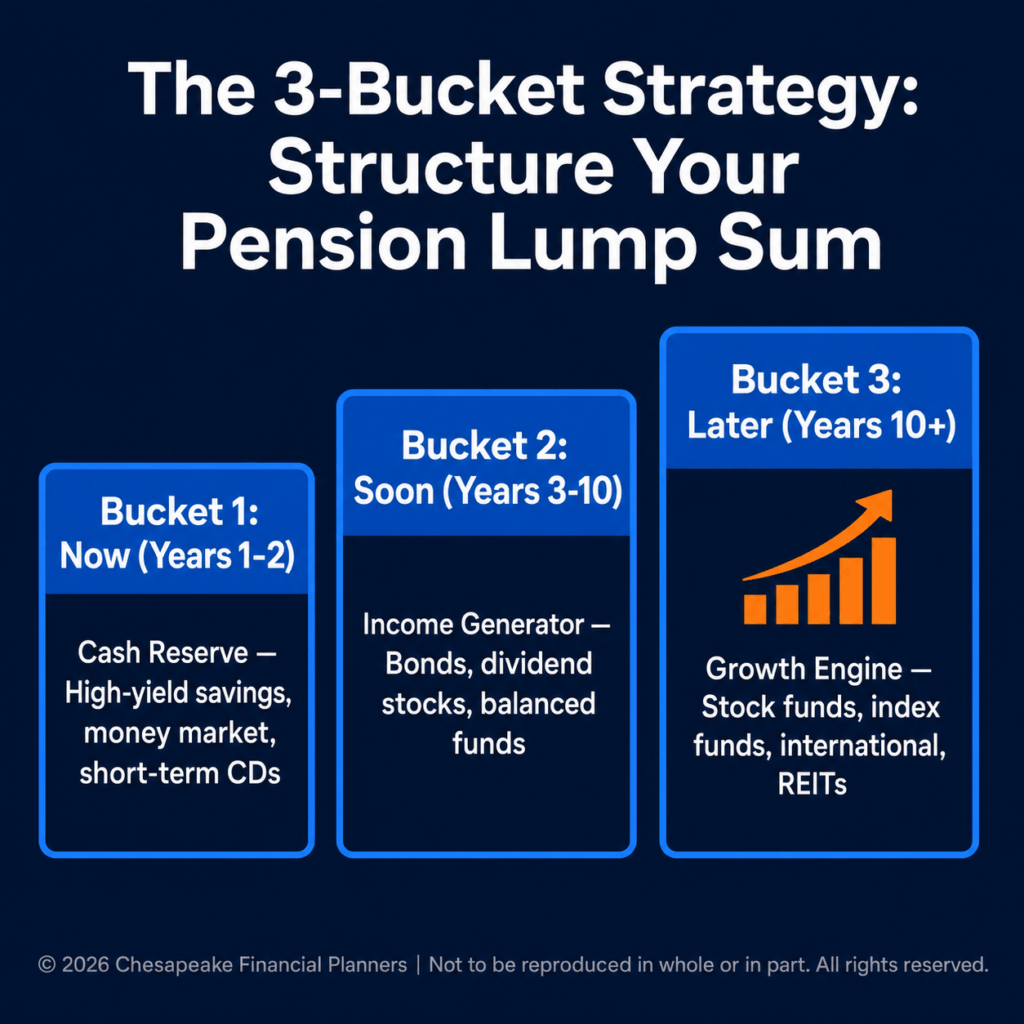
You should structure a pension lump sum into three buckets: a cash reserve for the next one to two years, an income sleeve for years three through ten, and a growth sleeve for year ten and beyond. The bucket approach keeps your near-term spending money out of the market so a downturn never forces you to sell investments at a loss.
Bucket 1 – Cash reserve (years 1 to 2). Hold one to two years of expenses in high-yield savings, money market funds, or short-term CDs. For most retirees that's roughly $50,000 to $100,000. This bucket exists so a bad market never dictates your spending.
Bucket 2 – Income generator (years 3 to 10). Roughly 40% to 50% of the portfolio goes here, in investment-grade bonds, dividend payers, balanced funds, or a short-term bond ladder. The job of this bucket is reliable income and principal stability.
Bucket 3 – Growth engine (years 10 and beyond). The remaining 30% to 50% targets long-term growth through diversified stock funds, low-cost index funds, international stocks, and REITs. This is the money that has to outpace inflation, so it can afford to ride out volatility.
As you spend Bucket 1, refill it from Bucket 2, and refill Bucket 2 from Bucket 3. That sequence forces you to trim your growth positions after they've risen, a disciplined version of selling high. This is the same logic we apply through the R.U.D.D.E.R. Method™, Chesapeake Financial Planners' six-step planning process: Review and Recognize, Uncover and Understand, Design and Develop, Discuss and Decide, Execute and Empower, and Reassess and Refine, where the "Reassess and Refine" step is exactly this annual rebalancing discipline.
How Does a Pension Lump Sum Work With Social Security?
A pension lump sum works best with Social Security when you use the lump sum to bridge spending in your early 60s so you can delay claiming and grow your benefit. According to the Social Security Administration, delaying your benefit past full retirement age earns delayed retirement credits worth about 8% per year up to age 70.
That delay is one of the few guaranteed, inflation-adjusted raises available in retirement. Spending down part of the lump sum from 62 to 70 to buy a larger lifetime Social Security check often produces more total household income than claiming early and preserving the portfolio. For married couples, coordinating both claims matters even more, because the higher earner's benefit becomes the survivor benefit.
The pension lump sum and Social Security are not separate decisions. They are two halves of the same income plan, and treating them in isolation usually leaves money on the table.
Frequently Asked Questions
Should I take the pension lump sum or the monthly annuity?
Take the lump sum if you value control, flexibility, and leaving money to heirs, and the monthly annuity if you value guaranteed lifetime income you cannot outlive. The right choice depends on your health, other income sources, and whether the pension is backed by a financially strong plan. Compare the annuity's effective payout rate against what a 3.5% to 4% withdrawal on the lump sum would produce.
How much income can a $500,000 pension lump sum produce?
A $500,000 pension lump sum can produce roughly $17,500 to $20,000 in inflation-adjusted income in the first year using a 3.5% to 4% withdrawal rate. That amount rises with inflation each year. Whether it's enough depends on combining it with Social Security and any other income, then measuring the total against your actual spending needs in retirement.
Do I have to pay taxes on a pension lump sum right away?
You do not have to pay taxes right away if you roll the pension lump sum directly into an IRA, which keeps the money tax-deferred until you withdraw it. If you take the cash instead, the entire amount is taxable that year and your employer must withhold 20% for federal taxes. A direct rollover avoids both the withholding and the immediate tax bill.
What happens to my pension lump sum if the market crashes early in retirement?
If the market crashes early in retirement, a bucket strategy protects you by funding your spending from cash and bonds instead of forcing you to sell stocks at a loss. This guards against sequence-of-returns risk, the danger that poor returns in your first retirement years permanently shrink your portfolio. Keeping one to two years of spending in cash buys time for the market to recover.
Can a pension lump sum last 30 years?
A pension lump sum can last 30 years or longer when you pair a sustainable withdrawal rate near 3.5% to 4% with a diversified, regularly rebalanced portfolio. Historical research behind the 4% withdrawal rule found that a balanced allocation survived three decades across nearly all market periods. Earlier retirees should plan for a longer horizon and lean toward the lower end of that range.
When you take a pension lump sum, you're not just managing money, you're replacing a paycheck that was supposed to last the rest of your life. At Chesapeake Financial Planners, we build pension and retirement income plans like this with clients every week. If you're weighing how to turn a lump sum into 30 years of dependable income, a second opinion costs you nothing. Visit chesapeakefp.com to learn more.
Should I take my pension as a lump sum or monthly payments?
How do I create sustainable retirement income streams?
Should I Take Social Security at 62 or Wait Until 70?
Will My Money Last If the Market Crashes During Retirement?
Want to go deeper? Our Retirement Income Blueprint Workbook walks through this step by step.
Disclosures
The information provided is for educational purposes only and should not be construed as investment advice. Investment strategies should be tailored to individual circumstances, risk tolerance, and goals. Past performance doesn't guarantee future results. Consult with qualified financial professionals regarding your specific situation.
Advisors associated with Chesapeake Financial Planners may be either (1) LPL Financial Registered Representatives offering securities through LPL Financial, Member FINRA and SIPC, and investment advisor representatives offering investment advice through Great Valley Advisor Group; or (2) solely investment advisor representatives offering investment advice through Great Valley Advisor Group and not affiliated with LPL Financial. Great Valley Advisor Group, and Chesapeake Financial Planners are separate entities from LPL Financial.


