
When should I consider timing my pension lump sum payment?
Last reviewed: July 2026
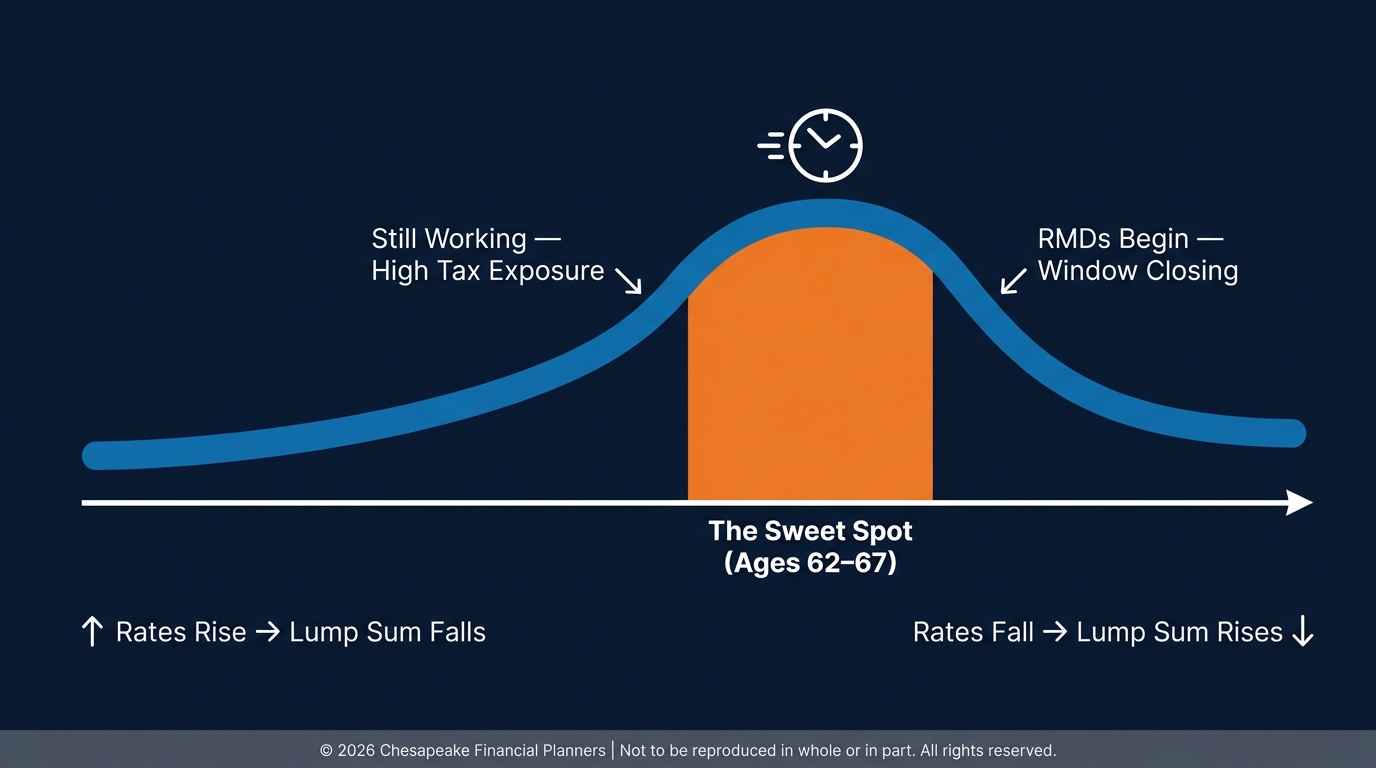
Pension lump sum timing matters most in the years between when you stop working and when required minimum distributions begin, because that low-income window gives you the most control over the tax bill. The right year to take or roll a lump sum can swing your outcome by tens of thousands of dollars, driven by three levers: interest rates, your tax bracket, and your health. Get the timing wrong and you can hand a chunk of the money back in taxes you never needed to pay.
Key Takeaways
- Pension lump sum values move opposite to interest rates: when rates rise, the cash offer shrinks, sometimes by 20% or more.
- The early-retirement window before RMDs at age 73 is usually the best time to roll and convert.
- Taking a large lump sum as cash while still working can push income into the top federal bracket.
- Health and life expectancy change the math; a shorter horizon often favors taking the lump sum sooner.
About the Author: Jeff Judge, CFP®, AEP®, ChFC®, CLU® is Managing Partner of Chesapeake Financial Planners in Forest Hill, Maryland. Jeff has watched clients lose more to bad timing on a lump sum than they ever lost picking the wrong investment. He has been helping families and business owners in Harford County and the Baltimore metro area navigate major financial decisions around windfalls and lump sum payments since earning his CFP® certification in 2013, by using Chesapeake Financial Planners’ signature process, the R.U.D.D.E.R. method™.
How do interest rates change your pension lump sum timing?
Pension lump sum timing is tied directly to interest rates because of how the lump sum is calculated. Your employer figures out what amount, invested today, would generate the same monthly payments you'd otherwise collect for life. Higher interest rates mean less money is needed today to fund those future checks, so the lump sum offer falls. Lower rates push it up.
The plan uses corporate bond yield curves published monthly by the IRS to set those segment rates. Most plans recalculate the offer once a year, often using a rate snapshot from a few months prior.
Here's the practical version. When rates climbed sharply, many lump sum offers dropped 20% to 30% on the same underlying pension. If rates are high now and you expect them to drift down, waiting a year could mean a larger offer. If rates are low and rising, locking in sooner protects the higher value. No one predicts rate moves with certainty, so treat the trend as one input, not a crystal ball.
Should I take my pension as a lump sum or monthly payments?

When is the best year to take a lump sum for tax purposes?
The best year to take a pension lump sum for tax purposes is usually a low-income year, most often during early retirement before Social Security and required minimum distributions start. The year you receive the money, or convert it, determines the bracket it lands in, and that single choice often matters more than the size of the offer.
Taking a lump sum while still working is the most common mistake Jeff sees. If you have a $150,000 salary and take a $400,000 lump sum as cash, you stack that on top of your wages and push the top dollars into the highest federal brackets. Even rolling it to an IRA is a missed opportunity, because you've used up the high-income years instead of the cheaper ones ahead.
Taking a lump sum in early retirement, roughly ages 62 to 72, opens the best planning window. Before Social Security and RMDs begin, your taxable income is often at its lowest. You can roll the lump sum into a traditional IRA with no immediate tax, then convert portions to a Roth at the 10% or 12% bracket over several years. The 2026 standard deduction further widens the room you have to convert cheaply.
Taking a lump sum after RMDs begin at 73 is usually the worst case. Once required distributions and Social Security set an income floor, a large lump sum on top can trigger IRMAA Medicare surcharges and spill income into higher brackets. As the Social Security Administration notes, up to 85% of benefits can become taxable as other income rises.
This is where the R.U.D.D.E.R. Method™ earns its keep. The R.U.D.D.E.R. Method™ is Chesapeake Financial Planners' six-step planning process: Review and Recognize, Uncover and Understand, Design and Develop, Discuss and Decide, Execute and Empower, and Reassess and Refine. We model the lump sum across several tax years before anyone signs anything.
What are the tax implications of a lump sum payout?
Should I roll my 401k into an IRA when I retire?
How do health and life expectancy affect lump sum timing?
Your health at the time of the decision changes the value of a lifetime pension, so it directly affects lump sum timing. A monthly check that pays for life is worth more the longer you expect to live, and worth less if a serious diagnosis shortens that horizon.
If you develop a condition that meaningfully reduces life expectancy, the lump sum often becomes the stronger choice and taking it sooner can make sense. You preserve more capital for a spouse or heirs and avoid the risk of the pension stopping early with little paid out. If you're in excellent health, the lifetime income stream gains value because you'll likely collect it for many years, and your timing decision shifts back toward interest rates and taxes rather than longevity.
Jeff often reminds clients that this is a personal calculation, not a market call. A spouse's health and survivor benefits belong in the same conversation, since the decision usually affects two lives, not one.
What happens to my pension lump sum if I pass away?

Should market conditions drive your lump sum timing?
Market conditions should be a minor factor in pension lump sum timing, not the main driver. Some retirees want to take the lump sum after a downturn so they can invest while prices are lower, and avoid taking it at a market peak right before a possible slide. The instinct is understandable.
The problem is that timing the market reliably is close to impossible, and a wrong guess on stocks can cost more than a right guess saves. Sequence of returns risk is real, especially in the first few years of retirement, but you manage it through a sensible withdrawal plan and asset allocation, not by trying to call the top or bottom. Let interest rates, taxes, and health lead the decision. Treat market level as a tiebreaker at most.
What withdrawal strategy should I use for a pension lump sum?
Frequently Asked Questions
When should I consider timing my pension lump sum payment?
Consider timing your pension lump sum around three factors: interest rates, your tax bracket, and your health. The strongest window is usually early retirement, after you stop working but before required minimum distributions begin at age 73, when your income and tax rate are typically at their lowest point.
Does waiting to take a lump sum always increase the amount?
No. Waiting only increases the lump sum if interest rates fall before your next recalculation. Because lump sums move opposite to rates, a rising-rate environment can shrink your offer by 20% or more if you wait. The direction of rates, not the calendar, decides whether patience pays.
Should I take my pension lump sum while still working?
Usually not, if you can avoid it. Taking a large lump sum as cash on top of your salary stacks the money into your highest tax brackets. Even rolling it to an IRA while working spends the high-income years you could have used later for cheaper Roth conversions in early retirement.
How do RMDs affect the timing of my lump sum?
Required minimum distributions begin at age 73 and set an income floor for the rest of your life. Adding a large lump sum on top of RMDs and Social Security can trigger IRMAA Medicare surcharges and higher brackets, which is why taking or converting the money before 73 is usually the more tax-efficient path.
Does my health change the best time to take a lump sum?
Yes. A serious health condition that shortens your life expectancy makes a lifetime monthly pension less valuable and often favors taking the lump sum sooner to preserve capital for heirs. Strong health makes the lifetime income stream more valuable, shifting the decision back toward interest rates and taxes.
Can I roll my pension lump sum into an IRA to delay taxes?
Yes. Rolling a pension lump sum directly into a traditional IRA defers the tax entirely until you withdraw the money. This is the standard move for retirees who want flexibility, and it sets up the option to convert portions to a Roth gradually during lower-income early-retirement years.
Ready to time this decision right?
A pension lump sum is usually a one-time, irreversible choice, and the timing question deserves more than a gut call. If you're weighing when to take or roll yours, Jeff Judge and the Chesapeake Financial Planners team will model it across tax years before you commit. Schedule a free fit call at chesapeakefp.com.
Want to go deeper? Our Tax Implications of Taking a Lump Sum walks through this step by step.
Disclosures
The information provided is for educational purposes only and should not be construed as investment advice. Investment strategies should be tailored to individual circumstances, risk tolerance, and goals. Past performance doesn't guarantee future results. Consult with qualified financial professionals regarding your specific situation.
This information is not intended to be a substitute for specific individualized tax, investment or legal advice. We suggest that you discuss your specific situation with a qualified tax, legal or financial advisor.
Advisors associated with Chesapeake Financial Planners may be either (1) LPL Financial Registered Representatives offering securities through LPL Financial, Member FINRA and SIPC, and investment advisor representatives offering investment advice through Great Valley Advisor Group; or (2) solely investment advisor representatives offering investment advice through Great Valley Advisor Group and not affiliated with LPL Financial. Great Valley Advisor Group, and Chesapeake Financial Planners are separate entities from LPL Financial.


