

What Withdrawal Strategy Should I Use for a Pension Lump Sum?
Last reviewed: July 2026
The best pension lump sum withdrawal strategy for most retirees is a hybrid approach: cover essential expenses with guaranteed income (an annuity or Social Security), then draw the rest from a diversified portfolio at a sustainable rate near 4% per year. The single biggest mistake is replacing a $4,000 monthly pension check dollar-for-dollar from an $800,000 portfolio, because that 6% withdrawal rate runs a real risk of depleting the account in your 80s.
A pension lump sum withdrawal plan has to do something the pension did automatically: turn a pile of money into income that lasts the rest of your life, no matter how long that is.
Key Takeaways
- The safe withdrawal rate from an invested lump sum sits near 4% in 2026, well below the 6% a typical pension replaces.
- Replacing pension income dollar-for-dollar from a portfolio risks depleting the account in 20 to 25 years.
- A hybrid floor-and-upside approach covers essentials with guaranteed income and invests the rest for growth.
- Coordinating withdrawals with Social Security and tax brackets can save tens of thousands over a retirement.
About the Author: Jeff Judge, CFP®, AEP®, ChFC®, CLU® is Managing Partner of Chesapeake Financial Planners in Forest Hill, Maryland. He has been helping families and business owners in Harford County and the Baltimore metro area navigate pension and retirement income decisions since earning his CFP® certification in 2013, by using Chesapeake Financial Planners’ signature process, the R.U.D.D.E.R. method™. Jeff has watched more than one retiree replace a pension check dollar-for-dollar from a portfolio and run the numbers into the ground by their early 80s, which is exactly the trap a withdrawal strategy is built to avoid.
What Makes a Pension Lump Sum Withdrawal Different?
A pension lump sum is your employer's offer to pay the present value of your future pension benefits in one payment. Instead of $4,000 a month for life, they hand you $800,000 today. The number comes from actuarial assumptions about how long you'll live and the interest rate used to discount future payments. When rates rise, lump sums shrink; when rates fall, they grow.
Here's the part most people miss. A pension can sustain a 6% payout because it pools longevity risk across thousands of participants and is backstopped, up to limits, by the Pension Benefit Guaranty Corporation. For 2026, the PBGC maximum guarantee for a single-life annuity at age 65 is $7,832.51 per month. Your personal portfolio gets none of that protection. It has to survive market crashes on its own, which is why your sustainable withdrawal rate is lower.
The withdrawal strategy is the whole game once the lump sum lands in your account. According to a 2025 Morningstar analysis, the starting safe withdrawal rate for a 30-year retirement is roughly 4% in 2026. Pull $48,000 a year from $800,000 and you're at 6%, far above that line and exposed to sequence-of-returns risk if markets drop early.
What Are the Main Withdrawal Strategies for a Lump Sum?
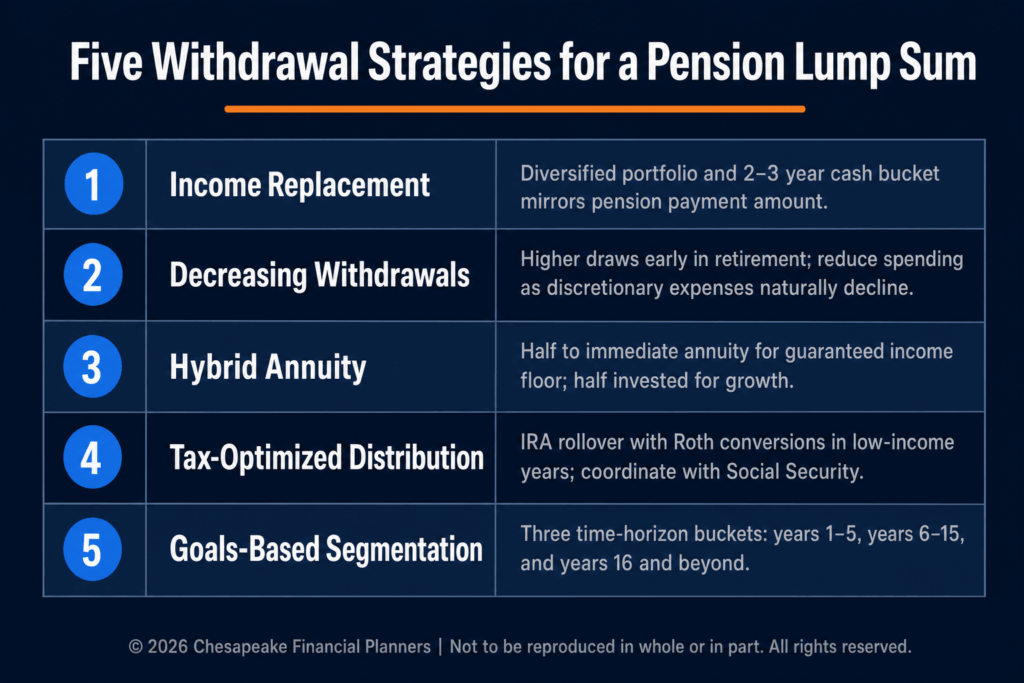
There is no universally correct answer. The right choice depends on your health, other income, tax situation, and how disciplined a spender you are. These five approaches cover the territory, and most strong plans blend two or three.
How does the income replacement approach work?
The income replacement approach invests the lump sum in a diversified portfolio of dividend stocks, bonds, and cash, then structures withdrawals to approximate your old pension payment while protecting principal. Use a bucket setup: keep two to three years of spending in cash and short-term bonds so you're never forced to sell stocks in a downturn. It delivers predictable income with flexibility, but it demands discipline and depends on returns being adequate over your lifetime.
How does the decreasing withdrawal approach work?
This strategy front-loads spending. Most retirees spend more in their active early years and less later, outside of healthcare, so you might draw $60,000 annually for the first decade, $45,000 for the next, then settle around $36,000. You get more money when you're most able to enjoy it, and you ease pressure on the portfolio later. The catch: you have to actually cut back when the plan says to, and rising health costs can eat the savings.
How does the hybrid annuity approach work?
The hybrid approach uses part of the lump sum to buy an immediate annuity, recreating a pension-like income floor, then invests the rest for growth. Take $400,000 of an $800,000 lump sum, buy guaranteed lifetime income to cover essentials, and invest the other $400,000 for flexibility and legacy. You reduce longevity risk while keeping upside. Annuities carry costs and limited flexibility, and a fixed annuity loses ground to inflation unless you pay for an inflation-adjusted version. This floor-and-upside design is what I steer most clients toward, because it removes the fear of running out without locking up every dollar.
How does the tax-optimized distribution approach work?
Roll the lump sum into an IRA, then coordinate withdrawals with Social Security timing, Roth conversions, and other income to manage your tax bracket year by year. In low-income years before Social Security and RMDs begin, take larger IRA distributions and convert to Roth. In high-income years, pull from Roth or taxable accounts instead. Done well, this saves tens of thousands in lifetime taxes. It also requires annual recalibration and usually professional guidance. A direct rollover matters here: under IRS rules, a 20% mandatory withholding applies to eligible distributions paid to you, so a trustee-to-trustee transfer avoids that hit.
How does goals-based segmentation work?
Goals-based segmentation splits the lump sum into pools by time horizon. A common split: $200,000 in conservative bonds and CDs for years one through five, $300,000 in balanced investments for years six through 15, and $300,000 in growth-oriented stocks for year 16 and beyond. Each pool gets a withdrawal approach matched to its horizon, so near-term spending never rides on stock market timing while long-term money stays invested for growth.
How a Planning Framework Ties the Strategies Together
Picking a strategy in isolation is how people end up second-guessing themselves every market dip. At Chesapeake Financial Planners, we run this decision through the R.U.D.D.E.R. Method™, Chesapeake Financial Planners' six-step planning process: Review and Recognize, Uncover and Understand, Design and Develop, Discuss and Decide, Execute and Empower, and Reassess and Refine. For a lump sum, that means starting with your full income picture and longevity expectations before deciding how much to annuitize, how much to invest, and how to sequence withdrawals across account types.
Jeff Judge often reminds clients that the withdrawal strategy and the tax strategy are the same conversation, not two. The order you tap accounts, the year you start Social Security, and whether you convert to Roth in your low-income early-retirement years can swing your lifetime tax bill by more than the difference between any two withdrawal methods above.
If you want to weigh the original decision first, see whether the lump sum even makes sense for you Should I take my pension as a lump sum or monthly payments?. Once you've chosen the lump sum, the What are the tax implications of a lump sum payout? piece walks through the IRA rollover and withholding mechanics in detail. For federal employees, coordinate any pension decision with What is the best strategy for withdrawing from my TSP when I retire?.
Frequently Asked Questions
What is a safe withdrawal rate for a pension lump sum?
A safe withdrawal rate for an invested pension lump sum is roughly 4% per year for a 30-year retirement, according to a 2025 Morningstar analysis. On an $800,000 lump sum, that's about $32,000 annually with reasonable confidence the money lasts. Withdrawing 6% to fully replace a pension check meaningfully raises the risk of depleting the account.
Should I roll my pension lump sum into an IRA?
Rolling a pension lump sum into an IRA through a direct trustee-to-trustee transfer is usually the right move for tax and flexibility reasons. It avoids the 20% mandatory federal withholding the IRS applies when an eligible distribution is paid directly to you, and it opens the door to Roth conversions and coordinated tax planning across your retirement years.
How long will an $800,000 lump sum last in retirement?
An $800,000 lump sum can last 30 years or more at a 4% withdrawal rate of roughly $32,000 a year, adjusted for inflation. At a 6% rate of $48,000 a year, the same portfolio risks depletion within 20 to 25 years, especially if poor market returns hit early in retirement. Your spending rate, not the balance alone, decides longevity.
Can I combine more than one withdrawal strategy?
Yes, and most strong plans do. A common blend uses a hybrid annuity to create a guaranteed income floor for essentials, goals-based segmentation for the invested remainder, and a tax-optimized sequence layered on top. Combining strategies lets you protect against running out of money while still keeping growth potential and tax flexibility across a long retirement.
Does taking the lump sum mean I lose PBGC protection?
Yes, taking the lump sum ends your pension and any PBGC backstop on that benefit. The Pension Benefit Guaranty Corporation insures monthly pension payments up to a maximum of $7,832.51 per month for a single-life annuity at age 65 in 2026, but only while the money stays in the plan. Once you take the cash, longevity and market risk shift entirely to you.
Where to Go From Here
The right pension lump sum withdrawal strategy isn't a single method off a menu; it's a floor of guaranteed income, a disciplined draw rate on the rest, and a tax sequence that fits your specific year-by-year picture. Get those three pieces working together and the decision that felt overwhelming becomes a plan you can actually follow. Ready to put a strategy around your lump sum? Jeff Judge and the Chesapeake team serve families and business owners across Harford County and the Baltimore metro. Schedule a free fit call at chesapeakefp.com.
Disclosures
The information provided is for educational purposes only and should not be construed as investment advice. Investment strategies should be tailored to individual circumstances, risk tolerance, and goals. Past performance doesn't guarantee future results. Consult with qualified financial professionals regarding your specific situation.
Contributions to a traditional IRA may be tax deductible in the contribution year, with current income tax due at withdrawal. Withdrawals prior to age 59 ½ may result in a 10% IRS penalty tax in addition to current income tax.
Advisors associated with Chesapeake Financial Planners may be either (1) LPL Financial Registered Representatives offering securities through LPL Financial, Member FINRA and SIPC, and investment advisor representatives offering investment advice through Great Valley Advisor Group; or (2) solely investment advisor representatives offering investment advice through Great Valley Advisor Group and not affiliated with LPL Financial. Great Valley Advisor Group, and Chesapeake Financial Planners are separate entities from LPL Financial.


