

What Should I Do With a Large Sum of Money I Suddenly Received?
Last reviewed: July 2026
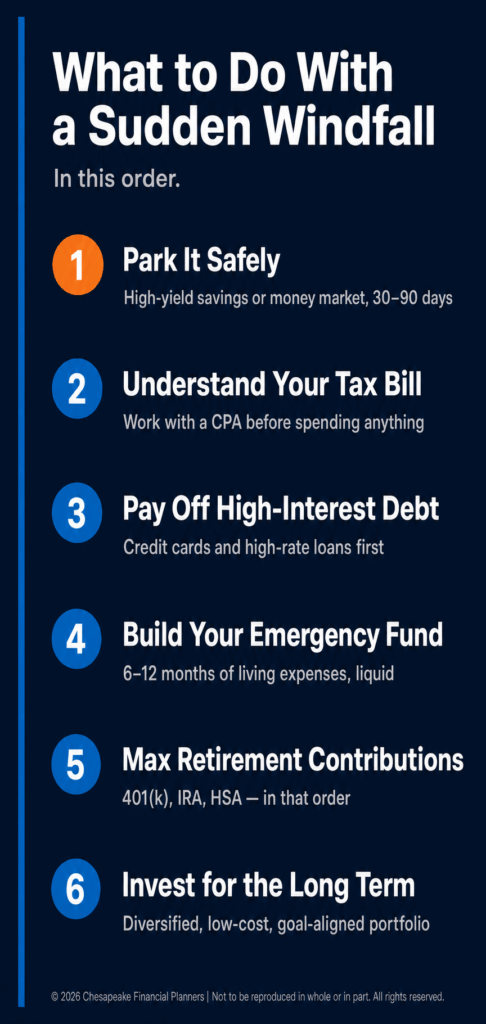
The first thing to do with a sudden windfall is nothing. Park the money in an FDIC-insured account, set aside a portion for taxes if it is taxable, and wait 30 to 90 days before making any major decision. Sudden windfall financial planning works best when the urgency to act is the first thing you resist. The biggest losses come from fast moves made while you are still emotional.
Key Takeaways
- Park your windfall in an FDIC-insured account, which protects up to $250,000 per depositor per bank while you plan.
- Set aside money for taxes immediately if the windfall is taxable, before you spend a dollar of it.
- The 2026 annual gift tax exclusion is $19,000 per recipient, which matters if family starts asking.
- Pay off high-interest debt first; eliminating 18% APR debt beats nearly any investment return.
About the Author: Jeff Judge, CFP®, AEP®, ChFC®, CLU® is Managing Partner of Chesapeake Financial Planners in Forest Hill, Maryland. Jeff has watched more windfalls disappear from impatience than from bad investments. The people who slow down almost always come out ahead. He has been helping families and business owners in Harford County and the Baltimore metro area navigate windfall events and sudden wealth opportunities since earning his CFP® certification in 2013, by using Chesapeake Financial Planners’ signature process, the R.U.D.D.E.R. method™.
Why Should You Wait Before Doing Anything With a Windfall?
You should wait because the period right after receiving a large sum is when your judgment is least reliable. Excitement, guilt, grief, and the urge to fix every problem at once all push you toward decisions you would not make six months later. A sudden windfall financial planning approach starts with a deliberate pause, not a portfolio.
Park the money somewhere safe and liquid. A high-yield savings account or a money market fund keeps it accessible while protecting your principal. FDIC insurance covers up to $250,000 per depositor, per insured bank, per ownership category, so if your sum exceeds that, spread it across more than one institution or use a cash management account that sweeps across banks.
Jeff Judge tells clients that the 30-to-90-day pause is not wasted time. It is the most valuable financial move they will make all year. The money earns interest while you build a plan, and the urge to do something dramatic usually fades on its own.
If the windfall came from a loss, like an inheritance or a life insurance payout, give yourself room to grieve first. Decisions made in acute grief rarely match your long-term interests. And tell as few people as possible. Once word spreads, the requests follow.
How Are Different Types of Windfalls Taxed?
Different windfalls are taxed in very different ways, and knowing which category yours falls into determines how much you actually get to keep. Some arrive tax-free; others can owe a third or more to the IRS. Getting this wrong is how people end up spending money they owed to the government.
Generally not taxable to the recipient: inheritances (though future earnings on inherited assets are taxable), most life insurance death benefits, and gifts. The person giving a gift may have reporting obligations above the 2026 annual exclusion of $19,000 per recipient, but the recipient owes nothing.
Generally taxable: lottery and gambling winnings, the sale of a business or appreciated property (capital gains), vested stock options and RSUs, certain lawsuit settlements depending on what they compensate, and distributions from inherited retirement accounts. According to the IRS, long-term capital gains are taxed at 0%, 15%, or 20% depending on your taxable income, while short-term gains are taxed as ordinary income.
If your windfall is taxable, set the tax money aside the day it arrives. Work with a CPA to calculate exactly what you owe and when. For large amounts, the IRS may require estimated quarterly payments, and underpaying triggers penalties.
Who Should Be on Your Professional Team?
A meaningful windfall calls for three professionals, and the cost of hiring them is almost always a fraction of what they save you. Trying to handle a six- or seven-figure sum alone is where expensive, irreversible mistakes happen.
A fee-only fiduciary financial advisor builds the plan for the whole picture: how much to invest, how much to keep liquid, and how the money fits your long-term goals. A fiduciary is legally required to act in your interest, unlike someone earning commissions on the products they recommend. The CFP Board holds CFP® professionals to a fiduciary standard when providing financial planning advice.
A CPA optimizes your tax strategy and keeps you out of trouble with quarterly estimates and timing. An estate planning attorney becomes necessary when the sum is large enough to affect your estate plan or call for trusts. This is where Chesapeake Financial Planners uses the R.U.D.D.E.R. Method™, our six-step planning process: Review and Recognize, Uncover and Understand, Design and Develop, Discuss and Decide, Execute and Empower, and Reassess and Refine. A windfall touches every one of those steps at once. Jeff Judge notes: "When a windfall is large enough to require an estate planning attorney, that is also the moment your entire financial plan needs to be stress-tested from the beginning, which is exactly what our R.U.D.D.E.R. Method is designed to do."
In Jeff's experience, the clients who assemble a team early treat the windfall like a foundation. The ones who skip it treat it like a checking account. The difference shows up within two years.
For the financial planning side specifically, see our guide on What should you do when you suddenly receive a large sum of money? for a deeper walkthrough.
What Should You Do With the Money First?
After the pause and the tax set-aside, the first productive move is to clear high-interest debt, then build security before you build wealth. The order matters more than the speed.
Pay off high-interest debt first. Eliminating credit card debt at 18% APR delivers a guaranteed return that beats almost any investment. Low-interest debt is a different calculation. A mortgage or student loan at 3% to 4% may be worth keeping if the money invested could reasonably earn more, so model both scenarios with your advisor before paying it down.
Next, resist lifestyle inflation. The new house carries higher taxes, insurance, and maintenance forever; the luxury car loses value the day you drive it off the lot. Before any large purchase, ask yourself one question: would I have bought this if the money had not landed in my lap? Spending some of a windfall on what you value is reasonable, but do it after the priorities, not in the first wave of excitement.
For a settlement or insurance-based windfall specifically, the tax treatment can be unusual, so review our guide on How do I handle a lawsuit settlement or insurance payout I wasn't expecting? before you allocate anything. And if your windfall came from inheriting assets, our piece on What should I do first after inheriting money or property? covers the step-up in basis and account-titling rules that catch people off guard.
Frequently Asked Questions
How long should I wait before investing a sudden windfall?
Wait 30 to 90 days before making any major decision with a sudden windfall. Park the money in an FDIC-insured high-yield savings or money market account during that window. This pause protects you from emotional, impulsive choices and gives you time to assemble a professional team and build a real plan before committing the funds.
Do I have to pay taxes on inherited money?
Inherited money itself is generally not taxable to the recipient at the federal level. However, future earnings on inherited assets are taxable, and distributions from inherited retirement accounts like IRAs are usually taxed as ordinary income. The tax rules vary by asset type, so confirm your specific situation with a CPA before spending or reinvesting any of it.
Is a lawsuit settlement taxable?
Whether a lawsuit settlement is taxable depends on what it compensates. Settlements for physical injury or illness are usually tax-free, while compensation for lost wages, punitive damages, and interest is generally taxable. Because the categories often get blended in a single settlement, have a CPA review the breakdown before you assume any portion is tax-free.
Should I pay off my mortgage with a windfall?
Paying off a low-interest mortgage with a windfall is often not the best financial move, though it can bring emotional peace of mind. If your mortgage rate is 3% to 4%, investing the money may earn more over time. High-interest debt like credit cards at 18% should always be paid off first because the guaranteed savings beat nearly any investment return.
How much money can someone give me tax-free?
For 2026, a person can give you up to $19,000 per year without any gift tax filing requirement, according to the IRS annual gift tax exclusion. Amounts above that require the giver to file a gift tax return, but the recipient still owes no tax. Married couples can combine exclusions to give a single recipient $38,000 per year tax-free.
Why do so many people lose their windfalls?
Most people lose windfalls through impulsive decisions made while emotional, not through bad luck. Excitement, guilt, and pressure from family drive fast spending, lifestyle inflation, and unmanaged tax bills. The fix is structural: pause before acting, set aside taxes immediately, hire a fiduciary team, and clear high-interest debt before any large discretionary purchase.
At Chesapeake Financial Planners, we work through sudden windfall financial planning with clients regularly, from inheritances to business sales to settlements. If you are holding a large sum and weighing your next move, a second opinion costs you nothing. Visit chesapeakefp.com to learn more.
Want to go deeper? Our First 90 Days After a Windfall walks through this step by step.
Disclosures
The information provided is for educational purposes only and should not be construed as investment advice. Investment strategies should be tailored to individual circumstances, risk tolerance, and goals. Past performance doesn't guarantee future results. Consult with qualified financial professionals regarding your specific situation.
Advisors associated with Chesapeake Financial Planners may be either (1) LPL Financial Registered Representatives offering securities through LPL Financial, Member FINRA and SIPC, and investment advisor representatives offering investment advice through Great Valley Advisor Group; or (2) solely investment advisor representatives offering investment advice through Great Valley Advisor Group and not affiliated with LPL Financial. Great Valley Advisor Group, and Chesapeake Financial Planners are separate entities from LPL Financial.


