
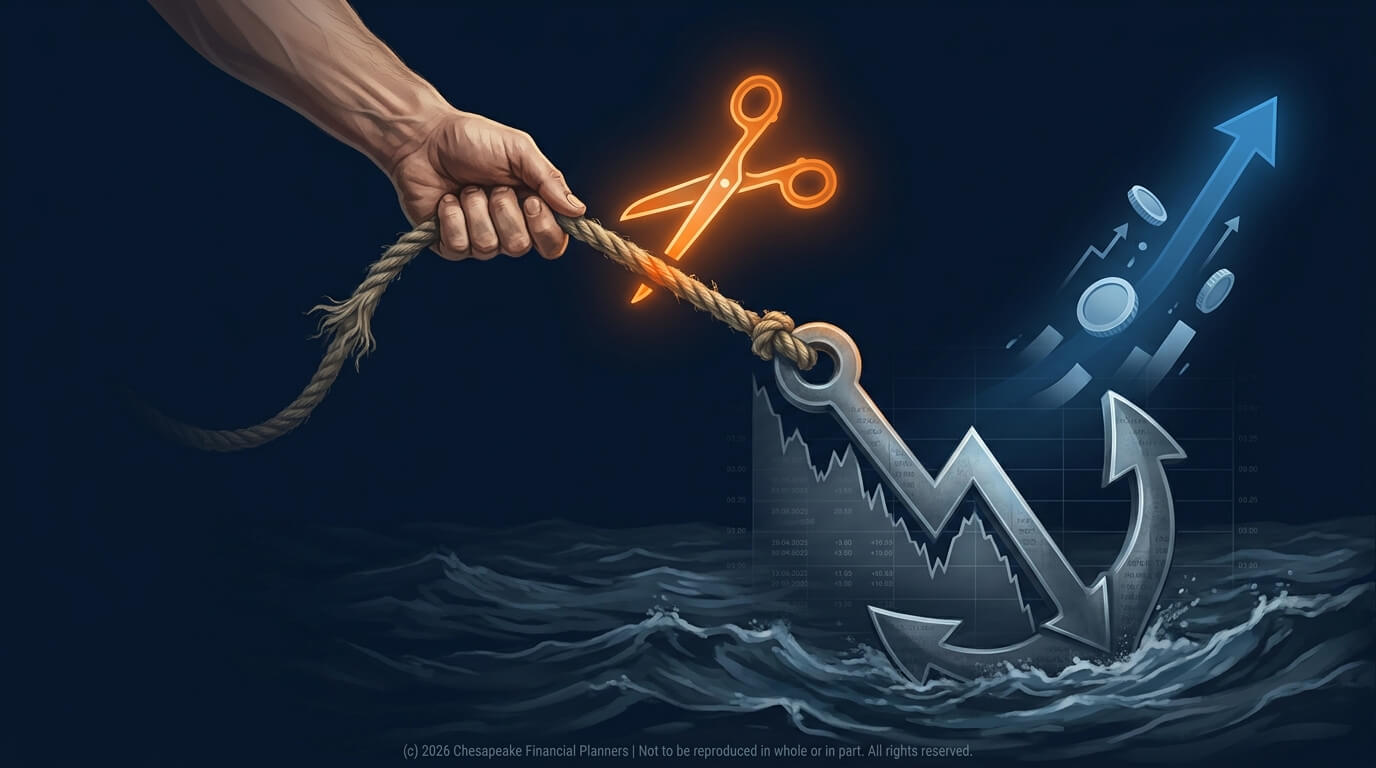
What Is the Sunk Cost Fallacy, and Why Do I Hold Losing Investments?
Last reviewed: July 2026
The sunk cost fallacy is the tendency to keep investing money, time, or effort into something because of what you've already put in, rather than what it's worth going forward. In investing, it shows up when you hold a losing stock because you "can't sell at a loss," even when the smart move is to cut it and redeploy the cash. The money you already lost is gone. It should have zero bearing on what you do next.
Key Takeaways
- The sunk cost fallacy makes you hold losing investments because of money already spent, not future potential.
- Past losses are irrelevant to today's decision; only the forward-looking value of an asset matters.
- Roughly 56% of investors hold losers too long and sell winners too early, per FINRA research on the disposition effect.
- Taxes reward selling losers: the IRS lets you deduct up to $3,000 in net capital losses against ordinary income each year.
About the Author: Jeff Judge, CFP®, AEP®, ChFC®, CLU® is Managing Partner of Chesapeake Financial Planners in Forest Hill, Maryland. He has been helping families and business owners in Harford County and the Baltimore metro area navigate behavioral investing mistakes since earning his CFP® certification in 2013, by using Chesapeake Financial Planners’ signature process, the R.U.D.D.E.R. method™. Jeff has watched clients hang onto a sinking position for years, convinced that selling would "lock in" a loss that was already very much real on paper.
What Is the Sunk Cost Fallacy in Plain English?
The sunk cost fallacy is a decision-making error where past, unrecoverable costs drive present choices. A sunk cost is any money, time, or effort you've already spent and cannot get back no matter what you do next. The fallacy is letting that spent resource trap you into continuing down a path that no longer makes sense.
You see it everywhere. You finish a bad movie because you paid for the ticket. You keep pouring money into a car repair because you've "already put $2,000 into it." In each case, the rational question is simple: knowing what I know right now, would I make this choice fresh today? If the answer is no, the past spending shouldn't change it.
Jeff Judge often frames it this way with clients: "The market doesn't know what you paid. Your stock has no memory of your purchase price." That single idea undoes most sunk cost thinking. The price you paid is your business and the IRS's business. It is not the company's, and it is not the market's.

Why Do I Hold Losing Investments Too Long?
You hold losers too long because selling forces you to admit you were wrong, and the human brain treats a realized loss as more painful than an equal-sized gain feels good. Behavioral economists call this loss aversion, and research has consistently found that losses hurt roughly twice as much as comparable gains feel rewarding. Holding the position lets you avoid that pain by keeping the loss "unrealized" and therefore, in your mind, not yet real. Jeff Judge notes: "The question I ask clients who are holding a beaten-down position is simple: if this money were sitting in your checking account right now, would you go buy that stock at today's price — and if the honest answer is no, that tells you everything."
This pairs with something called the disposition effect: the documented pattern of investors selling winners too quickly and clinging to losers too long. According to FINRA, this is one of the most reliably observed mistakes among individual investors. The math works against you because winners sold early stop compounding while losers held forever keep dragging on the portfolio.
There's also a story you tell yourself. "It'll come back." Sometimes it does. Often it doesn't, and "throwing good money after bad" turns one mistake into a slow bleed. The forward question matters more than the rearview one: if you had today's cash in hand, would you buy this stock at today's price? If not, you're holding it purely to avoid feeling the loss.
How Do I Break Out of Sunk Cost Thinking?
You break out of sunk cost thinking by reframing every holding as a fresh decision and ignoring your purchase price entirely. The cleanest mental trick is the "blank slate" test: pretend you just inherited cash equal to the current value of the position. Would you buy this exact stock today with that money? A "no" is a sell signal that has nothing to do with what you originally paid.
Here is a practical sequence that works:
- Write down your original reason for buying. If that thesis is broken, the reason to hold is gone.
- Run the blank slate test. Would you buy it fresh today at the current price?
- Check the tax angle. A loss isn't all bad news. Selling can generate a deduction.
- Compare the alternative. Could that same money work harder somewhere else right now?
This is where a structured process beats gut instinct. The R.U.D.D.E.R. Method™ is Chesapeake Financial Planners' six-step planning process: Review and Recognize, Uncover and Understand, Design and Develop, Discuss and Decide, Execute and Empower, and Reassess and Refine. The "Reassess and Refine" step exists specifically to catch positions you're holding for emotional reasons rather than financial ones.
How Can I Avoid Making Emotional Investment Decisions?
Does Selling a Loser Have a Tax Upside?
Yes, selling a losing investment can lower your tax bill through a strategy called tax-loss harvesting. When you sell at a loss in a taxable account, you can use that loss to offset capital gains elsewhere in your portfolio. If your losses exceed your gains, the IRS lets you deduct up to $3,000 of net capital loss against your ordinary income each year, and you can carry any excess forward to future years.
That reframes the whole decision. The sunk cost fallacy says "I can't sell, I'll lock in the loss." Tax-loss harvesting says "the loss is already real, so I might as well make it work for me." One mindset traps you. The other turns a mistake into a deduction.
Watch the wash-sale rule, though. The IRS disallows the loss if you buy the same or a substantially identical security within 30 days before or after the sale. There are clean ways around it, like buying a similar but not identical fund, and a planner can help you stay compliant while still capturing the benefit.
How do I diversify a concentrated company stock position without a huge tax bill?
Frequently Asked Questions
What is the sunk cost fallacy in investing?
The sunk cost fallacy in investing is holding a losing position because of the money you've already put in, rather than its future prospects. Investors fall into it when they refuse to sell a declining stock to avoid "locking in" a loss, even though the loss already exists on paper.
Why is it so hard to sell a stock at a loss?
Selling at a loss is hard because of loss aversion, a documented bias where the pain of a loss feels about twice as strong as the pleasure of an equal gain. Selling also forces you to admit the original decision was wrong, which the brain works hard to avoid by keeping the loss unrealized.
How do I know when to sell a losing investment?
Use the blank slate test: ask whether you'd buy this exact investment today at its current price with fresh cash. If the answer is no, your original investment thesis is likely broken, and you're holding the position to avoid emotional pain rather than for any forward-looking financial reason.
Is "throwing good money after bad" the same as the sunk cost fallacy?
Throwing good money after bad is the sunk cost fallacy in action. It describes continuing to invest in a failing position to justify what you've already spent. The smart move is to evaluate each new dollar on its own merits, ignoring the dollars already committed.
Does selling a losing stock save me money on taxes?
Yes, selling a losing stock in a taxable account can generate a capital loss that offsets gains and reduces your tax bill. The IRS allows you to deduct up to $3,000 of net losses against ordinary income each year, with any remainder carried forward to future tax years.
How Can I Avoid Making Emotional Investment Decisions?
The Bottom Line on the Sunk Cost Fallacy
The sunk cost fallacy costs investors real money because it keeps dead weight in a portfolio long after the original reason to own it has disappeared. Your purchase price is history. The only question that matters is whether each holding earns its place going forward.
If you want a simple framework for spotting the emotional traps that quietly drain returns, download our free guide to behavioral investing mistakes at chesapeakefp.com. It walks through the patterns that catch even disciplined investors and how to build a process that keeps them in check.
Want to go deeper? Our R.U.D.D.E.R Audit for DIY Investors walks through this step by step.
Disclosures
The information provided is for educational purposes only and should not be construed as investment advice. Investment strategies should be tailored to individual circumstances, risk tolerance, and goals. Past performance doesn't guarantee future results. Consult with qualified financial professionals regarding your specific situation.
This information is not intended to be a substitute for specific individualized tax, investment or legal advice. We suggest that you discuss your specific situation with a qualified tax, legal or financial advisor.
Advisors associated with Chesapeake Financial Planners may be either (1) LPL Financial Registered Representatives offering securities through LPL Financial, Member FINRA and SIPC, and investment advisor representatives offering investment advice through Great Valley Advisor Group; or (2) solely investment advisor representatives offering investment advice through Great Valley Advisor Group and not affiliated with LPL Financial. Great Valley Advisor Group, and Chesapeake Financial Planners are separate entities from LPL Financial.


