

What Is the Disposition Effect, and Why Do I Sell Winners and Hold Losers?
Last reviewed: July 2026
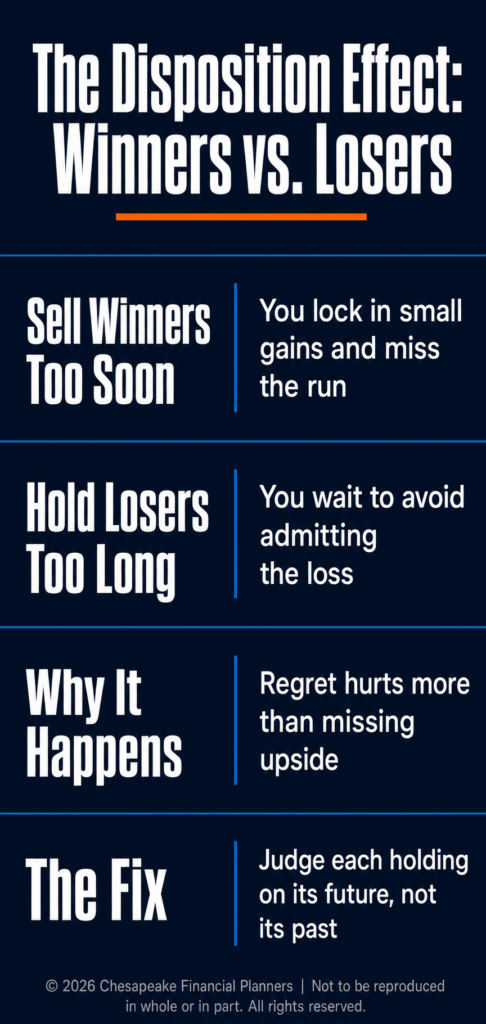
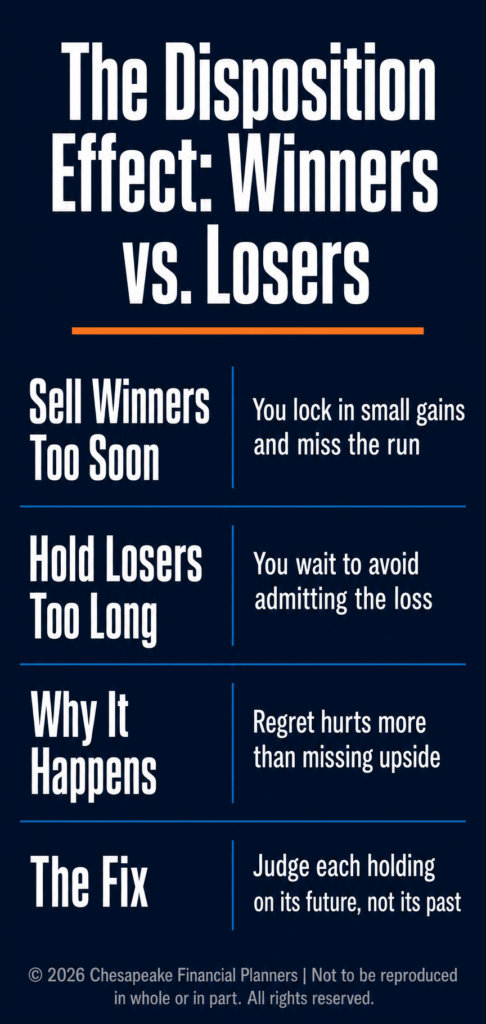
The disposition effect is the tendency to sell investments that have gained value while holding onto investments that have lost value. You do it because selling a winner feels like locking in a victory, and selling a loser forces you to admit a mistake. The pain of that admission is so strong that most people would rather hold a sinking position and hope it recovers than face the loss on paper. It is one of the most documented mistakes in all of behavioral finance, and it quietly drains returns from otherwise smart investors.
Key Takeaways
- The disposition effect is the bias toward selling winning investments too early and holding losing investments too long.
- Research by Terrance Odean found investors sell winners roughly 50% more often than losers.
- Selling winners early often triggers avoidable taxes, while the IRS caps net capital loss deductions at $3,000 per year.
- The fix is a rules-based process that removes the moment-to-moment emotion from sell decisions.
About the Author: Jeff Judge, CFP®, AEP®, ChFC®, CLU® is Managing Partner of Chesapeake Financial Planners in Forest Hill, Maryland. He has been helping families and business owners in Harford County and the Baltimore metro area navigate investment psychology and portfolio decisions since earning his CFP® certification in 2013, by using Chesapeake Financial Planners’ signature process, the R.U.D.D.E.R. method™. Jeff has watched clients hold a single broken stock for years out of pride, and the recovery they kept waiting for almost never came on the timeline they imagined.
What Is the Disposition Effect in Plain Terms?
The disposition effect is a behavioral bias where investors are reluctant to sell assets that have dropped in value and quick to sell assets that have risen. The term was coined in 1985 by economists Hersh Shefrin and Meir Statman, who built on the foundations of prospect theory. The core idea is simple: people feel the sting of a loss far more intensely than the satisfaction of an equivalent gain.
So when a stock is up, selling it produces a clean, comfortable feeling of having "won." When a stock is down, selling crystallizes a loss you have to own. Your brain treats those two acts very differently, even though the math underneath them is identical. A dollar of gain and a dollar of loss should carry equal weight in a rational decision. They never do.
The result is a portfolio that slowly fills up with your worst ideas while your best ideas get sold off early. You end up gardening backwards, pulling the flowers and watering the weeds. That single pattern, repeated over decades, can cost real money.
Why Do I Sell Winners Too Early?
You sell winners early because realizing a gain feels good right now, and waiting feels risky. The behavioral driver is what researchers call risk aversion in the domain of gains. Once you are ahead, your instinct shifts toward protecting the win rather than letting it run.
A well-known study by Terrance Odean, published in the Journal of Finance in 1998, analyzed thousands of individual brokerage accounts and found that investors sold winning stocks roughly 50% more often than losing stocks. The kicker: the winners they sold went on to outperform the losers they kept. They were systematically cutting their best holdings.
There is a tax cost layered on top of the behavioral one. Selling an appreciated position in a taxable account can trigger a capital gains bill you could have deferred for years, possibly forever if the asset were eventually passed to heirs. Jeff Judge often tells clients that the most expensive trades they make are not the bad buys, they are the good sells made one year too soon.
Why Do I Hold Losers Too Long?
You hold losers because selling means accepting that you were wrong, and your mind will do almost anything to avoid that. The technical phrase is loss aversion, and the research consistently shows losses feel roughly twice as painful as equivalent gains feel good.
So instead of cutting a losing position, you anchor to the price you paid and tell yourself it is not a real loss until you sell. You wait for the stock to "come back to even." But the market does not know or care what you paid. The price you bought at has zero bearing on whether the investment is a good idea today. That is the question that matters, and the disposition bias keeps you from asking it.
This shows up most painfully in concentrated positions. An investor who watched a single stock fall 60% will often refuse to sell, convinced that selling now would lock in a permanent loss. In reality, holding a broken position ties up capital that could be working somewhere productive. The recovery you are waiting on has an opportunity cost.

How Much Does the Disposition Effect Actually Cost Investors?
The disposition effect costs investors through worse holdings, higher taxes, and the broader behavior gap that erodes long-term returns. The behavior gap is the difference between what investments return and what investors actually earn after their own timing decisions. According to long-running DALBAR research on investor behavior, the average investor consistently underperforms the funds they own, largely because of poorly timed buys and sells. Jeff Judge notes: "DALBAR's numbers year after year tell the same story: the fund did fine, but the investor who kept second-guessing it earned significantly less, and the disposition effect is one of the quietest reasons why."
Selling winners early in a taxable account also accelerates capital gains. And when you finally do sell a loser, the IRS only lets you deduct up to $3,000 in net capital losses against ordinary income in a given year, with the rest carried forward. That asymmetry, taxed quickly on gains and limited on losses, means the disposition effect tends to work against you on both the behavioral and tax fronts at once.
The frustrating part is that none of this requires a market crash to hurt you. It compounds quietly, one trade at a time, in calm and chaotic markets alike. For more on the related mistakes investors make under stress, see How Can I Avoid Making Emotional Investment Decisions?.

How Do I Stop Selling Winners and Holding Losers?
The most reliable fix for the disposition effect is to replace in-the-moment judgment with a written, rules-based process you set up before emotion takes over. When you decide your sell rules in advance, you are deciding them while calm, not while a position is screaming at you.
At Chesapeake Financial Planners, we use the R.U.D.D.E.R. Method™, which is Chesapeake Financial Planners' six-step planning process: Review and Recognize, Uncover and Understand, Design and Develop, Discuss and Decide, Execute and Empower, and Reassess and Refine. The Reassess and Refine step is where disposition bias gets caught, because rebalancing on a schedule forces you to sell what has grown too large and buy what has lagged, the exact opposite of your instinct.
A few practical guardrails help:
- Rebalance on a calendar, not a feeling. Pick a date or a drift threshold and act on it regardless of how any position feels.
- Judge each holding on its future, not its purchase price. Ask whether you would buy it today at the current price. If the honest answer is no, your cost basis is irrelevant.
- Pair sell discipline with tax-loss harvesting. Realizing a loss on purpose can offset gains elsewhere and reframes the loss as a tool instead of a defeat.
- Use automation where you can. Systematic rebalancing inside a managed portfolio removes the human moment that the bias exploits.
These rules will not make selling a loser feel good. They make it happen anyway, which is the entire point. To understand how a structured rebalancing approach fits a broader plan, see How Can I Avoid Making Emotional Investment Decisions? and How do I diversify a concentrated company stock position without a huge tax bill?.
Frequently Asked Questions
What is the disposition effect in investing?
The disposition effect is the documented tendency to sell investments that have gone up while holding investments that have gone down. It happens because realizing a gain feels rewarding and realizing a loss feels like admitting failure. The bias often leaves investors holding their weakest positions while cutting their strongest ones.
Is the disposition effect the same as loss aversion?
No, but they are closely linked. Loss aversion is the broader principle that losses feel about twice as painful as equivalent gains feel good. The disposition effect is the specific investing behavior that loss aversion produces: holding losers too long to avoid the pain of a realized loss, and selling winners too early to lock in a comfortable gain.
Does the disposition effect hurt long-term returns?
Yes. Research by Terrance Odean found the winning stocks investors sold tended to outperform the losing stocks they kept, meaning the bias systematically trims the best holdings. Combined with accelerated capital gains taxes on early sales, the disposition effect quietly drags on long-term performance for many individual investors.
How does the disposition effect affect my taxes?
Selling winners early in a taxable account can trigger capital gains taxes you might have deferred for years. Meanwhile, the IRS limits the net capital loss you can deduct against ordinary income to $3,000 per year, carrying the rest forward. That asymmetry means the bias often costs you on the tax side as well as the behavioral side.
What is the best way to overcome the disposition effect?
The most effective fix is a written, rules-based selling process decided in advance, before emotion sets in. Scheduled rebalancing, judging each holding on its future rather than its purchase price, and pairing sell discipline with tax-loss harvesting all help. Automating decisions inside a managed portfolio removes the emotional moment the bias depends on.
Why do investors keep holding a stock that keeps falling?
Investors hold falling stocks because selling forces them to accept a loss and admit they were wrong, which loss aversion makes deeply uncomfortable. Many anchor to the price they paid and wait to "get back to even." The market, however, does not care what you paid, so the only question that matters is whether the investment is worth owning today.
Putting a real process around your investments is the single most effective defense against this bias. If you found this helpful, our investor behavior guide covers the most common decision traps and how to build guardrails against them in depth. Download it at chesapeakefp.com.
Disclosures
The information provided is for educational purposes only and should not be construed as investment advice. Investment strategies should be tailored to individual circumstances, risk tolerance, and goals. Past performance doesn't guarantee future results. Consult with qualified financial professionals regarding your specific situation.
Advisors associated with Chesapeake Financial Planners may be either (1) LPL Financial Registered Representatives offering securities through LPL Financial, Member FINRA and SIPC, and investment advisor representatives offering investment advice through Great Valley Advisor Group; or (2) solely investment advisor representatives offering investment advice through Great Valley Advisor Group and not affiliated with LPL Financial. Great Valley Advisor Group, and Chesapeake Financial Planners are separate entities from LPL Financial.


