

How Do I Set Up a 401(k) for Your Small Business?
Last reviewed: July 2026
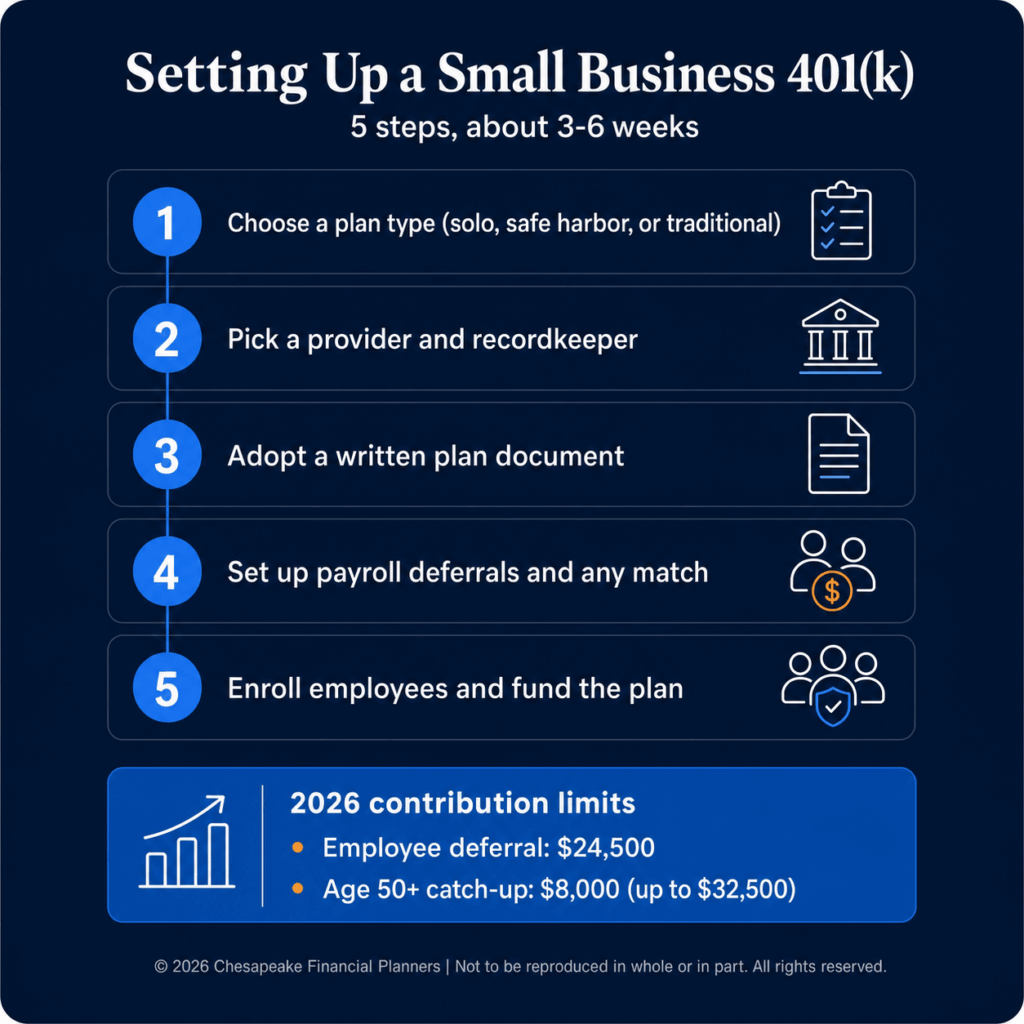
Setting up a small business 401k takes about three to six weeks and follows five steps: choose a plan type, pick a provider, draft a plan document, set up payroll integration, and enroll your employees. You can run a plan with as few as one employee, and the tax deductions on contributions often offset a meaningful chunk of the setup and administration cost. The right structure depends on how many people you employ and how much you want to put away for yourself.
Key Takeaways
- A small business 401k can be set up in three to six weeks once you choose a provider and plan type.
- For 2026, employees can defer up to $24,500 in a 401(k), with higher catch-up limits after age 50.
- Safe harbor plans let business owners skip annual nondiscrimination testing in exchange for a required employer contribution.
- SECURE 2.0 tax credits can cover a large share of startup costs for small employers in the first three years.
About the Author: Jeff Judge, CFP®, AEP®, ChFC®, CLU® is Managing Partner of Chesapeake Financial Planners in Forest Hill, Maryland. He has been helping families and business owners in Harford County and the Baltimore metro area navigate retirement plan decisions since earning his CFP® certification in 2013, by using Chesapeake Financial Planners’ signature process, the R.U.D.D.E.R. method™. Jeff has seen too many owners default to the cheapest provider and discover later that the plan design quietly capped how much they could save for themselves.
A 401(k) is one of the most flexible retirement tools available to a small business owner. It lets you save more than an IRA allows, gives you a tax deduction on contributions, and helps you attract and keep good employees. But the setup process trips people up because the choices you make early on lock in how much you can contribute and how much administrative work you take on. Here is how the pieces fit together.
What Are the Steps to Set Up a Small Business 401k?
Setting up a small business 401k follows a clear sequence. Skip a step and you usually pay for it later in compliance headaches.
- Choose a plan type. Decide between a traditional 401(k), a safe harbor 401(k), or a solo 401(k) if you have no employees other than a spouse. This single choice drives everything that follows.
- Select a provider. This is your recordkeeper and administrator. Options range from low-cost online platforms to full-service firms that bundle investment advice.
- Draft the plan document. This legal document defines eligibility, the contribution formula, vesting, and the matching structure. Your provider usually supplies a template.
- Integrate payroll. Employee deferrals flow from each paycheck into the plan. Modern providers sync directly with payroll software to avoid manual errors.
- Enroll employees. You provide required disclosures, set up the enrollment portal, and educate your team on their options.
According to the Department of Labor, plan sponsors carry fiduciary responsibility, which means you are legally obligated to run the plan in the best interest of participants. Jeff Judge often reminds owners that the fiduciary duty does not disappear just because you hired a provider; you still own the decision to monitor fees and investment options.
Solo 401k vs Small Business 401k: Which One Fits?
The difference between a solo 401k vs small business 401k comes down to one question: do you have employees other than yourself and a spouse? A solo 401(k) covers an owner-only business and skips the compliance testing a regular plan requires. A small business 401(k) covers a team and brings nondiscrimination testing, employer contribution rules, and more administration.
| Feature | Solo 401(k) | Small Business 401(k) |
|---|---|---|
| Who it covers | Owner and spouse only | Owner plus W-2 employees |
| Nondiscrimination testing | Not required | Required (unless safe harbor) |
| Administrative cost | Lower | Higher |
| Form 5500 filing | Only once assets exceed $250,000 | Required annually |
| Employer match | Optional | Often expected or required |
Want to go deeper? Our 10 Signs You're Ready for a Certified Financial Planner walks through this step by step.
If you plan to hire within a year or two, many advisors suggest starting with a structure that scales. Switching plan types later means new documents, new disclosures, and a transition period that can confuse employees. Jeff has watched owners outgrow a solo plan in eighteen months and wish they had built for the team they were about to hire.
Should I Choose a Solo 401(k) or SEP IRA for My Business?
How Much Does a Small Business 401k Cost?
A small business 401k carries three cost layers: setup fees, ongoing administration, and investment expenses. Setup runs from a few hundred dollars on a low-cost online platform to a couple thousand for a full-service firm. Ongoing administration typically falls between $750 and $3,000 per year for a small plan, plus a per-participant charge that often lands between $25 and $100 annually.
Investment expenses are the layer owners overlook. These are the fund-level fees charged inside the plan, expressed as an expense ratio. A plan stuffed with high-cost actively managed funds can quietly drain returns over decades, which is why low-cost index options matter for both you and your team.
Then there is the part that softens the bill. The SECURE 2.0 Act created a startup tax credit that can cover up to 100% of eligible administrative costs for employers with 50 or fewer employees, capped at $5,000 per year for the first three years. There is also an additional credit for employer contributions. For many small employers, these credits turn the first three years into something close to a wash.
When you compare providers, look past the headline setup fee. A platform with a low entry price but a high per-participant charge and an expensive fund menu can cost far more over five years than a slightly pricier provider with cheap index funds. Jeff tells clients to ask every provider for an all-in fee disclosure in writing, then compare the total across a realistic five-year window rather than the first-year sticker.
What Is a Safe Harbor 401k and Should You Use One?
A safe harbor 401k is a plan design that automatically passes the IRS nondiscrimination tests in exchange for a guaranteed employer contribution. Regular 401(k) plans must prove each year that they do not unfairly favor owners and highly compensated employees. When those tests fail, the plan has to refund contributions to the owners, which defeats the purpose for someone trying to max out their own savings.
A safe harbor plan removes that risk. In exchange, you commit to one of two contribution formulas: a nonelective contribution of 3% of pay to every eligible employee, or a matching formula that typically matches the first 4% an employee defers. The IRS outlines the specific safe harbor requirements and notice deadlines.
For an owner who wants to contribute the maximum to their own account, safe harbor is often the cleanest path. The employer contribution becomes a known cost rather than a year-end surprise. The trade-off is that the contribution is mandatory and immediately vested, so you are committing real dollars to your team every year. Whether that math works depends on your payroll size and how much you personally want to save. Jeff Judge notes: "For an owner who wants to max out their own deferrals, the safe harbor contribution is really an insurance premium against getting a refund check in February because the plan failed nondiscrimination testing."
This is one of the steps in Chesapeake Financial Planners' R.U.D.D.E.R. Method™, the firm's six-step planning process: Review and Recognize, Uncover and Understand, Design and Develop, Discuss and Decide, Execute and Empower, and Reassess and Refine. Plan design decisions like safe harbor belong in the Design and Develop step, where the numbers get tested against your actual goals.
How Can Business Owners Use Profit-Sharing Plans for Tax Benefits?

What Mistakes Do Owners Make When Setting Up a 401k?
The most common mistakes come from rushing the plan design to get to a low price. Owners pick the cheapest provider, accept the default plan document, and never revisit the fees. Years later they discover the fund menu is expensive or the contribution formula caps what they can save for themselves.
A second frequent error is missing the required employee notices and deadlines. Safe harbor plans in particular carry strict notice rules, and a missed deadline can blow the safe harbor status for the entire year. A third mistake is treating the plan as set-and-forget. Plan sponsors have an ongoing duty to benchmark fees and review investment options, and skipping that review is both a fiduciary risk and a quiet drag on everyone's returns.
Jeff sees owners get the contribution formula wrong more than any other single thing. They build a generous match they cannot sustain in a slow year, then have to cut it and damage trust with their team. The fix is to model the employer cost against a realistic range of business outcomes before you sign the plan document, not after.
How do business owners plan for retirement differently?
Frequently Asked Questions
How much can a small business owner contribute to a 401(k) in 2026?
A small business owner can contribute as both employee and employer. For 2026, the employee deferral limit is $24,500, and combined employee-plus-employer contributions can reach a total annual limit set by the IRS. Owners age 50 and older add a catch-up contribution on top, which makes a 401(k) far more generous than an IRA for serious savers.
How long does it take to set up a small business 401k?
Setting up a small business 401k usually takes three to six weeks from start to first contribution. The timeline depends on how quickly you select a provider, finalize the plan document, and integrate payroll. Safe harbor plans must be established before a notice deadline, so starting early in the year gives you the most flexibility for the design you want.
Do I have to match employee contributions in a small business 401k?
You are not always required to match in a traditional 401(k), but matching helps with nondiscrimination testing and employee retention. A safe harbor 401k does require a set employer contribution in exchange for skipping the annual testing. Decide your match based on a realistic view of your cash flow, because cutting a match later damages trust with your team.
Can I set up a 401(k) if I have no employees?
Yes. An owner-only business with no employees other than a spouse can use a solo 401(k), which carries lower cost and no nondiscrimination testing. According to the IRS, a solo 401(k) only requires a Form 5500 filing once plan assets exceed $250,000, making it a simple and powerful option for self-employed savers.
Is a small business 401k tax deductible?
Yes. Employer contributions to a small business 401k are generally tax deductible as a business expense, and employee deferrals reduce taxable income for the worker. On top of the deduction, SECURE 2.0 startup tax credits can cover a large share of administrative costs for the first three years, which lowers the real cost of launching a plan for small employers.
If you found this helpful, our business owner retirement planning guide covers plan selection and exit strategy in depth. Download it at chesapeakefp.com.
Disclosures
The information provided is for educational purposes only and should not be construed as investment advice. Investment strategies should be tailored to individual circumstances, risk tolerance, and goals. Past performance doesn't guarantee future results. Consult with qualified financial professionals regarding your specific situation.
This information is not intended to be a substitute for specific individualized tax, investment or legal advice. We suggest that you discuss your specific situation with a qualified tax, legal or financial advisor.
Advisors associated with Chesapeake Financial Planners may be either (1) LPL Financial Registered Representatives offering securities through LPL Financial, Member FINRA and SIPC, and investment advisor representatives offering investment advice through Great Valley Advisor Group; or (2) solely investment advisor representatives offering investment advice through Great Valley Advisor Group and not affiliated with LPL Financial. Great Valley Advisor Group, and Chesapeake Financial Planners are separate entities from LPL Financial.


