

Is It Worth Refinancing Your Mortgage? The Break-Even Math
Last reviewed: July 2026
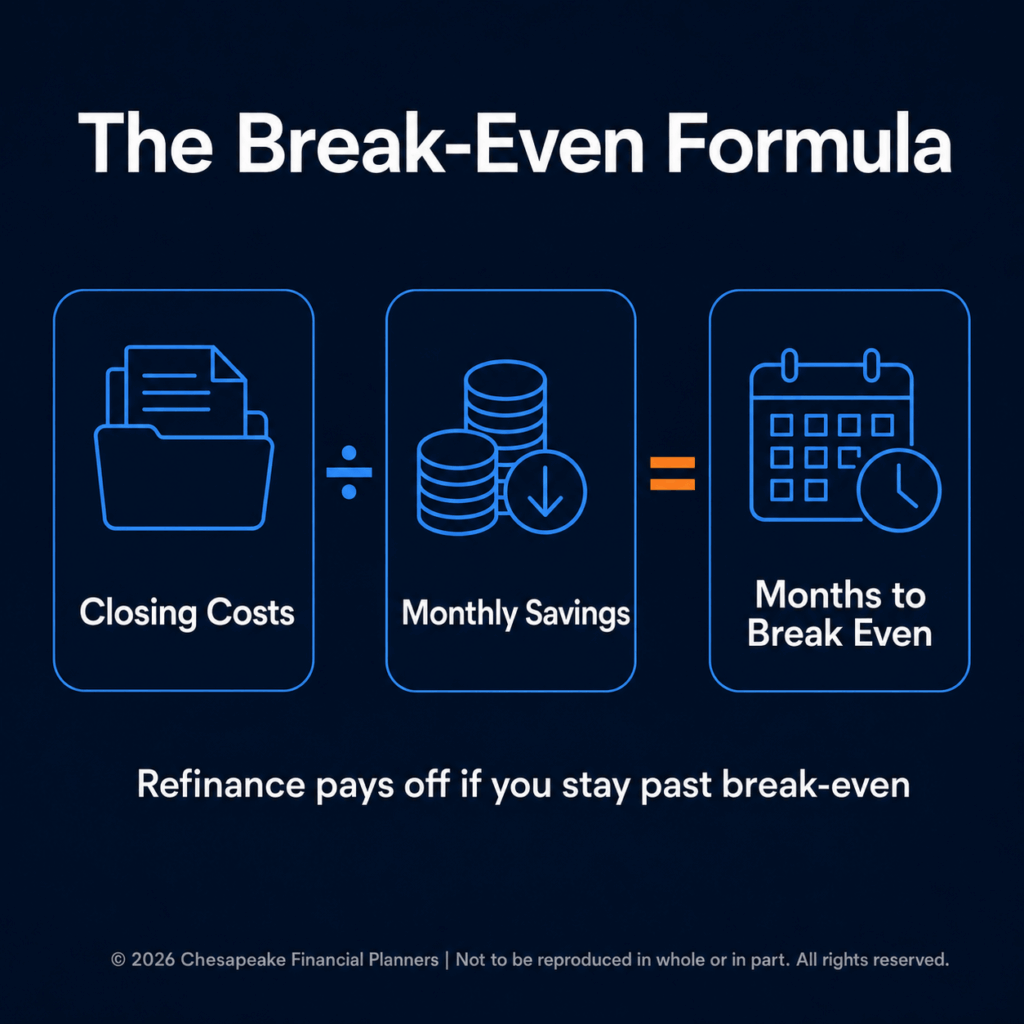
Refinancing your mortgage is worth it when the monthly savings recover your closing costs before you sell or refinance again. The math is simple: divide your total closing costs by your monthly savings, and that number is how many months you need to stay in the home to break even. If you plan to stay past that point, refinancing usually pays off. If you might move sooner, it rarely does.
Key Takeaways
- Divide total closing costs by monthly savings to find your break-even point in months, then compare it to how long you'll stay.
- Refinance closing costs typically run 2% to 6% of the loan amount, according to the CFPB.
- The average 30-year fixed mortgage rate sat near 6.8% in early 2026 (Freddie Mac PMMS via FRED; updated weekly).
- A no-closing-cost refinance trades a lower upfront bill for a higher interest rate, so the savings shrink.
- Resetting a 25-year loan back to 30 years can raise lifetime interest even if your monthly payment drops.
About the Author: Jeff Judge, CFP®, AEP®, ChFC®, CLU® is Managing Partner of Chesapeake Financial Planners in Forest Hill, Maryland. He has been helping families and business owners in Harford County and the Baltimore metro area navigate mortgage and debt decisions since earning his CFP® certification in 2013, by using Chesapeake Financial Planners’ signature process, the R.U.D.D.E.R. method™. Jeff has watched plenty of homeowners chase a lower rate without ever running the break-even number, and that one missed step is what usually turns a "good deal" into a wash.
How Do You Calculate the Refinance Break-Even Point?
The break-even point tells you how long you must keep the new loan before the savings cover what you paid to get it. Take your total closing costs and divide them by your monthly payment savings. The result is the number of months to break even.
Say your refinance costs $6,000 and drops your payment by $200 a month. Divide $6,000 by $200 and you get 30 months. You break even in two and a half years. Stay in the home past that point, and every month after is real savings. Move before it, and you lost money on the deal.
This is the single number that decides whether a refinance is worth it. According to the Consumer Financial Protection Bureau, closing costs commonly run 2% to 6% of the loan balance, so on a $300,000 mortgage you could be looking at $6,000 to $18,000 in upfront cost. That range alone explains why two homeowners with the same rate drop can reach very different conclusions.
What is the best way to pay off debt quickly?
When Does Refinancing a Mortgage Actually Make Sense?
Refinancing makes sense when you'll stay in the home well past the break-even point, the rate drop is meaningful, and your financial picture isn't about to change. Those three conditions matter more than any single rate threshold you've seen quoted online.
The old "refinance when rates drop 1%" rule is a shortcut, not a law. A half-point drop on a $500,000 loan saves more in dollars than a full point on a $150,000 loan. What matters is the dollar savings against the dollar cost, not the percentage by itself. Run the break-even math instead of trusting a rule of thumb.
Timing also depends on your plans. If you expect to move within three years, sell, or pay the loan off early, a refinance with a 30-month break-even barely earns its keep. Jeff often tells clients that the mortgage decision can't be made in isolation; it sits inside the rest of the plan, alongside your savings rate, your job stability, and how long you actually intend to keep the house.
What are the fundamentals of personal financial planning?
What Are the Real Costs of Refinancing?
The real cost of refinancing is the full stack of closing costs, not just the new rate. These include the loan origination fee, appraisal, title insurance, recording fees, and sometimes discount points. The Federal Reserve notes that these costs are what make the break-even calculation necessary in the first place.
Here is a comparison of two common ways to structure a refinance.
| Feature | Standard Refinance | No-Closing-Cost Refinance |
|---|---|---|
| Upfront cost | 2% to 6% of loan amount | $0 to minimal |
| Interest rate | Lower | Higher than standard |
| Monthly savings | Larger | Smaller |
| Break-even point | Slower at first, then full savings | No upfront cost to recover |
| Best for | Staying in the home long term | Uncertain timeline or short stay |
A no-closing-cost refinance doesn't make the costs disappear. The lender folds them into a higher rate or rolls them into the loan balance. You pay either way. For a homeowner who isn't sure how long they'll stay, the no-cost route can still be the smarter call because there's nothing to break even on.
Watch the loan term too. Refinancing a mortgage you've paid on for five years back into a fresh 30-year loan lowers your monthly payment but stretches your repayment by five extra years. According to Freddie Mac, with rates near 6.8% in early 2026, that extra interest adds up fast. You can ask for a shorter term to avoid resetting the clock.
How Much Should I Have in My Emergency Fund?
How Does Refinancing Fit Into Your Larger Financial Plan?
A refinance is one move inside a larger plan, and it should support your other goals rather than crowd them out. Lowering a payment is only useful if you do something productive with the freed-up cash. Otherwise you've taken on new closing costs for the privilege of spending a little more each month.
The smart play is to redirect the monthly savings on purpose. Send it to a high-interest debt, an emergency fund, or a retirement account. At Chesapeake Financial Planners, this is where our planning process earns its keep. The R.U.D.D.E.R. Method™ is Chesapeake Financial Planners' six-step planning process: Review and Recognize, Uncover and Understand, Design and Develop, Discuss and Decide, Execute and Empower, and Reassess and Refine. A refinance decision runs through the same framework as any other money choice, which keeps it tied to the bigger picture. Jeff Judge notes: "Refinancing without a plan for the monthly savings is like cutting your grocery bill and spending the difference on lottery tickets — the math worked, but the outcome didn't."
Your credit score and home equity drive the rate you'll be offered. The Federal Housing Finance Agency tracks how equity positions shift with home prices, and more equity generally means better terms. If your score has improved or your home value has climbed since you bought, you may qualify for a rate you couldn't get before.
Why Do Your Money Values Matter More Than Your Investment Choices?

Frequently Asked Questions
Should I refinance my mortgage if rates drop only half a percent?
Maybe, depending on your loan size and how long you'll stay. A half-point drop on a large balance can save real money, while the same drop on a small loan may not cover closing costs. Run the break-even math: divide total costs by monthly savings, then compare that to your timeline before deciding.
How long does it take to break even on a mortgage refinance?
Most refinances break even somewhere between two and four years, but the exact number depends entirely on your costs and savings. Divide your total closing costs by your monthly payment reduction. If closing costs are $6,000 and you save $200 monthly, you break even in 30 months. Past that point, the savings are yours to keep.
Does refinancing hurt my credit score?
Refinancing causes a small, temporary dip in your credit score from the hard inquiry and the new account, usually a few points that recover within several months. The bigger risk is rate-shopping spread across many weeks. Cluster your applications within a short window so credit bureaus treat them as a single inquiry rather than several.
Is a no-closing-cost refinance actually free?
No, a no-closing-cost refinance is not free; the lender simply moves the costs elsewhere. They typically charge a higher interest rate or roll the fees into your loan balance. You pay either way. The structure can still be worthwhile if you're unsure how long you'll stay, since there's no upfront cost to recover.
What credit score do I need to refinance my mortgage?
Most conventional refinances require a minimum credit score around 620, though the best rates usually go to borrowers above 740. A higher score means a lower rate, which directly improves your break-even math. If your score has climbed since you bought the home, you may now qualify for terms that make refinancing worth a fresh look.
Should I refinance to a shorter loan term?
Refinancing into a shorter term, like moving from 30 years to 15, raises your monthly payment but slashes total interest paid over the life of the loan. It makes sense if you can comfortably handle the higher payment and want to be mortgage-free sooner. Run the numbers against your other goals, including retirement savings, before committing.
If you've run the break-even math and you're still not sure whether a refinance fits the rest of your plan, that's exactly the kind of question worth a second set of eyes. At Chesapeake Financial Planners, we work through mortgage and debt decisions with clients every week, always in the context of their full financial picture. A second opinion costs you nothing. Visit chesapeakefp.com to learn more about whether you should refinance your mortgage now or wait.
Disclosures
The information provided is for educational purposes only and should not be construed as investment advice. Investment strategies should be tailored to individual circumstances, risk tolerance, and goals. Past performance doesn't guarantee future results. Consult with qualified financial professionals regarding your specific situation.
Advisors associated with Chesapeake Financial Planners may be either (1) LPL Financial Registered Representatives offering securities through LPL Financial, Member FINRA and SIPC, and investment advisor representatives offering investment advice through Great Valley Advisor Group; or (2) solely investment advisor representatives offering investment advice through Great Valley Advisor Group and not affiliated with LPL Financial. Great Valley Advisor Group, and Chesapeake Financial Planners are separate entities from LPL Financial.


