
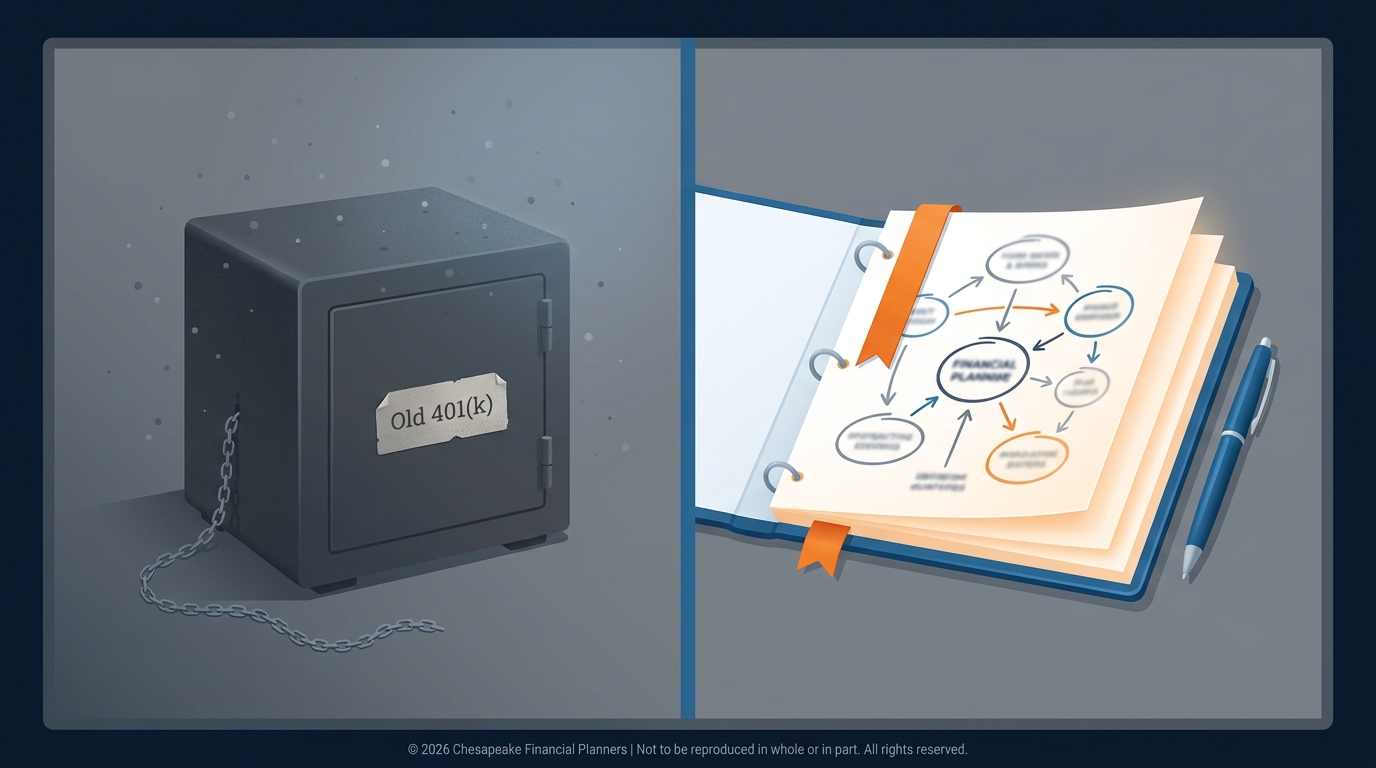
Should I Move My 401(k) to an Independent Financial Advisor?
Last reviewed: July 2026
Moving your 401(k) to an independent financial advisor makes sense when you want ongoing professional management, broader investment options, and financial planning that goes beyond a single account. You roll the old 401(k) into an IRA the advisor manages for you. But it is not always the right move. If you left your job at 55 or later, work in a high-liability profession, or have access to ultra-low-cost institutional funds, leaving the money where it is can win. The decision to move 401k to advisor comes down to fees, flexibility, creditor protection, and whether you actually want hands-on guidance.
Key Takeaways
- Rolling a 401(k) to an advisor-managed IRA gives you broader investment choices and coordinated planning beyond the account itself.
- Independent advisors typically charge 0.59% on the first $1 million, so weigh the fee against the value delivered.
- The Rule of 55 lets you tap a 401(k) penalty-free if you leave work at 55+; rolling to an IRA forfeits that.
- 401(k)s carry unlimited federal creditor protection under ERISA; IRA protection varies by state.
About the Author: Jeff Judge, CFP®, AEP®, ChFC®, CLU® is Managing Partner of Chesapeake Financial Planners in Forest Hill, Maryland. He has been helping families and business owners in Harford County and the Baltimore metro area navigate retirement rollover decisions since earning his CFP® certification in 2013, by using Chesapeake Financial Planners’ signature process, the R.U.D.D.E.R. method™. Jeff has watched people leave six figures sitting in an old 401(k) they forgot the password to. The account doesn't manage itself, and inertia has a real cost.
What Are Your 401(k) Rollover Options When You Leave a Job?
When you leave an employer, you have four 401k rollover options. Each one has tradeoffs, and the best 401k rollover decision depends on your balance, your age, and how much help you want.
- Leave it in your old employer's plan. If your balance is over $7,000, most plans let you stay. You keep the plan's funds and protections but gain no new flexibility.
- Roll it into your new employer's 401(k). Consolidates accounts and keeps ERISA protection, but you're still limited to a curated fund menu.
- Roll it into an IRA managed by an independent advisor. A financial planner manages the money inside an IRA, coordinating it with the rest of your plan.
- Roll it into a self-directed IRA you manage yourself. Maximum flexibility, zero advisory fees, and full responsibility on you.
Jeff often tells clients the worst choice is the one nobody makes on purpose: forgetting the account entirely. According to the Bureau of Labor Statistics, the median worker stays at a job just over four years, which means most people accumulate several old plans over a career. Each one is a login, a statement, and an investment mix nobody is watching.
What should I do with my 401(k) when I change jobs?
Why Move Your 401(k) to an Independent Financial Advisor?
Rolling your 401(k) to an advisor-managed IRA buys you three things a 401(k) cannot: active oversight, a wider investment universe, and planning that connects the account to your whole financial life. Here is what that looks like in practice.
A good advisor monitors and rebalances your portfolio instead of letting it drift. Most 401(k) participants pick funds once and never revisit them. The Investment Company Institute reports that 401(k) plans hold trillions in assets, much of it in default target-date funds that were never matched to the individual's full picture.
The IRA vs 401k difference on investment access is real. A 401(k) typically offers 10 to 30 funds. An IRA opens the door to individual stocks, bonds, ETFs, REITs, and thousands of mutual funds. That flexibility matters more as your balance grows and your needs get specific.

Comprehensive planning is where an independent financial planner earns the relationship. A 401(k) is just an account. An advisor coordinates retirement income, tax strategy, Social Security timing, and estate decisions together. This is the core of the R.U.D.D.E.R. Method™, Chesapeake Financial Planners' six-step planning process: Review and Recognize, Uncover and Understand, Design and Develop, Discuss and Decide, Execute and Empower, and Reassess and Refine. A rollover is a single decision; a plan is the framework around it.
Consolidation is the quiet win. If you have three old 401(k)s scattered across former employers, a rollover to financial advisor management folds them into one IRA with one strategy. Fewer logins, one statement, one coordinated allocation.
Why Does a Financial Planning Process Matter More Than Investment Selection?
When Should You Keep Your 401(k) Instead of Rolling It?
Keep your 401(k) when its specific protections or features outweigh the benefits of moving. Three situations make staying put the smarter call.
First, the Rule of 55. If you leave your job in the year you turn 55 or later, the IRS lets you take penalty-free withdrawals from that employer's 401(k). Roll it to an IRA and that door closes until age 59½. For anyone eyeing early retirement, this is often the deciding factor.
Second, creditor protection. A 401(k) carries unlimited federal protection under ERISA. The Department of Labor administers those protections, and they hold regardless of where you live. IRA protection comes from federal bankruptcy law and state statutes, and it varies. If you're a physician, a business owner, or anyone in a high-liability field, that difference is worth real money.
Third, institutional pricing. Large 401(k) plans sometimes offer index funds with expense ratios near 0.03%, pricing most individuals can't access elsewhere. If your plan is genuinely cheap and well-built, that's a strong reason to stay.
Jeff has seen people roll a 401(k) the year they turned 56, lose the Rule of 55, and then need cash at 57. That mistake cost one client a 10% penalty on a withdrawal that would have been free six months earlier. The numbers matter, but so does the timing.
Can I roll my old 401(k) into an IRA instead?
What Does It Cost to Move Your 401(k) to an Advisor?
Independent advisors who charge on assets under management typically run around 0.59% on the first $1 million, with the rate stepping down on larger balances. On a $500,000 account, that's roughly $2,950 a year. Compare that to a 401(k) index fund at 0.03%, which on the same balance runs $150 a year.
| Factor | Advisor-Managed IRA | Stay in 401(k) |
|---|---|---|
| Typical annual cost | ~0.59% AUM (plus fund costs) | Often under 0.10% |
| Investment options | Thousands | 10-30 funds |
| Comprehensive planning | Yes | No |
| Rule of 55 access | Lost | Kept (if you qualify) |
| Creditor protection | State-dependent | Unlimited (ERISA) |
| Consolidation | Easy | Limited |
The fee is not the question. The value-per-dollar is. A good advisor delivers tax-aware withdrawal sequencing, rebalancing, behavioral coaching that keeps you invested through downturns, and coordination across your whole plan. Vanguard research on advised investor outcomes has long quantified the gap between guided and unguided behavior. The fee justifies itself when the planning is real. It doesn't when the advisor just buys you a target-date fund and sends a quarterly statement.
Is financial planning worth it if I already have investments?
Frequently Asked Questions
Should I move my 401(k) to an independent financial advisor or leave it?
Move it if you want active management, broader investments, and coordinated planning across your finances. Leave it if you qualify for the Rule of 55, work in a high-liability profession needing ERISA creditor protection, or have access to ultra-low-cost institutional funds inside the plan. The right answer depends on your age and goals.
How much does an independent financial advisor charge to manage my 401(k) rollover?
Independent advisors typically charge around 0.59% of assets under management annually on the first million, stepping down on larger balances. On a $500,000 IRA, that's roughly $2,950 per year, plus the underlying fund expenses. The fee is worth it when the advisor delivers tax planning, rebalancing, and coordinated advice beyond the account.
Will I pay taxes if I roll my 401(k) into an IRA?
No, a direct rollover from a 401(k) into a traditional IRA is not a taxable event when the money moves trustee-to-trustee. You only trigger taxes if you convert pre-tax funds to a Roth or take an indirect rollover and fail to redeposit within 60 days. Always request a direct transfer to avoid mandatory withholding.
What is the Rule of 55 and how does a rollover affect it?
The Rule of 55 lets you take penalty-free withdrawals from your current employer's 401(k) if you leave your job in the year you turn 55 or later. Rolling that 401(k) into an IRA forfeits this benefit, forcing you to wait until age 59½ for penalty-free access. Early retirees should weigh this carefully.
Is my money safer in a 401(k) or an IRA?
A 401(k) generally offers stronger creditor protection because ERISA provides unlimited federal protection regardless of your state. IRAs are protected under federal bankruptcy law and state statutes, which vary in strength and coverage. For high-liability professionals like physicians and business owners, the 401(k) often provides better asset protection against lawsuits.
Can I roll multiple old 401(k)s into one IRA?
Yes, you can consolidate several old 401(k) accounts into a single IRA managed by one advisor. This simplifies tracking, reduces the number of logins and statements, and lets a planner coordinate one unified investment strategy. Consolidation is one of the most common and practical reasons people choose a rollover to financial advisor management.
Choosing whether to move 401k to advisor is rarely a pure math problem. It's about whether ongoing guidance fits where you are right now. If you're weighing this decision and want a clear read on your specific numbers, Jeff Judge and the Chesapeake team serve families and business owners across Harford County and the Baltimore metro. Schedule a free fit call at chesapeakefp.com.
Want to go deeper? Our 401(k) vs. IRA Rollover Guide walks through this step by step.
Disclosures
The information provided is for educational purposes only and should not be construed as investment advice. Investment strategies should be tailored to individual circumstances, risk tolerance, and goals. Past performance doesn't guarantee future results. Consult with qualified financial professionals regarding your specific situation.
Advisors associated with Chesapeake Financial Planners may be either (1) LPL Financial Registered Representatives offering securities through LPL Financial, Member FINRA and SIPC, and investment advisor representatives offering investment advice through Great Valley Advisor Group; or (2) solely investment advisor representatives offering investment advice through Great Valley Advisor Group and not affiliated with LPL Financial. Great Valley Advisor Group, and Chesapeake Financial Planners are separate entities from LPL Financial.


