

What Is a QLAC and Should You Use One?
Last reviewed: July 2026
A QLAC, or qualified longevity annuity contract, is a deferred income annuity you buy with money from a traditional IRA or 401(k) so that income payments begin later in life, as late as age 85. In plain terms, a QLAC is longevity insurance: you hand an insurer a lump sum now in exchange for income payments down the road, protecting you against the risk of outliving your savings. Because the money sits inside the contract, it is also left out of your required minimum distributions until those payments start.
Key Takeaways
- A QLAC is a deferred income annuity bought with retirement account money that delays income until later in life.
- In 2026, you can move up to $210,000 of IRA or 401(k) money into a QLAC.
- Money inside a QLAC is left out of required minimum distribution math, lowering your RMDs until payments begin.
- A QLAC is longevity insurance, best suited to people worried about outliving savings rather than chasing growth.
About the Author: Jeff Judge, CFP®, AEP®, ChFC®, CLU® is Managing Partner of Chesapeake Financial Planners in Forest Hill, Maryland. He has been helping families in Harford County and the Baltimore metro area plan retirement income since earning his CFP® certification in 2013, by using Chesapeake Financial Planners’ signature process, the R.U.D.D.E.R. method™. Jeff sees a QLAC less as an investment and more as insurance against a long life, and he reminds clients that the decision usually hinges on health, family history, and how much lifetime income they already expect from Social Security and a pension.
What Is a QLAC?
A QLAC is a qualified longevity annuity contract, a type of deferred income annuity that meets specific IRS rules so it can be held inside a traditional IRA or workplace retirement plan. You buy it with a portion of your retirement savings, choose a future date when income will switch on, and the insurer commits to paying you a set amount for life once that date arrives. The "qualified" part simply means the IRS has blessed it for use with pre-tax retirement dollars.
What makes a QLAC different from a regular annuity is the deferral. You are not buying income that starts now; you are buying income that starts years later, which is why a smaller premium can buy a larger future paycheck. That structure makes a QLAC a tool for one specific worry: living long enough that your other savings run thin. The income payments are backed by the claims-paying ability of the issuing insurer, so the strength of the company behind the contract matters.
How Does a QLAC Work?
A QLAC works in three simple stages, and the IRS sets the boundaries for each one. First, you fund it with retirement account dollars. In 2026, you can put up to $210,000 from your traditional IRAs and 401(k)-type plans into QLACs, a lifetime cap that applies across all your accounts combined, not per account. Second, the payments are deferred while the contract sits and the future benefit grows. Third, income begins on the start date you chose, which can be pushed as late as age 85.
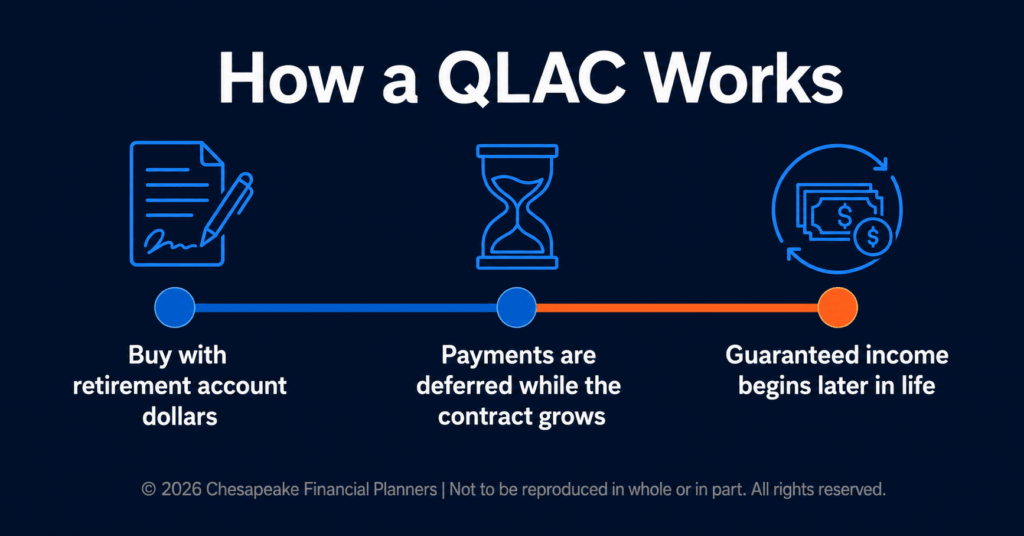
The deferral creates a valuable side effect. Normally you must begin required minimum distributions from retirement accounts at age 73, and those withdrawals are taxable whether you need the money or not. Money parked in a QLAC is excluded from the balance used to calculate RMDs, so it quietly shrinks your required withdrawals and the tax bill that comes with them until the annuity starts paying. At that point, the income is taxed as ordinary income, the same as any other traditional retirement withdrawal. In effect, a longevity annuity lets you trade a slice of today's required distributions for a larger, later stream of income.
What Are the Benefits and Drawbacks of a QLAC?
The appeal of a QLAC comes down to three things. It provides income you cannot outlive, which is real protection if longevity runs in your family. It lowers your required minimum distributions, deferring tax on the dollars inside the contract. And it gives you a predictable future paycheck backed by the insurer's claims-paying ability, which can make the rest of your portfolio easier to invest because you know a baseline of income is coming.
The drawbacks are just as real and deserve equal weight. The money is illiquid once committed, so you generally cannot tap it if an emergency hits before payments begin. A basic QLAC pays nothing to your heirs if you die early, though a return-of-premium rider can address that for an added cost that lowers your income. Fixed payments also lose purchasing power to inflation over time unless you pay extra for a cost-of-living adjustment. And you give up the growth that money might have earned if it had stayed invested. A QLAC is a hedge against a long life, not a way to grow wealth, and that trade-off is the whole point.
Should You Use a QLAC?
A QLAC tends to fit a fairly specific profile. It makes the most sense if you are in good health, have a family history of longevity, and worry about running out of money in your late eighties or nineties. It also helps if you have other liquid savings to cover near-term needs and emergencies, and if trimming your required minimum distributions and the related taxes is appealing. For someone with those traits, converting a slice of retirement savings into income that arrives deep into retirement can take a real worry off the table.
It is a poor fit in the opposite situations. If you need access to the money, want to leave a large inheritance, are in poor health, or have limited savings to begin with, a QLAC usually does not earn its place. Jeff Judge often tells clients that a QLAC answers a single question well, "what if I live a very long time," and that you should only buy one after your Social Security claiming strategy and emergency cash are already settled. In his experience, the people who regret an annuity are usually the ones who bought too much of it or bought it before the rest of their plan was in place. Because the tax and estate angles are specific to your situation, it is worth comparing how a QLAC interacts with your What Is the Difference Between Marginal and Effective Tax Rate? and with whether your Is Social Security Taxable? 2026 Tax Rules Explained before committing.
Frequently Asked Questions
What is a QLAC in simple terms?
A QLAC is a deferred income annuity you buy with traditional IRA or 401(k) money that pays you income for life starting at a future date you choose, up to age 85. It works like longevity insurance, protecting you against outliving your savings, and the dollars inside it are excluded from required minimum distributions until payments begin.
How much can you put into a QLAC in 2026?
In 2026 you can contribute up to $210,000 of pre-tax retirement money to QLACs. This is a lifetime limit that applies across all your traditional IRAs and eligible employer plans combined, not a separate cap for each account. The IRS adjusts the dollar limit for inflation periodically, so the figure can rise in future years.
Does a QLAC reduce required minimum distributions?
Yes. Money held in a QLAC is removed from the account balance used to calculate your required minimum distributions, which begin at age 73. That lowers the amount you are forced to withdraw, and the tax on it, until the annuity starts paying. Once income begins, those payments are taxed as ordinary income.
When does a QLAC start paying income?
You choose the start date when you buy the contract, and it can be set for any point up to age 85. The longer you defer, the larger the eventual payments, because the insurer expects to pay for fewer years. Most buyers pick a start date in their late seventies or early eighties to get the most longevity protection from the premium.
What happens to a QLAC when you die?
It depends on the options you select. A basic QLAC stops paying at your death and leaves nothing to heirs, which is part of why it costs less. If you add a return-of-premium or cash-refund feature, your beneficiaries can receive any premium not yet paid out as income, but that rider reduces your monthly payments in exchange for the death benefit.
So, should you use a QLAC? The honest answer is that it depends on your health, your other income, and how much you fear outliving your money. A QLAC is a focused tool for longevity protection and RMD relief, not a one-size-fits-all solution, so it belongs in a plan only after the basics are covered. If you want a simple framework for organizing retirement income decisions like this one, our What are the fundamentals of personal financial planning? walks through it step by step. Download it at chesapeakefp.com. Jeff Judge notes: "A QLAC works best for clients who have solid income already covered and are specifically trying to insure against the tail risk of living into their late eighties or nineties, but it is not a starting point, it is a finishing touch on a retirement income plan."
Want to go deeper? Our Retirement Income Blueprint Workbook walks through this step by step.
This material is for educational purposes only and should not be considered tax or legal advice. Please consult with your tax advisor or attorney regarding your specific situation.
The opinions voiced in this material are for general information only and are not intended to provide specific advice or recommendations for any individual.
All investing involves risk including loss of principal. No strategy assures success or protects against loss.
There is no guarantee that a diversified portfolio will enhance overall returns or outperform a non-diversified portfolio. Diversification does not protect against market risk.
Fixed annuities are long-term investment vehicles designed for retirement purposes. Gains from tax-deferred investments are taxable as ordinary income upon withdrawal. Guarantees are based on the claims paying ability of the issuing company. Withdrawals made prior to age 59 ½ are subject to a 10% IRS penalty tax and surrender charges may apply.
Disclosures
The information provided is for educational purposes only and should not be construed as investment advice. Investment strategies should be tailored to individual circumstances, risk tolerance, and goals. Past performance doesn't guarantee future results. Consult with qualified financial professionals regarding your specific situation.
Contributions to a traditional IRA may be tax deductible in the contribution year, with current income tax due at withdrawal. Withdrawals prior to age 59 ½ may result in a 10% IRS penalty tax in addition to current income tax.
Advisors associated with Chesapeake Financial Planners may be either (1) LPL Financial Registered Representatives offering securities through LPL Financial, Member FINRA and SIPC, and investment advisor representatives offering investment advice through Great Valley Advisor Group; or (2) solely investment advisor representatives offering investment advice through Great Valley Advisor Group and not affiliated with LPL Financial. Great Valley Advisor Group, and Chesapeake Financial Planners are separate entities from LPL Financial.


