

Is Social Security Taxable? 2026 Tax Rules Explained
Last reviewed: July 2026
Yes, your Social Security benefit can be taxable, but whether it is depends entirely on your total income. Up to 85% of your benefit can be subject to federal income tax once your other income crosses certain thresholds. The question of whether Social Security is taxable comes down to a figure called provisional income: below the first threshold, none of your benefit is taxed, and above the second, up to 85% is.
Key Takeaways
- Up to 85% of Social Security benefits can be federally taxable, depending on your total income.
- Taxation is based on provisional income: your AGI plus tax-exempt interest plus half of your benefits.
- For single filers, taxation starts at $25,000 of provisional income; for joint filers, it starts at $32,000.
- Those thresholds have not been adjusted for inflation since the 1980s, so more retirees owe this tax each year.
About the Author: Jeff Judge, CFP®, AEP®, ChFC®, CLU® is Managing Partner of Chesapeake Financial Planners in Forest Hill, Maryland. He has been helping retirees in Harford County and the Baltimore metro area plan around Social Security taxation since earning his CFP® certification in 2013, by using Chesapeake Financial Planners’ signature process, the R.U.D.D.E.R. method™. Jeff has watched clients accidentally trigger this tax with a single large IRA withdrawal, which is why he plans the income, not just the benefit.
What Counts as Income for Social Security Taxes?
The IRS does not look at your benefit in isolation. It looks at a measure called provisional income, sometimes called combined income, which decides how much of your benefit is taxed. The formula is straightforward: take your adjusted gross income, add any tax-exempt interest such as municipal bond interest, then add half of your annual Social Security benefit.
That last piece surprises people. Even though only part of your benefit may end up taxed, half of the full benefit is counted when figuring whether you cross a threshold. This is why a retiree with modest taxable income can still owe tax on benefits once pensions, IRA withdrawals, dividends, and part-time work are added in. Understanding the social security tax math starts with this one number. For example, a married couple with $40,000 of IRA withdrawals, $1,000 of municipal bond interest, and $30,000 in benefits has provisional income of $56,000: the $40,000, plus the $1,000, plus half the benefits. That figure, not the $30,000 benefit itself, is what the thresholds measure against.
Is Social Security Taxable? The Income Thresholds
Whether your benefit is taxed, and how much, depends on where your provisional income falls within two thresholds set by the IRS. Here is how it breaks down.
| Provisional income | Single filer | Married filing jointly |
|---|---|---|
| Below first threshold | Under $25,000: none taxed | Under $32,000: none taxed |
| Between thresholds | $25,000 to $34,000: up to 50% taxed | $32,000 to $44,000: up to 50% taxed |
| Above second threshold | Over $34,000: up to 85% taxed | Over $44,000: up to 85% taxed |
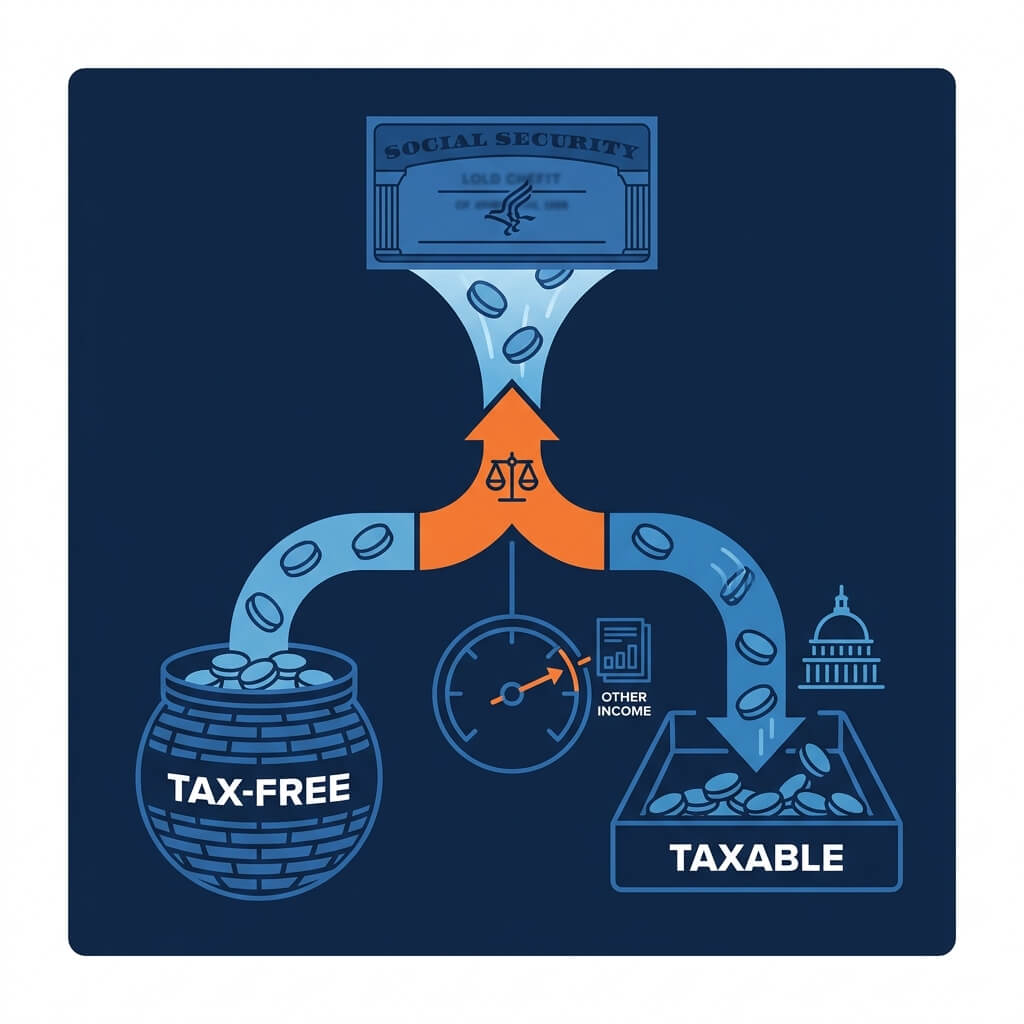
So a single retiree with provisional income under $25,000 owes no federal tax on benefits at all. Cross into the middle band and up to half the benefit becomes taxable; cross the top and up to 85% does. The Social Security Administration confirms these same income tiers in its own guidance.
How Much of Your Benefit Is Actually Taxed?
A common myth is that crossing a threshold makes your entire benefit taxable. It does not. The most that can ever be taxed is 85% of your benefit, so at least 15% is always free of federal tax, no matter how high your income. The percentages describe how much of the benefit enters your taxable income, not a tax rate applied to it.
There is an important wrinkle worth knowing. These thresholds were written into law in 1983, when the 50% tier began, and 1993, when the 85% tier was added, and they have never been indexed to inflation. That means that as benefits and incomes rise over the decades, more and more retirees get pulled into owing this tax, even though the dollar thresholds look the same as they did decades ago. It is a quiet tax increase built into the design.
How Can You Reduce Taxes on Your Social Security?
Because the tax is driven by provisional income, the lever is managing that income. Roth IRA withdrawals do not count toward provisional income, so drawing from a Roth instead of a traditional IRA in a given year can keep you under a threshold. Qualified charitable distributions from an IRA, careful timing of large withdrawals, and spreading income across years all help too.
There is also a new break to know about for 2026. Under the 2025 tax law, the IRS confirms that people age 65 and older can claim an additional deduction of up to $6,000 per person for tax years 2025 through 2028, which phases out at higher incomes. It does not change how benefits are taxed, but by lowering taxable income, it reduces or erases the tax many retirees owe on their benefits. Jeff Judge tells clients to plan withdrawals years in advance, because the difference between a Roth dollar and a traditional dollar in retirement often decides how much of their Social Security stays in their pocket. For more on how brackets interact, see our What Is the Difference Between Marginal and Effective Tax Rate? explainer, and if you are coordinating with a former spouse's record, our Social Security Divorced Spouse Benefits: What Are You Entitled To? guide.
Frequently Asked Questions
Is Social Security taxable?
Yes, Social Security can be taxable at the federal level, with up to 85% of your benefit subject to income tax depending on your total income. The exact amount is based on provisional income, which combines your adjusted gross income, tax-exempt interest, and half your benefit. Below set thresholds, none of the benefit is taxed.
At what income is Social Security taxed?
For single filers, federal taxation of benefits begins at $25,000 of provisional income, and up to 85% becomes taxable above $34,000. For married couples filing jointly, taxation starts at $32,000 and reaches the 85% tier above $44,000. These thresholds are fixed and not adjusted for inflation, so they capture more retirees over time.
Can 100% of my Social Security be taxed?
No. The maximum portion of your Social Security benefit that can be included in your taxable income is 85%, so at least 15% is always free of federal tax. The 85% figure is a ceiling on how much of the benefit counts as income, not a tax rate, so your actual tax depends on your bracket.
Do states tax Social Security benefits?
Most states do not tax Social Security benefits, including Maryland, where Chesapeake Financial Planners is based. A small number of states still tax some benefits, often with their own income exemptions. Because rules vary and change, confirm your state's treatment, but for most retirees the tax question is a federal one.
Did the 2025 tax law end taxes on Social Security?
No. The 2025 law did not repeal the taxation of Social Security benefits. Instead, it added a temporary deduction of up to $6,000 for people age 65 and older for 2025 through 2028, which lowers taxable income. For many middle-income retirees this reduces or eliminates the tax owed on benefits, but the underlying rules still apply.
So is Social Security taxable? For many retirees, yes, up to 85% of the benefit, and the trigger is provisional income rather than the benefit itself. The good news is that the number you can influence is your other income, which means smart withdrawal planning can shrink the bill. If you want a simple framework for coordinating income, taxes, and Social Security, our What are the fundamentals of personal financial planning? walks through it step by step. Download it at chesapeakefp.com. Jeff Judge notes: "The Social Security taxation rules have not gone away, but which accounts you pull from and in what order can meaningfully affect how much of your benefit ends up taxable, which is why we build withdrawal sequencing into every retirement income plan we design."
Want to go deeper? Our Medicare and Social Security Guide walks through this step by step.
This material is for educational purposes only and should not be considered tax or legal advice. Please consult with your tax advisor or attorney regarding your specific situation.
The opinions voiced in this material are for general information only and are not intended to provide specific advice or recommendations for any individual.
All investing involves risk including loss of principal. No strategy assures success or protects against loss.
There is no guarantee that a diversified portfolio will enhance overall returns or outperform a non-diversified portfolio. Diversification does not protect against market risk.
Disclosures
The information provided is for educational purposes only and should not be construed as investment advice. Investment strategies should be tailored to individual circumstances, risk tolerance, and goals. Past performance doesn't guarantee future results. Consult with qualified financial professionals regarding your specific situation.
This information is not intended to be a substitute for specific individualized tax, investment or legal advice. We suggest that you discuss your specific situation with a qualified tax, legal or financial advisor.
Advisors associated with Chesapeake Financial Planners may be either (1) LPL Financial Registered Representatives offering securities through LPL Financial, Member FINRA and SIPC, and investment advisor representatives offering investment advice through Great Valley Advisor Group; or (2) solely investment advisor representatives offering investment advice through Great Valley Advisor Group and not affiliated with LPL Financial. Great Valley Advisor Group, and Chesapeake Financial Planners are separate entities from LPL Financial.


