

How Can I Avoid Probate When Planning My Estate?
Last reviewed: July 2026
You avoid probate by transferring assets through tools that pass directly to your beneficiaries instead of through the court, chiefly a revocable living trust, beneficiary designations, joint ownership, and transfer-on-death registrations. Probate is the court process that validates a will and distributes assets, and it is public, often slow, and not free. The strategies below move most or all of your estate around it, so your family inherits faster and more privately.
Key Takeaways
- Probate is the court process for distributing a deceased person's assets, and the Consumer Financial Protection Bureau notes it is public and can be expensive.
- A revocable living trust is the most comprehensive probate-avoidance tool because trust assets pass to heirs without court involvement.
- Beneficiary designations and transfer-on-death registrations move accounts directly to named heirs and override your will.
- Avoiding probate is separate from avoiding estate tax; the 2026 federal estate exclusion is $15 million per person.
About the Author: Jeff Judge, CFP®, AEP®, ChFC®, CLU® is Managing Partner of Chesapeake Financial Planners in Forest Hill, Maryland. He has been helping families and business owners in Harford County and the Baltimore metro area structure their estates since earning his CFP® certification in 2013, by using Chesapeake Financial Planners’ signature process, the R.U.D.D.E.R. method™. Jeff's view: most families don't fail at estate planning by choosing the wrong tool, they fail by never retitling the assets, which leaves a perfectly good trust empty.
Why is avoiding probate worth the effort?
Avoiding probate is worth the effort because the court process is public, can be expensive, and often takes months to more than a year before heirs can access assets. As the Consumer Financial Protection Bureau puts it, "Probate is a public process, and it can be expensive and lengthy." During it, accounts can be frozen while the estate is settled. For a surviving spouse who needs liquidity, that delay is more than an inconvenience.
There are three real costs. Money: legal fees, court costs, and executor compensation that commonly run into the thousands, and on a larger estate, far more. Time: many estates take six to eighteen months to settle, longer if the will is contested. Privacy: the will, the asset inventory, and who inherits what all become public record that anyone can pull.
One clarification matters before going further. Avoiding probate is not the same as avoiding estate tax. Probate is a process problem; estate tax is a separate question that, for 2026, only applies above the $15 million-per-person federal exclusion. You can sidestep probate entirely and still owe estate tax, or owe no estate tax and still get stuck in probate. They are different problems with different fixes.
Which assets go through probate, and which avoid it automatically?
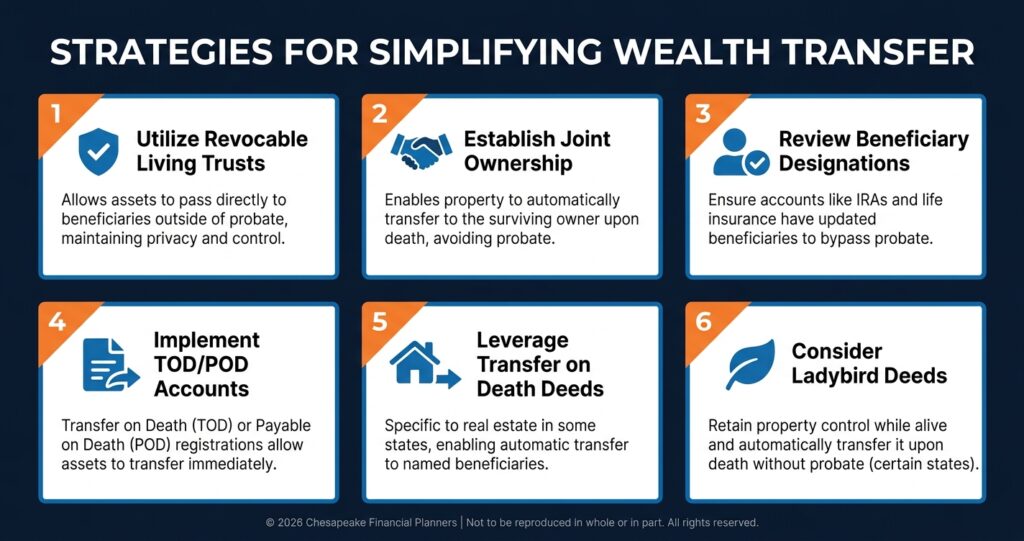
Assets titled only in your name go through probate, while assets with a named beneficiary or a surviving co-owner pass automatically outside it. Knowing which bucket each asset falls into is the starting point, because the goal is simply to move everything into the second bucket.
Probate generally applies to real estate titled in your name alone, solo bank and investment accounts, vehicles in your name only, and personal property like furniture and collectibles. These have no built-in way to transfer at death, so the court steps in to decide where they go.
Assets that skip probate automatically include jointly owned property with right of survivorship, accounts with beneficiary designations such as retirement plans and life insurance, anything held in a revocable living trust, and transfer-on-death or payable-on-death accounts. The practical strategy for most families is to minimize the first list by converting assets into the second.
What are the main probate avoidance strategies?
The main probate avoidance strategies range from a comprehensive trust to simple free registrations, and most families layer several. Each works on its own, so you can match the tool to the asset.
A revocable living trust is the most comprehensive option. You retitle assets into the trust, serve as your own trustee with full control during life, and a successor trustee distributes everything at death with no court involvement. The CFPB notes a common reason to set one up is to avoid probate. It also keeps your affairs private and handles incapacity, though it costs more upfront and only works if you actually fund it.
Beneficiary designations and transfer-on-death registrations are the free, simple workhorses. Retirement accounts, life insurance, and annuities pass to named beneficiaries directly. Brokerage accounts can add a transfer-on-death (TOD) registration and bank accounts a payable-on-death (POD) one, so they move to your chosen person on death with no probate. A POD designation has a second benefit: the FDIC insures these accounts up to $250,000 per eligible beneficiary, which can expand coverage on a larger balance. The catch is maintenance: these override your will, so an outdated beneficiary form can send money to an ex-spouse regardless of what your will says. Jeff Judge notes: "Beneficiary designations are free to update and take about ten minutes, but I've seen them send an entire IRA to an ex-spouse because nobody reviewed the form after a divorce — they override everything, including a will signed the same week."
Joint ownership with right of survivorship transfers property automatically to the surviving co-owner, which works cleanly for married couples. Be cautious adding an adult child to a deed or account purely to dodge probate; it exposes the asset to the child's creditors and divorce, can trigger gift-tax reporting above the 2026 annual gift exclusion of $19,000 per recipient, and can complicate a later sale. A trust or a TOD registration usually accomplishes the same goal without those side effects.
How do you build a complete probate-avoidance plan?
You build a complete plan by assigning the right transfer tool to each asset, then confirming nothing is left titled in your name alone. A layered plan typically looks like the table below.
| Asset | Probate-avoidance tool |
|---|---|
| Primary residence | Revocable living trust (or TOD deed where the state allows) |
| Bank accounts | Payable-on-death to spouse, then children |
| Brokerage accounts | Transfer-on-death to spouse, then children |
| Retirement accounts | Named primary and contingent beneficiaries |
| Life insurance | Direct beneficiaries, or a trust if heirs are minors |
Two mistakes undo more plans than any other. The first is an unfunded trust: people pay for a trust and never retitle the house or the accounts into it, so those assets still go through probate. The second is forgetting contingent beneficiaries, so if your primary beneficiary dies before you, the asset falls back into your estate and into probate anyway.
This is exactly the kind of work a structured process catches. The R.U.D.D.E.R. Method™ is Chesapeake Financial Planners' six-step planning process: Review and Recognize, Uncover and Understand, Design and Develop, Discuss and Decide, Execute and Empower, and Reassess and Refine. The Execute and Empower step is where most plans live or die, because it is the difference between signing a trust and actually moving the assets into it. As Jeff Judge puts it, "An estate plan you signed but never funded is a fire extinguisher still in the box."
Related Topics Worth Reading
Probate avoidance is one piece of a full estate plan. These related topics complete it.
- The foundational documents every estate plan needs and how trusts fit. What does a complete estate plan include and where do you start?
- When a will is enough and when you need a trust instead. Should I Get a Trust or Is a Will Enough?
- The beneficiary-form mistakes that quietly override your will. What Are the Most Common Beneficiary Designation Mistakes?
- How Maryland's estate and inheritance tax rules affect local families. How do Maryland's estate tax and inheritance tax work together, and how do you plan around both?
- The bigger picture of building a legacy plan around trusts and exemptions. What does a complete estate plan include and where do you start?
Frequently Asked Questions
What is the easiest way to avoid probate?
The easiest way to avoid probate is to add beneficiary designations and transfer-on-death registrations to your accounts, which is free and takes minutes. Retirement accounts and life insurance already use beneficiaries; brokerage accounts can add a TOD registration and bank accounts a POD one. These assets then pass directly to your named person at death, completely skipping the court process.
Does a will avoid probate?
No, a will does not avoid probate; it is the document the probate court uses to validate and distribute your estate. A will directs who receives your probate assets, but those assets still pass through the court process. To avoid probate, you need tools that transfer assets outside the will, such as a revocable living trust, beneficiary designations, or joint ownership with right of survivorship.
How much does probate cost?
Probate costs vary widely by state and estate size but commonly include attorney fees, court costs, and executor compensation that can reach into the thousands of dollars. The Consumer Financial Protection Bureau notes probate can be expensive, and larger or contested estates cost more. Avoiding probate through a trust or beneficiary designations typically costs far less than the process it replaces.
Is a revocable living trust worth it?
A revocable living trust is usually worth it for estates with real estate, property in more than one state, a desire for privacy, or complex family situations. It avoids probate, keeps your affairs private, and manages assets if you become incapacitated. The main drawbacks are a higher upfront cost than a simple will and the ongoing need to retitle assets into the trust to keep it effective.
Do beneficiary designations override a will?
Yes, beneficiary designations override a will, which surprises many families. The beneficiary named on a retirement account, life insurance policy, or TOD account receives that asset regardless of what your will says. This is why reviewing and updating beneficiary forms after a marriage, divorce, birth, or death is essential, since an outdated form can direct money to someone you no longer intend.
Building a plan that keeps your family out of court
Probate avoidance comes down to a simple principle: move your assets into tools that transfer directly, and make sure nothing is left titled in your name alone. The right probate avoidance strategies depend on what you own and your family situation, and most plans combine a trust with beneficiary and transfer-on-death designations. If you found this helpful and want to map the right tools to your own estate, our team at Chesapeake Financial Planners works through this with families across Harford County and beyond. Visit chesapeakefp.com to learn more.
Want to go deeper? Our Estate Document Locator walks through this step by step.
Estate planning requires legal assistance. Neither LPL Financial nor its registered representatives offer legal advice.
Disclosures
The information provided is for educational purposes only and should not be construed as investment advice. Investment strategies should be tailored to individual circumstances, risk tolerance, and goals. Past performance doesn't guarantee future results. Consult with qualified financial professionals regarding your specific situation.
Advisors associated with Chesapeake Financial Planners may be either (1) LPL Financial Registered Representatives offering securities through LPL Financial, Member FINRA and SIPC, and investment advisor representatives offering investment advice through Great Valley Advisor Group; or (2) solely investment advisor representatives offering investment advice through Great Valley Advisor Group and not affiliated with LPL Financial. Great Valley Advisor Group, and Chesapeake Financial Planners are separate entities from LPL Financial.


