

What is present bias, and why do I under-save for retirement?
Last reviewed: July 2026
Present bias is the human tendency to overvalue rewards available right now and undervalue rewards that arrive in the future. It is the reason a $200 dinner tonight feels more real than $200 growing in your 401(k) for 30 years, even though the future money is worth far more. When that future is something as distant as retirement, present bias quietly convinces you to under-save, because the version of you who will need that money feels like a stranger.
Key Takeaways
- Present bias makes immediate rewards feel more valuable than larger future rewards, which drives chronic under-saving for retirement.
- Hyperbolic discounting is the mathematical pattern behind present bias, where the future gets discounted steeply and unevenly.
- The IRS set the 2026 employee 401(k) deferral limit at $24,500, giving savers more room to counteract the bias.
- Automating contributions removes the daily decision, which is the single most effective fix for present bias.
About the Author: Jeff Judge, CFP®, AEP®, ChFC®, CLU® is Managing Partner of Chesapeake Financial Planners in Forest Hill, Maryland. He has been helping families and business owners in Harford County and the Baltimore metro area navigate retirement saving behavior since earning his CFP® certification in 2013, by using Chesapeake Financial Planners’ signature process, the R.U.D.D.E.R. method™. Jeff often tells clients that present bias is not a character flaw, it is wiring, and the fix is to design around it rather than rely on willpower.
Most people assume under-saving is a discipline problem. It usually is not. It is a wiring problem, and the wiring has a name. Once you understand how present bias works, you can stop blaming yourself and start building a system that saves whether you feel motivated or not.
What is present bias and how does it work?
Present bias is a cognitive shortcut that makes the present moment feel disproportionately important compared to any future moment. Your brain evolved to prioritize immediate survival, not to weigh a retirement balance four decades out. So when you face a choice between spending now and saving for later, the "now" option gets an unfair advantage every single time.
Here is the mechanism in plain terms. Given a choice between $100 today and $110 next week, many people grab the $100. But given a choice between $100 in 52 weeks and $110 in 53 weeks, almost everyone waits the extra week. The one-week delay is identical in both cases. The only thing that changed is whether the delay starts today. That inconsistency is present bias in action.
Retirement saving is the extreme version of this. The reward sits 20, 30, or 40 years away. The cost, your contribution, lands today. Present bias stacks the deck against the future you, and it does so quietly, decision after decision, until decades have passed.
How do I balance saving for retirement and enjoying life now?

How does hyperbolic discounting explain under saving retirement?
Hyperbolic discounting is the formal name for the math behind present bias. Economists once assumed people discounted the future at a steady rate, a smooth curve. Real human behavior does not work that way. People discount the near future steeply and the distant future more gently, producing a curved, inconsistent pattern that flips your preferences depending on timing.
This explains the under saving retirement pattern almost perfectly. When retirement is far away, the curve is nearly flat, so the difference between saving 6% and 10% of your income feels trivial. You keep telling yourself you will ramp up "next year." But next year arrives, the curve is just as steep at that new starting point, and the same trivial-feeling gap shows up again. The promised increase never happens.
A worker who delays saving from age 25 to age 35 does not lose ten years of contributions. They lose ten years of compounding on those contributions, which can mean hundreds of thousands of dollars by retirement. According to Fidelity, saving consistently starting in your 20s is what makes their savings benchmarks achievable. Hyperbolic discounting is precisely what stops most people from starting early.
The cruel part is that the people most affected by under saving rarely feel reckless in the moment. Each individual decision to delay feels reasonable. It is the accumulation that does the damage.
Why does retirement feel so far away that I keep delaying?
Retirement feels far away because your brain treats your future self almost like a different person. Research on what psychologists call "future self-continuity" shows that for many people, the neural activity associated with thinking about themselves in retirement looks more like thinking about a stranger than thinking about themselves today. You will not sacrifice for a stranger as readily as you will for yourself.
This is instant gratification dressed up in adult clothing. The desire for instant gratification, spending now rather than saving for later, is not just a teenager's problem. It runs the same circuitry at 45 that it ran at 15. The difference is that the stakes are far higher, and the time left to recover from under-saving is far shorter.
There is also a simple visibility problem. The dinner, the vacation, the upgraded car all deliver an immediate, tangible payoff you can see and feel. The retirement contribution delivers a number on a statement you might glance at once a quarter. Jeff Judge has watched clients who earn good incomes for decades arrive at age 60 genuinely surprised by how little they set aside, not because they were careless, but because the future never felt urgent enough to act on.
How Do I Set Financial Goals After a Major Life Change?
How do I overcome present bias and actually save more?
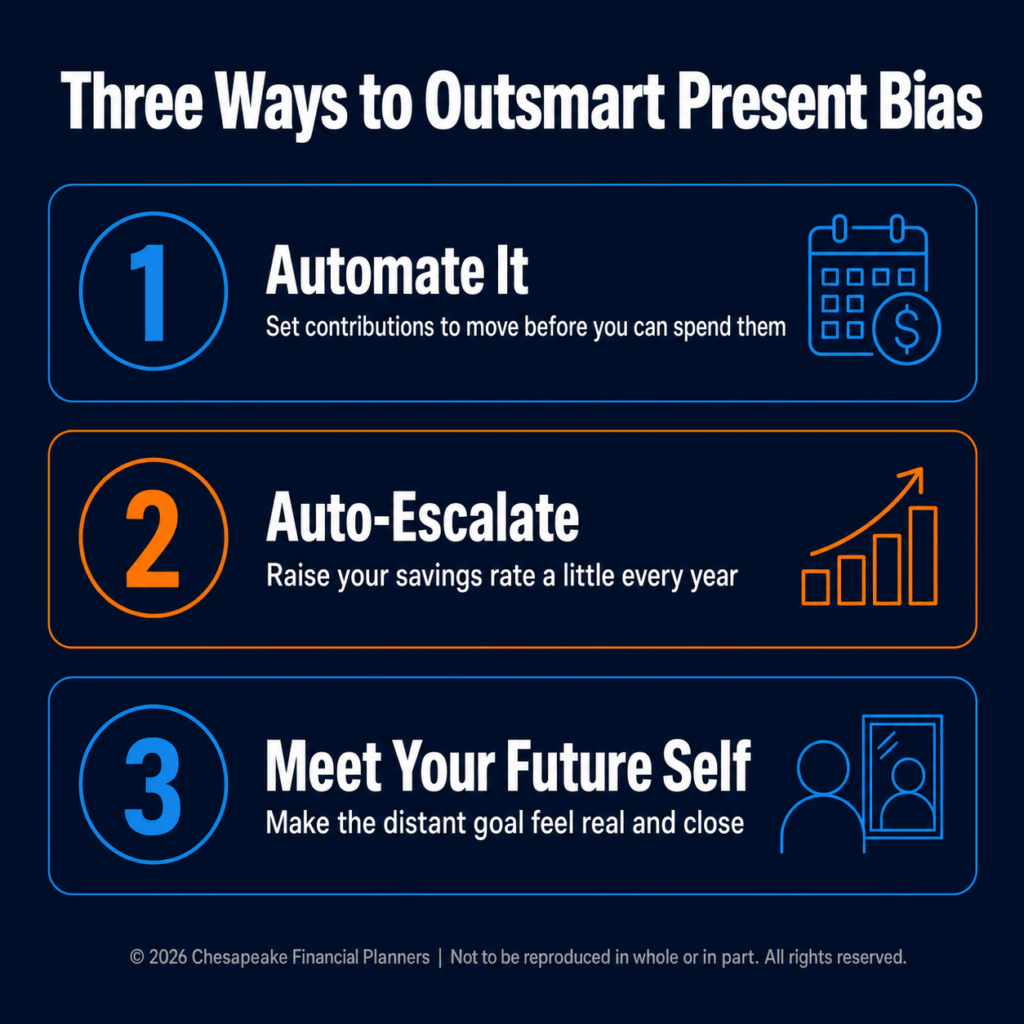
You overcome present bias by removing the decision from your daily life, not by trying to out-discipline it. Willpower is the wrong tool because present bias attacks you fresh every single day. The winning move is to make one good decision once and let a system carry it out automatically from then on.
The most powerful lever is automation. When your retirement contribution comes out of your paycheck before the money ever hits your checking account, present bias never gets a vote. According to Vanguard's How America Saves report, plans that automatically enroll employees see participation rates well above plans that require workers to opt in, often above 90% versus far lower voluntary rates. The default does the saving that present bias would otherwise block. Jeff Judge notes: "Automation is the only savings strategy that works seven days a week, because it never has to compete with what you feel like doing today."
A second lever is pre-commitment. Set your contributions to escalate automatically by 1% each year, ideally timed to your raise so you never feel the cut. You are committing your future self in advance, at a moment when the future feels abstract and the sacrifice feels painless. By the time the increase hits, it is already in motion.
At Chesapeake Financial Planners, we build these guardrails using the R.U.D.D.E.R. Method™, Chesapeake Financial Planners' six-step planning process: Review and Recognize, Uncover and Understand, Design and Develop, Discuss and Decide, Execute and Empower, and Reassess and Refine. The point is not to fix your willpower. It is to design a structure that saves correctly even on the days you do not feel like it.
The 2026 contribution limits give you real room to work with. The IRS set the 2026 employee deferral limit at $24,500 for 401(k) plans and $7,500 for IRA contributions. The structure is sitting there. Present bias is the only thing standing between you and using it.
Should I max out my 401(k) or invest somewhere else?
Why Does a Financial Planning Process Matter More Than Investment Selection?
Frequently Asked Questions
What is present bias in simple terms?
Present bias is the tendency to value rewards you can have right now far more than larger rewards you would receive later. Given a choice, your brain consistently favors immediate payoffs, which makes saving for a distant goal like retirement feel much harder than it logically should.
What is the difference between present bias and hyperbolic discounting?
Present bias is the behavior, favoring the present over the future, while hyperbolic discounting is the mathematical pattern that describes it. Hyperbolic discounting shows that people discount the near future steeply and the distant future gently, producing inconsistent choices that flip depending on when the delay begins.
Does present bias cause people to under-save for retirement?
Yes, present bias is one of the leading behavioral causes of under saving for retirement. Because retirement sits decades away, the reward feels abstract while the cost of contributing lands today. This imbalance leads people to repeatedly delay or minimize savings, losing years of valuable compounding growth.
How can I overcome present bias when saving?
The most effective way to overcome present bias is to automate your saving so the decision is removed from your daily control. Set up automatic payroll contributions and annual escalation tied to raises. By committing in advance, you bypass the daily pull of instant gratification entirely.
Is instant gratification the same as present bias?
Instant gratification and present bias are closely related but not identical. Instant gratification is the immediate satisfaction you feel from a reward now, while present bias is the underlying cognitive tendency that overvalues those immediate rewards relative to future ones. Present bias is what makes instant gratification so persistently hard to resist.
How much does delaying retirement savings actually cost?
Delaying savings costs far more than the missed contributions because you also lose years of compounding growth on that money. A worker who waits from age 25 to 35 forfeits a decade of compounding, which can amount to hundreds of thousands of dollars by retirement, depending on contribution amounts and returns.
Present bias is not a flaw you need to fix with guilt. It is wiring you can design around. If you want a practical framework for building automatic saving habits that hold up against instant gratification, download our free retirement planning guide at chesapeakefp.com and start putting the future you back on equal footing.
Disclosures
The information provided is for educational purposes only and should not be construed as investment advice. Investment strategies should be tailored to individual circumstances, risk tolerance, and goals. Past performance doesn't guarantee future results. Consult with qualified financial professionals regarding your specific situation.
Advisors associated with Chesapeake Financial Planners may be either (1) LPL Financial Registered Representatives offering securities through LPL Financial, Member FINRA and SIPC, and investment advisor representatives offering investment advice through Great Valley Advisor Group; or (2) solely investment advisor representatives offering investment advice through Great Valley Advisor Group and not affiliated with LPL Financial. Great Valley Advisor Group, and Chesapeake Financial Planners are separate entities from LPL Financial.


