
Should I Pay Off Debt or Invest My Inheritance?
Last reviewed: July 2026
Whether you should pay off debt or invest an inheritance depends almost entirely on the interest rate on your debt. Wipe out anything above roughly 8% first, because no investment reliably beats a guaranteed return that high. Then decide on the rest based on your emergency fund, your retirement readiness, and how much the debt actually weighs on you.
Key Takeaways
- Pay off high-interest debt first; eliminating a balance at the average 21%+ credit card APR acts like a guaranteed double-digit return.
- Low-rate debt under about 4% usually stays put while you invest, since markets have historically outpaced it.
- Build a three-to-six-month emergency fund before committing the rest of the inheritance anywhere.
- A hybrid split, paying some debt and investing the rest, fits most people better than going all-in on one path.
About the Author: Jeff Judge, CFP®, AEP®, ChFC®, CLU® is Managing Partner of Chesapeake Financial Planners in Forest Hill, Maryland. He has been helping families and business owners in Harford County and the Baltimore metro area navigate inheritance and sudden-money decisions since earning his CFP® certification in 2013, by using Chesapeake Financial Planners’ signature process, the R.U.D.D.E.R. method™. Jeff has watched far too many people rush an inheritance into one big move within weeks of receiving it, and the ones who pause for ninety days almost always make a sharper call.
Receiving an inheritance stirs up a strange mix of grief and possibility. The money arrives at one of the hardest moments of your life, and then you have to make decisions about it. Take a breath first. Then work the problem in the order below.
How Do I Decide Between Paying Off Debt and Investing?
The cleanest starting point is the interest rate on each debt you carry. Compare that rate against what you could reasonably expect to earn by investing. When the debt rate is higher, paying it off wins. When it is lower, investing usually wins. That single comparison resolves most of the question before emotion enters the picture.
The reason is simple math. Paying off a debt is a guaranteed, tax-free return equal to that debt's interest rate. Investing carries no guarantee. The S&P 500 has returned roughly 10% annually before inflation over the long run, according to historical market data tracked by NYU Stern, but any given year can be negative. So a debt rate above that long-run average is almost always worth clearing first. A rate well below it tilts toward investing.
Jeff Judge often reminds clients that the inheritance does not have to do just one job. You can clear the dangerous debt, shore up your savings, and still put a meaningful chunk to work in the market. Framing it as all-or-nothing is where people go wrong.
Should I Pay Off High-Interest Debt First?
Yes. High-interest debt should be the first dollar your inheritance touches. Credit cards, payday loans, and personal loans above roughly 10% destroy wealth faster than nearly any investment can rebuild it. As of 2026, the average credit card interest rate sits above 21% according to Federal Reserve data, and many cardholders pay well into the high twenties.
Run the numbers on a $20,000 balance at 21%. That costs you about $4,200 a year in interest alone. Eliminating it is the equivalent of locking in a guaranteed 21% annual return with zero risk and no tax bill. No portfolio offers that. Pay it off and stop the bleeding.
What should I do with money I inherited from a relative?
What About Moderate and Low-Interest Debt?
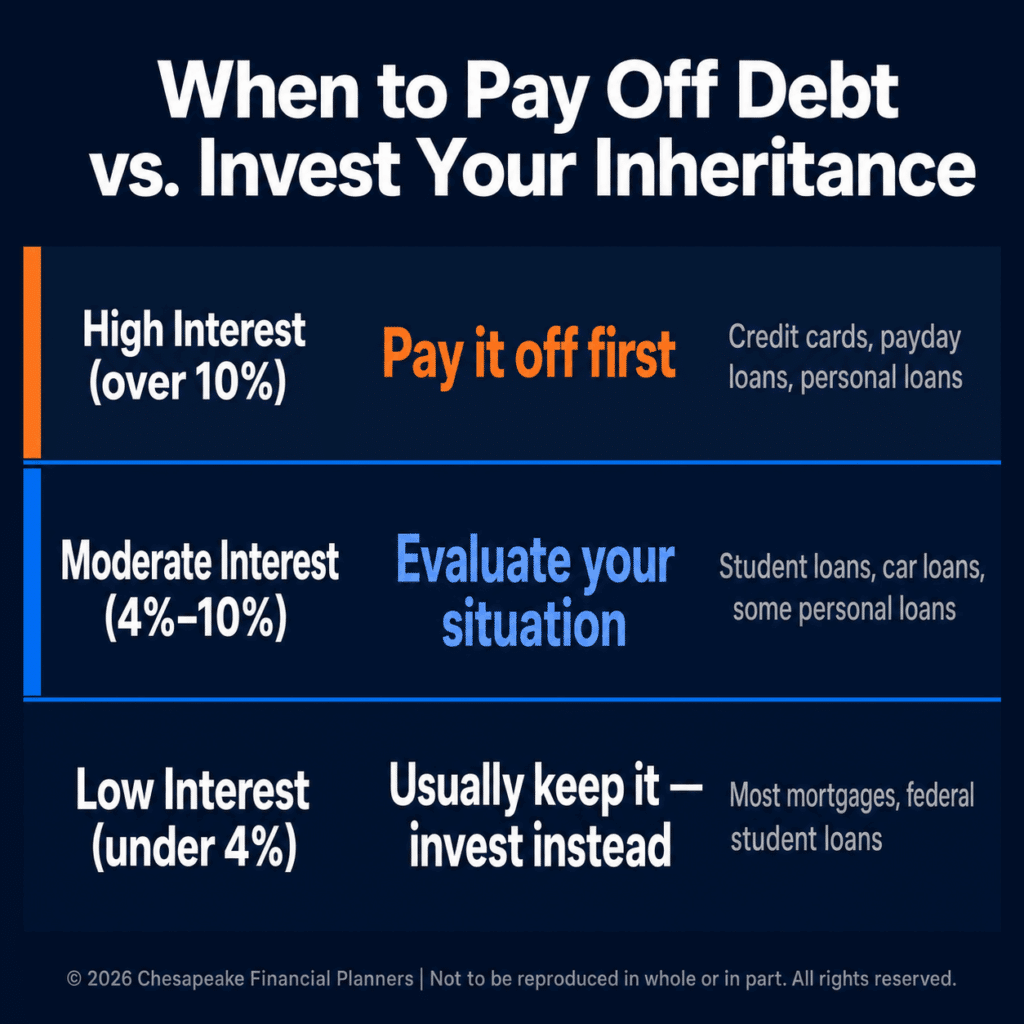
Moderate-interest debt sits in the gray zone where the answer genuinely depends on your situation. Car loans, personal loans in the 6% to 10% range, and some private student loans fall here. The math is close enough that other factors break the tie: your emergency fund, your risk tolerance, and whether the monthly payment strains your cash flow.
Low-interest debt usually stays. Mortgages and federal student loans below about 4% generally should not be rushed to payoff with inheritance money. When you pay 3.5% on a mortgage and could reasonably earn 7% to 10% invested over time, keeping the loan and investing the difference grows your net worth faster. Federal student loans also carry protections worth preserving, including income-driven repayment plans. For 2026, the Department of Education sets federal undergraduate loan rates annually, and most remain well below market return expectations. Jeff Judge notes: "When your mortgage rate is 3.5% and a diversified portfolio has historically returned 7% to 10%, paying that loan off early with inheritance money means giving up the spread — and over 20 years, that gap compounds into real money."
Here is how the three tiers compare:
| Debt Type | Typical Rate | General Move | Why |
|---|---|---|---|
| High-interest (credit cards, payday) | 18%+ | Pay off immediately | Guaranteed return beats any investment |
| Moderate (car, personal, private student) | 6%-10% | Depends on situation | Close to long-run market returns |
| Low-interest (mortgage, federal student) | Under 4% | Usually keep and invest | Investing likely outearns the debt cost |
Do I Need an Emergency Fund Before Investing My Inheritance?
Yes, and it comes before almost everything else. Before you pay down moderate debt or invest a dollar, confirm you hold three to six months of essential expenses in an accessible account. Without that cushion, the next car repair or medical bill lands on a credit card, and you end up rebuilding the exact high-interest debt you just cleared.
This is the mistake Jeff sees most often. Someone inherits $80,000, pays off every loan they have, feels great for a month, then hits an unexpected $6,000 expense with no liquid savings and reaches for a credit card at 24%. The emergency fund is not exciting, but it is what keeps the rest of your plan from unraveling. Fund it first, then allocate the remainder.
What should I do first after inheriting money or property?
What If I'm Behind on Retirement Savings?
If retirement savings are thin, investing part of the inheritance in tax-advantaged accounts may serve you better than aggressive debt payoff on low-rate loans. Time in the market is the asset you cannot buy back. Someone at 50 with little saved often benefits more from funding an IRA or maxing a 401(k) than from shaving years off a 3.5% mortgage.
Weigh your whole picture: retirement gap, job stability, and near-term goals like a home down payment or college funding. Income stability matters too. If your work feels shaky, keeping more in liquid, accessible accounts beats locking everything into debt payoff that you cannot reverse. This is exactly the kind of trade-off the R.U.D.D.E.R. Method™, Chesapeake Financial Planners' six-step planning process, is built to sort through deliberately rather than in a rush.
What should you do when you suddenly receive a large sum of money?
What Is the Hybrid Approach?
The hybrid approach means you split the inheritance across goals instead of choosing one. For most people this beats going all-in on debt or all-in on investing, because it addresses several priorities at once and respects both the math and your peace of mind.
A common allocation looks like this: roughly 40% to 50% toward eliminating high-interest and reducing moderate-interest debt, 10% to 15% to top off the emergency fund, and the remaining 35% to 50% invested for long-term growth. The exact split shifts with your debt load and savings gap. Someone debt-free already might invest nearly all of it; someone drowning in credit card balances might direct most of it to payoff first.
Money decisions are not purely mathematical. If debt genuinely keeps you up at night, the relief of clearing it carries real value a spreadsheet cannot measure. Jeff has had clients knock out a low-rate loan against his "optimal" math advice simply because the weight of it was affecting their sleep and their marriage. That was the right call for them.
What's the best way to handle debt coming into a marriage?
Frequently Asked Questions
Should I pay off my mortgage with inheritance money?
Usually not, if your mortgage rate is below about 4%. Investing that money instead is likely to earn more over time than the interest you would save, since long-run market returns have historically exceeded low mortgage rates. The exception is emotional: if being mortgage-free brings you genuine peace, that value counts too.
Is it better to invest a lump sum or pay down debt first?
Pay off any debt charging more than roughly 8% to 10% before investing, because clearing it delivers a guaranteed return at that rate. Below that threshold, investing the lump sum often wins mathematically. The decision hinges on comparing your specific debt rate against realistic expected investment returns over your time horizon.
How much of my inheritance should I keep in cash?
Keep enough to cover three to six months of essential living expenses in an accessible emergency fund before investing or paying down moderate debt. If your income is irregular or your job feels uncertain, lean toward the six-month end. This cash cushion prevents you from rebuilding high-interest debt when surprise expenses hit.
Does paying off debt count as a return on investment?
Yes. Paying off debt produces a guaranteed, tax-free return equal to the debt's interest rate. Eliminating a credit card balance at 21% effectively earns you 21% with zero risk, which no investment can promise. This is why high-interest debt payoff almost always beats investing the same dollars.
Should I tell my financial advisor about an inheritance before deciding?
Yes, ideally before you make any major move. An advisor can model the tax impact, your retirement gap, and the debt-versus-invest math against your full financial picture. Many people rush the decision within weeks; pausing to plan with a professional often surfaces options, like tax-advantaged account funding, that you would otherwise miss.
If you have just inherited money and you are weighing debt against investing, a second opinion costs you nothing. At Chesapeake Financial Planners, we work through inheritance and sudden-money decisions with families every week. Visit chesapeakefp.com to learn more.
Want to go deeper? Our First 90 Days After a Windfall walks through this step by step.
Disclosures
The information provided is for educational purposes only and should not be construed as investment advice. Investment strategies should be tailored to individual circumstances, risk tolerance, and goals. Past performance doesn't guarantee future results. Consult with qualified financial professionals regarding your specific situation.
Advisors associated with Chesapeake Financial Planners may be either (1) LPL Financial Registered Representatives offering securities through LPL Financial, Member FINRA and SIPC, and investment advisor representatives offering investment advice through Great Valley Advisor Group; or (2) solely investment advisor representatives offering investment advice through Great Valley Advisor Group and not affiliated with LPL Financial. Great Valley Advisor Group, and Chesapeake Financial Planners are separate entities from LPL Financial.


