

Should I choose Parent PLUS loans or private student loans?
Last reviewed: July 2026
Choose a Parent PLUS loan if your credit is fair or limited, you want flexible federal repayment and protections, or you might pursue Public Service Loan Forgiveness, and choose a private parent loan if you have excellent credit and want to minimize borrowing costs. Both let parents borrow for a child's college after scholarships and federal student loans run out, but they price and protect that debt very differently. The right answer depends on your credit, your need for flexibility, and, above all, whether the loan threatens your own retirement.
On This Page
- Key Takeaways
- What is the difference between Parent PLUS and private parent loans?
- How do the costs, rates, and repayment compare?
- Who is responsible, and what about forgiveness and taxes?
- How should you decide, and what should you do before borrowing?
- Related Topics Worth Reading
- Frequently Asked Questions
- Borrowing for college without borrowing trouble
- Disclosures
Key Takeaways
- Parent PLUS loans carry a fixed federal rate of 8.94% for the 2025-26 year plus an origination fee, with federal repayment flexibility and PSLF eligibility.
- Private parent loans are credit-based, often have no origination fee, and may beat the PLUS rate for excellent credit, but offer no federal protections or forgiveness.
- Parent loans are the parent's debt, not the child's; they affect your credit and your ability to borrow.
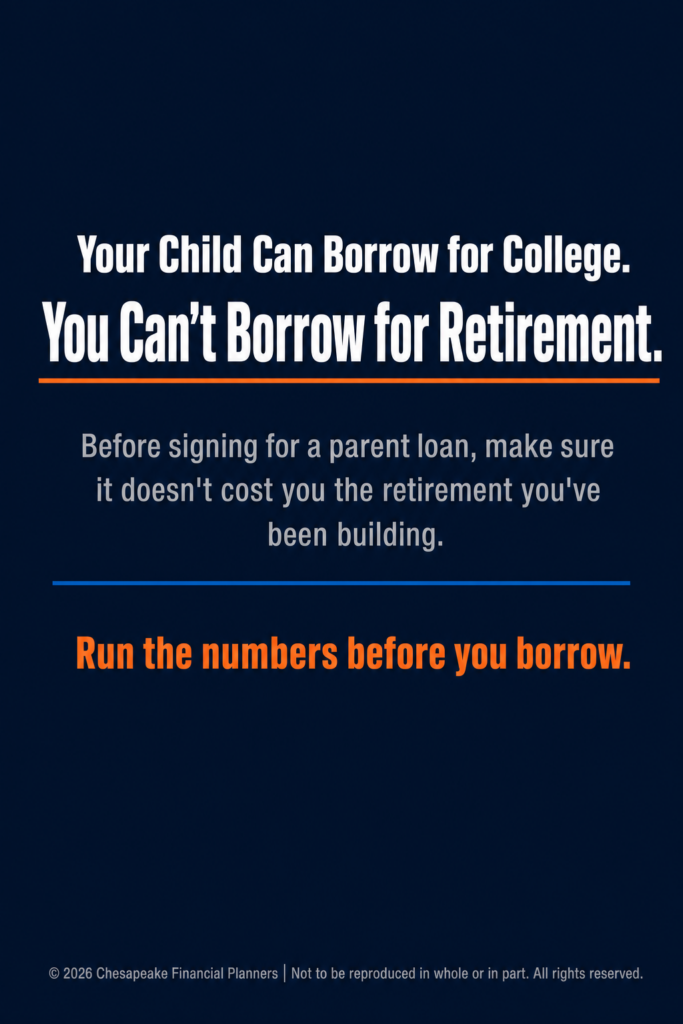
- Your child can borrow for college, but you cannot borrow for retirement; do not let parent loans derail your own plan.
About the Author: Jeff Judge, CFP®, AEP®, ChFC®, CLU® is Managing Partner of Chesapeake Financial Planners in Forest Hill, Maryland. He has helped Harford County and Baltimore-area parents weigh college borrowing against their own goals since earning his CFP® certification in 2013, by using Chesapeake Financial Planners’ signature process, the R.U.D.D.E.R. method™. As Jeff puts it: "The most important sentence in this whole decision is that you cannot borrow for retirement, so before signing for either loan, make sure the payment does not quietly come out of the future you are supposed to be funding for yourself."
What is the difference between Parent PLUS and private parent loans?
The core difference is that Parent PLUS loans are federal, with a fixed rate set by the government and federal protections, while private parent loans are credit-based, with rates and terms that depend on your financial profile. That distinction shapes cost, flexibility, and safety.
A Parent PLUS loan is a federal loan for parents of dependent undergraduates, issued by the U.S. Department of Education. It carries a fixed interest rate, 8.94% for the 2025-26 award year, with rates set annually, plus an origination fee of 4.228% deducted from each disbursement. As Federal Student Aid puts it, "Remember that interest rates and fees are generally lower for federal student loans than private student loans." It requires only a basic credit check (no adverse credit history such as a recent default, foreclosure, bankruptcy discharge, or serious delinquency), not a strong credit score, and you can borrow up to the full cost of attendance minus other aid. It also comes with federal repayment flexibility and forgiveness eligibility. A private parent loan, by contrast, comes from a bank, credit union, or online lender, with a variable or fixed rate typically ranging from roughly 4% to 14% depending on your credit, usually no origination fee, and approval based on your credit score, income, and debt-to-income ratio.
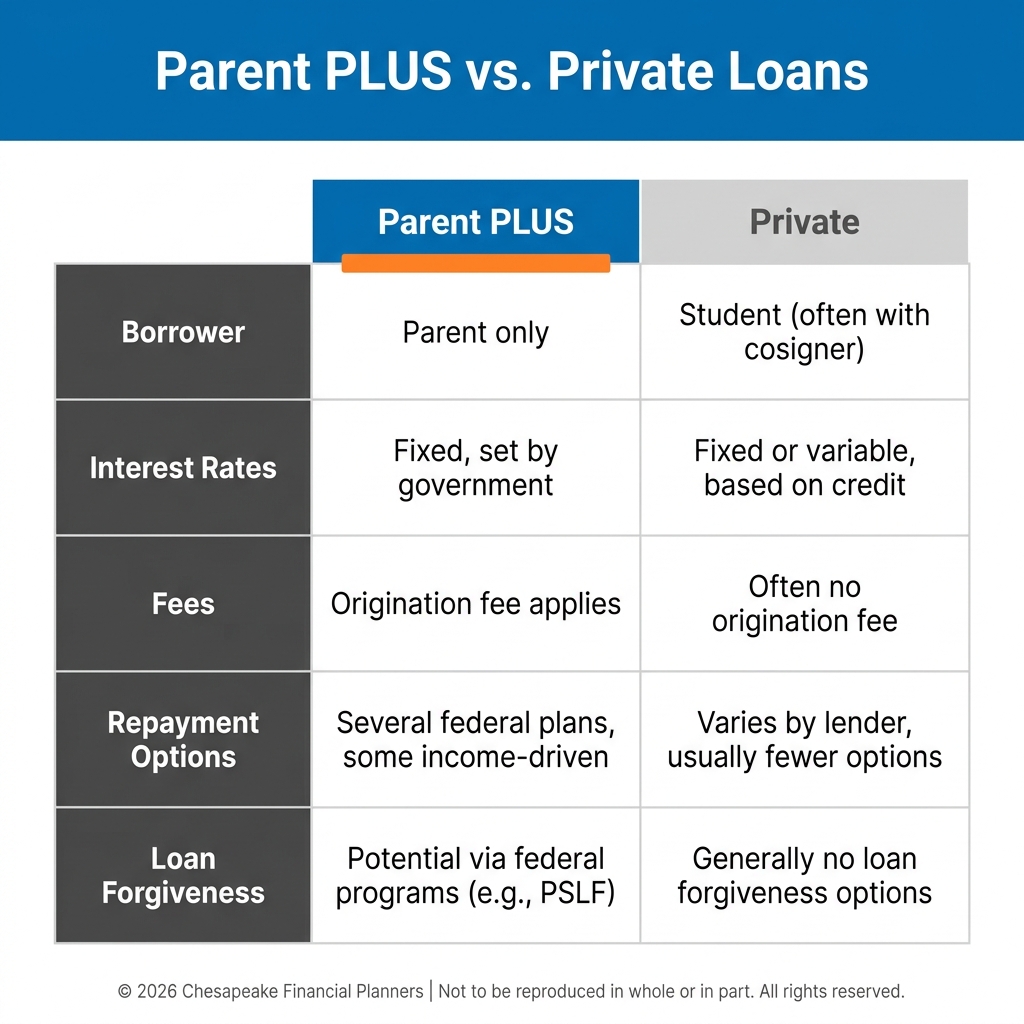
The table below summarizes how the two stack up.
| Feature | Parent PLUS | Private parent loan |
|---|---|---|
| Interest rate | 8.94% fixed (2025-26), set annually | Roughly 4% to 14%, credit-based |
| Origination fee | 4.228% per disbursement | Usually none |
| Credit check | Basic (no adverse history) | Score-based approval |
| Repayment | Flexible federal options, IDR via consolidation | Less flexible, fixed terms |
| Forgiveness | PSLF eligible | Not eligible |
So the trade-off is predictability and protection versus potential cost savings. Parent PLUS gives you a known rate regardless of credit and a federal safety net; a private loan can be cheaper if your credit is excellent, but it ties your rate to your profile and strips away federal benefits. Which matters more depends on your credit and how much you value flexibility.
How do the costs, rates, and repayment compare?
On cost, Parent PLUS has a fixed rate plus an origination fee while private loans are credit-based with usually no fee, and on repayment, Parent PLUS is more flexible than most private loans. Running the actual numbers, not just the rate, is what reveals the cheaper option.
On rates and fees, the 2025-26 Parent PLUS rate is 8.94% fixed, but the 4.228% origination fee adds real cost, on a $20,000 loan, that fee is about $846 taken off the top before your child sees a dollar. Private loans span a wide range: excellent credit might qualify for roughly 4% to 5%, while fair credit could mean 10% or more. The practical rule is that with excellent credit, a private loan often costs less, while with average or limited credit, Parent PLUS may be cheaper despite its higher headline rate, because you are essentially guaranteed approval as long as you have no adverse credit history. Always calculate the total cost: a $40,000 Parent PLUS loan at 8.94% over 10 years costs roughly $60,600 in total payments, while the same loan at 5% costs roughly $50,900, so small rate differences compound into thousands.
On repayment, Parent PLUS offers more options, standard 10-year, graduated, and extended terms (up to 25 years if you owe more than $30,000), plus access to income-driven repayment if you consolidate into a Direct Consolidation Loan. Private loans typically offer fixed 5-, 10-, or 15-year terms with limited hardship options. One important caveat: the federal income-driven repayment system is being overhauled in 2026, with several plans being replaced over the next couple of years, so if income-driven repayment is part of your reasoning for choosing Parent PLUS, verify the current federal repayment plans at studentaid.gov rather than relying on older plan names. This kind of careful cost-and-feature comparison is exactly what the R.U.D.D.E.R. Method™ is built for. The R.U.D.D.E.R. Method™ is Chesapeake Financial Planners' six-step planning process: Review and Recognize, Uncover and Understand, Design and Develop, Discuss and Decide, Execute and Empower, and Reassess and Refine, and a borrowing decision lives in Discuss and Decide, weighed against your whole financial picture.
Who is responsible, and what about forgiveness and taxes?
The parent is solely responsible for repaying either loan, Parent PLUS may qualify for Public Service Loan Forgiveness while private loans never do, and both may allow a student-loan interest deduction. These three points carry consequences people often overlook.
Responsibility is the critical one: a parent loan, whether PLUS or private, is the parent's debt, not the child's. It appears on your credit report, affects your debt-to-income ratio, and can limit your ability to buy a home, refinance, or borrow for anything else, and your child cannot simply take it over after graduation (short of refinancing it into their own name with a private lender). Many families still expect the child to handle some or all of the payments, but legally the obligation is yours, so an honest conversation up front matters.
On forgiveness, Parent PLUS loans can be eligible for Public Service Loan Forgiveness if you work for a qualifying government or nonprofit employer and meet the requirements (which generally requires consolidating to access an income-driven plan first), while private loans offer no forgiveness whatsoever, what you borrow, you repay. On taxes, both Parent PLUS and private parent loans may qualify for the student loan interest deduction of up to $2,500 of interest per year, subject to income phaseouts that for 2026 begin at $175,000 of modified adjusted gross income for married couples filing jointly and $85,000 for single or head-of-household filers. Because both the forgiveness landscape and federal repayment rules are shifting, confirm specifics at studentaid.gov before counting on them.
How should you decide, and what should you do before borrowing?
Decide based on your credit and need for flexibility, but first exhaust other options, calculate the true cost, and protect your retirement. The decision framework is straightforward once you have done the groundwork.
Lean toward Parent PLUS if your credit is fair or limited, you value flexible repayment and federal protections like deferment and forbearance, or you work in public service and may pursue forgiveness. Lean toward a private loan if your credit is excellent (often 720 or higher), you want to minimize borrowing costs, and you are comfortable with less flexibility and no forgiveness. You are not limited to one: some families use Parent PLUS for part of the gap and a private loan for the rest, blending federal protection with a potentially lower private rate.
Before you borrow at all, take three steps. First, exhaust other options, maximize federal student loans in your child's name, pursue every scholarship, and use work-study, because parent loans should be a last resort, not a first move. Second, calculate the real cost over the life of the loan, not just the monthly payment, since rate and fee differences add up to thousands. Third, and most important, protect your retirement: your child can borrow for college, but you cannot borrow for retirement, so if taking on parent loans would mean cutting your retirement contributions, reconsider the amount or the school. An honest conversation with your child about how much you can responsibly borrow, and who will ultimately pay, rounds out a sound decision.
Related Topics Worth Reading
Borrowing for college connects to the rest of your college and retirement plan. These related topics go deeper.
- How to fund college when you earn too much for need-based aid. What are my college funding options when my income disqualifies us from financial aid?
- The FAFSA strategy that still helps higher-income families. Can a high-income family qualify for financial aid, and what strategies are allowed?
- Comparing the main college savings accounts. Should I Choose a 529 Plan or Coverdell ESA?
- Why protecting retirement comes before funding college. How do I coordinate all my retirement income sources to minimize taxes and maximize income?
- Repayment strategy for borrowers with six-figure incomes. How Should High Earners Pay Off Student Loans?
Frequently Asked Questions
Should I choose a Parent PLUS loan or a private parent loan?
Choose a Parent PLUS loan if your credit is fair or limited, you want flexible federal repayment and protections, or you may pursue Public Service Loan Forgiveness, since you are essentially guaranteed approval without adverse credit history. Choose a private parent loan if you have excellent credit and want to minimize borrowing costs, as you may qualify for a lower rate. Compare the total cost, including the Parent PLUS origination fee, and consider a blend of both if it fits.
What is the Parent PLUS loan interest rate?
The Parent PLUS loan interest rate is fixed at 8.94% for loans first disbursed during the 2025-26 award year (July 1, 2025 through June 30, 2026), with the rate set annually by the federal government. There is also an origination fee of 4.228% deducted from each disbursement, which adds to the effective cost. Because the rate is fixed and does not depend on your credit score, Parent PLUS can be cheaper than a private loan for parents with weaker credit.
Are Parent PLUS loans or private loans better?
Neither is universally better; it depends on your credit and priorities. Parent PLUS loans offer a fixed rate regardless of credit, flexible federal repayment, and forgiveness eligibility, making them better for parents with average or limited credit who value protections. Private loans can offer lower rates for parents with excellent credit and often have no origination fee, but they lack federal flexibility and forgiveness. Compare total costs and weigh how much you value the federal safety net.
Who is responsible for repaying a parent student loan?
The parent who takes out the loan is solely responsible for repaying it, whether it is a Parent PLUS or a private parent loan. The debt appears on the parent's credit report, affects their debt-to-income ratio, and can limit their ability to buy a home or borrow further. The child cannot legally assume the loan after graduation, though families often agree informally that the child will make some or all of the payments. An upfront conversation about this is important.
Can I deduct interest on a Parent PLUS or private parent loan?
Yes, both Parent PLUS and private parent loans may qualify for the student loan interest deduction, which allows you to deduct up to $2,500 of interest paid per year, as long as you are legally obligated on the loan and meet the income limits. For 2026, the deduction phases out beginning at $175,000 of modified adjusted gross income for married couples filing jointly and $85,000 for single or head-of-household filers. Above those income levels, the deduction is reduced or unavailable.
Borrowing for college without borrowing trouble
Parent PLUS and private parent loans both bridge the gap when aid falls short, but they suit different families: Parent PLUS for fair credit and federal flexibility, private loans for excellent credit and lower cost, and sometimes a blend of the two. Whatever you choose, exhaust other options first, calculate the true lifetime cost, and never let college borrowing compromise your own retirement, because that is the one thing you genuinely cannot finance. With federal repayment rules in flux in 2026, verify current options before relying on them. Jeff Judge and the Chesapeake Financial Planners team help parents across Harford County and the Baltimore metro fund college without putting their future at risk. Schedule a free fit call at chesapeakefp.com.
Want to go deeper? Our Why Financial Advice Isn’t Just for Retirees walks through this step by step.
Disclosures
The information provided is for educational purposes only and should not be construed as investment advice. Investment strategies should be tailored to individual circumstances, risk tolerance, and goals. Past performance doesn't guarantee future results. Consult with qualified financial professionals regarding your specific situation.
Advisors associated with Chesapeake Financial Planners may be either (1) LPL Financial Registered Representatives offering securities through LPL Financial, Member FINRA and SIPC, and investment advisor representatives offering investment advice through Great Valley Advisor Group; or (2) solely investment advisor representatives offering investment advice through Great Valley Advisor Group and not affiliated with LPL Financial. Great Valley Advisor Group, and Chesapeake Financial Planners are separate entities from LPL Financial.


