

Should I choose a 529 plan or a Coverdell ESA?
Last reviewed: July 2026
For most families saving for college, a 529 plan is the better choice because it has far higher contribution limits, no income restrictions, and often state tax benefits, while a Coverdell ESA shines for broad K-12 expenses if you qualify. Both accounts grow tax-free when used for education, but they differ sharply in how much you can contribute, who can contribute, and what counts as a qualified expense. The good news is you do not have to pick just one; many families use both, leaning on each account's strengths.
On This Page
- Key Takeaways
- What is the core difference between a 529 plan and a Coverdell ESA?
- How do contribution limits and income rules compare?
- Which account covers more, and which offers more flexibility?
- Which account is right for your family?
- Related Topics Worth Reading
- Frequently Asked Questions
- Choosing the right education account for your family
- Disclosures
Key Takeaways
- A 529 plan has no annual federal contribution limit and no income restrictions; a Coverdell ESA caps contributions at $2,000 per child per year.
- Coverdell ESAs phase out for higher earners ($95,000–$110,000 single, $190,000–$220,000 married); 529 plans have no income limit.
- Coverdell ESAs cover a broader range of K-12 expenses, while 529 plans now cover up to $20,000 per year of K-12 tuition for 2026.
- 529 plans offer superfunding, state tax breaks, and a Roth IRA rollover option that Coverdell ESAs do not.
About the Author: Jeff Judge, CFP®, AEP®, ChFC®, CLU® is Managing Partner of Chesapeake Financial Planners in Forest Hill, Maryland. He has helped Harford County and Baltimore-area families build education savings plans since earning his CFP® certification in 2013, by using Chesapeake Financial Planners’ signature process, the R.U.D.D.E.R. method™. Jeff's view: people agonize over picking the "right" account, but for most families the 529 wins on contribution room alone, and the real question is simply how much to put in and when.
What is the core difference between a 529 plan and a Coverdell ESA?
The core difference is scale and flexibility: a 529 plan lets you save far more with fewer restrictions, while a Coverdell ESA offers broader K-12 expense coverage but tight contribution and income limits. Both deliver tax-free growth and tax-free withdrawals for qualified education expenses; the structures are what diverge.
A 529 plan is a state-sponsored investment account where contributions grow tax-deferred and come out tax-free for qualified education costs. As the IRS explains, "Earnings are not subject to federal tax and generally not subject to state tax when used for the qualified education expenses of the designated beneficiary, such as tuition, fees, books, as well as room and board at an eligible education institution and tuition at elementary or secondary schools." Most states run their own plans (you can usually use another state's), and many offer a state tax deduction or credit for contributions. There is no federal deduction, but the tax-free growth is the main benefit. A Coverdell Education Savings Account is a federally created account that also grows tax-free for education, with one notable edge: it covers a wider range of K-12 expenses. The catch is its much lower contribution limit and income restrictions on who can contribute.
The practical upshot is that for most families saving for college, the 529 plan's higher limits and lack of income caps make it the workhorse, while the Coverdell is a specialist tool for families focused on private K-12 costs beyond tuition. Understanding where each fits is the whole decision.
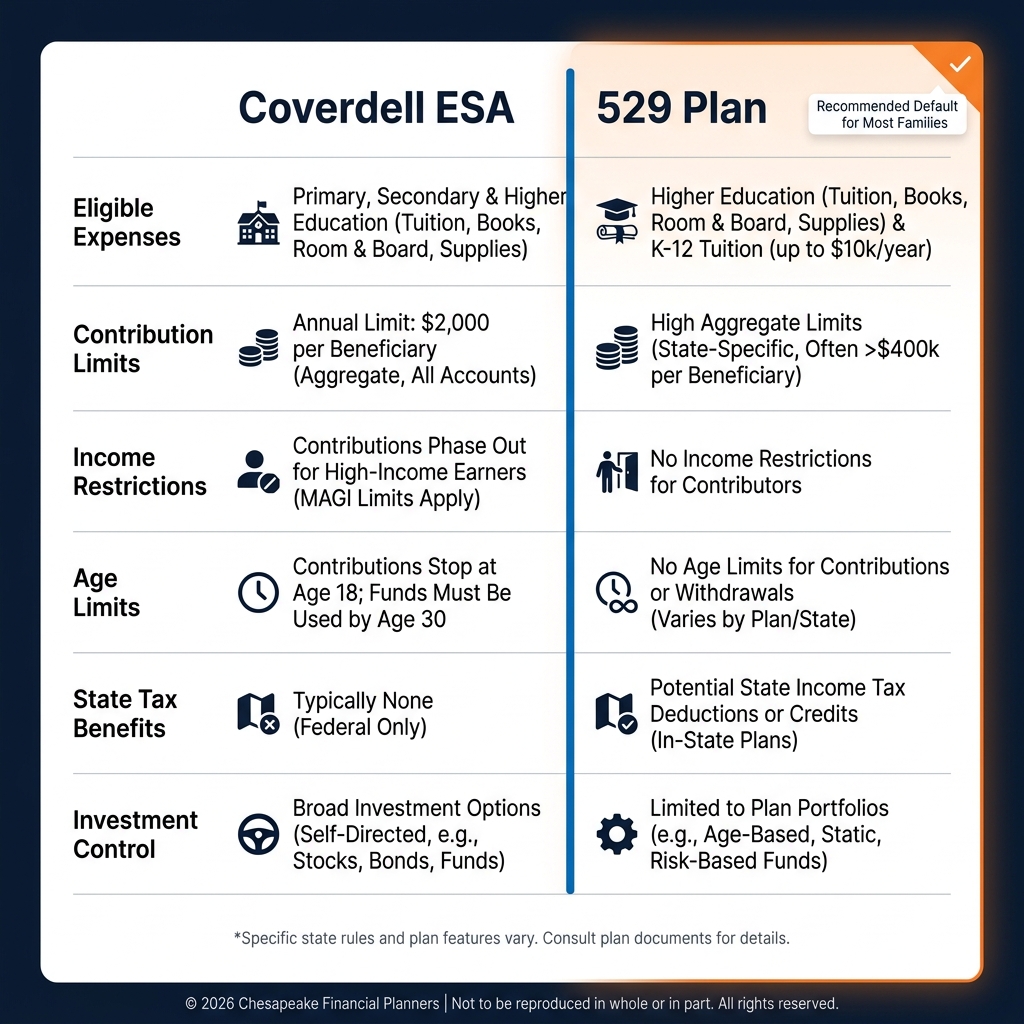
The table below lays the two accounts side by side on the features that decide the choice for most families.
| Feature | Coverdell ESA | 529 plan |
|---|---|---|
| Annual contribution limit | $2,000 per beneficiary | No federal limit ($19,000/yr gift exclusion applies) |
| Income restriction | Phases out $95K–$110K single; $190K–$220K married | None |
| K-12 coverage | Broad: tuition, books, supplies, tutoring, transport | Tuition only, up to $20,000/yr (2026) |
| Superfunding | Not available | Up to $95,000 ($190,000 joint) via 5-year election |
| Roth rollover | Not available | Up to $35,000 lifetime, under conditions |
| Age limit | Must distribute by age 30 | No age restriction |
How do contribution limits and income rules compare?
Contribution limits are where the 529 plan pulls decisively ahead, and income rules add another point in its favor. These two factors decide the account for most families before anything else.
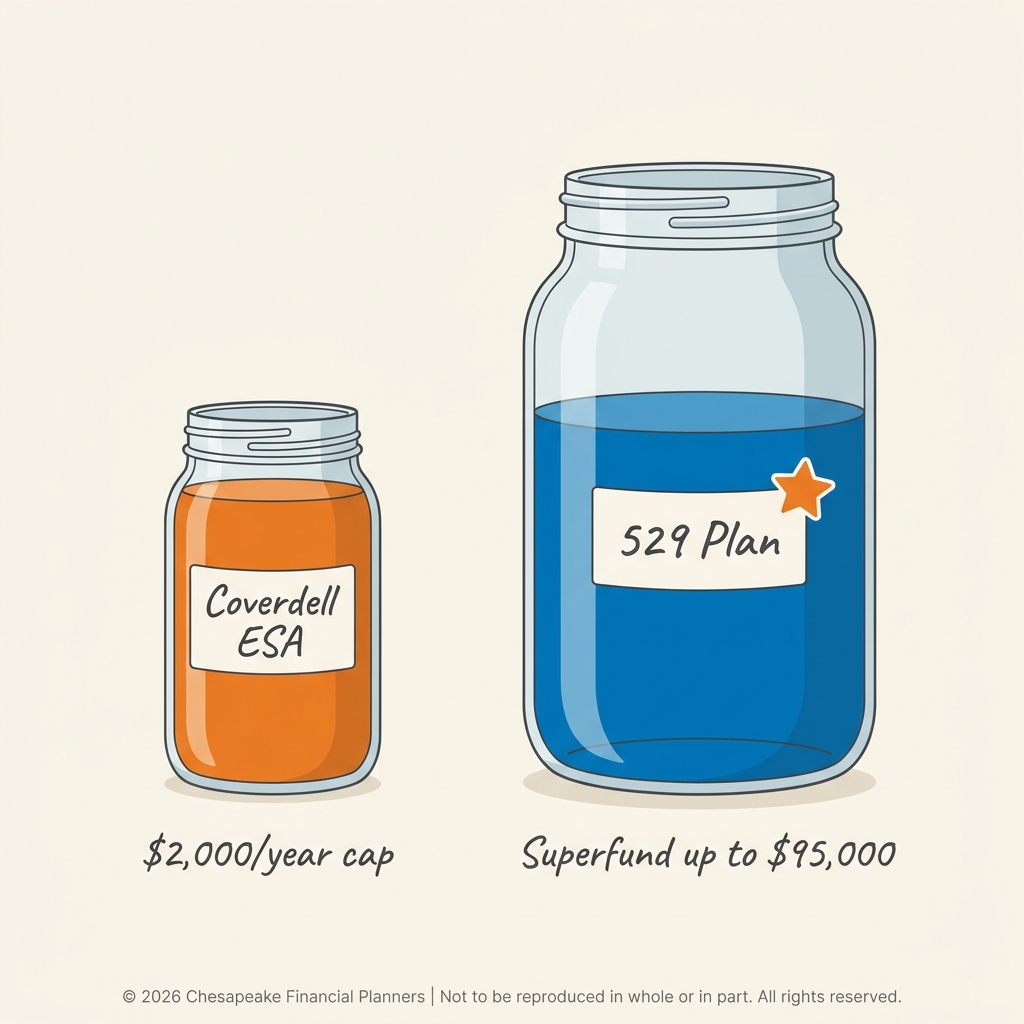
A Coverdell ESA limits contributions to $2,000 per beneficiary per year, total, across all contributors. If both parents and grandparents want to chip in, they collectively cannot exceed $2,000 per child annually, which simply will not build enough for several years of college even with strong growth. A 529 plan, by contrast, has no annual federal contribution limit, only a lifetime cap set by each state, often in the range of several hundred thousand dollars per beneficiary. You can contribute far more each year, and the 529 also offers superfunding, the ability to front-load five years of gifts at once, up to $95,000 per individual or $190,000 per couple, without triggering gift tax, while contributions above the annual gift exclusion of $19,000 for 2026 may otherwise require a gift tax filing.
Income rules reinforce the gap. Coverdell contributions phase out for single filers earning $95,000 to $110,000 and married couples earning $190,000 to $220,000, above which you cannot contribute directly at all. A 529 plan has no income restrictions whatsoever, whether you earn $50,000 or several million, you can contribute, which makes 529s especially valuable for high earners locked out of other tax-advantaged accounts. For families juggling retirement, parent care, and education savings at once, the freedom to accelerate 529 contributions in strong years is a real planning advantage the Coverdell's $2,000 cap cannot match.
Which account covers more, and which offers more flexibility?
The Coverdell ESA covers a broader set of K-12 expenses, while the 529 plan offers more flexibility on contributions, state tax benefits, beneficiary changes, and a Roth rollover. Each account wins in a different dimension, which is why some families use both.
On qualified expenses, the Coverdell is broader for K-12: it covers tuition, fees, books, supplies, equipment, tutoring, uniforms, transportation, and even room and board for younger students, making it attractive for private elementary and secondary schooling. The 529 plan now covers K-12 tuition too, up to $20,000 per year per beneficiary for 2026 after the One Big Beautiful Bill Act doubled the prior $10,000 limit, but only tuition, not the wider range of costs. For college, the two are largely equivalent: both cover tuition, fees, books, supplies, equipment, and room and board for at-least-half-time students, both cover registered apprenticeships, and both can pay up to $10,000 in student loan repayment.
On flexibility, the 529 leads in most respects. It offers age-based portfolios that automatically grow more conservative as college nears (or static options if you prefer), state tax deductions or credits in more than 30 states, and easy beneficiary changes to other family members without tax consequences. It also allows leftover funds to be rolled into the beneficiary's Roth IRA, up to a $35,000 lifetime limit under conditions, a valuable backstop against overfunding. The Coverdell offers wider investment choice (often the full brokerage menu), but it must be fully distributed by the time the beneficiary turns 30, a ticking clock the 529 does not impose. This balancing of features against your family's goals is exactly the kind of work the R.U.D.D.E.R. Method™ supports. The R.U.D.D.E.R. Method™ is Chesapeake Financial Planners' six-step planning process: Review and Recognize, Uncover and Understand, Design and Develop, Discuss and Decide, Execute and Empower, and Reassess and Refine, and education-account selection lives in Design and Develop, fit to your income, timeline, and the schools you anticipate.
Which account is right for your family?
For most families saving primarily for college, the 529 plan is the right default, while a Coverdell ESA makes sense for specific K-12 situations, and using both is often the smartest move. The choice follows your income, savings goals, and what you are paying for.
A 529 plan is the better fit when you are saving meaningful amounts for college, want state tax benefits, earn too much for Coverdell contributions, or simply prefer simpler administration with age-based portfolios. A Coverdell ESA fits when you want comprehensive K-12 expense coverage beyond tuition, your income qualifies, you want maximum investment control, and the $2,000 annual cap is enough for your purpose. Because they are not mutually exclusive, many families fund a Coverdell for near-term K-12 costs while building a 529 for long-term college savings, capturing each account's strengths.
The key is fitting education savings into your whole financial picture, balanced against retirement contributions, an emergency fund, and other goals competing for the same dollars. An account that maximizes education tax benefits but starves your retirement is not actually optimal. The right answer weighs all of it together.
Related Topics Worth Reading
Choosing an education account connects to broader college and tax planning. These related topics go deeper.
- How to fund college when you earn too much for need-based aid. What are my college funding options when my income disqualifies us from financial aid?
- The new rule letting leftover 529 money become Roth savings. How does the new 529-to-Roth rollover work?
- How grandparents can help without hurting financial aid. How does the grandparent 529 work after FAFSA simplification?
- The FAFSA strategy that still helps high-income families. Can a high-income family qualify for financial aid, and what strategies are allowed?
- Weighing federal and private loans for any remaining gap. Should I choose Parent PLUS loans or private student loans?
Frequently Asked Questions
What is the difference between a 529 plan and a Coverdell ESA?
Both are tax-advantaged education accounts that grow tax-free, but a 529 plan has no annual federal contribution limit and no income restrictions, while a Coverdell ESA caps contributions at $2,000 per child per year and phases out for higher earners. The Coverdell covers a broader range of K-12 expenses, whereas the 529 covers K-12 tuition (up to $20,000 per year for 2026) plus college, and adds state tax benefits, superfunding, and a Roth rollover option.
How much can I contribute to a Coverdell ESA versus a 529 plan?
A Coverdell ESA limits total contributions to $2,000 per beneficiary per year across all contributors. A 529 plan has no annual federal contribution limit, only a lifetime cap set by each state, often several hundred thousand dollars per beneficiary, and it allows superfunding of up to $95,000 per individual or $190,000 per couple in a single year using a five-year gift-tax election. This makes the 529 far better suited to building substantial college savings.
Can high-income families use a Coverdell ESA?
Often not directly. Coverdell ESA contributions phase out for single filers with modified adjusted gross income between $95,000 and $110,000 and married couples between $190,000 and $220,000, above which direct contributions are not allowed. A 529 plan, by contrast, has no income restrictions, so high-income families can always contribute. High earners who want a Coverdell sometimes work around the limit by gifting to the child, who then contributes, but the 529 is usually simpler.
Is a 529 plan or Coverdell ESA better for K-12 private school?
A Coverdell ESA is generally more flexible for K-12 because it covers tuition plus books, supplies, tutoring, uniforms, transportation, and more, while a 529 plan covers only K-12 tuition, up to $20,000 per year per beneficiary for 2026 after the One Big Beautiful Bill Act raised the limit. If your K-12 costs are mostly tuition, the 529 may suffice and adds other benefits; if you have substantial non-tuition K-12 expenses, the Coverdell's broader coverage can be the better fit.
Can I have both a 529 plan and a Coverdell ESA for the same child?
Yes, you can contribute to both a 529 plan and a Coverdell ESA for the same child, and many families do, using each account's strengths. A common approach funds a Coverdell for near-term K-12 expenses, taking advantage of its broad coverage, while building a 529 for long-term college savings with higher contributions and state tax benefits. Just keep total contributions within each account's rules and coordinate them with your other financial goals.
Choosing the right education account for your family
For the large majority of families saving for college, the 529 plan is the stronger default, with higher limits, no income caps, state tax benefits, and a Roth rollover backstop, while the Coverdell ESA earns its place for families with significant K-12 expenses who qualify to contribute. Because you can use both, the real task is matching each account to its best purpose and fitting the whole thing into a plan that also protects your retirement. Jeff Judge and the Chesapeake Financial Planners team help families across Harford County and the Baltimore metro do exactly that. Schedule a free fit call at chesapeakefp.com.
529 plans and Coverdell ESAs have specific tax rules and qualified expense definitions. Non-qualified withdrawals may incur taxes and penalties.
Want to go deeper? Our College Funding Playbook walks through this step by step.
Disclosures
The information provided is for educational purposes only and should not be construed as investment advice. Investment strategies should be tailored to individual circumstances, risk tolerance, and goals. Past performance doesn't guarantee future results. Consult with qualified financial professionals regarding your specific situation.
Prior to investing in a 529 Plan, investors should consider whether the investor's or designated beneficiary's home state offers any state tax or other state benefits such as financial aid, scholarship funds, and protection from creditors that are only available for investments in such state's qualified tuition program. Withdrawals used for qualified expenses are federally tax free. Tax treatment at the state level may vary. Please consult with your tax advisor before investing.
This information is not intended to be a substitute for specific individualized tax, investment or legal advice. We suggest that you discuss your specific situation with a qualified tax, legal or financial advisor.
Advisors associated with Chesapeake Financial Planners may be either (1) LPL Financial Registered Representatives offering securities through LPL Financial, Member FINRA and SIPC, and investment advisor representatives offering investment advice through Great Valley Advisor Group; or (2) solely investment advisor representatives offering investment advice through Great Valley Advisor Group and not affiliated with LPL Financial. Great Valley Advisor Group, and Chesapeake Financial Planners are separate entities from LPL Financial.


