

How Do I Overcome Emotional Biases When Investing?
Last reviewed: July 2026
You overcome emotional biases when investing by building rules that fire before your gut does. Investment biases are predictable mental shortcuts that push you to buy high, sell low, and hold losers too long. The fix is structural: a written plan, an automatic rebalancing schedule, and a process you trust more than your feelings in any given month.
Key Takeaways
- Investment biases are systematic thinking errors that cause investors to buy high and sell low at the worst possible times.
- Loss aversion makes losses feel roughly twice as painful as equivalent gains, per research from Kahneman and Tversky.
- The average equity fund investor underperformed the S&P 500 by 5.5 percentage points in a recent DALBAR-style gap analysis.
- Systematic rebalancing forces you to do the opposite of what recency bias and herd mentality suggest.
- A written investment policy is the single most reliable defense against emotional decisions in a volatile market.
About the Author: Jeff Judge, CFP®, AEP®, ChFC®, CLU® is Managing Partner of Chesapeake Financial Planners in Forest Hill, Maryland. He has been helping families and business owners in Harford County and the Baltimore metro area navigate investment decisions since earning his CFP® certification in 2013, by using Chesapeake Financial Planners’ signature process, the R.U.D.D.E.R. method™. Jeff has watched calm, intelligent clients try to liquidate solid portfolios during a three-week selloff, and the biggest value he adds in those moments is simply being the person who says "not today."
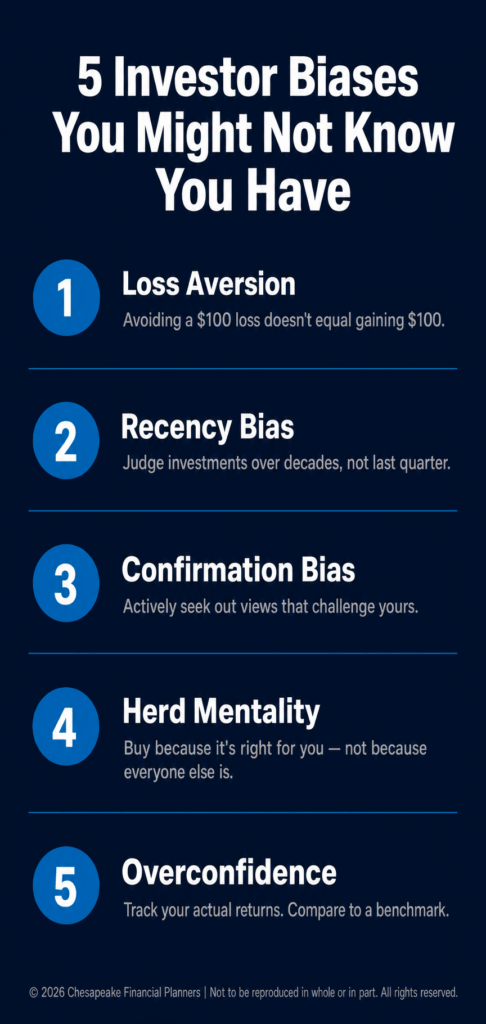
Behavioral finance is the study of how psychology drives financial decisions. The short version: you are wired to make bad investing moves at exactly the wrong moments. That wiring kept your ancestors alive on the savanna. It quietly drains your portfolio in a brokerage account. Here is how the most common investment biases work, what they cost, and how to beat each one.
What Is Loss Aversion and How Does It Hurt Investors?
Loss aversion is the tendency to feel the pain of a loss far more intensely than the pleasure of an equivalent gain. The original research by Daniel Kahneman and Amos Tversky found people weigh losses roughly twice as heavily as gains. That imbalance drives real money mistakes.
It shows up three ways. You hold losing investments too long, hoping they will "come back" rather than admit the loss. You sell winners too early to lock in a gain before it can evaporate. And you stay too conservative overall, missing decades of growth because short-term dips terrify you.
Say you bought a stock at $50 and it slid to $30. Selling means admitting you were wrong, so you cling to it instead of asking whether it is still worth owning. The fix is to judge your process, not the outcome of one position. A good decision can still lose money. Set sell rules in advance, and think in portfolios, not single stocks. One sour position barely matters if the whole portfolio is built correctly.
How Does Recency Bias Cause Investors to Buy High and Sell Low?
Recency bias is the habit of overweighting recent events and assuming current trends will run forever. It is one of the most expensive investment biases because it directly inverts the "buy low, sell high" rule.
You buy stocks or sectors after they have already surged, certain the rally continues. You dump them after a crash, certain the decline continues. You abandon diversification because "international hasn't done anything lately." Tech is the classic case. Investors piled in during the 2020-2021 run, then watched the Nasdaq fall roughly 33% in 2022. Those who bought at the top locked in the damage.
The defense is mechanical. Rebalance on a schedule, which forces you to trim what surged and add to what lagged, the exact opposite of what recency bias whispers. Study market history so cycles stop surprising you. And stick to your target allocation even when one corner of the market is having a great year. The plan exists precisely so you do not rewrite it mid-emotion.
How Do Overconfidence and Herd Mentality Sabotage Returns?
Overconfidence bias is the belief that you are a better investor than you actually are, and herd mentality investing is the urge to follow the crowd into and out of positions. Most people believe they are above-average investors, the same way most people believe they are above-average drivers. By definition, that math cannot hold.
Overconfidence leads to overtrading, concentrated bets, and ignored risk. The data is unkind here. The average equity fund investor has historically trailed the funds they actually owned by several percentage points a year, largely from buying and selling at the wrong times. Herd mentality adds fuel: when everyone is buying a meme stock or fleeing a selloff, the social pressure to join is enormous.
The antidote is humility built into the system. Use low-cost index funds so you stop trying to outguess the market. Track your trades honestly and compare them to a simple buy-and-hold benchmark. Most people who run that exercise stop overtrading within a year. Herd behavior loses its grip when your buy and sell decisions are set by a calendar, not a headline.

How Does a Written Plan Defend Against Confirmation Bias?
Confirmation bias is the tendency to seek out information that supports what you already believe while dismissing anything that contradicts it. It is quieter than the other investment biases, which makes it more dangerous. You read only bullish takes on stocks you own, wave off critical reports as "noise," and surround yourself with people who agree with you.
Jeff Judge often points out that the most expensive word in investing is "obviously." When a client is certain a position is undervalued and dismisses every warning sign, the conviction itself is the risk. A written investment policy statement breaks the loop because it commits you to rules before emotion enters the room. It defines your target allocation, your rebalancing triggers, and the conditions under which you will buy or sell, all decided when you are calm.
This is where a documented process earns its keep. The R.U.D.D.E.R. Method™ is Chesapeake Financial Planners' six-step planning process: Review and Recognize, Uncover and Understand, Design and Develop, Discuss and Decide, Execute and Empower, and Reassess and Refine. A repeatable framework like this keeps decisions tied to your goals instead of the day's market mood. For more on staying grounded in turbulent markets, see How Can I Avoid Making Emotional Investment Decisions? and What should I do if the stock market crashes?.
A few more resources worth bookmarking: How Do I Overcome My Fear of Investing in the Stock Market? and Is my portfolio diversified enough to handle market volatility?.
Frequently Asked Questions
What are the most common investment biases?
The most common investment biases are loss aversion, recency bias, overconfidence, confirmation bias, and herd mentality. Each one nudges you toward buying high and selling low. They are systematic, predictable, and shared by nearly all investors, which is exactly why building rules to counter them works so reliably over time.
How does loss aversion affect investment decisions?
Loss aversion makes the pain of a loss feel roughly twice as strong as the pleasure of an equal gain. That imbalance causes investors to hold losing positions too long, sell winners too early, and stay overly conservative. Judging your process rather than individual outcomes is the most effective counterweight to this bias.
Can you actually eliminate emotional bias from investing?
No, you cannot eliminate emotional bias, because it is hardwired into human psychology. You can, however, neutralize its effect on your money by building structure around your decisions. A written investment plan, an automatic rebalancing schedule, and low-cost index funds let your system act rationally even when you feel anything but calm.
What is the single best defense against investment biases?
The single best defense against investment biases is a written investment policy statement combined with systematic rebalancing. Deciding your rules in advance, while calm, removes emotion from the moment of decision. Rebalancing then forces you to trim winners and add to laggards, the opposite of what fear and greed suggest.
Does hiring a financial advisor help reduce behavioral mistakes?
Yes, a good advisor often helps most by being the person who keeps you invested during downturns and disciplined during rallies. Much of an advisor's measurable value comes from behavioral coaching rather than stock picking. Having an objective party enforce your plan reduces the emotional, biased decisions that quietly erode long-term returns.
Recognizing investment biases is the first step; building a structure that overrides them is where the real money is made. If this was useful, our free guide on behavioral finance and disciplined investing walks through how to build a rules-based plan that protects you from your own worst instincts. Download it at chesapeakefp.com.
Disclosures
The information provided is for educational purposes only and should not be construed as investment advice. Investment strategies should be tailored to individual circumstances, risk tolerance, and goals. Past performance doesn't guarantee future results. Consult with qualified financial professionals regarding your specific situation.
Advisors associated with Chesapeake Financial Planners may be either (1) LPL Financial Registered Representatives offering securities through LPL Financial, Member FINRA and SIPC, and investment advisor representatives offering investment advice through Great Valley Advisor Group; or (2) solely investment advisor representatives offering investment advice through Great Valley Advisor Group and not affiliated with LPL Financial. Great Valley Advisor Group, and Chesapeake Financial Planners are separate entities from LPL Financial.


