

What Is Market Volatility and How Should I Handle It?
Last reviewed: July 2026
Market volatility is the rate and size of price swings in the market over a given period. It measures how much prices move, not which direction they move. A volatile market can climb just as easily as it can fall. For long-term investors, volatility is not a malfunction to fear. It is the normal cost of admission for the higher returns stocks have historically delivered, and learning to sit through it is one of the most valuable habits you can build.
Key Takeaways
- Market volatility measures how fast and how far prices move, not their direction. Volatile markets can go up or down.
- Stock market volatility is normal. The S&P 500 sees double-digit intra-year drops in most years yet finishes positive most of the time.
- The VIX index above 20 signals elevated expected swings; readings below 15 suggest calm conditions.
- Selling during a downturn locks in losses and risks missing the recovery, which often arrives without warning.
- A diversified mix matched to your time horizon is the single best tool for handling investment volatility.
About the Author: Jeff Judge, CFP®, AEP®, ChFC®, CLU® is Managing Partner of Chesapeake Financial Planners in Forest Hill, Maryland. He has been helping families and business owners in Harford County and the Baltimore metro area navigate market volatility and portfolio decisions since earning his CFP® certification in 2013, by using Chesapeake Financial Planners’ signature process, the R.U.D.D.E.R. method™. Jeff often tells clients that the investors who do worst in a downturn are rarely the ones with the wrong portfolio. They are the ones who abandon a good plan at the worst possible moment.
What Is Market Volatility?
Market volatility is a measure of how much and how quickly prices change over a set period. High volatility means large, rapid swings in both directions. Low volatility means smaller, steadier movements. The most-watched gauge is the Cboe Volatility Index, or VIX, sometimes called the "fear gauge" because it reflects the size of swings investors expect over the next 30 days.
A VIX reading above 20 generally signals elevated expected volatility, while readings below 15 point to calmer conditions. During the March 2020 selloff, the VIX briefly closed above 80, one of its highest levels on record.
The most important thing to remember about stock market volatility is that it measures movement, not direction. A market can be highly volatile while trending upward. People hear "volatile" and assume "falling," but the two are not the same. Volatility just means prices are moving fast.
Why Does the Market Move Up and Down?
Markets move for countless reasons, but a handful of drivers do most of the heavy lifting. Economic data such as jobs reports, GDP growth, and inflation readings shifts investor sentiment within minutes of release. Corporate earnings move individual stocks when profits come in stronger or weaker than analysts expected. Interest rate decisions from the Federal Reserve ripple through borrowing costs, corporate margins, and how investors price future earnings.
Geopolitical events add another layer. Wars, contested elections, trade disputes, and pandemics all inject uncertainty, and markets dislike uncertainty more than they dislike bad news. Finally, there is investor psychology. Fear and greed drive a large share of short-term moves. When everyone rushes for the exits at once, prices drop faster than any change in business value would justify.
Here is the insight worth holding onto: most day-to-day investment volatility is driven by emotion and short-term headlines, not by a real change in what businesses are worth. The companies in your portfolio did not lose a fifth of their long-term value because of one bad inflation print. The price moved. The value usually did not.
Is Volatility Normal, and Should I Worry About It?
Volatility is completely normal and, in a sense, necessary. It is the price you pay for the long-term returns stocks provide. According to J.P. Morgan Asset Management, the S&P 500 has finished the year positive in roughly three out of every four years going back to 1980, yet the average intra-year drop in that span was around 14%. Read that twice. In a typical year, the market falls double digits at some point and still ends higher.
That gap between the scary moment and the eventual outcome is where most investing mistakes happen. The decline feels permanent while you are living through it. It rarely is.
Take 2021 as an example. The S&P 500 finished the year up about 27% on a price basis, but along the way it absorbed a roughly 5% pullback in the winter and another dip in the fall, plus steady daily noise. An investor who checked their statement only once that December would have seen a banner year. An investor who watched every tick would have felt every bump.
Without volatility there would be no risk, and without risk there would be no premium return. You are being compensated for your willingness to endure the swings. Jeff Judge puts it plainly with clients: the swings are not the cost of a broken system, they are the fee the market charges for above-cash returns.

What Are the Different Types of Market Declines?
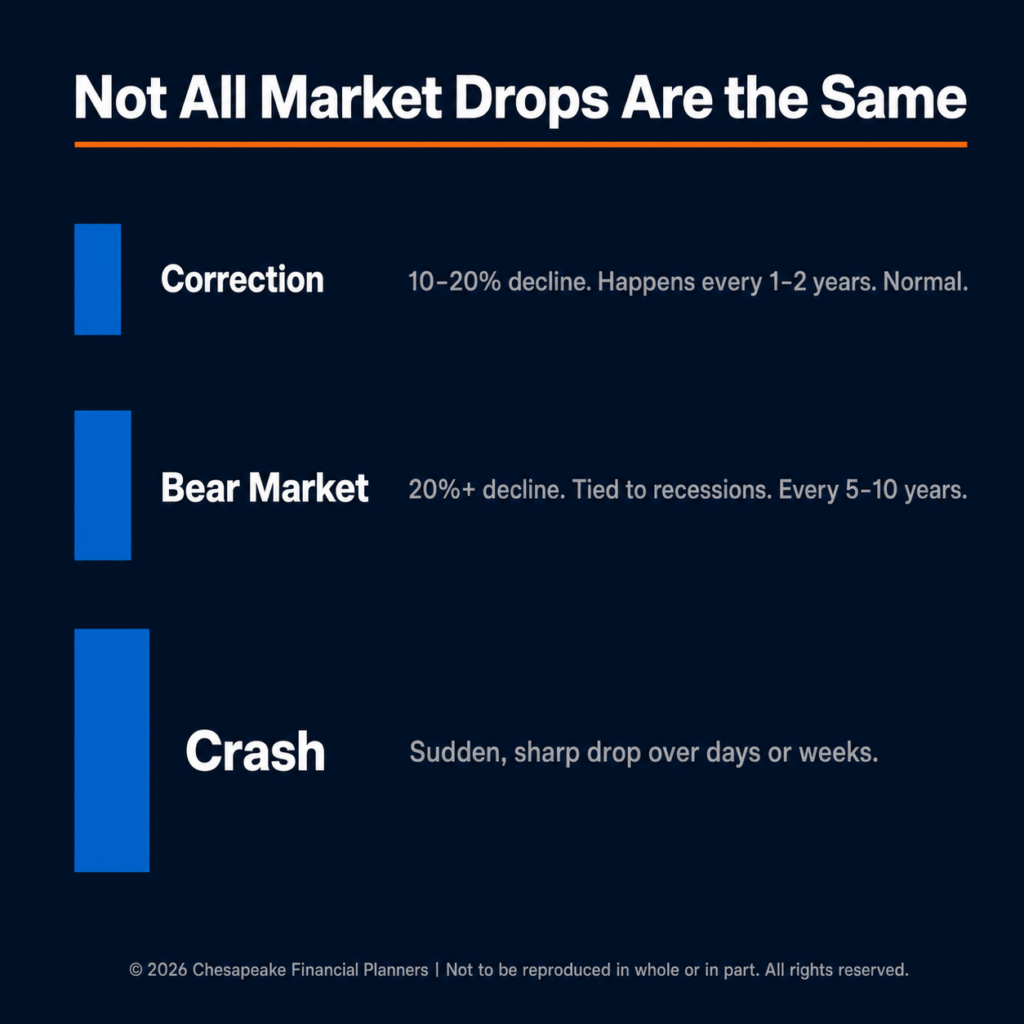
Not every downturn is the same, and knowing the difference helps you keep your head when headlines get loud. The table below breaks down the main categories.
| Type of decline | Size | How often | What it usually means |
|---|---|---|---|
| Correction | 10% to 20% drop | Roughly every 1 to 2 years | A normal, healthy pullback |
| Bear market | 20%+ drop | Roughly every 5 to 10 years | Often tied to recession or major crisis |
| Crash | Sudden sharp drop over days | Rare | A fast panic, frequently followed by recovery |
A correction of 10% to 20% is a routine event, not a crisis. Bear markets are more severe and are often linked to a recession or a broad shock. Crashes are sudden, violent drops measured in days rather than months, like October 1987 when the market fell about 22% in a single session, or the March 2020 selloff tied to the pandemic.
One distinction worth keeping straight is volatility versus drawdown. Volatility describes how much prices bounce around. Drawdown describes how far the market has fallen from its most recent peak. A market can be volatile without a deep drawdown, and it can grind to a deep drawdown without dramatic daily swings. Understanding which one you are looking at helps you respond to what is actually happening rather than what the headline implies. If you want to gauge whether your own holdings can withstand these swings, it is worth asking Is my portfolio diversified enough to handle market volatility?.
How Should I Actually Handle Market Volatility?
The hardest part of investing is not picking funds. It is sitting still when your gut screams to act. The most reliable way to handle volatility is to decide in advance how you will respond, so the decision is already made before the fear arrives.
Start with your time horizon. Money you need in the next year or two should not be exposed to stock market volatility in the first place. Money you will not touch for a decade or more can ride out almost any storm, because history is firmly on the side of the patient. Match your asset allocation to those horizons and the day-to-day noise becomes far easier to ignore. Our guide on How should my investment mix change as I get closer to retirement? walks through how that mix should shift over time.
A diversified portfolio is your shock absorber. When stocks fall, bonds and other assets often hold steadier, softening the blow. Rebalancing on a schedule forces you to trim what has run up and add to what has lagged, which is a disciplined way of buying low without having to predict anything. Jeff Judge notes: "The clients who rebalance on a calendar — not when they feel scared and not when they feel confident — are the ones who end up buying low and trimming high almost by accident, which is the only reliable way to do it." And resist the urge to sell into a panic. Selling locks in the loss and then dares you to guess the right moment to get back in, a guess very few people win. For more on this, see How Can I Avoid Making Emotional Investment Decisions?.
Frequently Asked Questions
What does market volatility mean in simple terms?
Market volatility means how much and how quickly investment prices move up and down over a period of time. High volatility means large, fast swings in either direction. Low volatility means smaller, steadier movements. Volatility measures the size of the movement, not whether prices are rising or falling.
Is high market volatility good or bad for investors?
High market volatility is neither inherently good nor bad. For long-term investors, it is simply the normal cost of earning stock-market returns and can even create buying opportunities. For someone who needs cash within a year or two, high volatility is a real risk, which is why short-term money should not sit in volatile assets in the first place.
What is the VIX index and what does it tell me?
The VIX index, run by Cboe, measures the level of price swings investors expect in the S&P 500 over the next 30 days. It is often called the "fear gauge." Readings above 20 generally signal elevated expected volatility, while readings below 15 suggest calmer conditions. The VIX reflects expectations, not a guaranteed forecast.
Should I sell my investments when the market gets volatile?
Selling during a volatile market usually hurts long-term investors because it locks in losses and forces you to guess when to buy back in. Recoveries often arrive suddenly and without warning, so investors who sell frequently miss the strongest rebound days. A better approach is to match your allocation to your time horizon and stay invested through the swings.
How is a correction different from a bear market?
A correction is a market decline of 10% to 20% from a recent peak and tends to happen every one to two years. A bear market is a deeper decline of 20% or more, occurs roughly every five to ten years, and is often tied to a recession or major crisis. Corrections are routine; bear markets are more severe.
How can I protect my portfolio from market volatility?
The most effective protection is diversification combined with an asset allocation matched to when you will need the money. Spreading holdings across stocks, bonds, and other assets cushions the impact when one area falls. Rebalancing on a schedule keeps your risk level steady, and keeping short-term cash needs out of stocks removes the pressure to sell at a bad time.
Volatility is not the enemy. Reacting to it is. If you found this helpful, our investor education library covers how to build a portfolio that can weather these swings without keeping you up at night. Download our free guide to handling market volatility at chesapeakefp.com.
Disclosures
The information provided is for educational purposes only and should not be construed as investment advice. Investment strategies should be tailored to individual circumstances, risk tolerance, and goals. Past performance doesn't guarantee future results. Consult with qualified financial professionals regarding your specific situation.
Advisors associated with Chesapeake Financial Planners may be either (1) LPL Financial Registered Representatives offering securities through LPL Financial, Member FINRA and SIPC, and investment advisor representatives offering investment advice through Great Valley Advisor Group; or (2) solely investment advisor representatives offering investment advice through Great Valley Advisor Group and not affiliated with LPL Financial. Great Valley Advisor Group, and Chesapeake Financial Planners are separate entities from LPL Financial.


