
How Do I Overcome My Fear of Investing in the Stock Market?
Last reviewed: July 2026
You overcome the fear of investing by reframing what risk actually means, starting with small amounts you can afford to lose, and automating your contributions so emotion never touches the decision. The fear is normal, but staying in cash is the bigger gamble. Inflation guarantees a slow loss of purchasing power, while a diversified portfolio has historically rewarded patient investors over time.
Key Takeaways
- Loss aversion makes the pain of a loss feel about twice as strong as the pleasure of an equal gain.
- Since 1926, the S&P 500 has finished positive in roughly three of every four years.
- Inflation cooled to 2.4% in March 2026, but cash still loses ground over decades.
- Dollar-cost averaging removes the pressure of timing the market and turns volatility into an advantage.
- Starting ten years earlier can mean a difference of over $1 million by retirement, even with identical monthly contributions.
About the Author: Jeff Judge, CFP®, AEP®, ChFC®, CLU® is Managing Partner of Chesapeake Financial Planners in Forest Hill, Maryland. He has been helping families and business owners in Harford County and the Baltimore metro area work through investment anxiety and build durable portfolios since earning his CFP® certification in 2013, by using Chesapeake Financial Planners’ signature process, the R.U.D.D.E.R. method™. Jeff puts it plainly: the clients who struggle most aren't the ones who pick the wrong fund, they're the ones who waited a decade to start.
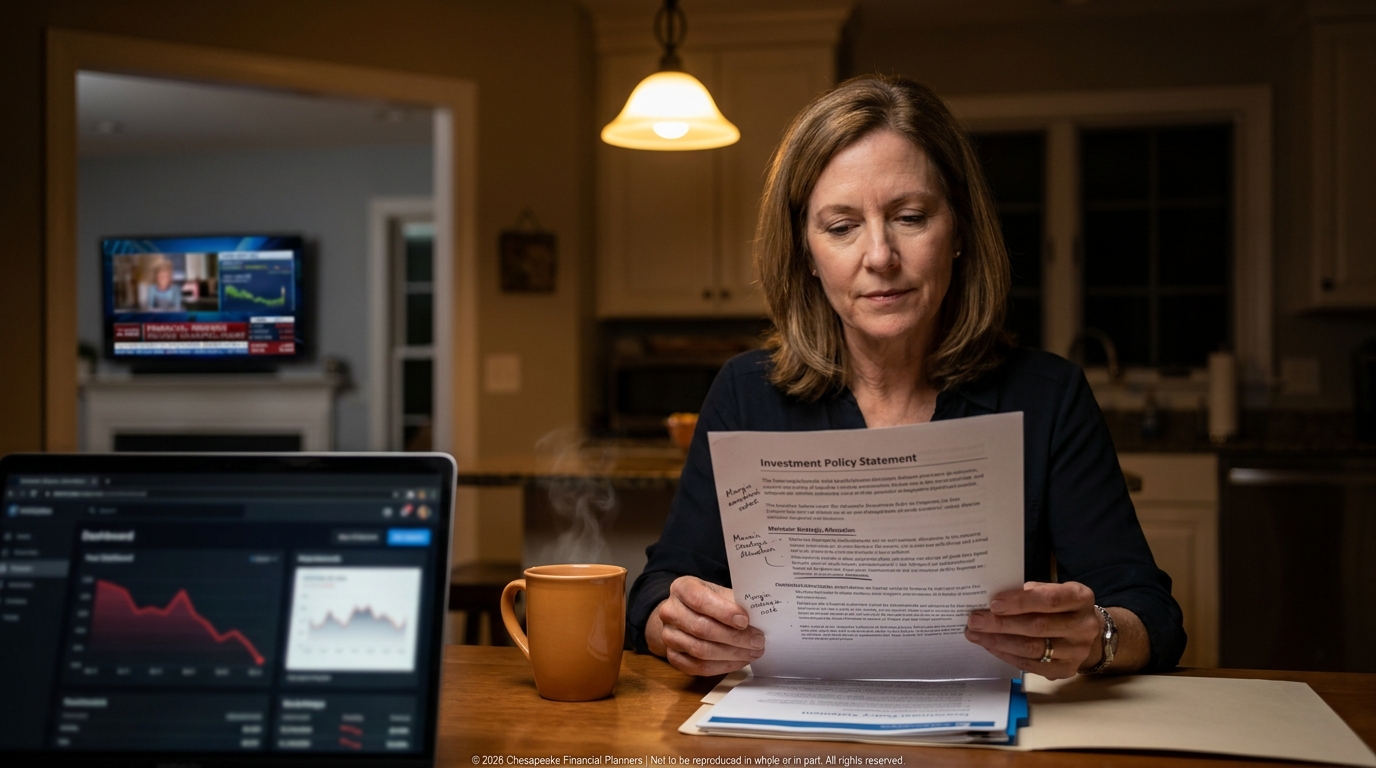
You've meant to invest for years. You know you should. But every time you go to move money into an investment account, your chest tightens. What if you lose it all? What if you buy right before a crash? That fear of investing keeps millions of capable people on the sidelines, watching their savings quietly erode. Here's where the fear comes from, what it actually costs you, and how to move past it.
Why Are We So Afraid to Invest?
Investment anxiety isn't a character flaw. It's wired into how our brains process money, and understanding the wiring is the first step to disarming it.
The biggest culprit is loss aversion. Behavioral economists have documented that the pain of losing $100 feels roughly twice as intense as the pleasure of gaining the same $100. So the fear of dropping $10,000 in a downturn overwhelms the excitement of gaining $30,000 over a decade, even though the gain is both more likely and more valuable. Your brain is running a threat-detection program that was useful on the savanna and counterproductive in a brokerage account.
We also remember crashes far better than recoveries. The 2008 financial crisis, the dot-com bust, the COVID drop in early 2020. Those are vivid because they were dramatic and heavily covered. What fades from memory is that the market recovered each time and went on to new highs. Since 1926, the S&P 500 has posted positive annual returns in about 75% of years. A quarter of years bring losses, but over time the wins dramatically outweigh them.
Then there's the language barrier. Stocks, bonds, ETFs, index funds, expense ratios, asset allocation. When something feels complicated and high-stakes, the human default is to procrastinate. We tell ourselves "I'll learn more first," and that day rarely arrives. Add the fear of looking foolish in front of friends or family, plus inherited money stories ("the market is just gambling"), and the paralysis compounds.
How Can I Avoid Making Emotional Investment Decisions?


What Is the Real Risk of Not Investing?
The real risk of not investing is inflation slowly stripping your purchasing power while your money sits in cash. The market feels dangerous because it moves; inflation feels safe because it's invisible. That perception is exactly backwards.
Even with inflation cooling to 2.4% in March 2026 according to the Bureau of Labor Statistics, cash still loses ground over time. Picture $50,000 in a savings account earning 1% while prices rise 3% a year. In year one your purchasing power slips to about $48,500. By year ten it's worth roughly $37,000 in today's dollars. By year thirty, around $20,500. Your account balance never dropped, but you quietly surrendered more than half of what that money could buy.
Time is the asset most people waste. Consider two savers. Investor A puts away $500 a month starting at age 25 and stops at 65. Investor B waits until 35 and invests the same $500 a month until 65. Assuming an 8% average annual return, Investor A ends up near $1.75 million and Investor B around $745,000. Investor A contributed only $60,000 more but finished with more than $1 million extra. That gap is the price of waiting "until you feel ready."
Jeff Judge sees this pattern constantly with new clients. "People obsess over picking the perfect fund and lose three years to the decision," he says. "The fund choice matters far less than simply starting. Time in the market does the heavy lifting." That observation is why the firm's planning process front-loads getting money invested over optimizing every last detail.
How Does Inflation Affect My Savings and Retirement Money?

How Do I Actually Start Investing Without Panicking?
You start by reframing risk, beginning with small amounts, automating contributions, and diversifying so no single company can wreck you. Each step is designed to lower the emotional temperature so you can act.
First, reframe what risk means. Old thinking says investing is risky because you might lose money. New thinking recognizes that not investing is the guaranteed loss, because inflation erodes your purchasing power every single year. Risk isn't volatility; it's whether you'll have enough to retire and keep pace with rising costs.
Second, start small to build confidence. You don't need thousands. Open a brokerage account and invest $50 or $100 in a broad-market index fund. Watch it move up and down for a few months. You'll see firsthand that the world doesn't end when your balance dips, and that experience is worth more than any article.
Third, favor time in the market over timing the market. Even professional investors can't reliably call tops and bottoms. Dollar-cost averaging, setting up automatic transfers that invest the same amount every month regardless of price, smooths out the highs and lows and removes emotion from the equation. According to FINRA, this disciplined approach helps investors avoid the costly trap of reacting to short-term swings.
Fourth, diversify. Buying one stock is speculation. Owning a total stock market index fund or a broad ETF means holding hundreds or thousands of companies at once, so a single bad apple can't sink your plan. Vanguard and other major firms have long documented how diversification reduces the volatility you actually feel.
At Chesapeake Financial Planners, we walk clients through this using the R.U.D.D.E.R. Method™, our six-step planning process: Review and Recognize, Uncover and Understand, Design and Develop, Discuss and Decide, Execute and Empower, and Reassess and Refine. The "Uncover and Understand" step is where the fear of investing gets named out loud and addressed directly, before a single dollar moves.
What Is Market Volatility and How Should I Handle It?
Frequently Asked Questions
Is it normal to be scared of investing?
Yes, fear of investing is completely normal and rooted in how the brain processes money. Loss aversion makes the pain of a potential loss feel about twice as strong as the pleasure of an equal gain. Recognizing the fear as a predictable mental pattern, rather than a verdict on your judgment, is the first step toward acting despite it.
How much money do I need to start investing?
You can start investing with as little as $50 or $100, since many brokerages now offer no-minimum accounts and fractional shares. The goal of starting small is not building wealth overnight but getting comfortable watching your balance move. Once you've experienced a few ups and downs without panic, increasing your contributions becomes far easier.
What is dollar-cost averaging and why does it reduce fear?
Dollar-cost averaging means investing the same fixed amount on a regular schedule, regardless of whether the market is up or down. It reduces fear by removing the pressure to time your entry perfectly and by automating the decision so emotion never enters the process. Over time, this approach smooths out price swings and builds a consistent investing habit.
Should I wait until the market drops before I invest?
No, waiting for the market to drop usually costs more than it saves, because even professionals can't reliably time the bottom. Time in the market consistently beats timing the market over long horizons. Starting now and investing steadily through dollar-cost averaging captures growth you'd otherwise miss while sitting in cash that inflation slowly erodes.
Isn't keeping my money in savings the safe choice?
Keeping all your money in savings feels safe but quietly loses purchasing power to inflation every year. Even with inflation at 2.4% in early 2026, cash earning low interest falls behind rising prices over time. A diversified portfolio carries short-term volatility but has historically outpaced inflation and protected long-term buying power far better than cash.
Ready to Take the First Step?
Fear of investing rarely disappears from reading alone. It fades when you have a plan you trust and someone to talk through the worst-case scenarios with. If this helped, our free investing starter guide breaks down how to build your first diversified portfolio step by step, with no jargon. Download it at chesapeakefp.com and turn that knot in your chest into a plan you can actually act on.
Want to go deeper? Our R.U.D.D.E.R Audit for DIY Investors walks through this step by step.
Disclosures
The information provided is for educational purposes only and should not be construed as investment advice. Investment strategies should be tailored to individual circumstances, risk tolerance, and goals. Past performance doesn't guarantee future results. Consult with qualified financial professionals regarding your specific situation.
Stock investing includes risks, including fluctuating prices and loss of principal.
Advisors associated with Chesapeake Financial Planners may be either (1) LPL Financial Registered Representatives offering securities through LPL Financial, Member FINRA and SIPC, and investment advisor representatives offering investment advice through Great Valley Advisor Group; or (2) solely investment advisor representatives offering investment advice through Great Valley Advisor Group and not affiliated with LPL Financial. Great Valley Advisor Group, and Chesapeake Financial Planners are separate entities from LPL Financial.


