

What is a mega backdoor Roth, and how do I use one?
Last reviewed: July 2026
A mega backdoor Roth is a strategy that lets certain 401(k) savers move tens of thousands of dollars of after-tax contributions into a Roth account each year, far beyond the standard Roth IRA limit. For 2026, it can route as much as $72,000 in total 401(k) contributions (your deferral, your employer's contributions, and after-tax money combined) toward Roth treatment, depending on your plan and how much your employer already puts in. If your income is too high to contribute to a Roth IRA directly, this is one of the few remaining ways to build a sizable Roth balance.
The catch: your employer's plan has to allow two specific features, and most plans don't. The rest of this guide explains how the mega backdoor Roth works, who it fits, and how to find out whether your plan supports it.
On This Page
- Key Takeaways
- What is a mega backdoor Roth?
- How does the mega backdoor Roth actually work?
- How much can you actually contribute in 2026?
- Does your 401(k) plan even allow a mega backdoor Roth?
- Who should consider a mega backdoor Roth, and who shouldn't?
- Related Topics Worth Reading
- Frequently Asked Questions
- Put a plan around it
- Disclosures
Key Takeaways
- A mega backdoor Roth uses the gap between the employee deferral limit and the 2026 total 401(k) ceiling of $72,000 to move after-tax dollars into Roth treatment.
- The strategy requires two plan features most 401(k)s lack: after-tax contributions and either in-plan Roth conversions or in-service distributions, as clarified in IRS Notice 2014-54.
- Converting after-tax dollars to Roth quickly limits taxable earnings — some plans auto-convert each contribution the same day it is made.
- High earners phased out of direct Roth IRA contributions above $252,000 joint in 2026 can use the mega backdoor Roth to build meaningful Roth balances through their workplace plan.
- The regular backdoor Roth IRA is capped at $7,500 for 2026; the mega backdoor Roth can move far larger amounts depending on plan features and employer contributions.
About the Author: Jeff Judge, CFP®, AEP®, ChFC®, CLU® is Managing Partner of Chesapeake Financial Planners in Forest Hill, Maryland. He has been helping families and business owners in Harford County and the Baltimore metro area navigate retirement savings and Roth strategies since earning his CFP® certification in 2013, by using Chesapeake Financial Planners’ signature process, the R.U.D.D.E.R. method™. Jeff sees the mega backdoor Roth misunderstood more than almost any other strategy: people assume their plan allows it when it usually doesn't, and they skip the one call to HR that would settle the question in five minutes.
What is a mega backdoor Roth?
A mega backdoor Roth is a method for getting after-tax dollars out of a 401(k) and into a Roth account, where future growth and qualified withdrawals receive Roth tax treatment. It works by using a part of the tax code most savers ignore: the gap between the employee deferral limit and the much higher total contribution limit.
Here's the distinction that trips people up. Your standard 401(k) deferral, the money you choose to set aside from each paycheck, is capped at $24,500 for 2026 if you're under 50. But the IRS sets a separate, larger ceiling on everything that can land in your 401(k) from all sources combined. After-tax contributions live in the space between those two numbers. The mega backdoor Roth is simply the act of filling that space and then converting it to Roth.
It is not the same as a regular How do I do a backdoor Roth IRA?, which moves a much smaller amount through a traditional IRA. The "mega" version runs through your workplace plan and involves far larger sums.
How does the mega backdoor Roth actually work?
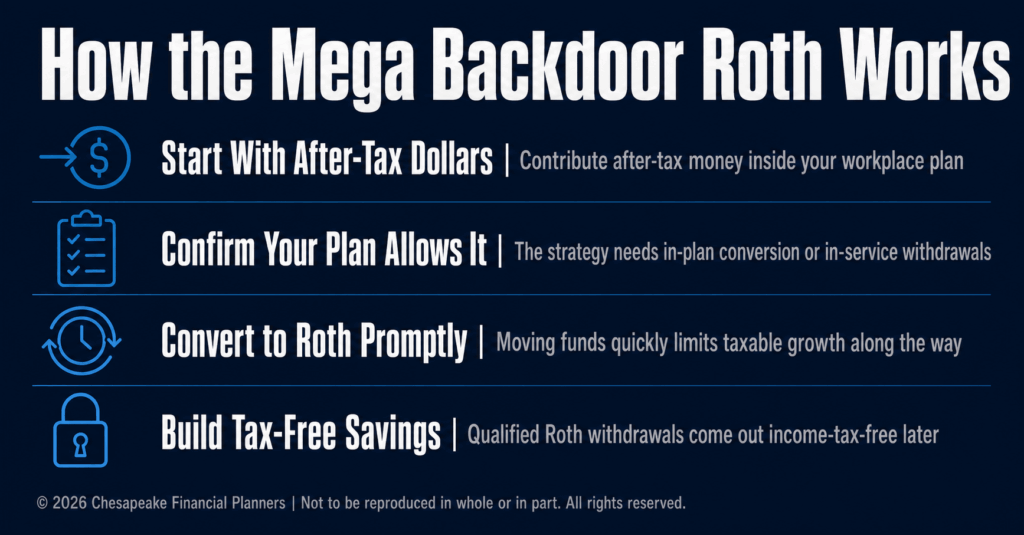
The mega backdoor Roth works in two steps: you make after-tax (non-Roth) contributions to your 401(k), then you convert those dollars to Roth before they generate much in earnings.
Step one is the after-tax contribution. This is a third contribution type, separate from your pre-tax and Roth deferrals. You're putting in money you've already paid taxes on, and it sits in a designated after-tax sub-account inside the plan.
Step two is the conversion. You move those after-tax dollars into Roth treatment one of two ways: an in-plan Roth conversion (the money stays in the 401(k) but becomes Roth), or an in-service distribution that rolls the after-tax money out to a Roth IRA. The IRS clarified how to split after-tax money from its earnings in Notice 2014-54, which lets you direct the after-tax portion to a Roth IRA and the earnings to a traditional IRA.
Timing matters. Any growth that happens between the contribution and the conversion is taxable when you convert, so this after-tax 401(k) conversion should be done quickly. Jeff's rule with clients: convert quickly and convert often. Some plans support automatic, same-day conversion of each after-tax contribution, which keeps the taxable earnings close to zero. If yours does, use it.
How much can you actually contribute in 2026?
For 2026, the total amount that can go into your 401(k) from all sources is $72,000, up from $70,000 in 2025. That figure, set under Section 415(c) of the tax code, is the ceiling the mega backdoor Roth works against.
The IRS stated it plainly in its annual cost-of-living announcement:
"The limitation for defined contribution plans under section 415(c)(1)(A) is increased in 2026 from $70,000 to $72,000."
To find your after-tax headroom, start at $72,000 and subtract two things: your own elective deferrals (up to $24,500 for 2026) and whatever your employer contributes in match or profit sharing. What's left is the most you could contribute after-tax and then convert.
A quick example. Say you defer the full $24,500 and your employer adds $10,000 in match. That's $34,500 of the $72,000 used. The remaining $37,500 is the after-tax room a mega backdoor Roth could fill, if your plan allows it.
If you're 50 or older, the numbers climb. The age-50 catch-up adds $8,000, lifting the combined ceiling to $80,000 for 2026. Savers aged 60 to 63 get a larger catch-up under SECURE 2.0, raising the total to $83,250. The catch-up sits on top of the $72,000 base, so it widens your after-tax room rather than competing with it.
| Saver age in 2026 | Total 401(k) contribution ceiling |
|---|---|
| Under 50 | $72,000 |
| 50 to 59, or 64 and up | $80,000 |
| 60 to 63 | $83,250 |
Does your 401(k) plan even allow a mega backdoor Roth?
Most 401(k) plans do not support the mega backdoor Roth, so this is the first thing to check before you build any plan around it. Two features have to both be present.
First, the plan must permit after-tax (non-Roth) contributions above the standard deferral limit. Many plans cap you at the $24,500 deferral and offer nothing beyond it. Second, the plan must allow either in-plan Roth conversions or in-service distributions, so you can actually move the after-tax money to Roth. Without the conversion step, the after-tax money just sits there and its earnings accrue as taxable money.
Call your plan administrator or HR and ask three direct questions: Does the plan allow after-tax contributions above my regular deferral? Does it allow in-plan Roth conversions or in-service rollovers? And can those conversions be automated? The answers tell you whether the strategy is even on the table.
Jeff has watched high earners assume for years that their plan supported this, only to learn it didn't, and he has seen the reverse just as often: people sitting on a plan that allowed it the whole time and leaving the room unused for years. The plan document decides this, not your salary.

Who should consider a mega backdoor Roth, and who shouldn't?
A mega backdoor Roth fits high earners who have already filled their other tax-advantaged accounts and still have money to set aside. If you're already putting in the full 401(k) deferral, you're phased out of direct Roth IRA contributions, and you have cash flow to spare, you're the core candidate.
For 2026, the Roth contribution limit for direct contributions phases out between $153,000 and $168,000 for single filers and $242,000 and $252,000 for married couples filing jointly. Above those income ceilings, a high earner loses the ability to contribute to a Roth IRA directly, and the mega backdoor Roth becomes one of the few routes left to add meaningful Roth dollars.
It fits less well if you haven't yet maxed your regular deferral (do that first), if your cash flow is tight, or if you expect a notably lower tax rate in retirement than you carry today. After-tax contributions use money you've already been taxed on, so the benefit is the Roth growth, not an upfront deduction. And if you might need this money before retirement, it's less flexible than a taxable brokerage account.
This is where a defined process helps. At Chesapeake Financial Planners, we run decisions like this through the R.U.D.D.E.R. Method™. The R.U.D.D.E.R. Method™ is Chesapeake Financial Planners' six-step planning process: Review and Recognize, Uncover and Understand, Design and Develop, Discuss and Decide, Execute and Empower, and Reassess and Refine. A mega backdoor Roth touches your tax bracket today, your expected bracket later, your When does a Roth conversion make financial sense and how do you execute it?, and your estate goals, so it belongs inside a plan rather than bolted on by itself.
Related Topics Worth Reading
- How Do High Earners Open a Backdoor Roth IRA in 2026?
- When does a Roth conversion make financial sense and how do you execute it?
- Should I Choose a Roth 401k or Traditional 401k?
Frequently Asked Questions
Is the mega backdoor Roth legal?
Yes. The mega backdoor Roth relies on existing IRS rules for after-tax 401(k) contributions and Roth conversions, and the IRS clarified the rollover mechanics in Notice 2014-54. Congress has discussed limiting it before, but as of 2026 it remains allowed in plans that support the required features.
How is a mega backdoor Roth different from a regular backdoor Roth?
A regular backdoor Roth moves money through a traditional IRA and is capped at the $7,500 IRA contribution limit for 2026. A mega backdoor Roth runs through your 401(k) and can move far larger amounts, up to the difference between your other contributions and the $72,000 total limit.
What happens to the earnings on my after-tax contributions?
Earnings on after-tax contributions accumulate tax-deferred, but they are taxable when you convert them to Roth. This is why converting quickly matters: the less time the money sits, the smaller the taxable earnings. Some plans auto-convert each contribution, keeping taxable growth close to zero.
Can I do a mega backdoor Roth if I'm self-employed?
Possibly. A solo 401(k) can be structured to allow after-tax contributions and in-plan conversions, but most off-the-shelf solo 401(k) documents don't include those features. You would need a plan document that specifically permits them, which often means a customized plan. Ask your plan provider directly.
Does the mega backdoor Roth affect my regular Roth IRA contributions?
No. The mega backdoor Roth runs through your 401(k) and is separate from your annual Roth IRA limit. If your income still allows direct Roth IRA contributions, you can do both. For high earners phased out of direct contributions, the mega backdoor Roth fills that gap.
Will I owe taxes when I do a mega backdoor Roth?
Generally only on the earnings. Your after-tax contributions were already taxed, so converting the contribution portion itself isn't taxed again. Any investment growth that occurred before the conversion is taxable in the year you convert. Converting soon after each contribution keeps that taxable amount small.
Put a plan around it
A mega backdoor Roth is one of the larger Roth-building moves available to high earners, but it lives or dies on two plan features and on converting your after-tax dollars before they grow. Start with one call to your plan administrator. If the features are there, the 2026 numbers give you real room to work with.
If you found this helpful, our guide to Roth strategies for high earners walks through the backdoor Roth, Roth conversions, and the mega backdoor Roth together in one place. Download it at chesapeakefp.com.
There is no guarantee that a diversified portfolio will enhance overall returns or outperform a non-diversified portfolio. Diversification does not protect against market risk.
Contributions to a traditional IRA may be tax deductible in the contribution year, with current income tax due at withdrawal. Withdrawals prior to age 59 ½ may result in a 10% IRS penalty tax in addition to current income tax.
Traditional IRA account owners have considerations to make before performing a Roth IRA conversion. These primarily include income tax consequences on the converted amount in the year of conversion, withdrawal limitations from a Roth IRA, and income limitations for future contributions to a Roth IRA. In addition, if you are required to take a required minimum distribution (RMD) in the year you convert, you must do so before converting to a Roth IRA.
A Roth IRA offers tax deferral on any earnings in the account. Qualified withdrawals of earnings from the account are tax-free. Withdrawals of earnings prior to age 59 ½ or prior to the account being opened for 5 years, whichever is later, may result in a 10% IRS penalty tax. Limitations and restrictions may apply.
Want to go deeper? Our Roth Conversion Window walks through this step by step.
Disclosures
The information provided is for educational purposes only and should not be construed as investment advice. Investment strategies should be tailored to individual circumstances, risk tolerance, and goals. Past performance doesn't guarantee future results. Consult with qualified financial professionals regarding your specific situation.
A Roth IRA offers tax deferral on any earnings in the account. Qualified withdrawals of earnings from the account are tax-free. Withdrawals of earnings prior to age 59 ½ or prior to the account being opened for 5 years, whichever is later, may result in a 10% IRS penalty tax. Limitations and restrictions may apply.
This information is not intended to be a substitute for specific individualized tax, investment or legal advice. We suggest that you discuss your specific situation with a qualified tax, legal or financial advisor.
Advisors associated with Chesapeake Financial Planners may be either (1) LPL Financial Registered Representatives offering securities through LPL Financial, Member FINRA and SIPC, and investment advisor representatives offering investment advice through Great Valley Advisor Group; or (2) solely investment advisor representatives offering investment advice through Great Valley Advisor Group and not affiliated with LPL Financial. Great Valley Advisor Group, and Chesapeake Financial Planners are separate entities from LPL Financial.


