

What are Medicare Parts A, B, C, and D?
Last reviewed: July 2026
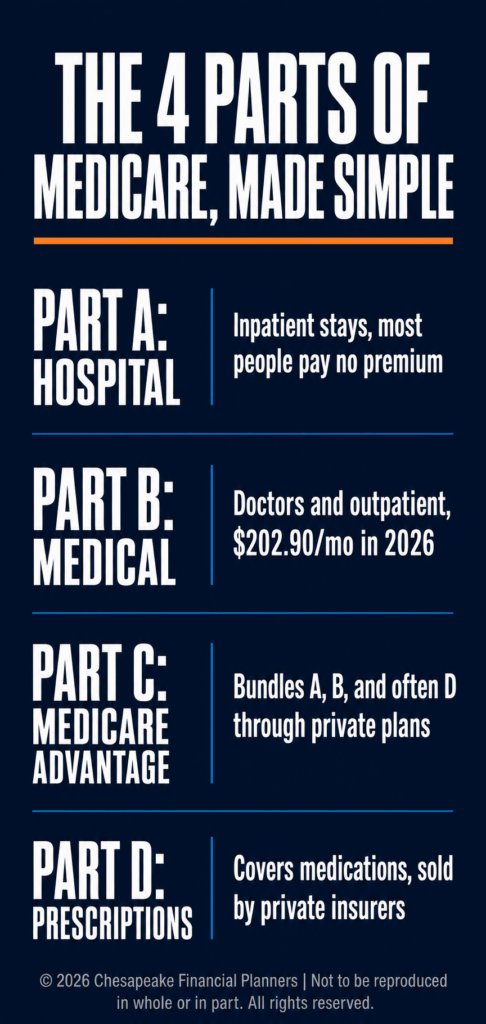
Medicare is the federal health insurance program for people 65 and older, split into four parts: Part A covers hospital care, Part B covers doctor visits and outpatient care, Part C (Medicare Advantage) bundles A and B through a private plan, and Part D covers prescription drugs. Understanding how these medicare parts explained side by side helps you avoid coverage gaps and surprise costs when you enroll. Each part covers something different, and the choices you make at 65 follow you for years.
Key Takeaways
- Original Medicare is Part A (hospital) plus Part B (medical); most people pay no Part A premium but do pay for Part B.
- The standard Part B premium is $202.90 per month in 2026, with higher earners paying IRMAA surcharges.
- Part C (Medicare Advantage) replaces Original Medicare through a private plan and often bundles drug coverage.
- Part D covers prescriptions, and missing your enrollment window can trigger a lifelong late penalty.
About the Author: Jeff Judge, CFP®, AEP®, ChFC®, CLU® is Managing Partner of Chesapeake Financial Planners in Forest Hill, Maryland. He has been helping families and business owners in Harford County and the Baltimore metro area navigate Medicare decisions since earning his CFP® certification in 2013, by using Chesapeake Financial Planners’ signature process, the R.U.D.D.E.R. method™. Jeff sees the same thing every year: people treat Medicare like a single product when it's really four separate decisions stacked together, and the costliest mistakes happen because nobody explained the parts up front.
What is Medicare Part A?
Medicare Part A is hospital insurance. It covers inpatient hospital stays, skilled nursing facility care, hospice, and some home health services. Most people pay no monthly premium for Part A because they paid Medicare taxes while working for at least 10 years (40 quarters).
Part A is not free of cost-sharing, though. For 2026, the inpatient hospital deductible is $1,736 per benefit period, according to the Centers for Medicare & Medicaid Services. A benefit period starts when you're admitted and ends after you've been out of the hospital for 60 consecutive days, so you can owe that deductible more than once in a single year if you have separate hospital stays.
Jeff often reminds clients that Part A does not cover long-term custodial care, which is the kind of help most people actually need as they age. That gap is why long-term care planning What is long-term care insurance and do I need it? sits in a different bucket entirely.
What is Medicare Part B?
Medicare Part B is medical insurance. It covers doctor visits, outpatient care, preventive services, lab tests, durable medical equipment, and ambulance transport. Unlike Part A, almost everyone pays a monthly premium for Part B.
The standard Part B premium for 2026 is $202.90 per month, and the annual Part B deductible is $283, per CMS. Higher-income retirees pay more through an Income-Related Monthly Adjustment Amount, or IRMAA, which is based on your tax return from two years earlier. This is where smart tax planning before retirement pays off, because a single large income year can push your premiums up for an entire year. If you're weighing Roth conversions, the interaction with Medicare premiums matters more than most people realize IRMAA 2026 and Roth conversions.
Part B comes with a strict enrollment window. Miss it without qualifying coverage, and you face a permanent late-enrollment penalty that gets added to your premium for as long as you have Part B.
What is Medicare Part C (Medicare Advantage)?
Medicare Part C, known as Medicare Advantage, is an all-in-one alternative to Original Medicare offered by private insurers approved by Medicare. When you choose a Part C plan, it replaces your Original Medicare coverage and delivers your Part A and Part B benefits through that private plan. Most Advantage plans also bundle in Part D drug coverage and may add extras like dental, vision, or hearing.
In 2026, the average monthly Medicare Advantage premium is projected to be about $14, according to CMS, though plans vary widely. The trade-off: Advantage plans typically use provider networks and require referrals or prior authorization, where Original Medicare lets you see any doctor who accepts Medicare.
Jeff Judge has watched clients pick an Advantage plan for the low premium, then get frustrated when their preferred specialist isn't in-network. The premium is only one number. The network, the out-of-pocket maximum, and how the plan handles the care you actually use matter just as much.
| Feature | Original Medicare (A + B) | Medicare Advantage (Part C) |
|---|---|---|
| Provider choice | Any doctor accepting Medicare | Plan network only |
| Drug coverage | Add Part D separately | Usually included |
| Out-of-pocket cap | None (without Medigap) | Annual maximum required |
| Extra benefits | No | Often dental, vision, hearing |
What is Medicare Part D?
Medicare Part D is prescription drug coverage. It's offered through private plans, either as a standalone drug plan added to Original Medicare or built into a Medicare Advantage plan. Every Part D plan has its own list of covered drugs, called a formulary, and its own pharmacy network.
A major change took effect in 2025 and continues into 2026: the annual out-of-pocket cap on prescription drugs is $2,100 in 2026, per CMS. Once your out-of-pocket drug spending hits that cap, you pay nothing more for covered prescriptions for the rest of the year. For retirees on expensive medications, this is a genuine improvement over the old system.
Like Part B, Part D carries a late-enrollment penalty. If you go 63 or more days without creditable drug coverage after you're eligible, you pay a permanent surcharge. Even if you take no prescriptions today, Jeff generally advises enrolling in a low-cost plan to protect against that penalty later.
How do the four parts of Medicare fit together?
Most retirees choose one of two paths. Path one is Original Medicare (Parts A and B) plus a standalone Part D plan, often with a Medigap supplement What Is the Best Medigap Plan for New Medicare Beneficiaries? to cover the gaps. Path two is a Medicare Advantage plan (Part C) that bundles everything into one plan.
There's no single right answer. The decision turns on your health, your doctors, your medications, and your budget. This choice is also one piece of a much bigger picture, since healthcare costs in retirement How Much Should I Budget for Healthcare Costs in Retirement? extend well beyond premiums.
Frequently Asked Questions
Do I have to enroll in all four parts of Medicare?
No, you do not have to enroll in all four parts. Most people enroll in Part A automatically and choose Part B, then pick either Part C (Medicare Advantage) or Part D for drug coverage. You won't have both Original Medicare with a separate Part D plan and a Medicare Advantage plan at the same time.
Is Medicare Part A really free?
Medicare Part A has no monthly premium for most people who worked and paid Medicare taxes for at least 10 years. It is not entirely free, though, because Part A includes cost-sharing. The 2026 inpatient hospital deductible is $1,736 per benefit period, and you can owe it more than once in a year.
What is the difference between Original Medicare and Medicare Advantage?
Original Medicare is the government-run program made up of Part A and Part B, letting you see any doctor who accepts Medicare. Medicare Advantage (Part C) is a private plan that replaces Original Medicare, usually with a provider network, an out-of-pocket maximum, and bundled drug and extra benefits.
What happens if I miss my Medicare enrollment window?
Missing your Medicare enrollment window can cost you permanently. Both Part B and Part D carry late-enrollment penalties that get added to your premium for as long as you have coverage. The Part B penalty rises the longer you wait, so enrolling on time or having qualifying coverage matters a great deal.
Does Medicare cover prescription drugs automatically?
No, Medicare does not cover prescription drugs automatically. You get drug coverage through Part D, either as a standalone plan added to Original Medicare or built into a Medicare Advantage plan. In 2026, Part D includes a $2,100 annual out-of-pocket cap on covered prescriptions, a meaningful protection for retirees on costly medications.
Getting Medicare right is just one piece of a retirement income plan that also has to account for taxes, longevity, and rising health costs. If you found this helpful, our guide on planning for healthcare costs in retirement covers the full picture in depth. Download it at chesapeakefp.com.
Disclosures
The information provided is for educational purposes only and should not be construed as investment advice. Investment strategies should be tailored to individual circumstances, risk tolerance, and goals. Past performance doesn't guarantee future results. Consult with qualified financial professionals regarding your specific situation.
Advisors associated with Chesapeake Financial Planners may be either (1) LPL Financial Registered Representatives offering securities through LPL Financial, Member FINRA and SIPC, and investment advisor representatives offering investment advice through Great Valley Advisor Group; or (2) solely investment advisor representatives offering investment advice through Great Valley Advisor Group and not affiliated with LPL Financial. Great Valley Advisor Group, and Chesapeake Financial Planners are separate entities from LPL Financial.


