

What Should You Do Immediately After Winning the Lottery?
Last reviewed: July 2026
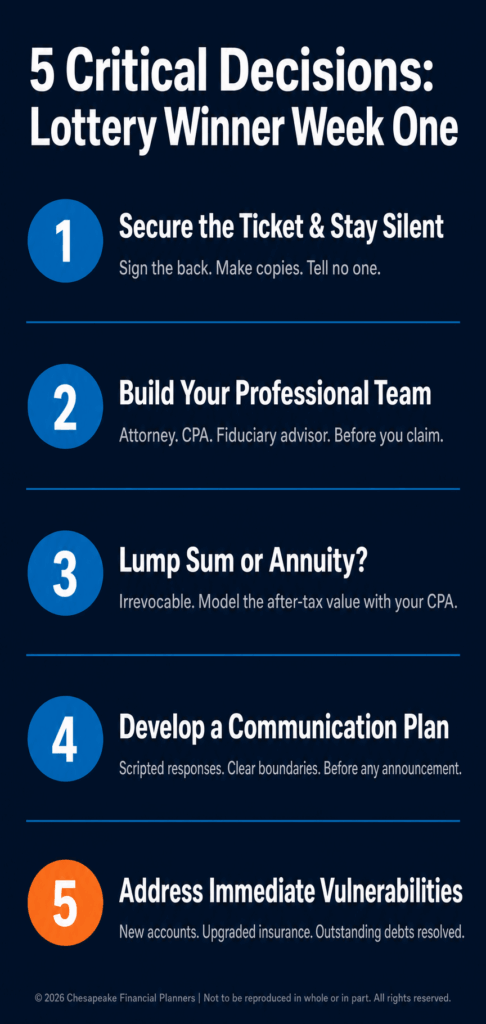
The first thing to do after winning the lottery is sign the back of your ticket, tell almost no one, and assemble a team of professionals before you ever contact the lottery commission. Your week-one lottery winner decisions carry more weight than any investment choice you'll make later. Get them right and the windfall lasts. Get them wrong and you join the long list of winners who ended up worse off than before they bought the ticket.
Key Takeaways
- Sign your ticket immediately; an unsigned lottery ticket is a bearer instrument that anyone holding it can legally claim.
- Federal tax withholding on lottery winnings starts at 24%, but the top federal rate of 37% applies to large jackpots in 2026.
- Only a handful of states allow anonymous lottery claims, so verify your state's rules before claiming.
- Assemble an attorney, a CPA, and a fiduciary financial advisor before you claim your prize.
- The lump sum versus annuity choice is irrevocable, so model both after-tax outcomes before deciding.
About the Author: Jeff Judge, CFP®, AEP®, ChFC®, CLU® is Managing Partner of Chesapeake Financial Planners in Forest Hill, Maryland. He has been helping families and business owners in Harford County and the Baltimore metro area navigate sudden wealth events since earning his CFP® certification in 2013, by using Chesapeake Financial Planners’ signature process, the R.U.D.D.E.R. method™. Jeff has seen the difference between winners who slow down for one week and winners who move fast: the slow ones almost always keep more of the money.
A sudden windfall feels like the end of your financial worries. In Jeff's experience, it's actually the start of the most consequential month of your financial life. Sudden wealth management isn't about picking investments. It's about controlling the first seven days before pressure, taxes, and predators get organized against you.
How Do You Secure a Winning Lottery Ticket?
Sign the back of the ticket before you do anything else. A lottery ticket is a bearer instrument, which means whoever physically holds an unsigned ticket can claim the prize. Your signature establishes ownership the moment you write it, and it's your only protection if the ticket is lost or stolen.
After signing, photograph the front and back. Store copies in separate secure places: a bank safe deposit box, a home safe, and encrypted digital storage. Then put the original somewhere genuinely secure, not your wallet or a kitchen drawer.
Want to go deeper? Our First 90 Days After a Windfall walks through this step by step.
Now stay quiet. Every person you tell tells someone else, and within days the circle widens to people you've never met. This is where requests for money, scams, and security risks begin. Limit early disclosure to your spouse and, at most, one trusted person for emotional support. Don't post on social media. Don't tell coworkers.
Research whether your state permits an anonymous claim. According to the North American Association of State and Provincial Lotteries, only a small number of states let winners stay fully anonymous, while most require some public identification. If anonymity is an option where you live, take it. The privacy is worth more than the publicity.
Who Should Be on Your Lottery Winner Team?
Build your professional team before contacting the lottery commission. You want expert guidance in place before any money changes hands, because the claiming process triggers tax and legal consequences you can't undo. To protect lottery winnings properly, you need three professionals working together.
First, an attorney experienced in sudden wealth or asset protection, not a general practitioner who handles real estate closings. Second, a CPA with serious tax-planning expertise who can model your liability and advise on the payout decision. Third, a fee-based financial planner for lottery winners who serves as a fiduciary, meaning they're legally required to put your interests first.
Jeff often tells clients that the cheapest mistake a new winner makes is hiring the first advisor who calls. Predatory salespeople target lottery winners precisely because they're making large decisions while overwhelmed. Verify any advisor through the CFP Board and check disciplinary history on FINRA BrokerCheck before signing anything.
These three professionals should coordinate, not operate in silos. Your attorney's asset protection plan has to align with your CPA's tax strategy and your advisor's investment approach. At Chesapeake Financial Planners, we run sudden-wealth clients through the R.U.D.D.E.R. Method™, Chesapeake Financial Planners' six-step planning process: Review and Recognize, Uncover and Understand, Design and Develop, Discuss and Decide, Execute and Empower, and Reassess and Refine. The first two steps alone keep most winners from acting on impulse.
What professionals does a lottery winner need to hire first?
Should You Take the Lump Sum or the Annuity?
Most lotteries let you choose between a lump sum, typically 50% to 60% of the advertised jackpot, or annuity payments spread over roughly 30 years. This choice is irrevocable, so model both outcomes before you decide.
The lump sum gives you full control immediately, the ability to invest for returns higher than the annuity's implied rate, and flexibility to act on opportunities. The annuity protects you from spending too fast, spreads your tax liability across decades, and provides a guaranteed income stream that's far less attractive to people asking for handouts.
Here's the part most winners miss: lottery winnings taxes apply either way. The IRS requires 24% federal withholding on large gambling winnings, but the actual top federal rate reaches 37% in 2026 for income above the highest bracket threshold. The annuity keeps more of your money in lower brackets each year; the lump sum is taxed heavily all at once.
| Factor | Lump Sum | Annuity |
|---|---|---|
| Control of funds | Immediate and full | Spread over ~30 years |
| Tax treatment | Taxed all at once at top rates | Spread across years, often lower brackets |
| Spending protection | None | Built-in by design |
| Investment flexibility | High | Limited |
| Attractiveness to predators | High | Lower |
For disciplined winners working with qualified professionals, advisors often lean toward the lump sum because it allows more long-term wealth building. But if financial discipline has been a struggle, the annuity's forced patience can be the smarter choice. Work with your CPA to compare the after-tax value of both. The right answer is not the same for everyone.
What happens to my finances after a liquidity event?
How Do You Build a Communication Plan After Winning?
By the end of week one, decide in advance who you'll tell, when, and what you'll say to requests for money. The questions and pressure are coming, and improvising in the moment is how winners give away fortunes they meant to keep.
Write down your boundaries before anyone asks. Decide on a standard response for solicitations, a giving budget if you want one, and a timeline for telling extended family. Jeff has watched clients who scripted these answers in advance stay calm under pressure, while those who didn't ended up saying yes to things they later regretted. A communication plan is part of broader sudden wealth management, not an afterthought.
What should you tell family after winning the lottery?
Frequently Asked Questions
What should you do first after winning the lottery?
Sign the back of your winning ticket immediately, because an unsigned ticket is a bearer instrument that anyone can claim. Then secure it in a safe deposit box, make copies, and tell almost no one. Assemble your professional team before you ever contact the lottery commission to claim the prize.
How much tax do you pay on lottery winnings?
Lottery winnings are taxed as ordinary income. The IRS requires 24% federal withholding on large prizes, but the actual top federal rate reaches 37% in 2026 for amounts above the highest bracket. State income tax may apply on top of that, and your CPA can model your true liability based on where you live.
Is it better to take the lump sum or the annuity?
It depends on your discipline and goals. The lump sum gives full control and more wealth-building potential for disciplined winners working with professionals, while the annuity spreads taxes across years and protects against overspending. Because the choice is irrevocable, model both after-tax outcomes with a CPA before deciding.
Can lottery winners stay anonymous?
Only a small number of states allow lottery winners to claim prizes anonymously; most require some public identification. Anonymity protects you from scams, unwanted requests, and security risks, so verify your state's rules before claiming. Where it's allowed, claiming through a trust or legal entity can add another layer of privacy.
How do you find a trustworthy financial advisor for lottery winnings?
Look for a fee-based Certified Financial Planner (CFP®) who serves as a fiduciary, legally required to put your interests first. Verify credentials through the CFP Board and check disciplinary history on FINRA BrokerCheck. Interview multiple candidates, ask about experience with sudden wealth, and never hire the first advisor who contacts you.
Why should you wait before claiming lottery winnings?
Waiting lets you sign and secure the ticket, research anonymity options, and assemble an attorney, CPA, and fiduciary advisor before money changes hands. Claiming triggers tax and legal consequences you cannot undo, so the prep work protects you. Most state lotteries give you months to claim, so there's no need to rush in week one.
If a sudden windfall has landed in your lap, the lottery winner decisions you make this week will shape the next thirty years. Our guide to sudden wealth events walks through the full playbook in depth. Download it at chesapeakefp.com and slow the process down before anyone else speeds it up.
What should you do when you suddenly receive a large sum of money?
Disclosures
The information provided is for educational purposes only and should not be construed as investment advice. Investment strategies should be tailored to individual circumstances, risk tolerance, and goals. Past performance doesn't guarantee future results. Consult with qualified financial professionals regarding your specific situation.
Advisors associated with Chesapeake Financial Planners may be either (1) LPL Financial Registered Representatives offering securities through LPL Financial, Member FINRA and SIPC, and investment advisor representatives offering investment advice through Great Valley Advisor Group; or (2) solely investment advisor representatives offering investment advice through Great Valley Advisor Group and not affiliated with LPL Financial. Great Valley Advisor Group, and Chesapeake Financial Planners are separate entities from LPL Financial.


