

Do I Need Long-Term Care Insurance?
Last reviewed: July 2026
Most people who reach age 65 will need some form of long-term care, but not everyone needs long-term care insurance to pay for it. You need it if you have enough assets to be worth protecting but not enough to comfortably self-fund years of care out of pocket. People with very few assets often qualify for Medicaid, and the very wealthy can usually pay directly. The decision comes down to where you sit in the middle, your family health history, and how much risk you want to kece off the table.
Key Takeaways
- About 70% of people turning 65 will need some long-term care, according to the U.S. Department of Health and Human Services.
- The 2024 national median cost of a private nursing home room ran roughly $116,800 per year, per the CareScout Cost of Care Survey.
- Long term care insurance makes the most sense for people with assets to protect but not enough to self-fund years of care.
- Buying in your mid-50s to early 60s usually balances premium cost against the risk of being declined for health reasons.
About the Author: Jeff Judge, CFP®, AEP®, ChFC®, CLU® is Managing Partner of Chesapeake Financial Planners in Forest Hill, Maryland. He has been helping families and business owners in Harford County and the Baltimore metro area navigate retirement and risk decisions since earning his CFP® certification in 2013, by using Chesapeake Financial Planners’ signature process, the R.U.D.D.E.R. method™. In Jeff's experience, the clients who regret their long-term care decision are almost never the ones who bought a policy; they're the ones who assumed they'd "figure it out later" and then got a diagnosis that closed the door.
What Is Long-Term Care Insurance?
Long-term care insurance is a policy that pays for help with daily living activities when you can no longer handle them on your own. Think bathing, dressing, eating, transferring in and out of bed, and managing incontinence. These are the activities of daily living, and most policies start paying benefits once you can't perform two of them without assistance, or once you have a cognitive impairment like dementia.
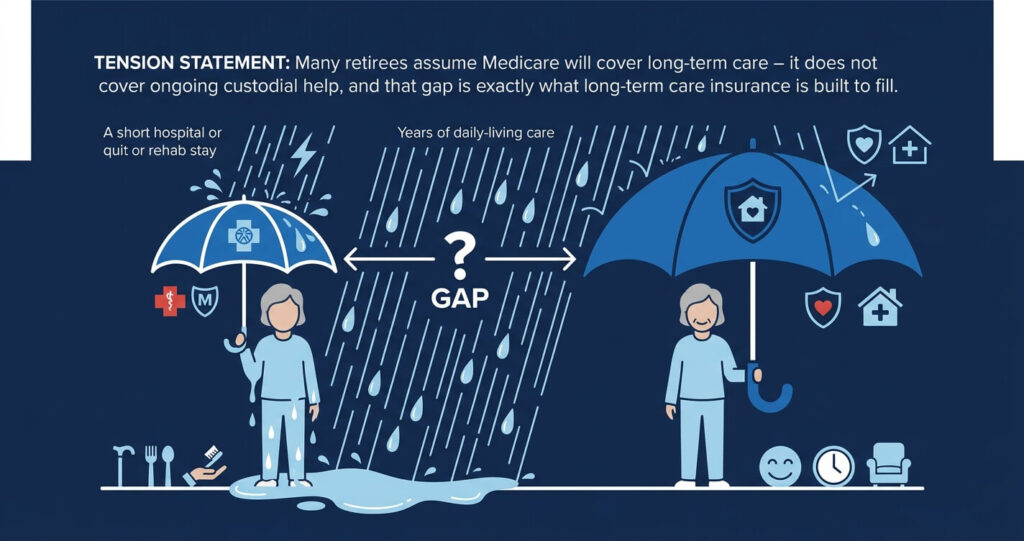
This is care that regular health insurance and Medicare do not cover for the long haul. Medicare pays for short, skilled, rehab-style stays after a hospitalization. It does not pay for the months or years of custodial help that someone with Alzheimer's or a stroke recovery might need. That gap is exactly what LTC insurance is built to fill.
Policies pay benefits in different settings: your own home, an assisted living facility, an adult day care center, or a nursing home. Home care is what most people actually want, and modern policies are designed to fund it.
How Likely Are You to Actually Use It?
Roughly 70% of people turning 65 today will need some type of long-term care during their lives, according to the U.S. Department of Health and Human Services. That is not a fringe risk. It is the base case.
The duration varies widely. Many people need care for less than a year. But around 20% will need it for longer than five years, and that long tail is where families get financially wiped out. Women tend to need care longer than men, partly because they live longer and more often outlive a spouse who could have provided unpaid care at home.
Here is the part people miss. The risk isn't just to you. It's to your spouse, who may spend down shared retirement savings to cover your care and then face their own later years with far less. Jeff Judge often tells clients that long-term care planning is really spousal protection planning in disguise. Protecting the healthy spouse is frequently the strongest argument for coverage.
What Does Long-Term Care Actually Cost?
The cost of long-term care is the number that changes the conversation. According to the 2024 CareScout Cost of Care Survey (formerly the Genworth survey), national median annual costs ran approximately:
| Care Setting | 2024 National Median Annual Cost |
|---|---|
| Homemaker services | ~$75,500 |
| Home health aide | ~$77,800 |
| Assisted living facility | ~$70,800 |
| Nursing home (semi-private room) | ~$104,000 |
| Nursing home (private room) | ~$116,800 |
These are medians, which means half of all care costs more. Costs also vary sharply by region, and dense markets like the Baltimore-Washington corridor often run well above the national figure. Run the math on three to five years of nursing home care and you're looking at a number that can exceed $500,000. That's the exposure a policy is designed to absorb.
These figures rise most years, often faster than general inflation, which is why good policies include an inflation protection rider. A benefit that looks generous today can look thin twenty years from now without it.
Who Should Buy Long-Term Care Insurance?
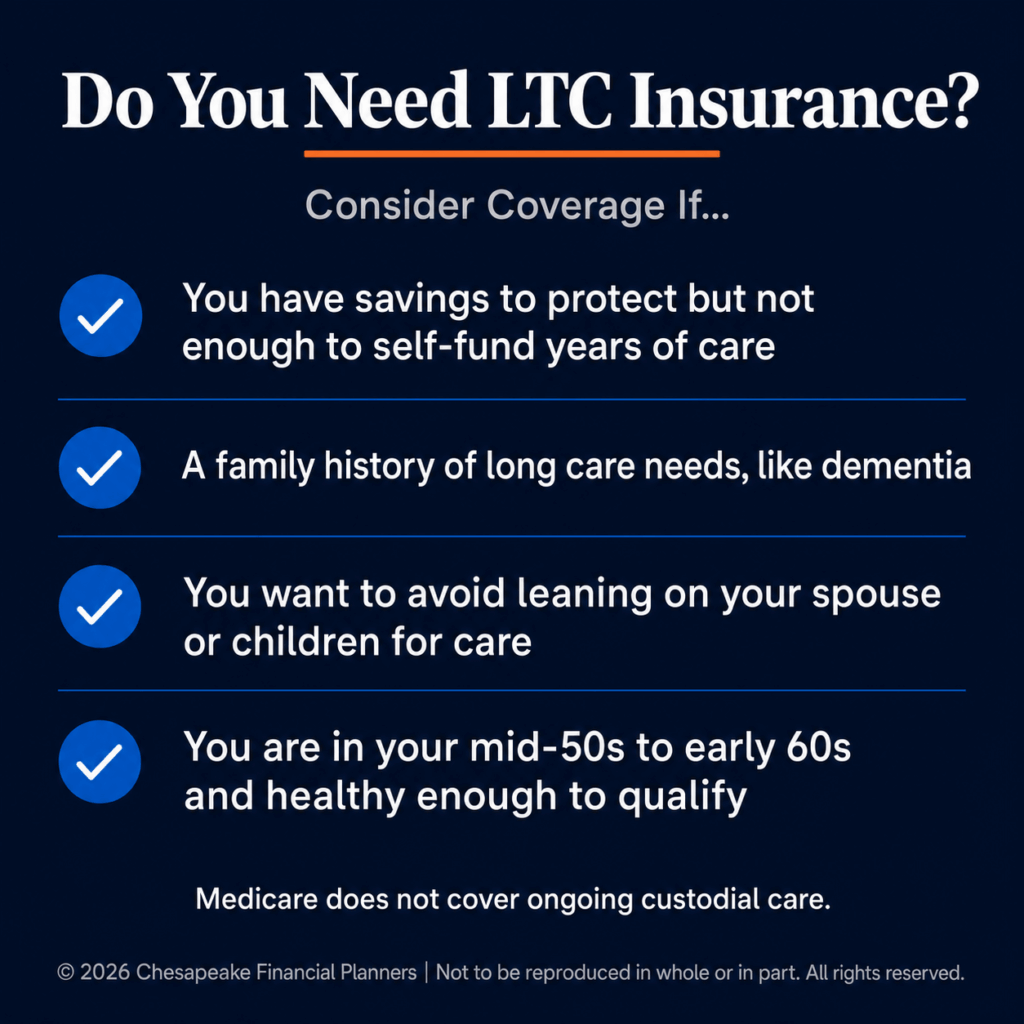
Long-term care insurance makes the most sense for people in the financial middle. If you have somewhere between $300,000 and roughly $2 million in assets outside your home, you have enough to lose that self-insuring is risky, but not so much that paying out of pocket is painless. That is the sweet spot.
If your assets are below that range, Medicaid becomes the realistic backstop, though it requires spending down most of what you have first and limits your choice of facilities. If your assets are well above it, you may decide to self-insure and earmark a portion of your portfolio for potential care costs.
The other half of the answer is health and timing. You generally apply in your mid-50s to early 60s, while you're still healthy enough to qualify. Wait too long and a health event can make you uninsurable at any price. This is one of the few financial products where being early beats being optimal.
How Does This Fit Into a Broader Plan?
Long-term care insurance is one piece of a risk-management picture, not a standalone decision. At Chesapeake Financial Planners, we look at it inside the full plan: your retirement income, your other insurance, your estate goals, and what you actually want your later years to look like.
That's the logic behind the R.U.D.D.E.R. Method™, Chesapeake Financial Planners' six-step planning process: Review and Recognize, Uncover and Understand, Design and Develop, Discuss and Decide, Execute and Empower, and Reassess and Refine. Long-term care almost always surfaces during the "Uncover and Understand" stage, because it's the risk clients most often underestimate until someone walks them through the numbers.
Hybrid policies that combine life insurance with a long-term care benefit have grown popular precisely because they address the old complaint about traditional LTC coverage: "What if I pay premiums for years and never use it?" With a hybrid, your heirs get a death benefit if you don't. That tradeoff isn't free, but for many clients it removes the emotional barrier to buying anything at all. For more on how risk planning fits the bigger picture, see What are the fundamentals of personal financial planning? and What Does a Real Financial Review Actually Cover?. Jeff Judge notes: "A hybrid life and long-term care policy costs more than traditional LTC, but for clients who kept saying no because they hated the idea of paying premiums and dying healthy, that death benefit rider is often what finally gets something in place."
Frequently Asked Questions
Does Medicare pay for long-term care?
No, Medicare does not pay for long-term custodial care, which is the help most people need over months or years. Medicare covers short, skilled nursing or rehab stays after a hospitalization, typically up to 100 days with conditions. Ongoing help with bathing, dressing, and daily living falls outside Medicare and is what long-term care insurance is built to cover.
When is the best age to buy long-term care insurance?
The best window is generally your mid-50s to early 60s. Buying in this range balances lower premiums against the real risk of being declined for health reasons later. The American Association for Long-Term Care Insurance reports that a meaningful share of applicants in their 60s are turned down for health reasons, and that rejection rate climbs with age. Waiting often costs you the option entirely.
How much does long-term care insurance cost?
Premiums vary widely by age, health, benefit amount, and the riders you choose, but a healthy couple in their mid-50s might pay a few thousand dollars per year combined for a meaningful traditional policy. Hybrid life-and-LTC policies are often funded with a larger single premium or paid over a set number of years. The right structure depends on your assets, health, and cash flow.
What happens if I never use the insurance?
With a traditional long-term care policy, you generally lose the premiums you paid if you never file a claim, similar to auto or homeowners insurance. This concern is exactly why hybrid policies exist: they combine long-term care coverage with a life insurance death benefit, so your heirs receive value even if you never need care. The hybrid approach costs more but removes the "use it or lose it" objection.
Can I just rely on Medicaid for long-term care?
You can, but Medicaid requires you to spend down most of your assets first and limits your choice of facilities to those that accept Medicaid. According to KFF, Medicaid is the largest single payer of long-term care in the country, which tells you how many families end up there. For people with assets to protect, planning ahead with insurance usually preserves more choice and dignity than relying on Medicaid as the default.
Where to Go From Here
The right answer on long-term care insurance is rarely "everybody needs it" or "nobody needs it." It's a calculation that runs through your assets, your health, your family history, and what you want your later years to look like. If you'd like to think it through, our free retirement and risk-planning guide walks through the questions to ask before you decide. Download it at chesapeakefp.com.
Want to go deeper? Our Why Financial Advice Isn’t Just for Retirees walks through this step by step.
Disclosures
The information provided is for educational purposes only and should not be construed as investment advice. Investment strategies should be tailored to individual circumstances, risk tolerance, and goals. Past performance doesn't guarantee future results. Consult with qualified financial professionals regarding your specific situation.
This material is for educational purposes only. Insurance products contain exclusions, limitations, and terms for keeping them in force. Please contact a qualified insurance professional for costs and complete details.
Advisors associated with Chesapeake Financial Planners may be either (1) LPL Financial Registered Representatives offering securities through LPL Financial, Member FINRA and SIPC, and investment advisor representatives offering investment advice through Great Valley Advisor Group; or (2) solely investment advisor representatives offering investment advice through Great Valley Advisor Group and not affiliated with LPL Financial. Great Valley Advisor Group, and Chesapeake Financial Planners are separate entities from LPL Financial.


