

Is Indexed Universal Life Insurance a Good Retirement Strategy?
Last reviewed: August 2026
For most high earners, indexed universal life insurance is not a good retirement strategy, at least not as a replacement for a brokerage account and not before your plain tax-advantaged accounts are full. The product can hold a narrow place in an estate or business plan. As the core way you fund retirement, it usually costs more, credits less, and locks up longer than the sales illustration lets on. Here is how the pitch actually works, and what to check before you sign anything.
Key Takeaways
- The pitch usually targets people in their 30s and 40s with strong cash flow but no coordinated planning team yet to flag it.
- Fill tax-advantaged accounts first: the 2026 401(k) deferral limit reaches $24,500 before any employer match.
- A backdoor Roth and an HSA worth up to $4,400 for self-only coverage in 2026 usually beat a policy funded at $50,000 a year.
- Commissions can exceed 100 percent of your first-year premium, and surrender charges can lock the cash up for 10 to 15 years.
About the Author: Jeff Judge, CFP®, AEP®, ChFC®, CLU® is Managing Partner of Chesapeake Financial Planners in Forest Hill, Maryland. He has spent his career helping high earners and business owners across Harford County and the Baltimore metro area weigh insurance and retirement decisions, and he earned his CFP® certification in 2013, working with clients through Chesapeake's signature process, the R.U.D.D.E.R. Method™. "Insurance can earn a place in a good plan," Jeff says. "It just rarely earns first place, ahead of the boring moves that actually come first."
Who is the indexed universal life insurance pitch actually built for?
The pitch rarely arrives in an obviously bad way. It shows up after a coworker's referral, at a wealth-building dinner seminar, or through a finance influencer who holds an insurance license. The audience is almost always the same person: someone in their 30s or 40s, income high enough to have real cash flow, usually somewhere between $200,000 and $400,000 a year with RSUs or a bonus in the mix, and not yet wealthy enough to have a team of professionals around them who would catch this first.
That gap matters. Someone with eight figures usually has an estate attorney, a CPA, and an advisor who talk to each other. Someone earning a few hundred thousand a year rarely has that layer yet. A client of mine fit the profile exactly. He was 39, a director at a healthcare company, W-2 income north of $200,000, and an agent had told him one policy funded at $50,000 a year could replace his taxable brokerage account entirely.
In the Baltimore metro and here in Harford County, the people who land on this pitch are often Johns Hopkins physicians, Aberdeen-area engineers and contractors, and mid-career tech and healthcare earners with RSUs or a fresh bonus. High income, doing the right things on paper, and squarely in the crosshairs of a sales conversation dressed up as planning advice. That local demand for a second opinion is why I see this product cross my desk so often.
What financial moves should come before an indexed universal life policy?
The unglamorous moves come first, and the pitch almost never asks about them. Nobody builds a dinner seminar around capturing an employer match, but that is where the money is.
Did anyone check whether you captured your full 401(k) match first? An employer match is the closest thing to free money in your financial life, and the 2026 401(k) deferral limit runs to $24,500 before that match is even counted. I have watched more than one person fund an insurance policy at tens of thousands a year while still leaving free employer match dollars on the table. After the match, an HSA offers a rare triple tax benefit, worth up to $4,400 for self-only coverage in 2026, and a backdoor Roth lets high earners move another $7,500 into a Roth for the year. Those moves are boring. They also almost always win.
This decision also never happens in isolation. The people I see usually have three old 401(k)s from former employers, a brokerage account nobody has rebalanced since a job change, and now a new policy nobody connected to the rest of the picture. Each piece got decided on its own, by a different person at a different moment. That is a coordination problem, and coordination is the entire point of a real planning process. The R.U.D.D.E.R. Method™ is Chesapeake Financial Planners' six-step planning process: Review and Recognize, Uncover and Understand, Design and Develop, Discuss and Decide, Execute and Empower, and Reassess and Refine.
In my experience, the policy is almost never the real problem. It is the most expensive symptom of a plan that nobody ever coordinated.
Jeff Judge, CFP®
What does the person selling the policy earn on day one?
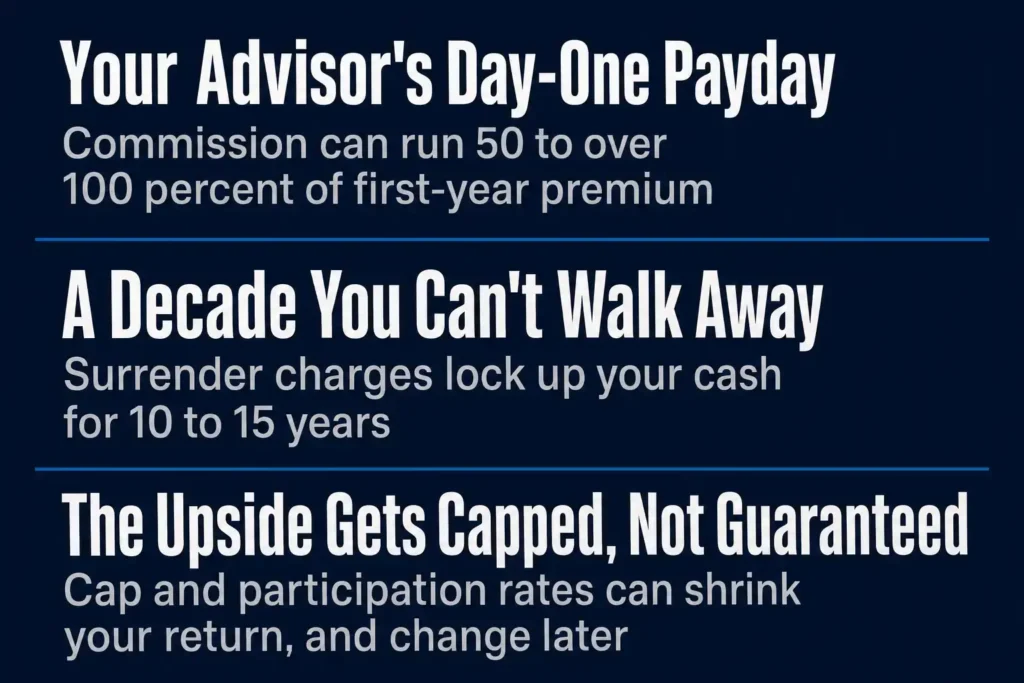
Here is the part nobody says out loud in the meeting. On many of these policies, the person selling it earns a commission that can run anywhere from roughly 50 percent to well over 100 percent of your first-year premium. Not your first-year gain. Your first-year premium, the actual dollars you just deposited. Fund the policy at $50,000 a year, and the agent could plausibly earn tens of thousands of dollars in year one, often before your money has done a single useful thing for you.
That figure is not hidden, but it sits in the paperwork in language dense enough that almost nobody reads it before signing. I am not saying every agent selling these policies acts in bad faith. Plenty believe in what they sell. But a front-loaded incentive this large shapes the whole conversation, and the policy design too. Indexed universal life commissions tend to reward higher premium and higher death benefit configurations over a lean, cash-value-efficient one. Nobody spends four minutes explaining surrender schedules and cap rates when a thirty-minute pitch closes just as well and pays the same.
With this specific product, in this specific structure, that fear is not paranoia. It is arithmetic.
How do surrender charges, caps, and participation rates limit your returns?
A commission that large gets paid back through you. Most of these policies carry a surrender charge schedule that runs 10 to 15 years. Pull out a meaningful amount, or cancel the policy inside that window, and a chunk of your own cash value gets clawed back on the way out. Surrender charges over a decade or more can cover a home purchase, job changes, and several market cycles while your money sits stuck.
The upside has its own two brakes. A cap rate sets a ceiling on how much of the index's gain the policy will credit in a year, no matter how well the index performs. A participation rate then trims your credited return further, sometimes to a fraction of the index's move. According to FINRA, the insurer sets both of these and can change them in later years, which can quietly lower your return after you are already locked in. Compare that to owning a low-cost index fund directly, and over two or three decades the gap between a capped result and full market exposure tends to widen every year.
| Feature | Indexed universal life insurance | Low-cost index fund held directly |
|---|---|---|
| Upside in a strong year | Capped by a cap rate, then trimmed by a participation rate | You keep the full index gain, minus a small fund fee |
| Downside in a losing year | Usually floored near 0 percent, but caps offset this over time | You absorb the full loss that year |
| Who can change the terms | The insurer can reset caps and participation rates | No one resets your terms; the fund tracks the index |
| Access to your money | Surrender charges for roughly 10 to 15 years | Sell any day the market is open |
| Layered costs | Insurance charges, admin fees, and loan interest | A single low expense ratio |
That table is why cash value life insurance so rarely wins a straight comparison against simply investing the same dollars, and the illustration never puts the two side by side.

Is indexed universal life insurance retirement income really tax-free, and what happens if the policy lapses?
The seminar version leans on two lines. One: this income arrives without the IRS ever touching it, unlike a 401(k) withdrawal. Two: your growth moves with an index, so a bad year will not hurt you. Both are technically defensible in the narrowest sense but badly misleading in how they get delivered.
So is that IUL retirement income actually taxed or not? What you are really doing when you take that income is borrowing against your own policy's cash value. While the policy stays in force, that policy loan is not treated as taxable income, and that single fact is the entire basis for the pitch. But the loan accrues interest and reduces your death benefit, and if the policy lapses or you surrender it with a loan outstanding, the retirement income story falls apart. The gain above what you paid in can become taxable all at once, in a year you did not choose. A policy already underperforming because of the caps, then drained by loans year after year, can lapse right when a surprise tax bill would hurt most.
None of this makes indexed universal life insurance evil. Term insurance is inexpensive relative to permanent coverage and does its one job well, and a few permanent strategies genuinely fit narrow estate or business situations. If you want the plain-English version of the choices, our guide to the types of life insurance lays them out. And if you are already several years into one of these policies, the fix is not automatically to cancel it. Sometimes the surrender charges are steep enough that riding it out or restructuring the death benefit makes more sense than walking away today. A past decision does not have to lock in every future one.
Frequently Asked Questions
Is indexed universal life insurance a good retirement strategy for most people?
For most high earners, no. Indexed universal life insurance rarely beats maxing tax-advantaged accounts and owning low-cost funds, and it should not replace a taxable brokerage account. As a primary retirement vehicle it usually credits less and costs more than the illustration suggests.
How much commission does an agent earn on an indexed universal life policy?
On many indexed universal life policies, the person selling it can earn roughly 50 percent to well over 100 percent of your first-year premium, not your first-year gain. On a policy funded at $50,000 a year, that can mean tens of thousands of dollars in year one, disclosed only deep in the paperwork that almost nobody reads before signing.
What is a surrender charge on an IUL policy?
A surrender charge is a penalty the insurer claws back from your cash value if you withdraw a large amount or cancel the policy early. On indexed universal life policies these schedules often run 10 to 15 years, a window that can cover a home purchase, a job change, and several market cycles before you can exit cleanly.
Is the retirement income from an indexed universal life policy taxed?
The income is usually structured as a policy loan against your cash value. While the policy stays in force, that loan is not treated as taxable income, which is the basis for the pitch. But the loan accrues interest and reduces the death benefit, and if the policy lapses with a loan outstanding, the gain can become taxable all at once.
What are cap rates and participation rates on an IUL?
A cap rate is the ceiling on how much of an index's gain the policy will credit in a year. A participation rate then trims your credited return further, sometimes to a fraction of the index's move. According to FINRA, the insurer sets and can later change both, which can lower your return after you are locked in.
Should I cancel my indexed universal life policy if I already have one?
Not automatically. If you are several years in, surrender charges may make riding it out, adjusting the death benefit, or restructuring smarter than walking away today. The right move depends on your specific contract, your cap rate history, and how many years remain on your surrender schedule, so review the policy with a planner before deciding.
Before you sign an indexed universal life policy, ask three questions.
- What do you earn the day I fund this, in the first year?
- What happens if I need this money back in year seven instead of year twenty?
- What has the cap rate actually done over the past ten years, not what the illustration projects?
If the person across the table gets uncomfortable answering those, you already have your answer about whether it was an advice conversation or a sales pitch. Ready to pressure-test an indexed universal life insurance pitch before you commit? Jeff Judge and the Chesapeake Financial Planners team work with high earners and business owners across Harford County and the Baltimore metro. Schedule a free fit call.
A version of this article was originally published on Jeff Judge's LinkedIn.
Disclosures
The information provided is for educational purposes only and should not be construed as investment advice. Investment strategies should be tailored to individual circumstances, risk tolerance, and goals. Past performance doesn't guarantee future results. Consult with qualified financial professionals regarding your specific situation.
CFP Board owns the marks CFP®, CERTIFIED FINANCIAL PLANNER®, and CFP® (with plaque design) in the U.S.
The ChFC® is the property of The American College of Financial Services, which reserves sole rights to its use, and is used by permission.
The CLU® is the property of The American College of Financial Services, which reserves sole rights to its use, and is used by permission.
Advisors associated with Chesapeake Financial Planners may be either (1) LPL Financial Registered Representatives offering securities through LPL Financial, Member FINRA and SIPC, and investment advisor representatives offering investment advice through Great Valley Advisor Group; or (2) solely investment advisor representatives offering investment advice through Great Valley Advisor Group and not affiliated with LPL Financial. Great Valley Advisor Group, and Chesapeake Financial Planners are separate entities from LPL Financial.
Chesapeake Financial Planners | 2402 Scotlon Ct, Forest Hill, MD 21050 | (410) 652-7868 | www.chesapeakefp.com
© 2026 Chesapeake Financial Planners | Not to be reproduced in whole or in part. All rights reserved.


