
How Do I Maximize My 401(k) Employer Match?
Last reviewed: July 2026
Capturing your full employer match 401k contribution is the highest-return move available to most workers with retirement money. Most plans match between 3 and 6 percent of pay, and missing the match forfeits an instant 50 to 100 percent return that compounds for the next two or three decades. The rules below cover 2026 contribution limits, vesting schedules, and the priority order Jeff Judge walks clients through every week.
On This Page
- Key Takeaways
- What Is a 401(k) Employer Match, and Why Is It Different From Other Returns?
- How Much Should You Contribute to Capture the Full Match?
- What Is a Vesting Schedule and When Do You Own the Employer Contribution?
- How Do Match Timing and True-Up Rules Decide What You Actually Receive?
- Should You Pay Off Debt or Build an Emergency Fund Before Maxing the Match?
- Roth 401(k) vs Traditional 401(k): Where Does the Employer Match Go?
- What Are the Most Expensive 401(k) Match Mistakes to Avoid?
- Frequently Asked Questions
- Where to Go From Here
- Disclosures
Key Takeaways
- The 2026 401(k) employee deferral limit is $24,500, and the IRS catch-up contribution rises to $8,000 for workers age 50 and older.
- Workers ages 60 to 63 can defer up to $11,250 in catch-up contributions under SECURE 2.0, for a total deferral cap of $35,750.
- Most plans match between 3 and 6 percent of pay. Contributing below that level forfeits an instant 50 to 100 percent return.
- Vesting schedules can take up to six years. Your contributions are always 100 percent vested; employer contributions are not.
- Capture the full match first, then attack debt above 6 percent, then fund your IRA, then push toward the $24,500 limit.
About the Author: Jeff Judge, CFP®, AEP®, ChFC®, CLU® is Managing Partner of Chesapeake Financial Planners in Forest Hill, Maryland. He has been helping families and business owners in Harford County and the Baltimore metro area work through retirement plan decisions since earning his CFP® certification in 2013, by using Chesapeake Financial Planners’ signature process, the R.U.D.D.E.R. method™. Jeff sees the same pattern every year: workers who shave their 401(k) contribution to free up cash flow, then realize at age 55 that the missing match cost them more than every market downturn combined.
What Is a 401(k) Employer Match, and Why Is It Different From Other Returns?
A 401(k) employer match is a 401k matching contribution your company adds to your retirement account based on a formula tied to how much you contribute from your paycheck. The most common formulas are dollar-for-dollar up to 3 percent of pay, fifty cents on the dollar up to 6 percent of pay, and 100 percent of the first 3 percent then 50 percent of the next 2 percent. According to Vanguard's How America Saves 2025 report, the average total contribution rate across participants and employers reached 12.0 percent in 2024, with the employer share averaging around 4.7 percent of pay.
How does an employer match actually compare to other returns?
Think of it this way: if your employer matches dollar for dollar up to 4 percent of pay and you contribute $4,000, you walk out with $8,000 in your account that day. That's a 100 percent return before the market does anything. The S&P 500 has averaged roughly 10 percent per year over the long run, which means it would take a decade of market returns to match what your employer hands you in twelve months. Jeff Judge often tells clients that the employer match is the closest thing to a free lunch in personal finance, and the only people who walk away from it are the ones who don't realize what they're walking away from. As Jeff puts it: "The match isn't a benefit, it's deferred salary. Anyone who doesn't take it is accepting a pay cut they could have prevented with five minutes of paperwork."
The IRS treats employer contributions as part of the broader 401k contribution limits. The combined cap under Section 415(c), which covers employee deferrals plus employer match plus profit sharing, is $72,000 in 2026. That ceiling rarely affects average earners but matters for executives and business owners with generous match formulas.
How Much Should You Contribute to Capture the Full Match?
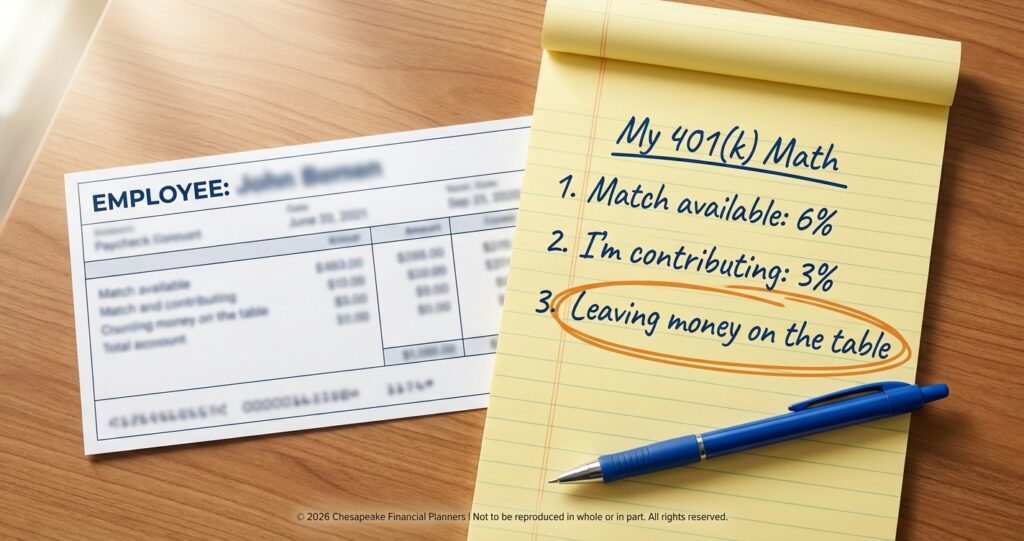
To capture the full match, you have to contribute at least the percentage of pay your employer is willing to match against. A 100 percent match up to 3 percent of pay requires a 3 percent contribution. A 50 percent match up to 6 percent requires a 6 percent contribution. The most common mistake is treating "I'm contributing 3 percent" as enough when the plan actually rewards contributions up to 6 percent.
What happens if you contribute less than the match cap?
You lose the unmatched portion forever, with no recovery option in a future year. Consider an example: salary $80,000, employer match formula 50 percent up to 6 percent. Contributing 3 percent puts $2,400 into your account and triggers a $1,200 match. Contributing 6 percent puts $4,800 in and triggers a $2,400 match. The 3-percentage-point difference in your contribution doubles your match. Over a 30-year career at 7 percent compounded returns, the missing $1,200 of annual match alone grows to roughly $113,000. That's the cost of a single misread contribution slider.
Two practical steps make this easy. First, ask your benefits team for the exact match formula in writing. Second, set your contribution at one percentage point above the match cap so a payroll glitch or rounding error doesn't cost you the last bit of match.
What Is a Vesting Schedule and When Do You Own the Employer Contribution?
A vesting schedule is the timeline that decides when employer contributions in your 401(k) actually belong to you. Your own contributions are always 100 percent vested from day one. The vesting rule only applies to the match and any profit-sharing dollars your employer adds. The Department of Labor sets the legal maximums under ERISA, and most plans choose one of three approaches.
When do you actually own your employer's contributions?
It depends on the schedule your plan uses. Immediate vesting means the match belongs to you the day it lands in the account. Cliff vesting keeps you at 0 percent ownership until you cross a threshold, often two or three years, at which point you become 100 percent vested. Graded vesting typically gives you 20 percent ownership after two years and adds 20 percent each year until you reach full ownership at six years. The ERISA maximum is a three-year cliff or a six-year graded schedule for traditional matching contributions.
Knowing your schedule matters most around job changes. Jeff has watched clients accept a new offer and walk out of their old job six weeks before a cliff vesting date, forfeiting $15,000 or more in employer contributions they would have kept by waiting. If a recruiter calls and you're within twelve months of a vesting milestone, negotiate a delayed start date. That single conversation can be worth more than a signing bonus.
How Do Match Timing and True-Up Rules Decide What You Actually Receive?
Match timing decides whether contributions made early in the year still earn a match later in the year. Some employers calculate the match per paycheck, others per pay period summed at year end, and a smaller group runs a "true-up" at year end to make participants whole. The mechanics matter most for high earners who front-load 401k contributions and hit the IRS deferral limit before December.
Can you actually lose match money by front-loading?
Yes, on a per-paycheck match plan with no true-up. Here is the trap. Your salary is $250,000 and the match is 50 percent up to 6 percent of pay, capped at $7,500 for the year. You decide to max out the $24,500 employee deferral limit by June. Once your contributions stop, the per-paycheck match also stops. From July through December you receive $0 in match instead of the $3,750 you would have earned by spreading contributions evenly. The plan administrator is following the document; the rule simply punishes front-loading.
The fix is to ask three questions of your benefits team: how is the match calculated, when is the match deposited, and does the plan offer a year-end true-up. If there is no true-up, smooth your contribution rate across all 24 or 26 pay periods. If you're a participant in a plan that does true-up, Fidelity's contribution-limit reference suggests you can front-load without penalty, but read the plan document before you assume it.
Should You Pay Off Debt or Build an Emergency Fund Before Maxing the Match?
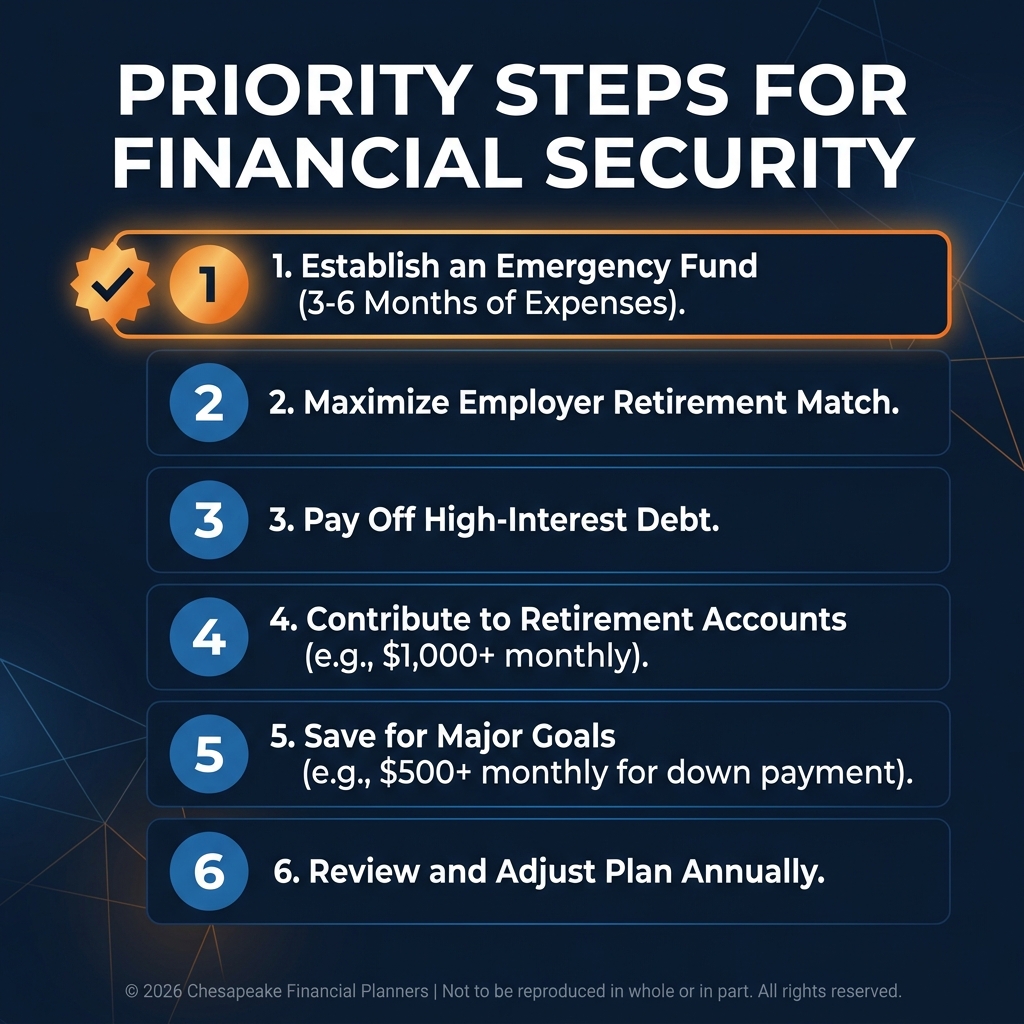
Capture the employer match first, even if you carry high-interest debt or have no emergency fund. The match is an instant 50 to 100 percent return in the year it is contributed; no credit card or savings account beats those terms. The right retirement savings priority for almost every household is to capture the match, then attack high-interest debt, then build the emergency fund, then push past the match.
What is the right priority order from there?
Jeff uses the R.U.D.D.E.R. Method™, Chesapeake Financial Planners' six-step planning process: Review and Recognize, Uncover and Understand, Design and Develop, Discuss and Decide, Execute and Empower, and Reassess and Refine. Applied to the match question, the framework looks like this:
- Capture your full employer match. Always first.
- Pay off debt above 6 to 7 percent interest. Credit cards and high-rate personal loans qualify; a 4 percent student loan usually does not.
- Build a 3 to 6 month emergency fund. Three months for dual-income households with stable jobs, six months for single-earner families or commission-based income.
- Max out an IRA. The 2026 IRA contribution limit is $7,500, with an $8,600 limit for workers age 50 and older. A Roth IRA is the default choice for most workers under 40.
- Increase 401(k) contributions toward the $24,500 limit. Use raises and bonuses; don't try to overhaul cash flow in one quarter.
- Fund taxable brokerage accounts or other goals. Education savings, real estate down payments, charitable giving accounts.
This order treats the match as a non-negotiable first move because the return on every other dollar in the priority list is uncertain. The match isn't.
Roth 401(k) vs Traditional 401(k): Where Does the Employer Match Go?
A Roth 401(k) holds after-tax contributions that grow and come out tax-free in retirement. A Traditional 401(k) holds pre-tax contributions that reduce taxable income today and come out as ordinary income later. The employee chooses the Roth or Traditional bucket on every paycheck; the employer match, until very recently, always went into the pre-tax side.
How is the employer match taxed if you contribute to a Roth 401(k)?
It depends on what the plan elected after SECURE 2.0. The law now permits employers to deposit the match directly into a Roth account, but only when the employee elects that treatment and the plan document allows it. The employee owes income tax on the matched amount in the year of the contribution, similar to receiving a small bonus. Most plans haven't updated yet, which means the match still flows into the Traditional bucket and is taxed when withdrawn in retirement. Workers earning above the IRS high earner threshold of $150,000 in prior-year Social Security wages also face a separate rule: starting in 2026, their catch-up contributions must be Roth.
Here is a quick comparison of the roth vs traditional 401k decision:
| Dimension | Traditional 401(k) | Roth 401(k) |
|---|---|---|
| Tax on contribution | Pre-tax (reduces taxable income now) | After-tax (no immediate deduction) |
| Tax on qualified withdrawal | Ordinary income | Tax-free |
| Employer match treatment | Always allowed; pre-tax by default | Allowed since SECURE 2.0; employee owes tax on the match in the year received |
| Required Minimum Distributions | Yes, starting at age 73 | None during the employee's lifetime as of 2024 |
| Best fit | Workers in the 32 percent bracket or higher expecting lower retirement brackets | Workers in the 22 to 24 percent bracket or expecting higher rates later |
Jeff splits contributions across both buckets for most clients in the 24 to 32 percent brackets, which keeps the tax decision flexible. A pure all-Roth or all-Traditional bet locks in an assumption about future tax rates that nobody can actually make.
What Are the Most Expensive 401(k) Match Mistakes to Avoid?
The match mistakes that cost the most aren't dramatic. They are quiet, slow, and almost always invisible until decades later. Six show up over and over in Jeff's client reviews, and they are easy to avoid once you've seen them.
What's the single most common mistake?
Not enrolling. A surprising share of new hires assume they were enrolled automatically and never notice the missing contribution on the first paycheck. Vanguard reports that 61 percent of plans now use auto-enrollment, which has cut this problem substantially, but the other 39 percent still require an active sign-up. Check your enrollment status this week if you haven't already.
The other five expensive mistakes:
- Contributing below the match cap. Covered above. The cost is the unmatched portion, every year, compounded.
- Cashing out at job changes. If you leave a job and take a cash distribution from your 401(k), you owe ordinary income tax plus a 10 percent early withdrawal penalty if you're under 59½. Roll the balance to an IRA or your new employer's plan instead. The DOL rollover guidance explains the mechanics.
- Leaving contributions in cash. A surprising number of accounts sit in a money market default fund earning 4 to 5 percent while the participant assumes they are invested in stocks. Check your allocation; the default is rarely what you want.
- Missing catch-up contributions after age 50. The 50-and-over catch-up rises to $8,000 in 2026, and workers age 60 to 63 can defer an additional $11,250 under SECURE 2.0. That is a $35,750 total deferral cap, money many late-career savers leave on the table because they don't realize the SECURE 2.0 rule exists.
- Front-loading without a true-up. Covered above.
Jeff has watched a single client correct three of these mistakes in one meeting and add an estimated $480,000 to a 30-year retirement projection. The match isn't the only lever, but it is the lever most people leave unpulled.

Frequently Asked Questions
What is the maximum 401(k) employer match for 2026?
There is no federal cap on the employer match itself, but the combined employee plus employer contribution is capped at $72,000 in 2026 under IRS Section 415(c). The actual match amount is set by your plan document. Most employers match between 3 and 6 percent of pay using formulas like dollar-for-dollar up to 3 percent or 50 cents on the dollar up to 6 percent of salary.
How much should I contribute to my 401(k) to maximize the match?
Contribute at least the percentage of pay your employer matches against, which is typically 3 to 6 percent. If the formula is 50 percent up to 6 percent of pay, contributing 6 percent captures the full match. Contributing less, say 4 percent, leaves part of the match on the table permanently. Set your deferral one percentage point above the match cap to protect against payroll rounding.
Do I get to keep the employer match if I leave my job?
It depends on your vesting schedule. If your plan uses immediate vesting, the match is yours from day one. If the plan uses a three-year cliff, you keep nothing if you leave before the cliff and 100 percent if you leave after. Graded vesting earns you 20 percent of the match each year over six years. Your own contributions are always 100 percent vested.
Can my employer match Roth 401(k) contributions directly?
Yes, since SECURE 2.0 took effect, but only if your plan document has been updated and you elect the Roth match. The matched amount is taxable to you in the year it is contributed. If your plan has not adopted the Roth match provision, the employer contribution still flows into the Traditional pre-tax side of your account, even when you contribute to the Roth bucket personally.
What are the 2026 IRS 401(k) contribution limits?
The 2026 employee deferral limit is $24,500, up from $23,500 in 2025. Workers age 50 and older can add $8,000 in catch-up contributions, and workers ages 60 through 63 can add $11,250 under SECURE 2.0. The combined employee plus employer cap is $72,000, or $80,000 with the age 50 catch-up included. The IRA limit rose to $7,500 in the same announcement.
Should I prioritize the 401(k) match over paying off debt?
Capture the match first, then attack debt. An employer match is an immediate 50 to 100 percent return, which is higher than the interest rate on essentially any debt you might carry. Once you've captured the full match, redirect cash flow toward credit card balances and any other debt above 6 to 7 percent. After the high-interest debt is gone, fund an emergency fund, then push past the match.
Is the 401(k) employer match really "free money"?
The employer contribution functions as additional pay you don't have to repay, deposited directly into your retirement account. Calling it free is also misleading, because the contribution is part of your total compensation package; not capturing it is the same as turning down a portion of your offered pay. Treat it as deferred salary that compounds for decades.
Where to Go From Here
If you're not sure whether you're capturing the full employer match 401k contribution, the fastest fix is to pull up your most recent pay stub and your benefits summary plan description side by side. The match formula and the per-paycheck deduction tell you everything in five minutes. For a deeper walkthrough of how the match fits into a full retirement plan, including catch-up timing, Roth versus Traditional decisions, and the priority order Jeff uses with clients, download the Chesapeake Financial Planners Retirement Readiness Guide at chesapeakefp.com.
Contributions to a traditional 401(k) are tax-deferred, meaning that taxable income is reduced by the amount of the contribution, but distributions are taxed as ordinary income in retirement.
Want to go deeper? Our 401k Readiness Checklist walks through this step by step.
Disclosures
The information provided is for educational purposes only and should not be construed as investment advice. Investment strategies should be tailored to individual circumstances, risk tolerance, and goals. Past performance doesn't guarantee future results. Consult with qualified financial professionals regarding your specific situation.
CFP Board owns the marks CFP®, CERTIFIED FINANCIAL PLANNER®, and CFP® (with plaque design) in the U.S.
Certified Financial Planner Board of Standards Center for Financial Planning, Inc. owns and licenses the certification marks CFP®, CERTIFIED FINANCIAL PLANNER®, and CFP® (with plaque design) in the United States to Certified Financial Planner Board of Standards, Inc., which authorizes individuals who successfully complete the organization’s initial and ongoing certification requirements to use the certification marks.
Advisors associated with Chesapeake Financial Planners may be either (1) LPL Financial Registered Representatives offering securities through LPL Financial, Member FINRA and SIPC, and investment advisor representatives offering investment advice through Great Valley Advisor Group; or (2) solely investment advisor representatives offering investment advice through Great Valley Advisor Group and not affiliated with LPL Financial. Great Valley Advisor Group, and Chesapeake Financial Planners are separate entities from LPL Financial.


