

How Do Hybrid Long Term Care Insurance Policies Work?
Last reviewed: July 2026
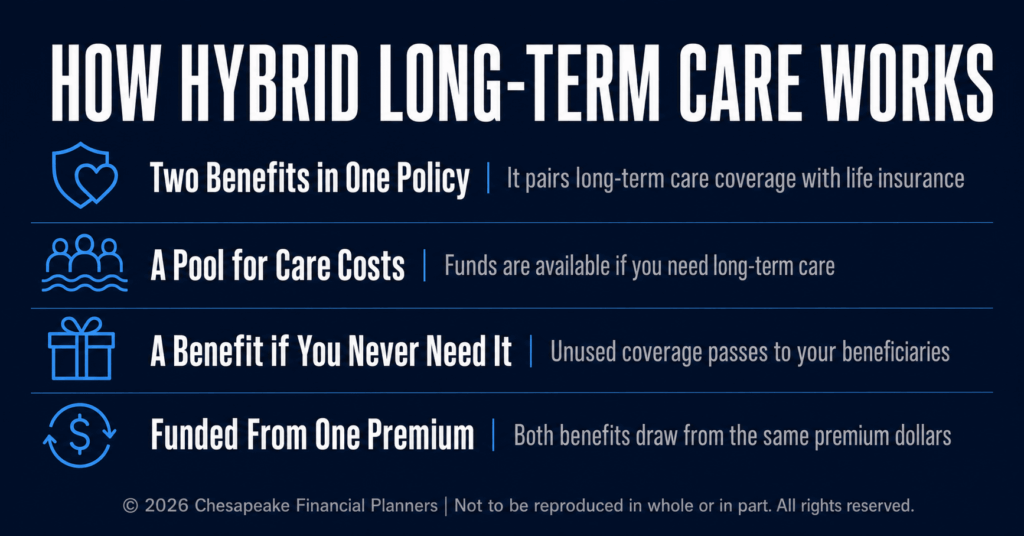
Hybrid long term care insurance (also called combination long-term care insurance) combines a permanent life insurance policy or annuity with a long-term care benefit rider, so a single premium funds two outcomes: care coverage if you need it, and a death benefit for your heirs if you do not. Most policies are funded with a single premium or a defined premium schedule (typically 5 or 10 years), and the LTC pool is structured to be several multiples of what you pay in. The trade-off compared with stand-alone LTC insurance is direct: premiums are higher upfront, but the money is not forfeited if you stay healthy.
Key Takeaways
- Hybrid long term care insurance combines a life insurance death benefit with a long-term care benefit pool funded from the same premium.
- Premiums are higher than stand-alone LTC insurance, but if you do not need care, your beneficiaries receive a death benefit.
- In 2026, the IRS limits the deductible portion of qualified LTC premiums for taxpayers age 71 and older to $6,200.
- You can fund a hybrid policy through a tax-deferred 1035 exchange from an existing cash-value life insurance policy or non-qualified annuity.
- The LTC benefit pool is typically two to five times the single premium paid, varying by policy structure and issue age.
About the Author: Jeff Judge, CFP®, AEP®, ChFC®, CLU® is Managing Partner of Chesapeake Financial Planners in Forest Hill, Maryland. He has been helping families and business owners in Harford County and the Baltimore metro area work through long-term care planning decisions since earning his CFP® certification in 2013, by using Chesapeake Financial Planners’ signature process, the R.U.D.D.E.R. method™. Jeff often tells clients that the right LTC question is not "what's the cheapest premium" but "what happens to the money if I never file a claim."
What Is Hybrid Long Term Care Insurance?
Hybrid long term care insurance is a permanent life insurance policy (or, less commonly, a fixed annuity) that pays out for qualifying long-term care services while you are living and a death benefit to your beneficiaries when you pass. The same dollars fund both pools. If you need care, the policy reimburses or pays per-diem benefits for qualifying expenses such as nursing home stays, assisted living, and home care, as defined under IRC §7702B and IRS Publication 502. If you do not need care, your heirs receive the remaining death benefit, often in full.
This product category is sometimes labeled linked benefit ltc, life insurance with ltc rider, or asset-based long-term care, because the LTC pool is anchored to an underlying life insurance or annuity asset rather than to a stand-alone LTC contract. Most modern policies allow the LTC pool to be drawn down faster than the death benefit accumulates, which is what gives the LTC coverage real heft. A policy with a $100,000 single premium might offer $300,000 to $500,000 in lifetime LTC benefits, depending on issue age and rider design.
The 2006 Pension Protection Act (PPA) made these products tax-attractive in a specific way: qualifying LTC benefits paid out of a hybrid policy are generally not taxable as ordinary income, and a 1035 exchange from an old life insurance policy or non-qualified annuity into a qualifying hybrid LTC contract is tax-deferred. Talk with your tax advisor about your specific situation, because the rules differ for annuity-based and life-insurance-based hybrids.
How Does a Hybrid LTC Policy Work?
A hybrid LTC policy works in three phases: funding, accumulation, and benefits. Most policies are funded with a single lump sum, but multi-year premium structures (5-pay, 10-pay, or lifetime pay) are available. After funding, the policy maintains both a death benefit and an LTC benefit pool. Both pools grow according to the contract, and a contractually defined cash value typically applies if you surrender the policy, subject to contract terms that vary by carrier.
Benefits trigger when you can no longer perform at least two activities of daily living (bathing, dressing, transferring, toileting, continence, or eating) or when you require substantial supervision because of severe cognitive impairment, as defined under IRC §7702B. A licensed health care practitioner must certify the need. Once on claim, the policy pays a monthly benefit up to the contract maximum for qualifying services, typically over a benefit period of 2 to 7 years.
Here is where the product distinguishes itself from stand-alone LTC. Every dollar drawn from the LTC pool reduces the death benefit on a defined schedule, and unused LTC benefits convert back to a death benefit at the insured's death. If you do not use the LTC pool, the full death benefit (less any policy loans or surrenders) passes to your beneficiaries. In Jeff's experience working with Harford County families, this feature is what gets the policies past the "I'd hate to waste the money" objection that kills so many stand-alone LTC conversations.
What Does Hybrid LTC Insurance Cost in 2026?
Single-premium hybrid LTC policies in 2026 commonly run $50,000 to $200,000, with the LTC pool sized at two to five times the single premium depending on issue age, gender, and underwriting class. Multi-year premium structures spread the funding over 5 or 10 years and run roughly $5,000 to $15,000 annually for similar coverage. Premiums are priced on issue age, so a 55-year-old will lock in materially better economics than a 70-year-old, all else equal.
According to LongTermCare.gov, the federal resource for LTC planning, the cost of care continues to rise faster than general inflation, and the gap between LTC inflation and traditional retirement inflation assumptions is one of the biggest planning risks for pre-retirees. A semi-private nursing home room runs well over $100,000 annually in most metros, and skilled home care often runs $50,000 to $75,000 a year. Hybrid LTC is structured to position a defined pool of funds against that risk.
Tax treatment of premiums depends on the policy type. With life-insurance-based hybrids, the portion of premium specifically allocated to qualified LTC coverage may be deductible as a medical expense if the policy meets the IRC §7702B definition of qualified LTC insurance. The IRS publishes annual age-banded deductibility limits under Revenue Procedure 2025-32: the age 51-60 limit is $1,860 for 2026, the age 61-70 limit is $4,960, and the limit rises to $6,200 for age 71 and older. These deductions are still subject to the 7.5% AGI floor for itemizers, so most clients will not capture them at the federal level.
Who Should Consider a Hybrid LTC Policy?
A hybrid LTC policy may be appropriate for someone who has enough liquid assets to fund the policy without disrupting retirement income, who wants LTC protection but objects to paying premiums for coverage they may not use, and who values leaving an inheritance if the LTC coverage goes unused. The typical buyer falls between ages 50 and 70 with at least $300,000 to $500,000 in non-retirement assets that can be repositioned. Medicare does not pay for most long-term custodial care, which is one of the structural gaps a private LTC strategy is built to address.
When deciding whether a hybrid policy fits the broader plan, Jeff and the CFP team apply the R.U.D.D.E.R. Method™, Chesapeake Financial Planners' six-step planning process: Review and Recognize, Uncover and Understand, Design and Develop, Discuss and Decide, Execute and Empower, and Reassess and Refine. The Discuss and Decide phase is usually where the hybrid LTC question gets answered, because the answer almost always depends on three other planning questions: whether you carry meaningful estate exposure, whether you have a surviving spouse to protect, and whether your existing cash-value life policy is underperforming relative to a 1035 exchange alternative.
Jeff has watched clients put off this decision for three to five years because the underwriting "felt complicated." It rarely gets cheaper to wait. Premiums increase with issue age, and an unexpected health event between ages 60 and 70 can push hybrid coverage out of reach. The trade-off is that the hybrid LTC premium ties up capital that could otherwise compound in a taxable account.

How Does Hybrid LTC Compare to Stand-Alone LTC Insurance?
Stand-alone (traditional) LTC insurance and hybrid LTC are structured very differently, and the right choice usually depends on whether the buyer is more sensitive to premium efficiency or to "use it or lose it" risk. A stand-alone LTC contract is priced more aggressively for the pure care risk, but premiums can be raised by the carrier subject to state insurance regulator approval, and if you do not need care, the premiums are gone. A hybrid policy locks in pricing on day one, returns the premium as either care benefits or a death benefit, and is generally not subject to rate increases on the base premium.
| Feature | Hybrid LTC (Life or Annuity Based) | Stand-Alone LTC Insurance |
|---|---|---|
| Funding | Single premium or 5- to 10-pay | Annual premiums for life |
| Premium increases | Generally not on base premium | Carrier may raise rates with regulator approval |
| If you do not need care | Death benefit to heirs | Premiums forfeited |
| LTC pool size | 2x to 5x of single premium typical | Higher leverage per premium dollar |
| Tax-deductible premium portion | Limited under IRC §213(d)(10) | Limited under IRC §213(d)(10) |
| 1035 exchange in | Allowed from life or non-qualified annuity | Not applicable |
| Underwriting | Simplified or full | Typically full medical |
The picture changes when the client already holds a cash-value life policy or non-qualified annuity that is not pulling its weight. A 1035 exchange of an old life policy into a hybrid LTC contract repositions an underused asset into LTC coverage on a tax-deferred basis, often without out-of-pocket premium. This is the move that gets the most traction in CFP's planning work, especially for clients who originally bought whole life decades ago for a need that has since gone away.
Related Topics Worth Reading
If you are working through how a hybrid LTC policy fits into a broader plan, these adjacent topics matter:
- Traditional long-term care insurance. Stand-alone LTC policies still work well for some buyers and fall short for others. The comparison hinges on premium structure, rate-increase exposure, and how strongly you feel about "use it or lose it" economics. traditional long term care insurance
- 1035 exchanges from life insurance to LTC. The Pension Protection Act of 2006 lets you reposition cash-value life insurance and non-qualified annuities into a hybrid LTC policy without triggering a taxable event on the embedded gain.
- Estate planning checklist. A hybrid LTC policy interacts with beneficiary designations, will provisions, and any trusts you have set up. Walk through the planning checklist before naming beneficiaries on the policy. What does a complete estate plan include and where do you start?
- Medicare vs long-term care insurance. Medicare pays for limited skilled care after qualifying hospital stays, not for the kind of custodial care that drives most LTC claims. This piece clarifies the gap that private LTC coverage is built to fill. medicare vs long term care insurance
- Irrevocable life insurance trusts (ILIT). If the policy death benefit pushes your estate over a state or federal exemption, ownership inside an ILIT can keep the death benefit out of the taxable estate. What is an ILIT, and how does it keep life insurance out of my estate?
- Pension Protection Act LTC tax benefits. The 2006 law is the reason hybrid LTC has the tax structure it does. Read the detail before assuming your hybrid policy works the same way as a stand-alone LTC contract.
Frequently Asked Questions
Is hybrid long term care insurance worth it?
Hybrid long term care insurance may be worth it for buyers who want LTC coverage but object to "use it or lose it" stand-alone LTC premiums, and who can fund the policy without straining other plans. Premiums are higher than stand-alone LTC, but the death benefit feature means the money is not forfeited if you stay healthy.
Are hybrid LTC insurance premiums tax-deductible?
Hybrid LTC premiums are generally not deductible the same way as stand-alone LTC premiums, because only the portion of premium specifically allocated to qualified LTC coverage qualifies under IRC §213(d)(10), subject to age-banded limits and the 7.5% AGI floor for itemizers. Consult your tax advisor on your specific policy and structure.
What happens to a hybrid LTC policy if I die without using the long-term care benefits?
If you die without using the long-term care benefits, your beneficiaries receive the policy's death benefit, less any outstanding policy loans, withdrawals, or LTC benefits already paid. Life insurance death benefits are generally income tax-free to beneficiaries, though estate-tax treatment depends on policy ownership and beneficiary structure. Confirm details with your tax advisor.
Can I do a 1035 exchange into a hybrid LTC policy?
Yes. The Pension Protection Act of 2006 allows tax-deferred 1035 exchanges from a cash-value life insurance policy or non-qualified annuity into a qualifying hybrid LTC policy, repositioning an underused contract into LTC coverage without triggering taxable gain. Work with your advisor and the receiving carrier to confirm eligibility.
How is hybrid LTC different from a stand-alone long-term care policy?
Hybrid LTC is built on a life insurance or annuity chassis, so the premium funds either care coverage or a death benefit. Stand-alone LTC is a separate contract with lower premium per dollar of LTC leverage, but no death benefit if care is never needed, and the carrier can request rate increases over time subject to state regulator approval.
What disqualifies you from hybrid long term care insurance?
Health conditions that affect functional ability or cognition are the most common disqualifiers, including dementia, Parkinson's disease, advanced cardiovascular conditions, recent stroke, and certain autoimmune conditions. Most carriers also decline applicants currently receiving long-term care services or those with a recent ADL impairment. Underwriting requirements vary by carrier and policy structure.
The CFP team has put together a Long-Term Care Planning Checklist that walks through the full set of questions to work through before you talk to a carrier: what to model, what to ask, and how to compare a 1035 exchange against funding a new policy directly. If you are weighing whether hybrid long term care insurance fits your plan, download the checklist at chesapeakefp.com to start the conversation with the right framework.
Want to go deeper? Our How to Avoid Common Mistakes With Inherited Wealth walks through this step by step.
Disclosures
The information provided is for educational purposes only and should not be construed as investment advice. Investment strategies should be tailored to individual circumstances, risk tolerance, and goals. Past performance doesn't guarantee future results. Consult with qualified financial professionals regarding your specific situation.
This material is for educational purposes only. Insurance products contain exclusions, limitations, and terms for keeping them in force. Please contact a qualified insurance professional for costs and complete details.
Advisors associated with Chesapeake Financial Planners may be either (1) LPL Financial Registered Representatives offering securities through LPL Financial, Member FINRA and SIPC, and investment advisor representatives offering investment advice through Great Valley Advisor Group; or (2) solely investment advisor representatives offering investment advice through Great Valley Advisor Group and not affiliated with LPL Financial. Great Valley Advisor Group, and Chesapeake Financial Planners are separate entities from LPL Financial.


