

What Are the Financial Steps for a Woman Going Through a Divorce?
Last reviewed: July 2026
The financial steps for a woman going through a divorce start with three moves: gather every financial document, open accounts in your own name, and build a realistic post-divorce budget before any settlement is signed. From there, you value the marital estate, decide how to divide retirement accounts (often through a QDRO), and protect your credit and income. Financial planning for women divorce situations is its own discipline because women statistically face longer retirements, more career interruptions, and a steeper income drop after the marriage ends.
Key Takeaways
- Gather financial documents and open individual accounts before filing, so you start the process with full visibility and your own credit.
- Dividing retirement accounts usually requires a QDRO, a court order that splits a 401(k) or pension without triggering early-withdrawal penalties.
- The 2026 IRA contribution limit is $7,500, giving newly single women a tax-advantaged way to rebuild savings.
- Gray divorce, the rise in divorces after age 50, has roughly doubled since 1990, per Census-based research, and hits women's retirement hardest.
- The marital home is rarely the asset to fight for; liquidity and future earning power matter more than square footage.
About the Author: Jeff Judge, CFP®, AEP®, ChFC®, CLU® is Managing Partner of Chesapeake Financial Planners in Forest Hill, Maryland. He has been helping families and business owners in Harford County and the Baltimore metro area navigate divorce and major financial transitions since earning his CFP® certification in 2013, by using Chesapeake Financial Planners’ signature process, the R.U.D.D.E.R. method™. Jeff has watched too many women accept a settlement that looked fair on paper but left them cash-poor and house-rich, and he tells clients the same thing every time: the asset you can spend matters more than the asset you can photograph.
On This Page
- What Should a Woman Do First When Divorce Becomes Likely?
- How Do You Value the Marital Estate Before Dividing It?
- How Do You Divide Retirement Accounts in a Divorce Without Triggering Taxes?
- What Are the Special Financial Risks of a Gray Divorce?
- How Do You Protect Your Credit and Income During and After Divorce?
- How Do You Rebuild a Financial Plan as a Newly Single Woman?
- Frequently Asked Questions
What Should a Woman Do First When Divorce Becomes Likely?
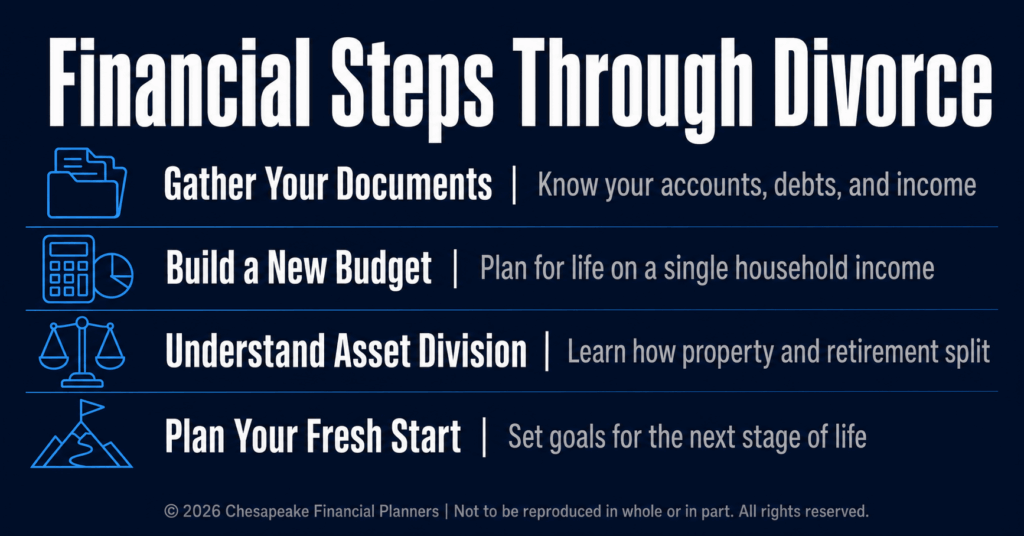
The first step is gathering documents and establishing financial independence before anything becomes contested. Pull together tax returns from the last three years, every account statement, mortgage and loan documents, pay stubs, and a list of all assets and debts. This is the foundation of the entire process, and it gets harder to access once tensions rise and passwords change.
What financial documents do you actually need?
You need a complete picture of what the marriage owns and owes. That means bank and brokerage statements, retirement account statements (401(k), IRA, pension, 403(b)), the most recent mortgage statement, credit card balances, life insurance policies, and business ownership records if either spouse owns a company. Make copies and store them somewhere only you can reach. If you need a working checklist, see our guide on What financial documents do I need to gather before filing for divorce?.
Next, open a checking account and a credit card in your own name if you do not already have them. A surprising number of women in long marriages have no individual credit history because every account was joint or in their spouse's name. The Consumer Financial Protection Bureau confirms that credit reports are built on individual account history, so an authorized-user card does not build the same standing as an account in your name.
Jeff Judge often sees women hesitate here because opening separate accounts feels like an act of war. It is not. It is basic preparation, and a good divorce attorney will tell you the same thing. The spouse who walks into the process with documents organized and credit established negotiates from strength.
At Chesapeake Financial Planners, the planning process for a transition like this follows the R.U.D.D.E.R. Method™, Chesapeake Financial Planners' six-step planning process: Review and Recognize, Uncover and Understand, Design and Develop, Discuss and Decide, Execute and Empower, and Reassess and Refine. The first two steps map directly onto this document-gathering phase, where you review what you have and uncover what you do not yet understand about the marital finances.
How Do You Value the Marital Estate Before Dividing It?
Valuing the marital estate means assigning a real, after-tax dollar figure to every asset and debt the marriage holds. This is where many settlements go wrong, because two assets with the same sticker price can have wildly different real value once taxes and liquidity are factored in.
Why are two assets of equal value not actually equal?
A $300,000 Roth IRA and $300,000 of home equity are not the same asset. The Roth comes out tax-free in retirement. The home carries selling costs, ongoing property taxes, maintenance, and capital-gains exposure above the $250,000 exclusion the IRS allows a single filer. A $300,000 traditional 401(k) is worth even less, because every dollar is taxed as ordinary income when withdrawn.
Maryland, like most states, follows equitable distribution rather than community property, which means the court divides marital assets fairly, not necessarily 50/50. That distinction matters. Equitable does not mean equal, and the factors a court weighs include each spouse's economic circumstances and contributions to the marriage.
Here is how three common marital assets compare on the dimensions that actually decide whether a settlement works:
| Asset | Liquidity | Tax treatment when used | Ongoing cost to hold |
|---|---|---|---|
| Roth IRA | Moderate (penalty-free contributions; earnings restricted before 59½) | Tax-free in retirement | None |
| Traditional 401(k) | Low until 59½ | Taxed as ordinary income | None |
| Marital home equity | Low (requires sale or refinance) | Capital gains above exclusion | Property tax, maintenance, insurance |
The lesson Jeff repeats to clients: do not anchor on the headline number. A woman who keeps the house and gives up the retirement accounts can end up cash-poor, unable to cover the carrying costs, and forced to sell at a bad time anyway. Liquidity buys options. For a fuller breakdown of common errors, see What financial mistakes do people make during major life changes?.
How Do You Divide Retirement Accounts in a Divorce Without Triggering Taxes?
You divide most employer retirement accounts using a Qualified Domestic Relations Order, or QDRO, a court order that lets a plan split a 401(k) or pension between spouses without triggering taxes or the 10% early-withdrawal penalty. This is one of the most misunderstood pieces of a divorce, and getting it wrong is expensive.
What is a QDRO and when do you need one?
A QDRO is a separate legal order, distinct from the divorce decree itself, that directs a retirement plan administrator to pay a portion of one spouse's account to the other. According to the U.S. Department of Labor, a QDRO is required to divide most employer-sponsored plans, including 401(k)s, 403(b)s, and traditional pensions. Without it, the plan administrator legally cannot release funds to a non-employee spouse.
IRAs are the exception. The IRS allows IRAs to be split through a "transfer incident to divorce" under the divorce decree, no QDRO needed. The transfer must be properly documented as part of the divorce so it is treated as a tax-free transfer rather than a taxable distribution.
How do you avoid taxes and penalties when splitting an account?
The key is moving money through the correct legal channel and keeping it inside the retirement system. When a QDRO directs funds to the receiving spouse, those funds can roll directly into that spouse's own IRA or qualified plan with no tax and no penalty. The danger is taking the money in cash instead. A QDRO actually allows the receiving spouse a one-time chance to take a cash distribution penalty-free (though still taxable), which can be useful for someone who needs liquidity, but the default smart move is a direct rollover.
Jeff Judge has watched this single mistake cost women tens of thousands of dollars. Someone receives a $200,000 share of a 401(k), takes it as cash to feel secure, and discovers at tax time that ordinary income tax just consumed a large slice of it. The R.U.D.D.E.R. Method™ Discuss and Decide step exists precisely for moments like this, where one decision made in a hurry can erase years of savings. For a deeper walkthrough, read How does a QDRO work and what do I need to know to protect my retirement savings in a divorce?.
One more point that women in long marriages often miss: you may be entitled to a share of a pension's future payments, not just its present cash value. A QDRO can be written to pay you a monthly benefit for life when your former spouse retires. That stream can be worth more than a lump sum, especially given that women live longer on average and need income that lasts.

What Are the Special Financial Risks of a Gray Divorce?
Gray divorce, the term for divorce after age 50, carries financial risks that younger divorces do not, because there is far less time to recover. Research drawing on Census data shows the divorce rate for adults over 50 has roughly doubled since 1990, and for women the financial fallout is steep.
Why does divorcing after 50 hit women harder?
Three forces compound. First, there is little time left to rebuild retirement savings before you stop working. Second, women in this generation more often stepped back from careers to raise children, leaving smaller Social Security records and pensions of their own. Third, the household's fixed costs, the mortgage, the insurance, the lifestyle, were built for two incomes and now have to be covered closer to one.
The Social Security Administration does provide an important protection here that many women overlook: if you were married at least 10 years and have not remarried, you can claim a spousal or survivor benefit on your ex-spouse's record, worth up to 50% of their full benefit while you are both living, without affecting what they receive. For a woman with a thin work record of her own, that benefit can be a meaningful piece of retirement income.
How do you rebuild retirement savings on a shorter runway?
You use every tax-advantaged tool available and you use it aggressively. In 2026, the IRA contribution limit is $7,500, and if you are 50 or older you can add a catch-up contribution on top. Inside a workplace plan, the 2026 401(k) employee contribution limit is $24,500, with an $8,000 catch-up for those 50 and older, letting a woman over 50 contribute well above the base limit in a single year.
Jeff tells gray-divorce clients to treat the first three years after the split as a savings sprint. Income is often higher than it will be in retirement, the kids are usually grown, and the standard deduction for a single filer in 2026 is $16,100, which shapes how much room there is to do Roth conversions or harvest income at a lower rate. Those years are the runway. For the bigger picture on transitions, see Can a financial planner help me navigate a major life transition?.
How Do You Protect Your Credit and Income During and After Divorce?
You protect your credit by separating joint debt as fast as legally possible and monitoring your reports, and you protect your income by securing alimony or child support in writing and rebuilding your own earning power. Joint debt is the trap most people forget about.
Why is joint debt more dangerous than joint assets?
A divorce decree can assign a debt to your ex-spouse, but it does not change your contract with the lender. If your name is on a joint credit card or mortgage and your ex stops paying, the lender comes after you, and it shows up on your credit report. The Consumer Financial Protection Bureau is explicit that a divorce decree does not override your original loan agreement. The fix is to close joint accounts, refinance shared loans into one name, and confirm in writing that balances are paid off, not just reassigned.
Pull your credit reports from all three bureaus at the free federal site and check them again every few months through the process. Watch for accounts you forgot about and for activity on cards you assumed were closed. Rebuilding from here is its own project; our guide on How do I rebuild my finances and establish financial independence after a divorce? covers the full sequence.
On the income side, secure any alimony or child support as an enforceable order, and if you have been out of the workforce, build a plan to re-enter or increase earnings. A practice-experience pattern Jeff sees often: women undervalue their own future earning power in the settlement because they are anxious in the moment, and they trade away income-producing assets for the security of the house. The math rarely favors that trade.
How Do You Rebuild a Financial Plan as a Newly Single Woman?
You rebuild by writing a new plan from scratch around a single income, single budget, and single set of goals, rather than patching the old joint plan. The financial life you are building now answers to one person, and that is actually an opportunity to design it deliberately.
What does the first year of a new plan look like?
Start with cash flow. Build a real budget on your post-divorce income, including the carrying costs of whatever assets you kept. Then update every beneficiary designation, on retirement accounts, life insurance, and bank accounts, because these override your will and many people forget an ex-spouse is still listed. Rewrite your will, powers of attorney, and healthcare directives next.
Then turn to investing. As a newly single woman, your asset allocation should reflect your actual time horizon and your need for income that lasts, given that women live longer on average. The Bureau of Labor Statistics reports women's labor force participation and earnings patterns that translate directly into smaller lifetime Social Security and pension benefits, which means your own portfolio has to work harder. For more on this, see What do women need to know about investing for financial independence?. Jeff Judge notes: "Women coming out of a long marriage often have a shorter earnings history and a longer life expectancy working against them at the same time, which means the portfolio has to carry more weight and the allocation decisions matter more, not less."
Confidence is part of the rebuild too. Many women come out of a long marriage having never managed the household investments, and the learning curve feels steep. It is climbable, and you do not have to climb it alone. Our perspective on Why Do Women Lack Confidence in Financial Planning Decisions? addresses exactly this, and many clients find that How do I take control of my finances after divorce or loss? is the most useful first read.
Jeff's view, after years of these cases, is blunt and encouraging at the same time: the women who do best are not the ones who got the biggest settlement, they are the ones who took ownership of the plan early and made decisions from information instead of fear. If you want a thinking partner for that, see When should I hire a financial planner after a life-changing event?.

Frequently Asked Questions
What financial steps should a woman take first when divorce is likely?
A woman should first gather three years of tax returns, all account statements, and loan documents, then open a checking account and credit card in her own name. Establishing individual credit and full visibility into the marital finances before anything becomes contested is the single most important early move and the foundation for every decision that follows.
What is a QDRO and do I need one to divide a 401(k)?
A QDRO, or Qualified Domestic Relations Order, is a court order that directs a retirement plan to split a 401(k) or pension between divorcing spouses. You need one for most employer plans because the plan administrator legally cannot release funds to a non-employee spouse without it. IRAs are the exception and divide through a transfer under the divorce decree instead.
How do I divide retirement accounts in a divorce without paying taxes?
Move the funds through the correct legal channel and keep them inside the retirement system. A QDRO lets your share of a 401(k) roll directly into your own IRA with no tax and no penalty. Taking the money as cash instead triggers ordinary income tax, so the default smart move is always a direct rollover unless you genuinely need the liquidity now.
Can I collect Social Security on my ex-husband's record after divorce?
Yes, if your marriage lasted at least 10 years and you have not remarried, you can claim a Social Security spousal benefit on your ex-spouse's record worth up to 50% of their full benefit. Claiming it does not reduce what your ex-spouse receives, and many women with shorter work histories overlook this meaningful source of retirement income.
What is gray divorce and why is it riskier for women?
Gray divorce refers to divorce after age 50, and research based on Census data shows the rate has roughly doubled since 1990. It is riskier for women because there is little time to rebuild retirement savings, work histories are often shorter from career breaks, and a household budget built for two incomes must now stretch across far less.
Should I keep the house in a divorce settlement?
Often no, because the marital home is rarely the smartest asset to fight for. A house is illiquid, carries property taxes, insurance, and maintenance, and can exceed the capital-gains exclusion when sold. Many women end up house-rich and cash-poor. Liquidity and income-producing assets usually serve a newly single woman better than square footage.
How do I protect my credit during a divorce?
Close joint credit accounts, refinance shared loans into one name, and confirm balances are paid off rather than just reassigned. A divorce decree does not override your contract with a lender, so a joint debt assigned to your ex still appears on your credit if they stop paying. Pull all three credit reports and monitor them throughout the process.
How much can I contribute to retirement accounts to rebuild savings after divorce?
In 2026 you can contribute up to $7,500 to an IRA and up to $24,500 to a workplace 401(k), with an additional $8,000 catch-up contribution for the 401(k) if you are 50 or older. Treating the first few years after divorce as a focused savings sprint, while income is often at its peak, helps rebuild a retirement on a shorter runway.
If this guide helped you map out the road ahead, our free divorce financial planning checklist walks through every document, deadline, and decision point in one place. Download it at chesapeakefp.com and start the process with a plan instead of a worry.
Disclosures
The information provided is for educational purposes only and should not be construed as investment advice. Investment strategies should be tailored to individual circumstances, risk tolerance, and goals. Past performance doesn't guarantee future results. Consult with qualified financial professionals regarding your specific situation.
Advisors associated with Chesapeake Financial Planners may be either (1) LPL Financial Registered Representatives offering securities through LPL Financial, Member FINRA and SIPC, and investment advisor representatives offering investment advice through Great Valley Advisor Group; or (2) solely investment advisor representatives offering investment advice through Great Valley Advisor Group and not affiliated with LPL Financial. Great Valley Advisor Group, and Chesapeake Financial Planners are separate entities from LPL Financial.


