

What financial mistakes do people make during major life changes?
Last reviewed: July 2026
The most common financial mistakes people make during major life changes are acting too fast, ignoring tax consequences, failing to rebuild a budget, and forgetting to update beneficiary and estate documents. Divorce, job loss, inheritance, widowhood, and serious illness all hit your finances at the exact moment your decision-making is most strained. The damage is rarely the headline event. It's the quiet, compounding errors made under stress that cost the most.
Key Takeaways
- The biggest financial mistakes during life changes come from rushing irreversible decisions before the dust settles.
- Early retirement account withdrawals before age 59½ trigger a 10% IRS penalty plus ordinary income tax.
- Failing to update beneficiary forms after divorce can send assets to an ex-spouse, regardless of your will.
- Rebuilding your budget from zero within 30 days gives you a true picture of your new financial baseline.
About the Author: Jeff Judge, CFP®, AEP®, ChFC®, CLU® is Managing Partner of Chesapeake Financial Planners in Forest Hill, Maryland. He has been helping families and business owners in Harford County and the Baltimore metro area navigate major financial transitions since earning his CFP® certification in 2013, by using Chesapeake Financial Planners’ signature process, the R.U.D.D.E.R. method™. Jeff has watched clients lose more money to rushed decisions in the first 90 days of a transition than to any single market downturn.
Big life changes arrive with just enough notice to make you second-guess everything. A divorce. A layoff. An inheritance you didn't ask for. A diagnosis. When your world tilts, your money tilts with it, and that's exactly when mistakes happen.
You're not alone if you've stumbled during a transition. Most people do. The problem isn't a lack of intelligence or care. It's that major life changes overwhelm your judgment at the precise moment you need it sharpest. Your attention splits between emotional survival and practical necessity, and financial clarity becomes the casualty. Here are the patterns Jeff Judge sees most often, and what to do instead.
Why do people make irreversible financial decisions too quickly?
When life shifts hard, there's pressure to do something. Anything. Sell the house. Cash out the 401(k). Make a big purchase to feel in control again.
Rushed financial decisions during emotional upheaval are usually the expensive ones. Selling assets in a down market locks in losses. Cashing out a retirement account early triggers taxes and penalties. Signing a lease or buying a property to "start fresh" commits you to costs your new budget can't carry.
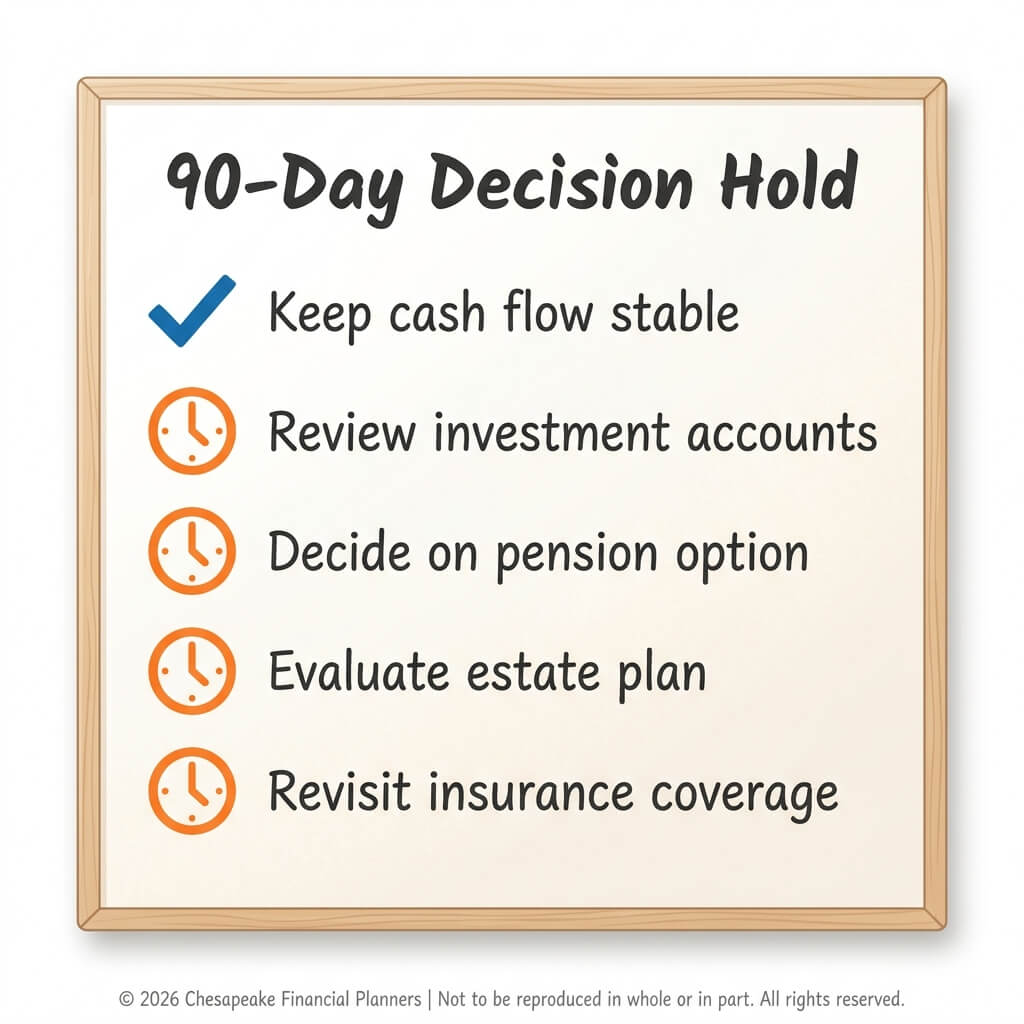
The fix is permission to pause. Unless there's a true deadline, and there usually isn't, delay major financial moves for at least 90 days. Keep your cash flow stable and meet your obligations, but don't make sweeping changes until you can think clearly. Jeff calls it a decision quarantine: write down every big move you're tempted to make, then revisit the list in three months. You'll be surprised how many items lose their urgency or reveal a better path once the emotion drains out.
This single discipline solves more transition problems than any clever strategy. The reader who internalizes nothing else should internalize this. Wait.
How do taxes catch people off guard during life transitions?
Life changes trigger tax consequences that aren't obvious in the moment. Divorce settlements, inheritance distributions, severance packages, insurance payouts, and early retirement withdrawals each carry their own tax weight. What looks like $100,000 can shrink to $70,000 after taxes, or push you into a higher bracket and trigger Medicare surcharges you never saw coming.
Early retirement account withdrawals are the classic trap. According to the IRS, money pulled from a traditional IRA or 401(k) before age 59½ generally faces a 10% early distribution penalty on top of ordinary income tax. On a $50,000 withdrawal, that penalty alone is $5,000 before the regular tax bill even starts.
Before you accept, sell, move, or withdraw anything significant, model the tax impact. A planner or CPA can project your bracket for the year, capital gains exposure, retirement account penalties, and state tax differences if you're relocating. Good tax planning during a transition routinely preserves a meaningful slice of money that would otherwise vanish to avoidable taxes. This is also why understanding How does a QDRO work and what do I need to know to protect my retirement savings in a divorce? matters so much before any settlement is finalized.
What happens when you let expenses drift after a major change?
After a big life change, your old budget no longer fits. Your household size changed. Your income changed. Your priorities shifted. Yet many people keep spending on autopilot, either out of habit or because they haven't faced the new math.
Unchecked spending drains savings faster than you realize, especially when income drops or costs jump. Two households after a divorce. Medical bills after a diagnosis. A single income where there used to be two.
Within the first 30 days, rebuild your budget from zero. Don't tweak the old one. Start fresh and answer four questions: What are your actual fixed expenses now? What income can you truly count on? What's temporarily elevated, like legal or moving costs, versus permanent? Where's the gap, and how long can your reserves cover it? This isn't about restriction. It's about knowing your new baseline so you can direct resources on purpose instead of by accident.
For anyone rebuilding after a split, How do I rebuild my finances and establish financial independence after a divorce? walks through the income and credit side of this work in detail.
Why do beneficiary and estate documents get overlooked?
Life changes don't just affect your bank balance. They affect who controls your money if you can't, and who inherits it when you're gone. Updating estate documents, beneficiary designations, and powers of attorney almost always falls to the bottom of the list.
Here's the trap most people don't know about: beneficiary designations on retirement accounts and life insurance override your will. Your ex-spouse can remain the named beneficiary on your 401(k) long after the divorce is final, and that designation wins, no matter what your will says. The Social Security Administration also pays survivor benefits based on specific eligibility rules that surviving spouses frequently misunderstand or claim at the wrong time.
Within 60 days of any major change, audit your retirement accounts, life insurance policies, transfer-on-death provisions, wills and trusts, financial and healthcare powers of attorney, and advance directives. Jeff considers this one of the highest-return, lowest-effort tasks in all of financial planning, and one of the most frequently skipped. For widows and widowers especially, What Financial Steps Should I Take After Losing My Spouse? covers the document sequence in the first year.
This work fits naturally into the R.U.D.D.E.R. Method™, Chesapeake Financial Planners' six-step planning process: Review and Recognize, Uncover and Understand, Design and Develop, Discuss and Decide, Execute and Empower, and Reassess and Refine. A life transition is exactly the moment to run the full sequence rather than patching one piece at a time. If you're unsure where to start, When should I hire a financial planner after a life-changing event? is a useful next read.
Frequently Asked Questions
What is the biggest financial mistake people make during a divorce?
The biggest financial mistake during a divorce is failing to update beneficiary designations afterward. Retirement accounts and life insurance pass by beneficiary form, not by your will, so an outdated designation can send your assets to an ex-spouse. Update every account within 60 days of the decree.
How much does it cost to withdraw retirement money early during a life change?
Withdrawing from a traditional IRA or 401(k) before age 59½ generally costs a 10% IRS early distribution penalty plus ordinary income tax on the full amount. On a $40,000 withdrawal, that penalty is $4,000 before regular income tax. Explore penalty exceptions and other funding sources first.
How long should I wait before making major financial decisions after a life change?
Wait at least 90 days before making major, irreversible financial decisions after a major life change, unless a true deadline forces your hand. This pause lets emotional pressure subside so you can evaluate options clearly. Keep cash flow stable and obligations current during the waiting period.
When should I update my estate documents after a major life event?
Update your estate documents within 60 days of any major life event, including marriage, divorce, birth, death, or remarriage. Audit your will, trusts, beneficiary designations, transfer-on-death provisions, and both financial and healthcare powers of attorney. These updates prevent assets from passing to the wrong people.
Do I need a financial advisor to handle a major life transition?
You don't strictly need an advisor, but a financial planner reduces blind spots and emotional decision-making when the stakes are high. A planner can stress-test scenarios, model tax outcomes, and coordinate your strategy across taxes, investments, and estate documents. Many transitions involve mistakes that cost far more than the planning fee.
What financial planning issues are unique to women during life changes?
Women often face longer life expectancies, more frequent career interruptions, and a higher likelihood of managing finances alone after a divorce or the death of a spouse. These realities make budgeting discipline, beneficiary updates, and long-term income planning especially important. Working with an advisor who understands these dynamics helps.
If you found this helpful, our guide on staying financially strong through transitions goes deeper on building a plan you can lean on when life shifts. Download it at chesapeakefp.com, and explore Can a financial planner help me navigate a major life transition? to see how the process works. A clear framework beats willpower every time a major change arrives.
Want to go deeper? Our What To Do When You Lose a Loved One walks through this step by step.
Disclosures
The information provided is for educational purposes only and should not be construed as investment advice. Investment strategies should be tailored to individual circumstances, risk tolerance, and goals. Past performance doesn't guarantee future results. Consult with qualified financial professionals regarding your specific situation.
Advisors associated with Chesapeake Financial Planners may be either (1) LPL Financial Registered Representatives offering securities through LPL Financial, Member FINRA and SIPC, and investment advisor representatives offering investment advice through Great Valley Advisor Group; or (2) solely investment advisor representatives offering investment advice through Great Valley Advisor Group and not affiliated with LPL Financial. Great Valley Advisor Group, and Chesapeake Financial Planners are separate entities from LPL Financial.


