

Should I Participate in My Company's ESPP Program?
Last reviewed: July 2026
Yes, you should almost always participate in your company's ESPP if it offers a discount and a lookback provision. An employee stock purchase plan with a 15% discount delivers a guaranteed return of roughly 18% on every dollar you contribute, before you even factor in the lookback. The smart ESPP strategy is simple: buy at the discount, sell quickly, and redeploy the proceeds into a diversified portfolio. The "taxes are complicated" excuse costs people thousands every year.
Key Takeaways
- A 15% ESPP discount produces a guaranteed pre-tax return near 18% per offering period, often higher with a lookback provision.
- Most participants should sell shares immediately to lock in the discount and avoid company stock concentration risk.
- The IRS caps ESPP purchases at $25,000 of stock value per calendar year as of 2026.
- A disqualifying disposition taxes the discount as ordinary W-2 income; set aside 35-40% of proceeds for taxes.
- Reinvesting after-tax ESPP proceeds turns a six-month concentrated bet into a long-term diversified position.
About the Author: Jeff Judge, CFP®, AEP®, ChFC®, CLU® is Managing Partner of Chesapeake Financial Planners in Forest Hill, Maryland. He has been helping families and business owners in Harford County and the Baltimore metro area navigate equity compensation decisions since earning his CFP® certification in 2013, by using Chesapeake Financial Planners’ signature process, the R.U.D.D.E.R. method™. Jeff sees the same pattern across tech and SaaS employees every year: people who max out their 401(k) without blinking will skip the one benefit that pays a near-guaranteed return.
What Is an ESPP and How Does the Discount Work?
An employee stock purchase plan is a benefit that lets you buy company stock at a discount, usually 15%, through after-tax payroll deductions. Most qualified plans run on a six-month offering period and include a lookback provision, which applies the discount to the lower of the stock price on the first or last day of the period.
Here is how a typical ESPP works:
- You contribute up to 15% of your salary (post-tax) through payroll deduction.
- Contributions accumulate for six months, called the offering period.
- At the end of the period, the company buys stock for you at a 15% discount.
- The lookback provision applies that discount to the lower of the day-one price or the final-day price.
Walk through the math. Say the stock is $100 on day one and $120 on day 180. Your purchase price is $100 × 0.85 = $85. You immediately own stock worth $120 that you paid $85 for. That is a 41% gain in six months, or roughly 82% annualized.
Even if the stock stayed flat at $100 the whole period, you still bought at $85 and own something worth $100. That is an 18% return on your money in six months. The discount alone, with no lookback benefit and no stock appreciation, is worth more than most people earn in a year of market returns. According to J.P. Morgan Asset Management, long-run equity returns average well under 10% annually. The ESPP discount dwarfs that. This is the core of any sound ESPP strategy. Jeff Judge notes: "An unfunded buy-sell is essentially an IOU from people who may not have the cash when it's actually needed, and I've seen that situation tear apart a partnership that survived 20 years of business challenges."
How does equity compensation affect my financial plan?
How Are ESPP Shares Taxed?
ESPP tax treatment depends entirely on how long you hold the shares after purchase. There are two outcomes, and the difference between them is smaller than most people assume.
A disqualifying disposition happens when you sell within two years of the grant date or one year of the purchase date. The discount you received is taxed as ordinary income and shows up on your W-2. Any additional gain above that is short-term or long-term capital gains depending on how long you held.
A qualifying disposition happens when you hold for at least two years from grant and one year from purchase. Part of the gain shifts to long-term capital gains treatment, which carries lower rates. The top long-term capital gains rate sits at 20% per the IRS as of 2026, versus ordinary income rates that can reach 37% at the highest federal bracket.
Here is the trade-off most people get wrong. The tax savings from a qualifying disposition are real, but capturing them means holding concentrated company stock for two full years. Jeff Judge often tells clients that the tax tail should not wag the diversification dog. A 10 to 15 percentage point tax difference is not worth the risk of watching a single stock cut your gains in half while you wait.
| Feature | Disqualifying Disposition | Qualifying Disposition |
|---|---|---|
| Holding requirement | Sell quickly after purchase | 2+ years from grant, 1+ year from purchase |
| Discount taxed as | Ordinary income (W-2) | Ordinary income (partial) |
| Extra gain taxed as | Short or long-term gains | Long-term capital gains |
| Concentration risk | Minimal (sell fast) | High (hold 2 years) |
| Best for | Most participants | Long-term company believers |
What Is the Smartest ESPP Strategy?
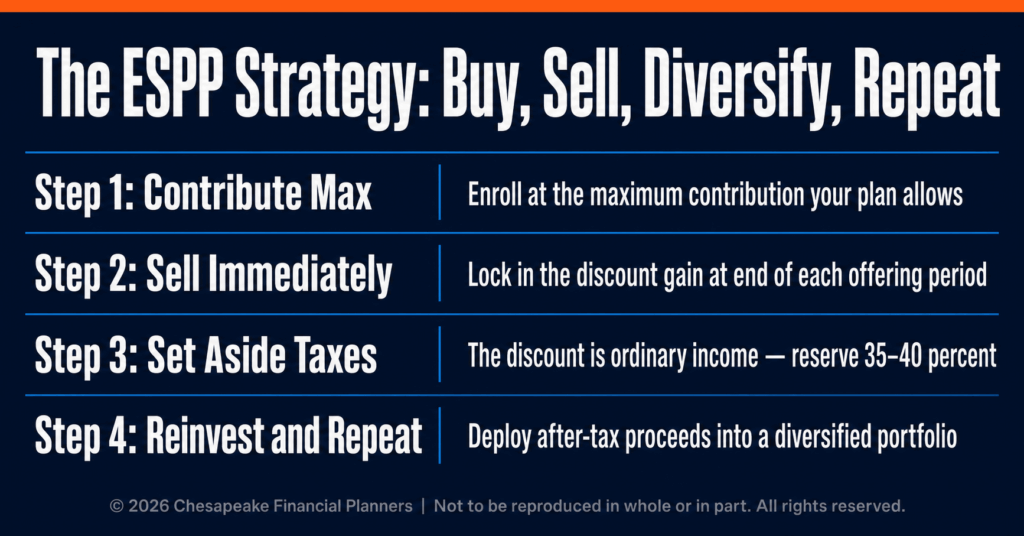
The smartest ESPP strategy for most employees is buy, sell, diversify, repeat. You capture the discount, get out before concentration risk builds, and redeploy the cash into investments that actually fit your plan.
Here is the framework:
- Contribute the maximum your plan allows. This usually means 15% of salary, capped by the IRS limit of $25,000 in stock value per calendar year. Yes, it dents your take-home pay, but you are only waiting six months to recover it plus an 18% or larger return.
- Sell immediately at the end of each offering period. Do not hold for tax treatment. Do not try to time the top. Lock in the discount the moment shares hit your account.
- Set aside the taxes. The discount lands as W-2 income. Reserve 35-40% of proceeds for federal, state, and FICA. Do not spend the gross.
- Reinvest in a diversified portfolio. Take the after-tax proceeds and put them into index funds, bonds, or whatever your asset allocation calls for. You have just converted a concentrated six-month bet into a durable position.
- Repeat every six months. This is a rinse-and-repeat engine. Each offering period delivers another discount capture.
This approach fits naturally into the R.U.D.D.E.R. Method™, Chesapeake Financial Planners' six-step planning process: Review and Recognize, Uncover and Understand, Design and Develop, Discuss and Decide, Execute and Empower, and Reassess and Refine. The ESPP decision is a small piece of a bigger picture, and it should connect to your overall allocation, not sit in a silo.
How Much of My Portfolio Should Be in One Stock?
How should my investment mix change as I get closer to retirement?
When Does Holding ESPP Shares Make Sense?
Holding ESPP shares makes sense only when you have already diversified the rest of your portfolio and genuinely want a long-term position in your employer. For the vast majority of participants, immediate selling wins, because the guaranteed discount is the entire point of the plan.
There is a real concentration trap here. Jeff has watched tech employees accumulate ESPP shares, RSUs, and stock options in the same company, then discover that 50% of their net worth rides on one ticker. When that stock drops 40% in a quarter, the ESPP discount they were protecting becomes meaningless. Diversification protects the gain you already locked in.
If you are convinced your company is undervalued and you want to hold, do it with eyes open. Track your total company exposure across every account, cap it at a percentage you can stomach losing, and treat the held shares as a deliberate bet, not a default.
How do I diversify a concentrated company stock position without a huge tax bill?
Frequently Asked Questions
Is participating in an ESPP worth it if I don't want more company stock?
Yes, an ESPP is worth it even if you do not want company stock, because you do not have to keep the shares. The strategy is to buy at the discount, then sell immediately to capture the guaranteed gain. You take the after-tax proceeds and reinvest them in a diversified portfolio, so you never hold concentrated risk for long.
How much can I contribute to an ESPP each year?
The IRS limits qualified ESPP purchases to $25,000 in stock value per calendar year, measured at the undiscounted grant-date price. Many plans also cap your payroll contribution at 15% of salary. Between those two limits, most high earners hit the $25,000 ceiling before they reach the percentage cap, so check both rules in your plan documents.
What is a disqualifying disposition and why would I choose one?
A disqualifying disposition means selling ESPP shares before meeting the two-year and one-year holding requirements. The discount gets taxed as ordinary W-2 income. Most people choose it on purpose because selling immediately locks in the gain, avoids concentration risk, and only costs roughly 10 to 15 percentage points more in tax than waiting two years.
How much should I set aside for taxes on ESPP gains?
Set aside 35-40% of your ESPP proceeds to cover federal income tax, state income tax, and FICA on the discount portion. The discount shows up as ordinary income on your W-2, and employers often under-withhold. Reserving that cushion prevents an unwelcome surprise when you file, especially in higher federal brackets.
Can I lose money on an ESPP?
You can lose money on an ESPP only if the stock falls more than your discount before you sell, which is why immediate selling matters. With a 15% discount and a lookback provision, the stock would need to drop sharply in a short window to wipe out the gain. Selling at purchase removes nearly all of that downside risk.
Should I prioritize my ESPP or my 401(k)?
Fund your 401(k) up to the full employer match first, since that match is also free money. After the match, an ESPP with a 15% discount and lookback often beats additional 401(k) contributions on a pure return basis. Jeff generally recommends capturing both: the match for retirement, the ESPP for near-term diversified growth.
If your company offers an ESPP with a discount, you are leaving a near-guaranteed return on the table by sitting it out. The ESPP strategy that works is unglamorous: buy, sell, diversify, repeat. If you want a clearer picture of how your ESPP fits alongside your RSUs, options, and overall allocation, our equity compensation guide walks through the full picture. Download it at chesapeakefp.com.
Disclosures
The information provided is for educational purposes only and should not be construed as investment advice. Investment strategies should be tailored to individual circumstances, risk tolerance, and goals. Past performance doesn't guarantee future results. Consult with qualified financial professionals regarding your specific situation.
Advisors associated with Chesapeake Financial Planners may be either (1) LPL Financial Registered Representatives offering securities through LPL Financial, Member FINRA and SIPC, and investment advisor representatives offering investment advice through Great Valley Advisor Group; or (2) solely investment advisor representatives offering investment advice through Great Valley Advisor Group and not affiliated with LPL Financial. Great Valley Advisor Group, and Chesapeake Financial Planners are separate entities from LPL Financial.


