
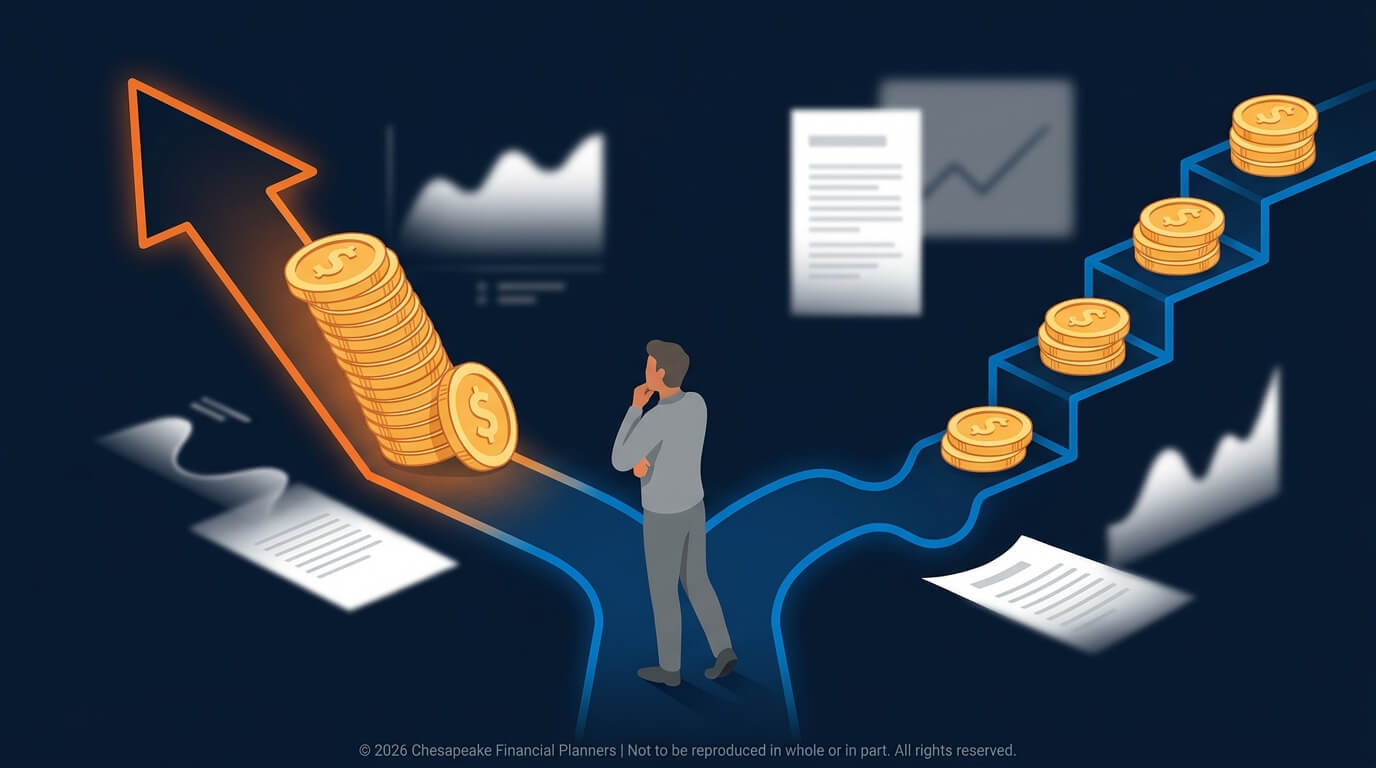
Should I Dollar-Cost Average or Invest a Lump Sum?
Last reviewed: July 2026
If you have a large sum ready to invest today, the math usually favors investing it all at once rather than spreading it out. Dollar-cost averaging means investing a fixed amount on a set schedule, while lump-sum investing puts the full amount to work immediately. Historically, putting the money in right away has beaten spreading it out roughly two-thirds of the time, simply because markets rise more often than they fall. But the right answer depends less on probability and more on how you'll behave if the market drops the week after you invest.
Key Takeaways
- Lump-sum investing has historically outperformed dollar-cost averaging in roughly two out of three rolling periods studied by Vanguard.
- Dollar-cost averaging trades a small amount of expected return for a meaningful reduction in regret and timing risk.
- The IRS 2026 contribution limit for 401(k) plans is $24,500, which shapes how windfall money flows into tax-advantaged accounts.
- Your real decision is behavioral: pick the approach you can actually stick with through a downturn.
About the Author: Jeff Judge, CFP®, AEP®, ChFC®, CLU® is Managing Partner of Chesapeake Financial Planners in Forest Hill, Maryland. He has been helping families and business owners in Harford County and the Baltimore metro area navigate windfalls and investing decisions since earning his CFP® certification in 2013, by using Chesapeake Financial Planners’ signature process, the R.U.D.D.E.R. method™. Jeff has watched more clients lose money to the anxiety of a poorly timed lump sum than to the strategy itself, which is why he treats this as a behavioral question first and a math question second.
What Is Dollar-Cost Averaging and How Does It Work?
Dollar-cost averaging is the practice of investing a fixed dollar amount at regular intervals, regardless of price. Instead of investing $120,000 today, you might invest $10,000 a month for twelve months. When prices are low, your fixed amount buys more shares; when prices are high, it buys fewer. Over time, this smooths out your average purchase price.
Most people already dollar-cost average without naming it. Every paycheck contribution to your 401(k) is dollar-cost averaging in action. The strategy gets its reputation from this steady, automatic discipline. The question on the table is different: when you have a large pile of cash sitting in a checking account, should you keep treating it like a paycheck, or should you invest it all at once?
The distinction matters because money already in cash has a cost. While you wait to deploy it over twelve months, the uninvested portion earns the yield of a money market account, which according to the FDIC has trailed long-term equity returns over most multi-year periods. That drag is the price of caution.
What happens to my finances after a liquidity event?
Why Does Lump-Sum Investing Usually Win?
Lump-sum investing usually wins because the stock market goes up more often than it goes down, and time in the market beats waiting on the sidelines. Vanguard's research, which examined rolling historical periods across U.S., U.K., and Australian markets, found that investing a lump sum immediately outperformed a twelve-month dollar-cost averaging approach in about 68% of cases. The average outperformance was modest but consistent.
The logic is simple. If you believe markets will rise over your investing horizon, then every dollar sitting in cash is a dollar not participating in that rise. Dollar-cost averaging deliberately keeps part of your money out of the market, which means you give up some of the expected gain in exchange for reduced exposure to a sharp early drop.
Jeff Judge often frames it this way for clients: dollar-cost averaging is buying insurance against regret, and like all insurance, it has a premium. That premium is the expected return you forfeit by holding cash. Whether the premium is worth paying depends entirely on you, not on a spreadsheet.

When Does Dollar-Cost Averaging Make More Sense?
Dollar-cost averaging makes more sense when the emotional cost of a bad outcome outweighs the small expected return you give up. The numbers favor lump-sum, but numbers don't lose sleep. Three situations tilt the decision toward dollar-cost averaging.
First, if investing the full amount at once would leave you unable to tolerate a 20% drop the following month, the steadier approach protects you from panic selling. A client who bails out at the bottom captures none of the long-term return the math promised.
Second, if the windfall represents a large share of your total net worth, the stakes of a poorly timed entry rise. Spreading the investment reduces the chance that a single bad day defines your outcome.
Third, dollar-cost averaging imposes discipline. For someone who would otherwise leave the money in cash indefinitely out of indecision, a structured twelve-month plan gets the money invested, which beats analysis paralysis.
This is the R.U.D.D.E.R. Method™, Chesapeake Financial Planners' six-step planning process: Review and Recognize, Uncover and Understand, Design and Develop, Discuss and Decide, Execute and Empower, and Reassess and Refine. The "Discuss and Decide" step is where this lump-sum-versus-averaging question lives, because the right answer is the one a client can hold to without flinching. Jeff Judge notes: "When a client is sitting on a large windfall, the Discuss and Decide conversation isn't just about expected returns — it's about finding the approach they can commit to without panicking if the market drops the week after they invest."
What should you do when you suddenly receive a large sum of money?
How Should I Invest a Windfall Specifically?
If you've received a windfall, start by deciding how much belongs in the market at all before you decide how to deploy it. A windfall is not automatically investment money. Some of it may need to cover taxes, an emergency reserve, or near-term goals.
Once you've carved out the truly long-term portion, the lump-sum-versus-dollar-cost-averaging question applies only to that slice. For most people receiving an inheritance, a settlement, or proceeds from selling a business, a reasonable compromise works well: invest a meaningful chunk immediately and dollar-cost average the rest over three to six months rather than twelve. This captures most of the lump-sum advantage while softening the worst-case timing.
Tax-advantaged accounts should fill first. The IRS set the 2026 401(k) employee contribution limit at $24,500 and the IRA limit at $7,500, so a windfall can fund those buckets before taxable investing begins. A common mistake Jeff sees is clients pouring a windfall straight into a taxable brokerage account while leaving contribution room unused, which costs them tax-deferred growth they can never recover.
What should I do with money I inherited from a relative?

What Does the Research Actually Say?
The research is consistent: lump-sum investing produces higher expected returns, but the gap is smaller than most people assume, and the worst-case outcomes are worse for lump-sum. According to Vanguard, the immediate-investment approach outperformed dollar-cost averaging by an average of roughly 1.5% to 2% over the periods studied, depending on the asset mix.
That edge sounds compelling until you sit through a market like early 2020 or 2022, when a lump-sum investor watched a quarter of their money vanish in weeks. The research captures the average, not the experience. As the Securities and Exchange Commission notes in its investor education materials, no strategy guarantees a profit or protects against loss in a declining market.
Jeff's view after years of these conversations: the research answers a question most clients aren't really asking. They want to know how to avoid feeling foolish, and that's a behavioral problem the data can't solve.
Frequently Asked Questions
Is dollar-cost averaging better than lump-sum investing?
Lump-sum investing generally produces higher expected returns because markets rise more often than they fall. Vanguard found lump-sum outperformed in about 68% of historical periods. However, dollar-cost averaging reduces the risk and emotional pain of a poorly timed entry, making it the better choice for investors who would panic during an early downturn.
How does dollar-cost averaging reduce risk?
Dollar-cost averaging reduces risk by spreading your purchases across time, so no single day determines your entry price. When you invest a fixed amount on a schedule, you buy more shares when prices fall and fewer when they rise. This lowers your timing risk and the chance of regret, though it does not protect against an overall declining market.
Should I dollar-cost average a large inheritance?
For a large inheritance, first separate the money you'll invest long-term from cash needed for taxes, an emergency fund, or near-term goals. For the investment portion, a practical compromise is investing a meaningful chunk immediately and averaging the rest over three to six months. This captures most of the lump-sum advantage while reducing the sting of a bad week.
Does dollar-cost averaging work in a falling market?
Dollar-cost averaging works well in a falling market because your fixed contributions buy more shares as prices drop, lowering your average cost. If the market then recovers, you benefit from those cheaper purchases. The strategy still does not guarantee a profit, and the SEC cautions that no approach protects fully against loss in a sustained downturn.
How long should I dollar-cost average a windfall?
Most planners suggest spreading a windfall over three to six months rather than a year, because longer periods leave more money sitting in cash and forfeit more expected return. A shorter window captures most of dollar-cost averaging's emotional benefit while keeping the opportunity cost low. The right length depends on the size of the windfall relative to your total net worth.
If you're weighing how to invest a windfall, our free Sudden Money Decision Guide walks through the tax, timing, and account-priority questions step by step. Download it at chesapeakefp.com to put a clear framework around your next move before you invest a dollar.
Want to go deeper? Our First 90 Days After a Windfall walks through this step by step.
Disclosures
The information provided is for educational purposes only and should not be construed as investment advice. Investment strategies should be tailored to individual circumstances, risk tolerance, and goals. Past performance doesn't guarantee future results. Consult with qualified financial professionals regarding your specific situation.
CFP Board owns the marks CFP®, CERTIFIED FINANCIAL PLANNER®, and CFP® (with plaque design) in the U.S.
Certified Financial Planner Board of Standards Center for Financial Planning, Inc. owns and licenses the certification marks CFP®, CERTIFIED FINANCIAL PLANNER®, and CFP® (with plaque design) in the United States to Certified Financial Planner Board of Standards, Inc., which authorizes individuals who successfully complete the organization’s initial and ongoing certification requirements to use the certification marks.
Advisors associated with Chesapeake Financial Planners may be either (1) LPL Financial Registered Representatives offering securities through LPL Financial, Member FINRA and SIPC, and investment advisor representatives offering investment advice through Great Valley Advisor Group; or (2) solely investment advisor representatives offering investment advice through Great Valley Advisor Group and not affiliated with LPL Financial. Great Valley Advisor Group, and Chesapeake Financial Planners are separate entities from LPL Financial.


