

How does the new 529-to-Roth rollover work?
Last reviewed: July 2026
The 529-to-Roth rollover, created by the SECURE 2.0 Act and effective since 2024, lets you move unused 529 college savings into the beneficiary's Roth IRA, tax-free and penalty-free, up to a $35,000 lifetime limit. It removes one of the biggest worries about funding a 529, what happens if you don't use all of it, by giving leftover money a path into retirement savings instead of a taxable withdrawal. The rule comes with real conditions, including a 15-year account-age requirement and annual limits, so it rewards understanding the details.
On This Page
- Key Takeaways
- What is the 529-to-Roth rollover and why does it matter?
- What are the rules and limits?
- How should you use this in your planning?
- Related Topics Worth Reading
- Frequently Asked Questions
- Turning leftover college savings into a head start
- Disclosures
Key Takeaways
- You can roll unused 529 funds into the beneficiary's Roth IRA, tax- and penalty-free, up to a $35,000 lifetime cap per beneficiary.
- The 529 account must have been open for at least 15 years, and recent contributions (and their earnings) are not eligible.
- Each year's rollover counts toward, and is capped by, the beneficiary's annual IRA contribution limit, and they must have earned income.
- The rollover goes to the beneficiary's Roth IRA, not the account owner's, so it benefits the student, not the parent.
About the Author: Jeff Judge, CFP®, AEP®, ChFC®, CLU® is Managing Partner of Chesapeake Financial Planners in Forest Hill, Maryland. He has helped Harford County and Baltimore-area families plan college savings since earning his CFP® certification in 2013, by using Chesapeake Financial Planners’ signature process, the R.U.D.D.E.R. method™. As Jeff puts it: "The old fear with 529s was overfunding, what if my kid gets a scholarship or skips college, and this rule quietly solves much of that, turning leftover education money into a head start on the next generation's retirement."
What is the 529-to-Roth rollover and why does it matter?
The 529-to-Roth rollover is a SECURE 2.0 provision, in effect since 2024, that allows leftover money in a 529 plan to be moved into the beneficiary's Roth IRA without taxes or penalties. It matters because it solves the long-standing worry of overfunding a 529.
Historically, the catch with 529 plans was that the tax benefits applied only to qualified education expenses, so if you saved more than your child ended up needing, perhaps because of a scholarship, a cheaper school, or a child who skipped college, withdrawing the leftover for non-education purposes meant paying income tax plus a 10% penalty on the earnings. That risk made some families hesitant to fully fund a 529. The new rollover changes the calculus: instead of a taxable, penalized withdrawal, unused 529 funds can become tax-free retirement savings for the beneficiary. As Fidelity summarizes the rule, "Under certain conditions, you can transfer tax- and penalty-free up to a lifetime limit of $35,000 in a 529 to a Roth IRA opened by the 529 beneficiary."
The practical effect is a valuable second exit for 529 money. A parent who oversaved, or whose child needed less than expected, can now give that money a productive home as a Roth IRA head start for the child, where it grows tax-free for decades. It is not unlimited, the $35,000 lifetime cap and other conditions keep it from being a backdoor way to fund unlimited Roth savings, but for the common situation of modest leftover funds, it is a genuinely useful planning tool. (Note that 529 aggregate balance caps are high and vary by state, so most families never approach them.)
What are the rules and limits?
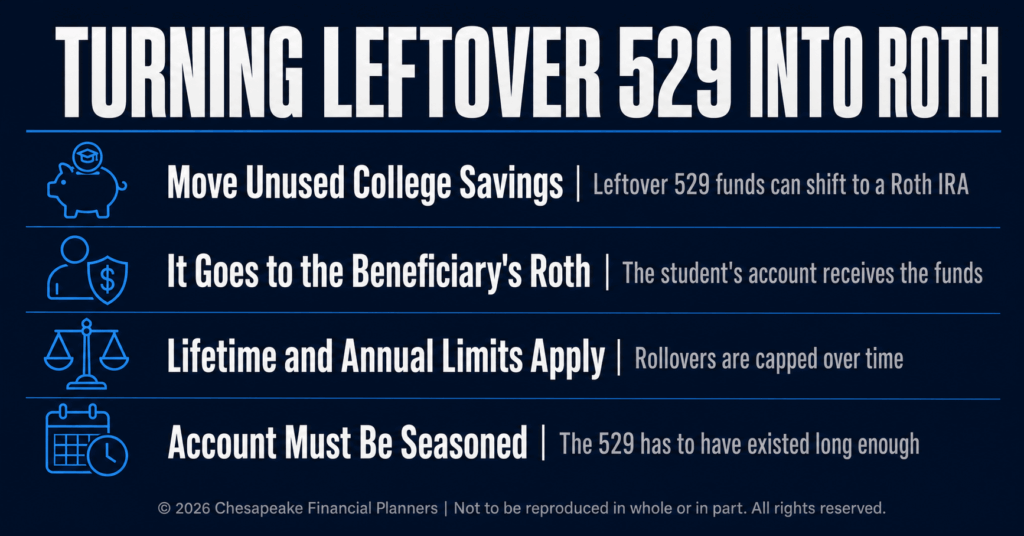
The rollover is capped at $35,000 over the beneficiary's lifetime, requires the 529 to be at least 15 years old, excludes recent contributions, and is limited each year by the beneficiary's IRA contribution limit. These conditions are specific and worth getting right.
The key rules are: a lifetime limit of $35,000 per beneficiary, regardless of how much is in the 529; a 15-year requirement, meaning the 529 account must have been open for at least 15 years before any rollover; and a 5-year lookback, under which contributions made in the last five years (and the earnings on them) are not eligible to roll, so only seasoned money qualifies. Each year, the amount you can roll is limited to that year's IRA contribution limit (for 2026, $7,500), and it counts against the beneficiary's own IRA contributions for the year, so a beneficiary cannot both contribute the full $7,500 themselves and roll $7,500 from the 529 in the same year. Critically, the beneficiary must have earned income at least equal to the amount rolled that year, just as with a normal Roth contribution, though the usual Roth income phase-out limits do not apply to these rollovers. Jeff Judge notes: "The 529-to-Roth rollover looks simple until you layer in the 15-year account age, the 5-year lookback on recent contributions, the annual IRA cap, and the beneficiary's earned income requirement all at once."
Because of the annual cap, reaching the full $35,000 takes several years of rollovers, not a single transfer. The rollover also goes specifically to the Roth IRA of the 529's beneficiary, the student, not to the account owner or parent, so it benefits the next generation rather than the saver. Coordinating these moving parts, account age, eligible amounts, annual limits, and the beneficiary's earned income, is exactly the kind of detail the R.U.D.D.E.R. Method™ is built to manage. The R.U.D.D.E.R. Method™ is Chesapeake Financial Planners' six-step planning process: Review and Recognize, Uncover and Understand, Design and Develop, Discuss and Decide, Execute and Empower, and Reassess and Refine, and a rollover strategy lives in Design and Develop, sequenced across years to use the limits efficiently.
How should you use this in your planning?
You should use the 529-to-Roth rollover as a flexible backstop, funding 529s a bit more confidently knowing leftovers have a path to Roth savings, while remembering the rule's limits and timing. It changes how aggressively families can save for college.
The most important shift is psychological and practical: the fear of overfunding a 529 is much smaller now, so a family can save for college more fully, knowing that a reasonable amount of unused money will not be trapped behind taxes and penalties but can instead seed the child's retirement. For a recent graduate with modest leftover 529 funds and some earned income, beginning to roll a few thousand dollars a year into a Roth IRA is a powerful way to give them a tax-free head start, decades of compounding ahead, on money that might otherwise have sat idle or been withdrawn at a cost.
That said, the rule is a backstop, not a strategy to deliberately overfund a 529 as a Roth workaround. The $35,000 lifetime cap, the 15-year account requirement, the 5-year lookback, and the earned-income condition all limit how much and how fast money can move, and the rules could be refined over time, so this should complement, not replace, normal retirement and education planning. Used well, it turns what used to be a worry, leftover college savings, into an opportunity to launch the next generation's retirement. As with any nuanced tax move, confirming the current rules and your specific eligibility with a financial advisor and tax professional ensures you capture the benefit cleanly.
Related Topics Worth Reading
The 529-to-Roth rule connects to college savings and Roth strategy. These related topics go deeper.
- Comparing the main college savings accounts. Should I Choose a Coverdell ESA or 529 Plan?
- How grandparents can help fund college without hurting aid. How does the grandparent 529 work after FAFSA simplification?
- The FAFSA strategy that still helps higher-income families. Can a high-income family qualify for financial aid, and what strategies are allowed?
- How to fund college when you earn too much for need-based aid. What are my college funding options when my income disqualifies us from financial aid?
- The backdoor Roth IRA for higher earners. How do I do a backdoor Roth IRA?

Frequently Asked Questions
How does the 529-to-Roth rollover work?
The 529-to-Roth rollover, created by the SECURE 2.0 Act and effective since 2024, lets you move unused 529 funds into the beneficiary's Roth IRA tax-free and penalty-free, up to a $35,000 lifetime limit per beneficiary. The 529 must have been open at least 15 years, recent contributions are not eligible, each year's rollover is capped by the annual IRA contribution limit and counts against the beneficiary's own contributions, and the beneficiary must have earned income. It provides a tax-friendly home for leftover college savings.
What is the lifetime limit on 529-to-Roth rollovers?
The lifetime limit is $35,000 per 529 beneficiary, regardless of how much is in the account. Because each year's rollover is also capped at the annual IRA contribution limit ($7,500 for 2026), reaching the full $35,000 takes multiple years of rollovers rather than a single transfer. The $35,000 cap follows the beneficiary, so changing the 529's beneficiary does not reset it for the same individual.
Does the 529 have to be open for a certain number of years?
Yes, the 529 account must have been open for at least 15 years before you can roll any funds to a Roth IRA. In addition, contributions made within the last five years, and the earnings attributable to them, are not eligible to roll, so only money that has been in the account longer qualifies. These timing rules are designed to prevent the rollover from being used as a short-term tax shelter.
Whose Roth IRA does the 529 money go into?
The rollover goes into the Roth IRA of the 529 plan's beneficiary, typically the student, not the account owner or the parent who funded the plan. This means the benefit accrues to the next generation: it gives the child a tax-free retirement head start rather than returning the money to the saver. The beneficiary must have earned income at least equal to the amount rolled in that year.
Can I overfund a 529 on purpose to use the Roth rollover?
It is generally not advisable to deliberately overfund a 529 just to exploit the Roth rollover, because the rule's limits, a $35,000 lifetime cap, the 15-year account requirement, the 5-year lookback on contributions, and the annual IRA-limit cap, sharply constrain how much and how fast money can move. The rollover is best viewed as a valuable backstop that lets you fund a 529 more confidently, not as a substitute for normal retirement saving or a backdoor to unlimited Roth contributions.
Turning leftover college savings into a head start
The 529-to-Roth rollover is one of the most useful recent changes in education planning, because it removes the old fear of overfunding a 529 by giving unused money a tax-free path into the beneficiary's retirement. Within its limits, a $35,000 lifetime cap, a 15-year account requirement, annual contribution-limit caps, and an earned-income condition, it lets families save for college more confidently and turn leftover funds into a powerful head start for the next generation. As with any advanced tax move, the details matter, so it is worth coordinating with professionals. Jeff Judge and the Chesapeake Financial Planners team help families across Harford County and the Baltimore metro plan college and retirement savings together, alongside their CPAs. Schedule a complimentary consultation at chesapeakefp.com.
Want to go deeper? Our College Funding Playbook walks through this step by step.
Prefer a different starting point? Our Tax Strategy Readiness Quiz is worth a look.
Disclosures
The information provided is for educational purposes only and should not be construed as investment advice. Investment strategies should be tailored to individual circumstances, risk tolerance, and goals. Past performance doesn't guarantee future results. Consult with qualified financial professionals regarding your specific situation.
CFP Board owns the marks CFP®, CERTIFIED FINANCIAL PLANNER®, and CFP® (with plaque design) in the U.S.
Certified Financial Planner Board of Standards Center for Financial Planning, Inc. owns and licenses the certification marks CFP®, CERTIFIED FINANCIAL PLANNER®, and CFP® (with plaque design) in the United States to Certified Financial Planner Board of Standards, Inc., which authorizes individuals who successfully complete the organization’s initial and ongoing certification requirements to use the certification marks.
A Roth IRA offers tax deferral on any earnings in the account. Qualified withdrawals of earnings from the account are tax-free. Withdrawals of earnings prior to age 59 ½ or prior to the account being opened for 5 years, whichever is later, may result in a 10% IRS penalty tax. Limitations and restrictions may apply.
Prior to investing in a 529 Plan, investors should consider whether the investor's or designated beneficiary's home state offers any state tax or other state benefits such as financial aid, scholarship funds, and protection from creditors that are only available for investments in such state's qualified tuition program. Withdrawals used for qualified expenses are federally tax free. Tax treatment at the state level may vary. Please consult with your tax advisor before investing.
Advisors associated with Chesapeake Financial Planners may be either (1) LPL Financial Registered Representatives offering securities through LPL Financial, Member FINRA and SIPC, and investment advisor representatives offering investment advice through Great Valley Advisor Group; or (2) solely investment advisor representatives offering investment advice through Great Valley Advisor Group and not affiliated with LPL Financial. Great Valley Advisor Group, and Chesapeake Financial Planners are separate entities from LPL Financial.


