

Last reviewed: August 2026
Coordinating business insurance with personal planning means treating your commercial coverage and your household financial plan as one connected system, not two files held by two people who never talk. Most owners keep a commercial insurance broker on one side and a financial advisor on the other, and neither sees the whole picture. That gap stays invisible until a disability, a lawsuit, a death, or a sale forces the two worlds together, usually at the worst possible moment.
Business insurance is not only about the company. It is a load-bearing piece of your personal wealth, your retirement readiness, and your estate plan. When the two run on separate tracks, gaps open quietly. When they are built together, you get a structure that actually holds.
Key Takeaways
- Coordinating business insurance with personal planning closes gaps in disability, liability, life, and health coverage that surface only during a claim or a sale.
- A personal disability policy paying $15,000 a month does little if $40,000 in monthly business overhead keeps running without separate overhead coverage.
- The 2026 federal estate tax exemption is $15 million per individual, so life insurance sized only to a buy-sell can still leave an estate-liquidity gap.
- Selling before 65 can open a health coverage gap, and each 12 months without Medicare Part B adds a 10% lifetime penalty.
About the Author: Jeff Judge, CFP®, AEP®, ChFC®, CLU® is Managing Partner of Chesapeake Financial Planners in Forest Hill, Maryland. He has been helping families and business owners in Harford County and the Baltimore metro area coordinate business insurance with personal financial planning since earning his CFP® certification in 2013, by using Chesapeake's signature process, the R.U.D.D.E.R. Method™. "The mistake I see most often is not a bad policy," Jeff says. "It is two good policies that were never designed to work together, so the money shows up in the wrong place when a family needs it most."
Why Does Coordinating Business Insurance With Personal Planning Matter?
It matters because your personal financial plan quietly makes assumptions that your business insurance can contradict. Take disability. An owner might carry a personal disability policy replacing $15,000 a month of income. On paper, the household is covered. Then a disability actually happens, and $40,000 a month in fixed business costs, rent, payroll, and debt service, keeps running. Without a separate business overhead expense insurance policy, those personal disability dollars get pulled into the company to keep the lights on. The plan assumed disability income would fund the household. The uncoordinated gap undermines that assumption before anyone notices.
What actually goes wrong when these plans run separately? The money shows up in the wrong place at the wrong time. A benefit meant for your family gets redirected into the business, or a life insurance payout meant for the company leaves your estate short. Nobody planned the gap. It formed because the broker and the advisor were solving different problems with the same dollars.
How Do Buy-Sell Agreements and Life Insurance Overlap in Your Plan?
Life insurance is where business and personal planning collide most often. Many co-owned businesses use life insurance to fund a buy-sell agreement, so a surviving partner can buy out a deceased owner's family. At the same time, your financial advisor is likely recommending life insurance to replace your income and cover estate liquidity. Those are two different jobs for the same category of coverage, and they usually get sized in isolation.
Here is the trap. Suppose the buy-sell values the business at $3 million, and the policy is sized to match. But the family's financial plan actually needs $5 million to stay on track. That is a $2 million shortfall nobody flagged, because the business attorney and the insurance agent were not talking to the advisor who built the plan. Buy-sells sized to a valuation from five or ten years ago make it worse. The business doubles, nobody updates the agreement, and a plan that assumed an $8 million exit gets capped at the old $4 million insurance limit.
Estate liquidity adds another layer. The 2026 federal estate tax exemption is $15 million per individual under the One Big Beautiful Bill Act, up from $13.99 million in 2025. Many Maryland owners land under the federal line, yet Maryland levies its own estate tax at a threshold well below the federal one, so business value can still create a state-level bill that life insurance needs to cover. Repositioning a key person insurance policy as you near exit, when the coverage no longer needs to backstop the company, can fund that liquidity, but only if the advisor knows the policy exists.

Where Do Liability Gaps Expose Your Personal Assets?
Liability is the gap that reaches straight into your personal balance sheet. Owners in professional services, medical practices, and government contracting usually carry commercial general liability and professional liability coverage, which handles claims up to the policy limit. The trouble starts above the limit. A judgment that runs past your commercial coverage can reach $3 million to $5 million of personal assets, because a business claim does not politely stop at the company's door.
A coordinated structure layers commercial and personal umbrella coverage so coverage runs continuously from the first dollar to $10 million or more, with no gap where the commercial policy ends and personal assets begin. Few owners have actually mapped it that way.
| Coverage layer | What it typically covers | Who usually owns it |
|---|---|---|
| Commercial general liability | Third-party injury and property claims against the business | The business |
| Professional liability | Claims tied to professional services or advice | The business |
| Commercial umbrella | Business claims above the underlying commercial limits | The business |
| Personal umbrella | Personal-side claims above home and auto limits | The owner |
| Coordinated review | Confirms no gap between the commercial tower and personal assets | Advisor plus broker |
Jeff Judge has watched a single uncovered judgment undo a decade of saving. "Owners insure the building and the trucks down to the dollar," he says, "then leave a seven-figure hole between where the business policy stops and where their personal net worth starts."
How Does Health Coverage Timing Affect Your Business Exit?
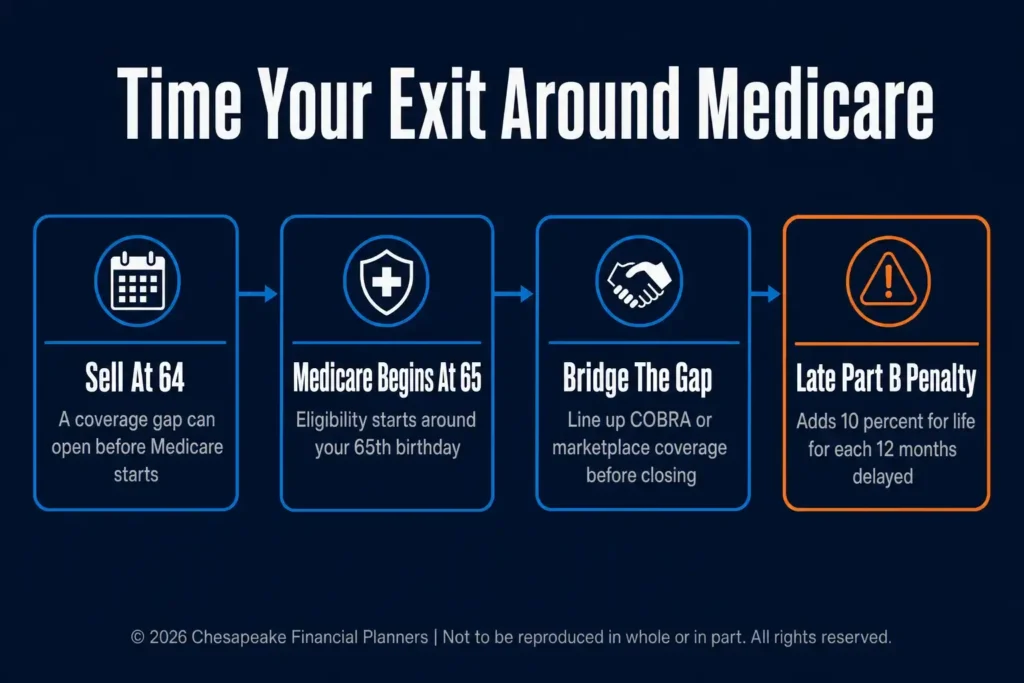
Health coverage timing is one of the most common gaps I see in pre-exit planning. Owners on the company health plan often have not mapped Medicare enrollment against their sale date. Medicare eligibility begins at age 65. Sell the business at 64, and you can open a coverage gap in the year before you qualify, right when you have walked away from the group plan.
When does selling at 64 create a coverage gap? It creates one whenever the sale ends your group coverage before your Medicare Initial Enrollment Period opens around your 65th birthday. That in-between year needs a bridge, marketplace coverage or COBRA, planned before closing rather than discovered after.
The penalty math makes timing matter. For each 12-month stretch you could have carried Medicare Part B but did not, Medicare adds a 10% lifetime penalty to your premium. With the 2026 base Part B premium at $202.90 a month, a mistimed exit can raise your healthcare costs for the rest of your life. Coordinating the sale date with your enrollment window closes that gap. Our guide on avoiding the Medicare late enrollment penalty walks through the timing.
How Do You Build a Coordinated Protection Structure?
Closing these gaps takes intentional coordination, not more coverage. The owners who get this right run two habits.
- An annual alignment review. Once a year, your financial advisor and your commercial broker compare notes, with or without you in the room, to confirm business coverage still matches what the personal plan assumes. This catches stale policy limits and missed opportunities before they become claims-time surprises.
- An integrated protection map. One document lists every layer, business liability, professional liability, personal umbrella, life, disability, and business overhead, in a single view. Gaps become visible on paper instead of at the worst moment.
This is where the R.U.D.D.E.R. Method™ fits. The R.U.D.D.E.R. Method™ is Chesapeake Financial Planners' six-step planning process: Review and Recognize, Uncover and Understand, Design and Develop, Discuss and Decide, Execute and Empower, and Reassess and Refine. The Reassess and Refine step is exactly where an annual coverage review lives, so the protection map does not drift out of date as the business grows.
This coordination problem is especially common among the owners we work with across Harford County and the Baltimore metro. Many run professional practices, government-contracting firms, or family businesses where the commercial broker and the financial plan have never been in the same conversation. From our Forest Hill office, part of the job is getting those two sides talking, because a business built in Maryland should not leave a family exposed by a coverage gap nobody owned. Owners weighing a sale or transition can start with our overview of financial planning for Harford County business owners.
Frequently Asked Questions
What does it mean to coordinate business insurance with personal financial planning?
It means treating your commercial coverage and your personal financial plan as one system instead of two. In practice, your financial advisor and your insurance broker align policy limits, beneficiaries, and timing so disability, life, liability, and health coverage all support the same plan. Coordination closes the gaps that form when each professional works alone.
Does business overhead expense insurance replace personal disability insurance?
No, they do different jobs and you often need both. Personal disability insurance replaces your income so your household keeps running. Business overhead expense insurance covers fixed business costs like rent, payroll, and debt service during your disability. Without the overhead policy, your personal disability benefit can get pulled into the business instead of funding your family.
How often should a buy-sell agreement be revalued?
Review the valuation behind your buy-sell agreement at least every one to two years, and after any major change in revenue, ownership, or growth. Values from five or ten years ago are common, and a business that has doubled can leave a family capped at an outdated insurance limit. Regular revaluation keeps the funding realistic.
Can key person insurance be repositioned for estate planning?
Yes, in many cases. As an owner approaches exit, key person coverage that once backstopped the company may no longer be needed for that purpose. Repositioning it toward personal estate liquidity or wealth transfer can be tax-efficient, but it only works if your financial advisor knows the policy exists and coordinates the change before the exit.
Why does exit timing matter for Medicare?
Exit timing matters because leaving your group health plan before age 65 can open a coverage gap. Medicare eligibility starts at 65, and each 12-month period you delay Part B adds a 10% lifetime penalty to your premium. Selling at 64 without a bridge plan can raise your healthcare costs permanently.
Coordinating business insurance with personal planning is not a one-time task, it is an annual habit that keeps your coverage and your plan pulling in the same direction. Jeff Judge and the Chesapeake Financial Planners team work with families and business owners across Harford County and the Baltimore metro to line up both sides before a claim or a sale forces the issue. Schedule a no-obligation fit call with Jeff.
A version of this article originally appeared in Baltimore Business Journal.
Disclosures
The information provided is for educational purposes only and should not be construed as investment advice. Investment strategies should be tailored to individual circumstances, risk tolerance, and goals. Past performance doesn't guarantee future results. Consult with qualified financial professionals regarding your specific situation.
Advisors associated with Chesapeake Financial Planners may be either (1) LPL Financial Registered Representatives offering securities through LPL Financial, Member FINRA and SIPC, and investment advisor representatives offering investment advice through Great Valley Advisor Group; or (2) solely investment advisor representatives offering investment advice through Great Valley Advisor Group and not affiliated with LPL Financial. Great Valley Advisor Group, and Chesapeake Financial Planners are separate entities from LPL Financial.
Chesapeake Financial Planners | 2402 Scotlon Ct, Forest Hill, MD 21050 | (410) 652-7868 | www.chesapeakefp.com
© 2026 Chesapeake Financial Planners | Not to be reproduced in whole or in part. All rights reserved.


