

Can I Retire Early Without Running Out of Money?
Last reviewed: July 2026
Yes, you can retire early without running out of money, but only if your withdrawal rate, healthcare coverage, and spending flexibility are built to handle a retirement that may stretch 40 years or longer. Most early retirees who succeed plan around a 3% to 3.5% withdrawal rate, bridge the gap to Medicare with private coverage, and stay willing to cut spending in down markets. The math gets harder the younger you leave work, but a clear plan makes early retirement realistic for far more people than they think.
Key Takeaways
- Early retirees often need their money to last 40 to 50 years, not the 30 years the classic 4% rule assumes.
- A more conservative 3% to 3.5% withdrawal rate meaningfully improves the odds your savings survive a longer retirement.
- In 2026, a 65-year-old couple may need about $351,000 for healthcare costs over retirement, per EBRI estimates.
- Healthcare before Medicare at 65 is the single biggest wildcard in most early retirement plans.
- Flexibility to trim spending during bear markets is one of the strongest predictors of a retirement plan that lasts.
About the Author: Jeff Judge, CFP®, AEP®, ChFC®, CLU® is Managing Partner of Chesapeake Financial Planners in Forest Hill, Maryland. He has been helping families and business owners in Harford County and the Baltimore metro area navigate early retirement decisions since earning his CFP® certification in 2013, by using Chesapeake Financial Planners’ signature process, the R.U.D.D.E.R. method™. Jeff often reminds clients that the question is rarely "can I retire early" and almost always "can I retire early at this spending level" — the number on the spreadsheet bends to the lifestyle you actually choose.
What Makes Retiring Early Harder Than Retiring at 65?
Retiring at 55 instead of 65 does not just remove ten working years. It adds ten years your money has to support you. If you live to 85, that is a 50% longer retirement. Live into your 90s, and your savings may need to stretch close to 40 years. That single fact changes every other decision.
The longer timeline stacks several risks on top of each other. Sequence of returns risk means a market drop in your first few retirement years can do lasting damage, because you are selling investments while they are down. Inflation compounds against you for decades; even a steady 3% rate cuts purchasing power roughly in half over 24 years. And you face years without Social Security or Medicare, the two safety nets most retirees lean on.
Jeff Judge has watched clients underestimate this gap for years. The people who retire early and stay retired are the ones who treated the first decade as the danger zone, not the victory lap. They build in margin precisely because there is no pension or Social Security check arriving yet to cushion a bad market.
What Should You Prioritize Financially in the 5 Years Before Retirement?
How Much Money Do You Really Need to Retire Early?
The classic "4% rule" suggests you can withdraw 4% of your portfolio in year one, adjust for inflation each year after, and have a reasonable chance your money lasts 30 years. The rule traces back to financial planner William Bengen, whose original research found that a 4% starting withdrawal survived every historical 30-year period he tested. For early retirees, though, 30 years is often too short an assumption.
You may need 40 to 50 years of income, not 30. You have no Social Security or pension to fall back on for the first stretch. And the market valuations on the day you retire matter enormously. Because of this, many planners suggest early retirees anchor to a 3% to 3.5% withdrawal rate instead.
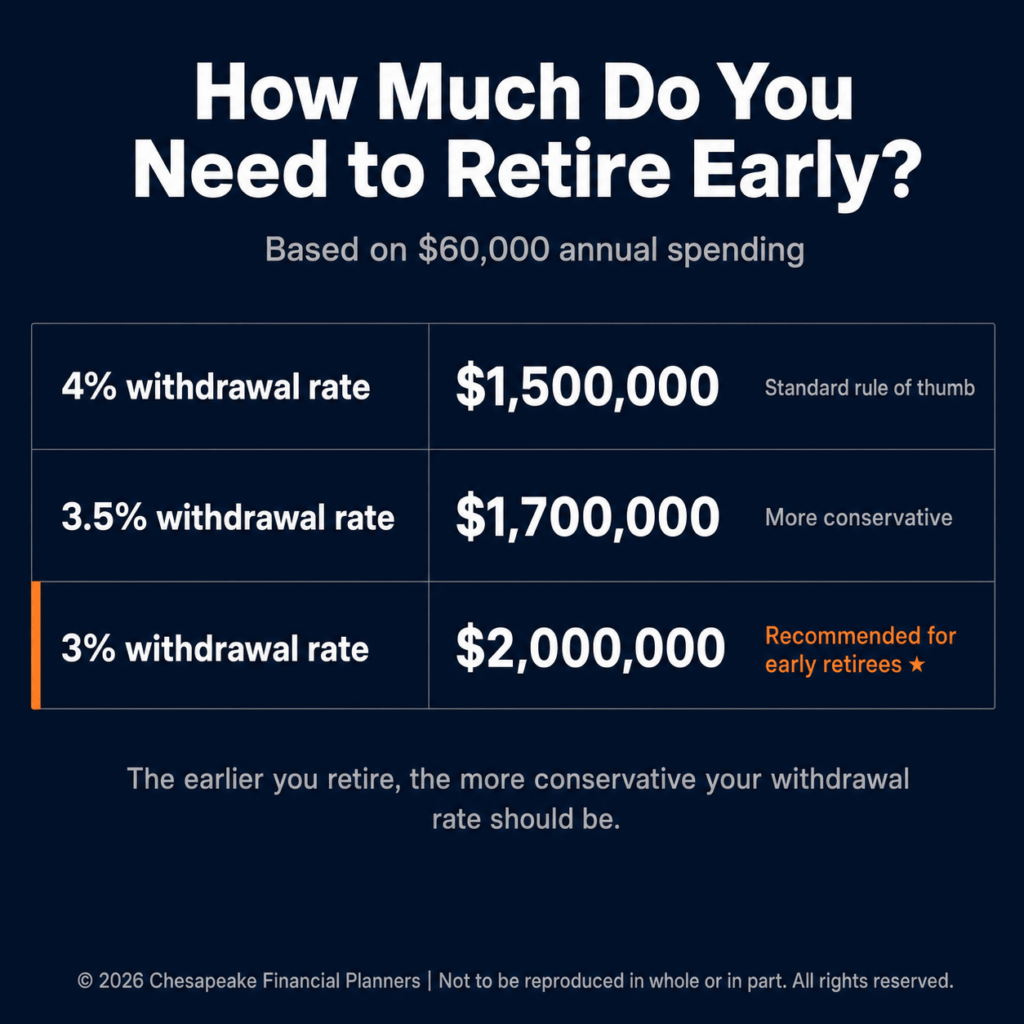
Here is what that looks like in real dollars if you plan to spend $60,000 a year:
| Withdrawal Rate | Portfolio Needed | Best Suited For |
|---|---|---|
| 4% | $1.5 million | Traditional retirement at 65+ |
| 3.5% | $1.7 million | Early retirement, moderate flexibility |
| 3% | $2.0 million | Very early retirement, low flexibility |
These figures assume your full spending comes from the portfolio. Social Security, a pension, rental income, or part-time work all reduce the number you actually need saved. For 2026, the Social Security Administration reports the maximum benefit at full retirement age is $4,018 per month, which can meaningfully shrink the portfolio burden once it eventually starts.
How Much Money Do I Actually Need to Retire Comfortably?
What Factors Decide If You Can Retire Early?
Six variables determine whether early retirement holds up, and most of them are inside your control more than people assume.
Your current savings and how they are invested set the starting point. Early retirees need portfolios that keep some growth exposure while protecting against an early downturn. Your annual spending is the other side of the equation, and the more honest you are about it, the better the plan. Many successful early retirees choose a more intentional, lower-cost lifestyle, which is alignment, not deprivation.
Healthcare coverage is the wildcard. A 65-year-old couple retiring in 2026 may need roughly $351,000 to cover medical expenses across retirement, according to EBRI, and early retirees face the steepest costs in the years before Medicare. Other income sources, even modest ones like part-time consulting or a rental, dramatically improve sustainability. Finally, your willingness to adjust spending during bad markets and your realistic longevity, based on health and family history, round out the picture.
This is where the R.U.D.D.E.R. Method™ helps. The R.U.D.D.E.R. Method™ is Chesapeake Financial Planners' six-step planning process: Review and Recognize, Uncover and Understand, Design and Develop, Discuss and Decide, Execute and Empower, and Reassess and Refine. Early retirement plans live or die on that final step, because reassessing every year is how you catch a withdrawal rate drifting off course before it becomes a problem.
How Much Should I Budget for Healthcare Costs in Retirement?
Am I saving enough to retire by age 60?
What Strategies Make Early Retirement Actually Work?
Two strategies do most of the heavy lifting for early retirees.
A dynamic withdrawal strategy replaces the rigid fixed percentage. Instead of drawing the same inflation-adjusted amount no matter what, you flex. In strong market years you might take 4% to 5%; in down years you tighten to 2% to 3%. That single behavior extends portfolio life more than almost any investment choice, because it stops you from selling deeply discounted assets to fund the same spending.
A bucket approach gives that flexibility structure. You divide the portfolio by time horizon. Bucket one holds cash and cash alternatives for the next zero to two years of spending. Bucket two holds conservative investments for years three through seven. Bucket three holds growth-oriented investments for year eight and beyond, doing the long-term work of beating inflation. When markets fall, you spend from bucket one and leave the growth bucket alone to recover.
Bridging healthcare also belongs in this list. Before Medicare at 65, you may rely on an ACA marketplace plan, COBRA, or a spouse's coverage. Managing your taxable income to qualify for ACA premium subsidies is one of the most overlooked early-retirement levers, and it pairs closely with decisions about Roth conversions and IRMAA later on.
Should I Do Roth Conversions Before I Retire?
How do Roth conversions affect IRMAA and Medicare Part B premiums?
Frequently Asked Questions
What is a safe withdrawal rate for early retirement?
Most planners recommend a 3% to 3.5% withdrawal rate for early retirees, rather than the traditional 4% rule. The lower rate accounts for a retirement that may last 40 to 50 years instead of 30, plus the years before Social Security and Medicare begin, when there is no safety net to fall back on.
How much do I need to retire early at $60,000 per year?
To support $60,000 of annual spending entirely from your portfolio, you would need roughly $1.5 million at a 4% withdrawal rate, $1.7 million at 3.5%, or $2 million at a more conservative 3%. Social Security, pensions, or part-time income reduce the amount you actually need saved before retiring early.
How do I pay for health insurance before Medicare?
Before Medicare eligibility at 65, early retirees typically use an ACA marketplace plan, COBRA from a former employer, or coverage through a spouse. Managing your taxable income can qualify you for ACA premium subsidies, which lowers cost significantly. Healthcare is often the single largest expense in early retirement budgets.
What is sequence of returns risk?
Sequence of returns risk is the danger that a market downturn early in retirement permanently damages your portfolio because you are withdrawing money while investments are down. The same average return can produce very different outcomes depending on when losses occur. Early retirees face heightened exposure because they withdraw for far longer.
Can I retire early if I have Social Security coming later?
Yes, but you must fund the gap years entirely from savings until Social Security begins, since benefits cannot start before age 62. Many early retirees use a bucket strategy to bridge this period. The Social Security Administration reports a 2026 maximum benefit of $4,018 monthly at full retirement age, which eases later years.
Does the 4% rule work for early retirement?
The 4% rule was designed for a 30-year retirement, so it can be too aggressive for someone retiring in their 50s. Early retirees who may need 40 to 50 years of income often shift to a 3% to 3.5% rate, or use a dynamic withdrawal strategy that flexes spending up in strong years and down in weak ones.
Early retirement is not reserved for lottery winners or tech founders. It comes down to your withdrawal rate, your healthcare bridge, and your honest spending number, and most of those levers are ones you can adjust. At Chesapeake Financial Planners, we run these scenarios with clients every week, stress-testing whether the plan survives a bad first decade. If you are weighing whether to retire early, a second opinion costs you nothing. Visit chesapeakefp.com to learn more.
Disclosures
The information provided is for educational purposes only and should not be construed as investment advice. Investment strategies should be tailored to individual circumstances, risk tolerance, and goals. Past performance doesn't guarantee future results. Consult with qualified financial professionals regarding your specific situation.
Advisors associated with Chesapeake Financial Planners may be either (1) LPL Financial Registered Representatives offering securities through LPL Financial, Member FINRA and SIPC, and investment advisor representatives offering investment advice through Great Valley Advisor Group; or (2) solely investment advisor representatives offering investment advice through Great Valley Advisor Group and not affiliated with LPL Financial. Great Valley Advisor Group, and Chesapeake Financial Planners are separate entities from LPL Financial.


