

Can a Financial Planner Help Me Retire Early?
Last reviewed: July 2026
Yes, a financial planner can help you retire early by building a withdrawal strategy that bridges the years before Social Security and Medicare, manages sequence-of-returns risk, and coordinates taxes across your accounts. The hard part of early retirement isn't saving the money. It's making that money last 35 or 40 years while you cover healthcare, taxes, and inflation without a paycheck. That's the exact problem a planner is built to solve.
Most people who want to retire early think the question is "do I have enough?" The better question is "can my money survive the order in which markets, taxes, and healthcare costs hit me?" A calculator can't answer that. A plan can.
Key Takeaways
- Early retirement requires bridging income from age 55 to 65 before Medicare and full Social Security become available.
- You can access retirement funds before 59½ penalty-free using IRS Rule 72(t) substantially equal payments.
- The 2026 401(k) employee contribution limit is $24,500, giving high savers room to accelerate before they leave work.
- A planner stress-tests your plan against market crashes, long lifespans, and higher costs, not just average returns.
About the Author: Jeff Judge, CFP®, AEP®, ChFC®, CLU® is Managing Partner of Chesapeake Financial Planners in Forest Hill, Maryland. Jeff has watched plenty of people save aggressively for years, then nearly derail their early retirement because they never planned the gap between leaving work and turning 65. He has been helping families and business owners in Harford County and the Baltimore metro area achieve early retirement through strategic income planning and investment management since earning his CFP® certification in 2013, by using Chesapeake Financial Planners’ signature process, the R.U.D.D.E.R. method™.
What Does It Actually Take to Retire Early?
Retiring early means leaving full-time work before the traditional age of 65, often somewhere between 50 and 60. The challenge isn't the dollar amount in your accounts. It's that those dollars now have to do more work over a longer timeline, with no paycheck backstopping a bad year.
To retire early, you need clear answers to four questions: when you want to stop working, what your annual spending will be, where your income comes from before age 65, and how long that income has to last. A planner forces precision here. Vague goals like "around 55, comfortable" don't survive contact with a 40-year projection.
Early retirement is harder than traditional retirement for concrete reasons. Your savings may need to last 40-plus years. You can't claim Social Security until age 62 at the earliest, and waiting boosts the benefit. Medicare doesn't begin until 65, so you fund your own health coverage for years. And a market drop in your first few retirement years does more lasting damage when you have no income coming in. This is why early retirement is a planning problem, not a savings problem.
A financial planner builds the bridge across all of it. Jeff often tells clients the single most overlooked piece is the five-to-ten-year window between leaving work and turning 65. Get that bridge wrong and everything downstream wobbles.
Should I Take Social Security at 62 or Wait Until 70?
How a Financial Planner Helps You Retire Early
A good planner doesn't just confirm whether early retirement is possible. They build the roadmap that makes it happen, then pressure-test it. At Chesapeake Financial Planners, we run this through the R.U.D.D.E.R. Method™, which is Chesapeake Financial Planners' six-step planning process: Review and Recognize, Uncover and Understand, Design and Develop, Discuss and Decide, Execute and Empower, and Reassess and Refine. Jeff Judge notes: "Early retirement planning isn't just about running projections until they look good — it's about stress-testing those projections against rising healthcare costs, sequence-of-returns risk, and a retirement that could last 40 years, then building in specific levers you can pull if the numbers shift."
Here's the concrete work a planner does for an early retiree:
- Builds a personalized projection. Not a rule of thumb. A model using your actual savings, expected returns, inflation, Social Security timing, healthcare costs, and longevity, then stress-tested against market downturns and living to 100.
- Designs the pre-65 income bridge. This pulls from taxable accounts, Roth contributions, or Rule 72(t) substantially equal periodic payments that let you tap retirement funds before 59½ without the 10% penalty.
- Coordinates taxes across account types. Drawing from taxable, tax-deferred, and Roth accounts in the right order can save tens of thousands over a long retirement. Roth conversions in low-income early years often do real work here.
- Plans healthcare before Medicare. Marketplace plans, COBRA, and managing income to qualify for premium subsidies all sit on the table before 65.
- Manages sequence-of-returns risk. A planner keeps a cash or bond cushion so a bad market year early on doesn't force you to sell assets at a loss.
If the projection shows a gap, the fixes are specific: raise your savings rate, adjust your allocation, optimize taxes, push retirement back a year, trim planned spending, or add income. The high 2026 contribution limits help here. The 401(k) employee limit is $24,500 and the IRA limit is $7,500, so a saver in their final working years can move serious money before they walk out the door.
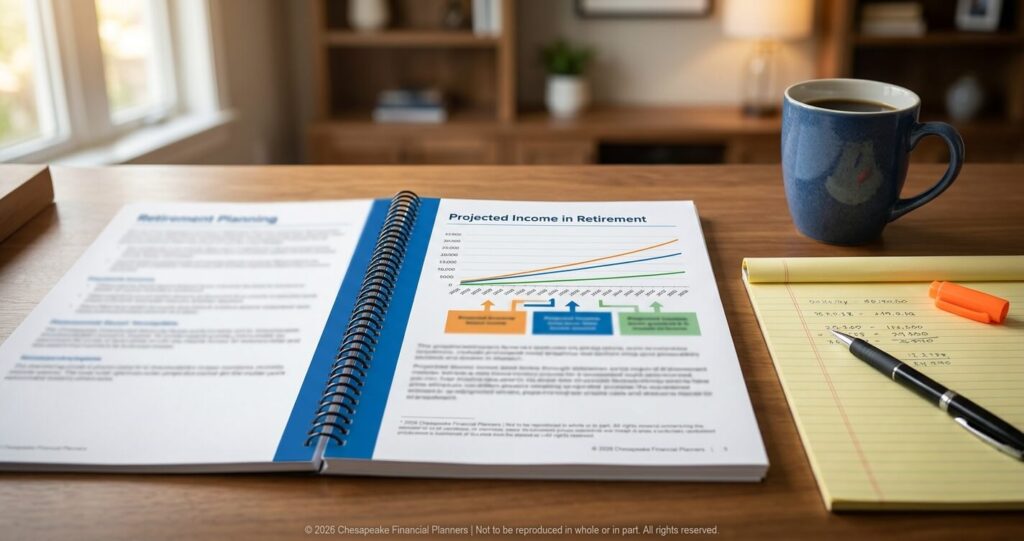
How do I create sustainable retirement income streams?
Will My Money Last If the Market Crashes During Retirement?
When You Might Be Able to Retire Early on Your Own
You don't always need a planner. If your situation is simple, your spending is well under your means, and you understand sequence risk and the 72(t) rules, you may be able to map it yourself. People who track their numbers closely and have a large taxable account to bridge the gap have a head start.
But the cost of getting early retirement wrong is steep, because you have fewer working years left to recover from a mistake. A single avoidable tax misstep or an underfunded healthcare plan can cost more than years of planning fees. Jeff's view: the people who most need a second set of eyes are the confident savers, because they've solved the saving and assume the rest is just as straightforward. It usually isn't.
How do I protect my financial independence long-term as a woman?
Frequently Asked Questions
Can a financial planner really help me retire early?
Yes. A financial planner helps you retire early by building a stress-tested projection, designing income to bridge the years before Social Security and Medicare, coordinating tax-efficient withdrawals, and managing market risk. The value isn't confirming you have enough. It's structuring how you draw it down so it lasts.
How can I access my retirement money before age 59½ without a penalty?
You can access retirement funds before 59½ penalty-free using IRS Rule 72(t), which allows substantially equal periodic payments based on your life expectancy. Roth IRA contributions can also be withdrawn anytime tax- and penalty-free. A planner sets these up correctly, because errors in a 72(t) schedule can trigger retroactive penalties.
What's the hardest part of retiring before 65?
The hardest part is funding healthcare and income for the years before Medicare starts at 65 and full Social Security becomes available. Early retirees must cover their own health insurance, often through marketplace plans, and create income from savings without a paycheck. This pre-65 bridge derails more early retirement plans than poor saving does.
How much do I need to retire early?
The amount depends on your annual spending, not a single magic number. A common starting point is 25 times your expected annual expenses, but early retirees often need more because their money must last 35 to 40 years and cover pre-Medicare healthcare. A planner replaces that rough estimate with a projection built on your actual numbers.
Does retiring early reduce my Social Security benefit?
Retiring early can reduce your Social Security benefit if it means claiming before your full retirement age, since benefits are permanently lower when claimed at 62. Stopping work early doesn't force you to claim early, though. Many early retirees live on savings first and delay Social Security to maximize the eventual benefit.
Ready to See If Early Retirement Adds Up?
Early retirement lives or dies on the details: the pre-65 bridge, the tax order, the sequence of returns. If you're weighing whether you can retire early, our guide to building reliable retirement income walks through the strategy in depth. Download it at chesapeakefp.com and see where your own plan stands.
Disclosures
The information provided is for educational purposes only and should not be construed as investment advice. Investment strategies should be tailored to individual circumstances, risk tolerance, and goals. Past performance doesn't guarantee future results. Consult with qualified financial professionals regarding your specific situation.
Advisors associated with Chesapeake Financial Planners may be either (1) LPL Financial Registered Representatives offering securities through LPL Financial, Member FINRA and SIPC, and investment advisor representatives offering investment advice through Great Valley Advisor Group; or (2) solely investment advisor representatives offering investment advice through Great Valley Advisor Group and not affiliated with LPL Financial. Great Valley Advisor Group, and Chesapeake Financial Planners are separate entities from LPL Financial.


