

What Behavioral Biases Quietly Hurt Business Owners?
Last reviewed: July 2026
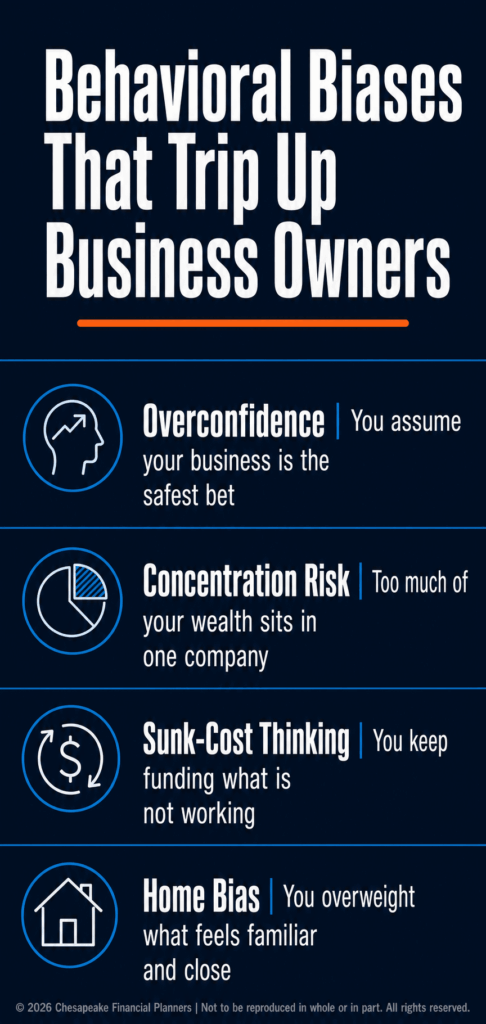
Business owner behavioral biases are the predictable mental shortcuts that lead owners to overvalue their own company, hold losing decisions too long, and treat their business as both an income source and a retirement plan at the same time. The most damaging ones are overconfidence, the sunk cost fallacy, the endowment effect, and concentration blindness. They rarely announce themselves. They show up as a missed valuation, a delayed exit, or a portfolio where 80% of net worth sits in one illiquid asset.
Key Takeaways
- Overconfidence, sunk cost, and the endowment effect cause owners to overvalue their company and delay rational exit decisions.
- About 20% of new businesses fail within the first year and roughly half within five years, per BLS data.
- Many owners hold the majority of their net worth in a single illiquid business, creating dangerous concentration risk.
- Naming a bias is the first step to building a process that counteracts it before it costs real money.
About the Author: Jeff Judge, CFP®, AEP®, ChFC®, CLU® is Managing Partner of Chesapeake Financial Planners in Forest Hill, Maryland. He has been helping families and business owners in Harford County and the Baltimore metro area navigate exit planning and concentrated-wealth decisions since earning his CFP® certification in 2013, by using Chesapeake Financial Planners’ signature process, the R.U.D.D.E.R. method™. Jeff has watched more than one owner turn down a fair offer in March, only to accept a lower one two years later because the bias never had a name.
The hardest part of advising business owners isn't the math. It's that the math runs straight into a wall of emotion the owner doesn't see. You built the thing. Of course you think it's worth more than the buyer does. That feeling is normal. It's also expensive. Below are the biases that quietly drain value, plus how to build a process that pushes back.
How Does Overconfidence Distort an Owner's Decisions?
Overconfidence is the gap between how skilled or accurate an owner believes they are and how skilled or accurate they actually turn out to be. For business owners, it usually shows up as optimism about growth, valuation, and the odds of survival.
The data is sobering. According to the Bureau of Labor Statistics, roughly 20% of new businesses fail within their first year, and only about half survive to year five. Most owners launching a venture genuinely believe they are in the surviving half. By definition, many are wrong.
Owner overconfidence isn't a character flaw. It's the same trait that got the business off the ground. You don't start a company by assuming you'll fail. But that same conviction makes it hard to hear a valuation you don't like, to plan for a downturn, or to diversify out of the asset you built with your own hands. Jeff Judge often tells clients that the confidence that built the business is the same confidence that can trap their net worth inside it.
The fix is process, not willpower. Run your assumptions past someone with no emotional stake. Stress-test the growth projections. Ask what has to be true for the optimistic case to hold, and how likely each of those things actually is.

What Is the Sunk Cost Fallacy in a Business Context?
The sunk cost fallacy is the tendency to keep investing time, money, or energy into a decision because of what you've already put in, rather than what the decision will return going forward. In a business, sunk cost thinking keeps owners tied to failing product lines, unprofitable locations, and partnerships that should have ended years ago.
The logic feels responsible. "I've put fifteen years and a million dollars into this. I can't walk away now." But the fifteen years and the million dollars are gone either way. The only question that matters is whether the next dollar and the next year earn a return. The sunk cost business trap is that it disguises emotional attachment as financial discipline.
This bias is especially dangerous around exit timing. Owners who have poured decades into a company often refuse to sell at a fair price because the offer doesn't "feel" like enough to justify the years. The years are not for sale. The future cash flows are. A buyer prices the future, not your history.
Jeff sees this most often when an owner is sitting on a reasonable offer but anchors to a number they invented based on effort rather than market value. The cleanest defense is to separate the decision from the history. Ask: if I were handed this business today with no past attached, would I keep running it or sell it at this price?
How Does the Endowment Effect Inflate What Owners Think Their Company Is Worth?
The endowment effect is the documented tendency to value something more highly simply because you own it. Studies dating back to the work of behavioral economists Daniel Kahneman, Jack Knetsch, and Richard Thaler found that people demand significantly more to give up an object than they would pay to acquire the same object. For a business owner, the endowment effect own company problem is the single largest source of valuation gaps in a sale.
You know every late night, every payroll you made when money was tight, every client you saved. The buyer knows none of that. They see EBITDA, customer concentration, and a multiple. The result is a predictable standoff: the owner's number and the market's number are often 20% to 40% apart, and the owner is genuinely shocked.
The endowment effect doesn't just hurt at sale. It distorts insurance decisions, succession planning, and how much an owner is willing to reinvest versus take off the table. When you overvalue the asset, you under-diversify around it.
The counter is an outside valuation grounded in comparable transactions, not in sentiment. A defensible third-party number gives you a reference point that your own attachment can't manufacture. This is exactly why we tell owners to start valuing the business years before any planned sale — When should I start valuing my business for a future sale?.
Why Is Concentration Risk the Most Dangerous Bias of All?
Concentration risk isn't a single bias. It's what happens when overconfidence, the endowment effect, and familiarity bias all point the same direction: keep everything in the business. Owners trust the asset they understand and built, so they let it become almost their entire net worth.
The Federal Reserve's Small Business Credit Survey consistently documents how tightly owner finances and business finances are intertwined, with many owners relying on personal funds and personal credit to support operations. When your income, your wealth, and your retirement all depend on one privately held, illiquid company, a single bad year, a key-employee departure, or an industry shift can take all three at once. Jeff Judge notes: "No investor would accept 80% of their portfolio in a single illiquid stock they couldn't sell for years, but that's exactly the position most business owners are in, and they often don't see it because the stock has their name on the door."
Familiarity feels like safety. It isn't. A diversified investor wouldn't dream of putting 80% of a portfolio into one small-cap stock they couldn't sell quickly. Yet that's the exact position most owners accept without noticing, because the single stock is their own company.
This is where having a process matters more than having a feeling. At Chesapeake Financial Planners we use the R.U.D.D.E.R. Method™, our six-step planning process: Review and Recognize, Uncover and Understand, Design and Develop, Discuss and Decide, Execute and Empower, and Reassess and Refine. The "Recognize" step exists precisely to name the concentration you've stopped seeing.

Frequently Asked Questions
What are the most common behavioral biases that hurt business owners?
The most common business owner behavioral biases are overconfidence, the sunk cost fallacy, the endowment effect, and concentration bias. Together they cause owners to overestimate their company's value, hold failing decisions too long, and keep nearly all of their net worth locked in one illiquid asset they cannot easily sell.
Why do business owners overvalue their own company?
Business owners overvalue their company largely because of the endowment effect, the documented tendency to value something more simply because you own it. Owners price in years of effort and personal sacrifice that a buyer cannot see or pay for. Buyers price future cash flow and risk, which is why owner and market valuations often differ by 20% to 40%.
How does the sunk cost fallacy affect selling a business?
The sunk cost fallacy makes owners reject fair offers because the price doesn't feel like enough to justify the years and money already invested. But those resources are gone regardless of what you decide next. A buyer pays for future earnings, not your history, so the only rational question is whether the offer reflects the business's forward value today.
How can a business owner reduce the impact of behavioral biases?
A business owner reduces bias impact by replacing feelings with process. Get an independent, transaction-based valuation rather than an emotional estimate, stress-test growth assumptions with someone who has no stake, and diversify net worth before an exit is forced. Naming each bias out loud is the first step, because an unnamed bias keeps making decisions for you.
Is concentration risk really a behavioral bias?
Concentration risk is the downstream result of several biases working together, including overconfidence, the endowment effect, and familiarity bias. Owners trust the asset they built and understand, so they let it grow into nearly all of their wealth. The danger is that one bad year can threaten income, net worth, and retirement at the same time.
If you want a clear-eyed look at how these biases may be shaping your own decisions, our guide on what business owners forget to plan before their exit — What Do Business Owners Most Often Forget to Plan Before Exiting? walks through the blind spots most often. You can also see how we evaluate and value a business objectively — How much is my business actually worth if I want to sell? before any sale conversation begins.
Business owner behavioral biases aren't a sign of poor judgment. They're a sign you care about what you built. The goal isn't to stop feeling that way. It's to build a process that makes good decisions anyway. If this struck a nerve, our free business owner planning guide breaks down each of these biases and the exact questions to ask before your next big decision. Download it at chesapeakefp.com.
Disclosures
The information provided is for educational purposes only and should not be construed as investment advice. Investment strategies should be tailored to individual circumstances, risk tolerance, and goals. Past performance doesn't guarantee future results. Consult with qualified financial professionals regarding your specific situation.
Advisors associated with Chesapeake Financial Planners may be either (1) LPL Financial Registered Representatives offering securities through LPL Financial, Member FINRA and SIPC, and investment advisor representatives offering investment advice through Great Valley Advisor Group; or (2) solely investment advisor representatives offering investment advice through Great Valley Advisor Group and not affiliated with LPL Financial. Great Valley Advisor Group, and Chesapeake Financial Planners are separate entities from LPL Financial.


