

What is the endowment effect, and why do I overvalue what I own?
Last reviewed: July 2026
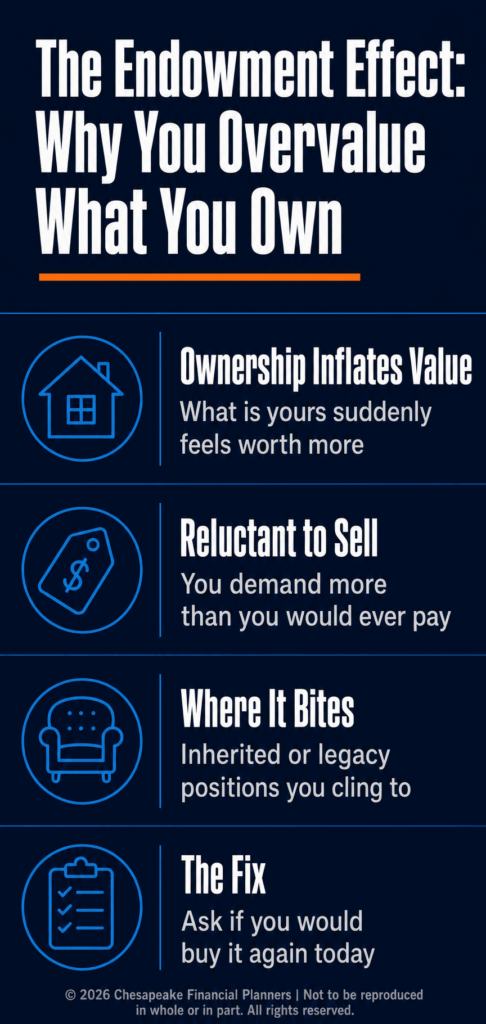
The endowment effect is the tendency to value something more highly simply because you own it. Once an asset is yours, your brain prices it higher than the same asset would fetch if you were deciding whether to buy it today. This bias shows up everywhere in investing, but it does the most damage with inherited stock, company shares, and any holding you've owned long enough to feel attached to.
Key Takeaways
- The endowment effect makes you demand more to sell an asset than you'd pay to buy the same asset new.
- In Kahneman, Knetsch, and Thaler's classic experiment, sellers demanded roughly twice what buyers offered for the same mug.
- Inherited stock triggers the strongest endowment bias because emotion and a stepped-up cost basis both reduce the urgency to sell.
- A single stock above 10% of your portfolio creates measurable concentration risk most investors overlook.
- The fix is to ask whether you'd buy the position today at its current price. If not, it may not belong in your plan.
About the Author: Jeff Judge, CFP®, AEP®, ChFC®, CLU® is Managing Partner of Chesapeake Financial Planners in Forest Hill, Maryland. He has been helping families and business owners in Harford County and the Baltimore metro area navigate inherited assets and concentrated stock positions since earning his CFP® certification in 2013, by using Chesapeake Financial Planners’ signature process, the R.U.D.D.E.R. method™. Jeff has watched the endowment effect cost families more than any market downturn, because it convinces people to hold a stock for reasons that have nothing to do with whether it's a good investment today.
What is the endowment effect in behavioral finance?
The endowment effect is a cognitive bias where people assign extra value to things merely because they own them. It was named and documented by economist Richard Thaler, who later won the Nobel Prize, and it sits at the center of behavioral finance.
The classic demonstration came from a study by Daniel Kahneman, Jack Knetsch, and Richard Thaler. Researchers gave coffee mugs to half a group of participants, then let people buy and sell. The result was striking: sellers, who had owned the mug for only minutes, demanded roughly twice what buyers were willing to pay. Nothing about the mug changed. The only difference was ownership.
That gap is the endowment bias in a single number. Owning something rewires how you price it. Behavioral economists tie this to loss aversion, the well-documented finding that the pain of giving something up feels stronger than the pleasure of gaining the same thing. The American Psychological Association and decades of follow-up research have confirmed the pattern holds across cultures and asset types.
Here's why this matters for your money. A coffee mug costs a few dollars. A concentrated stock position can be a six- or seven-figure decision. The same bias that makes you overvalue a mug makes you overvalue a stock you inherited from your father, and the stakes are not remotely comparable.
Why do I overvalue what I already own?
You overvalue what you own because ownership activates loss aversion, and selling feels like a loss rather than a neutral exchange. Your brain treats parting with the asset as giving something up, so it demands a premium to let go.
Three forces stack on top of each other. First, loss aversion itself, which research suggests makes losses feel roughly twice as painful as equivalent gains. Second, the status quo bias, the natural pull to leave things as they are. Third, the personal history attached to the asset, which is strongest with anything inherited or earned through years at a company.
Jeff Judge often tells clients to run a simple test. If you didn't already own this position, would you buy it today at this price, in this amount? When the honest answer is no, the only thing keeping the stock in the portfolio is the endowment effect. That is not an investment thesis. It's a feeling wearing the costume of a decision.
This is where overcoming fear of investing and the endowment effect overlap. Both are emotional defaults that feel like prudence but quietly work against your long-term plan.
How does the endowment effect affect inherited stock?
The endowment effect hits inherited stock harder than almost any other asset because emotion and tax rules pull in the same direction. You feel attached to a holding that came from someone you loved, and the tax code happens to make selling less urgent at first glance.
When you inherit a stock, you usually receive a stepped-up cost basis. The shares are revalued to their fair market value on the date of death, which can wipe out decades of embedded capital gains. The IRS explains the cost basis rules that govern this. That step-up is a genuine benefit. The problem is that people misread it as a reason to keep the stock forever, when it's actually a reason it's cheap to sell now.
Consider how often this plays out. A widow inherits $400,000 of a single utility stock her husband bought in 1985. She knows, intellectually, that her entire financial security shouldn't ride on one company. But selling feels like erasing him. So the position sits, untouched, for fifteen years. That's the endowment effect making a portfolio decision on emotional grounds.
The stepped-up basis actually makes this the ideal moment to diversify. You can sell with little or no capital gains tax and rebuild a balanced portfolio. Holding instead means you keep all the concentration risk and gain nothing in return. For more on the dangers of a single oversized holding, see concentration risk and why one stock shouldn't dominate your net worth.

How do I overcome the endowment effect with my investments?
You overcome the endowment effect by replacing emotion with a repeatable decision process, because the bias only thrives when each holding is judged sentimentally instead of systematically. The goal is to evaluate every position the same way, regardless of where it came from.
Start with the reframe Jeff uses constantly: separate the company from the dollars. The dollars don't know their history. If your inherited or company stock were instead $400,000 in cash, would you choose to put all of it into that one company today? Almost no one says yes. That answer tells you the position is being held by inertia, not conviction.
A few practical moves help break the grip:
- Set a concentration ceiling. Decide in advance the maximum percentage any single stock can occupy. Many advisors flag positions above 10% of a portfolio as concentrated, per FINRA guidance.
- Diversify on a schedule, not a feeling. Selling a fixed amount each quarter removes the emotional weight of any single sell decision.
- Use the cost basis you actually have. Inherited shares with a stepped-up basis and long-term gains, taxed at a top federal rate of 20% for the highest earners, are often far cheaper to unwind than you assume.
- Get an outside opinion. A second set of eyes that has no emotional stake in the holding sees the concentration clearly.
This is the same discipline that helps with avoiding emotional investment decisions across the board. The endowment effect is just one flavor of letting feelings drive the portfolio.

When does the endowment effect cost you the most?
The endowment effect costs you the most when a single emotionally held position grows large enough that its decline could derail your entire financial plan. Concentration plus attachment is the dangerous combination.
The math is unforgiving. A diversified portfolio can absorb the failure of any single company. A portfolio where one inherited or company stock makes up 40% of your net worth cannot. If that company stumbles, and individual companies stumble all the time, the loss isn't a setback. It's a different retirement. The SEC repeatedly emphasizes diversification as a core protection against exactly this risk.
Jeff has seen the bill come due more than once. The hardest conversations aren't with people who lost money in a market crash. They're with people who held a beloved stock through its long, slow decline, watched it fall 70%, and only then asked whether they should have diversified years earlier. The endowment effect doesn't feel expensive in the moment. It sends the invoice later.
The lesson isn't that you must sell everything sentimental. It's that you should know the difference between holding a stock because the numbers support it and holding it because letting go feels like a loss. One is investing. The other is the endowment effect quietly running your portfolio.
Frequently Asked Questions
What is a simple example of the endowment effect?
A simple example is the coffee mug experiment by Kahneman, Knetsch, and Thaler. People given a mug demanded roughly twice as much to sell it as other people were willing to pay to buy the identical mug. Ownership alone, after only minutes, doubled the perceived value, which is the endowment effect in action.
Is the endowment effect the same as loss aversion?
No, but they're closely linked. Loss aversion is the broader tendency to feel losses more intensely than equivalent gains. The endowment effect is one specific result of loss aversion: because selling an asset you own registers as a loss, you demand a premium to part with it. Loss aversion is the cause, the endowment effect is the symptom.
How does the endowment effect apply to inherited stock?
Inherited stock triggers an unusually strong endowment effect because emotion and tax rules combine. You feel attached to shares from a loved one, and the stepped-up cost basis can make selling nearly tax-free, which people misread as a reason to hold. In reality, a stepped-up basis makes the inheritance the cheapest, most logical time to diversify.
How can I stop overvaluing a stock I already own?
Ask one question: if you didn't own this stock, would you buy it today at this price and in this amount? If the answer is no, the only thing keeping it in your portfolio is the endowment effect. Then diversify on a fixed schedule rather than a feeling, and set a maximum percentage any single holding can occupy.
Does the endowment effect ever help investors?
Rarely in a useful way. The endowment effect can encourage long-term holding, which sometimes prevents panic selling during volatility. But it does this for the wrong reasons, attaching you to specific companies rather than to a sound strategy. A disciplined long-term plan delivers the same patience without the concentration risk that the endowment effect creates.
If concentrated stock or an inherited position is sitting heavier in your portfolio than it should, our free guide on managing concentration risk walks through how to diversify without a surprise tax bill. Download it at chesapeakefp.com and put a real process around the decision instead of leaving it to a feeling.
Disclosures
The information provided is for educational purposes only and should not be construed as investment advice. Investment strategies should be tailored to individual circumstances, risk tolerance, and goals. Past performance doesn't guarantee future results. Consult with qualified financial professionals regarding your specific situation.
Advisors associated with Chesapeake Financial Planners may be either (1) LPL Financial Registered Representatives offering securities through LPL Financial, Member FINRA and SIPC, and investment advisor representatives offering investment advice through Great Valley Advisor Group; or (2) solely investment advisor representatives offering investment advice through Great Valley Advisor Group and not affiliated with LPL Financial. Great Valley Advisor Group, and Chesapeake Financial Planners are separate entities from LPL Financial.


