

Should I take a FAANG job or a startup offer?
Last reviewed: July 2026
For most people, a big-tech (FAANG) offer is the higher-comp, lower-risk, better-balance choice, while a startup offer is the higher-risk, higher-learning, higher-upside gamble that makes sense mainly once you are financially secure. The trap is comparing the headline "total comp" numbers, because a FAANG offer's equity is liquid public stock you can sell at vesting, while a startup's equity is illiquid options that could be worth a fortune or zero. Comparing them honestly means risk-adjusting the startup equity, not taking its paper value at face value.
On This Page
- Key Takeaways
- Why don't the headline total-comp numbers tell the real story?
- What are the real differences beyond the numbers?
- When should you choose FAANG, and when a startup?
- How should you actually compare two offers?
- Related Topics Worth Reading
- Frequently Asked Questions
- Choosing with clear eyes
- Disclosures
Key Takeaways
- Headline total-comp numbers mislead, because FAANG equity is liquid while startup equity is illiquid and may be worth nothing.
- FAANG offers a strong base, liquid RSUs, refresher grants, and benefits; startups offer a lower base and option upside that depends on an exit.
- Risk-adjust startup equity heavily before comparing; most startups do not produce a big payout.
- A common smart path is FAANG first to build wealth and a resume, then a startup once you can afford the risk.
- A strong, liquid FAANG base lets you max tax-advantaged savings, including the 2026 401(k) elective deferral limit of $24,500, something a lower startup base can make harder.
About the Author: Jeff Judge, CFP®, AEP®, ChFC®, CLU® is Managing Partner of Chesapeake Financial Planners in Forest Hill, Maryland. As Jeff puts it: "The single biggest mistake I see is treating a startup option grant as if it were cash like a FAANG RSU; they are not remotely the same risk, and once you adjust for that, the lower-looking offer is often the richer one." He has been helping families and business owners in Harford County and the Baltimore metro area navigate complex equity compensation and tech industry financial planning since earning his CFP® certification in 2013, by using Chesapeake Financial Planners’ signature process, the R.U.D.D.E.R. method™.
Why don't the headline total-comp numbers tell the real story?
The headline numbers mislead because they add up cash and equity as if both were equally certain, when a FAANG offer's equity is liquid and a startup's is not. Two offers can look comparable on paper and be very different in reality.
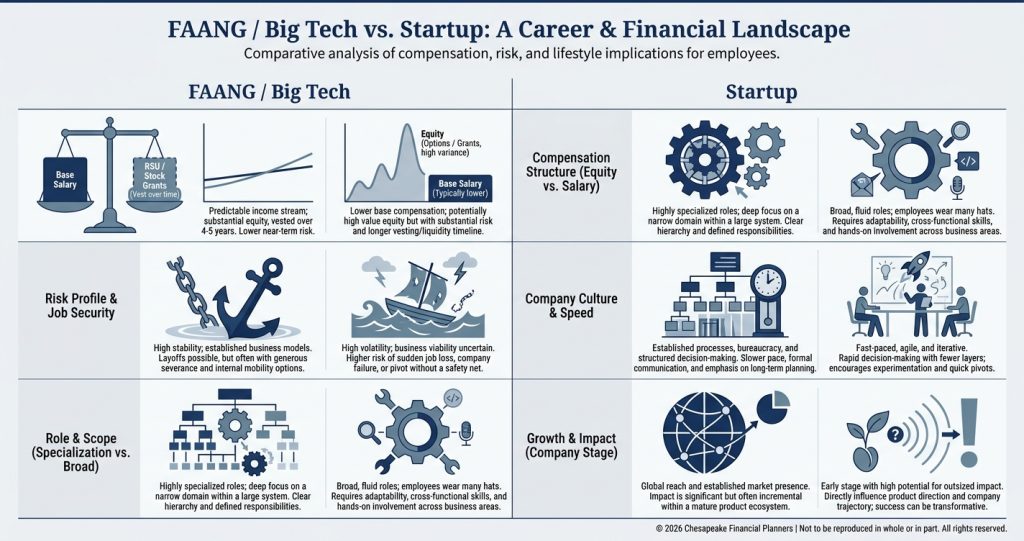
A FAANG offer typically pairs a strong, guaranteed base salary with restricted stock units (RSUs) in a public company that vest on a schedule and can be sold immediately, plus a signing bonus, a target bonus, and comprehensive benefits. The equity is essentially deferred cash, subject to normal stock-price movement. A startup offer typically has a lower base, a larger-sounding grant of stock options in a private company, a smaller signing bonus, and leaner benefits. That option grant is the catch: it is illiquid, often requires you to exercise and then wait years for a liquidity event that may never come, and could end up worth zero. The tax timing differs too; the IRS notes that "if you receive an option to buy stock as payment for your services, you may have income when you receive the option, when you exercise the option, or when you dispose of the option or stock received when you exercise the option," which is one reason startup options carry complications that liquid RSUs do not.
The two packages line up roughly like this.
| Dimension | FAANG / big tech | Startup |
|---|---|---|
| Base salary | Strong and predictable | Often below market |
| Equity type | RSUs in liquid public stock | Options in illiquid private company |
| Equity risk | Lower; can sell at vesting | High; value depends on a future exit |
| Benefits | Comprehensive (401(k) match, full health) | Variable, often limited early stage |
| Upside | Stable and steady | Could be zero or many times over |
So when you "risk-adjust" the two, by discounting the startup equity heavily for illiquidity and failure risk, a FAANG offer is frequently worth substantially more than a side-by-side comparison of headline figures suggests. The startup's paper value is real only "if the equity pans out," and most of the time it does not pan out in a big way. Understanding that asymmetry is the whole game.
What are the real differences beyond the numbers?
Beyond pay, FAANG and startups differ sharply on liquidity, risk, refresher grants, work-life balance, and career signal. These differences often matter more than the comp gap itself.
On liquidity, FAANG RSUs vest and can be sold right away, effectively cash, while startup options require exercise plus a liquidity event that might be five to seven years away, or never. On risk, a big-tech stock might fall but the company is unlikely to go to zero, whereas most startups fail and their equity can become worthless. On ongoing pay, FAANG typically issues annual refresher grants that keep your comp flat or growing, while a startup may or may not offer refreshers, so your comp can cliff after the initial grant vests. On work-life balance, FAANG roles are generally more predictable, while startups often expect longer hours and an always-on, "we're building something" intensity. On career signal, a FAANG name on your resume opens doors and reads as a strong credential, while a startup can accelerate your growth dramatically if it scales but requires explanation if it fails.
None of these is purely good or bad; they are trade-offs that depend on what you value. A clear-eyed comparison weighs liquidity and stability against learning, ownership, and upside, rather than fixating on a single comp number. This kind of multi-factor, personal decision is exactly what the R.U.D.D.E.R. Method™ is built to structure. The R.U.D.D.E.R. Method™ is Chesapeake Financial Planners' six-step planning process: Review and Recognize, Uncover and Understand, Design and Develop, Discuss and Decide, Execute and Empower, and Reassess and Refine, and an offer comparison lives in Discuss and Decide, weighed against your finances, career stage, and risk tolerance.
When should you choose FAANG, and when a startup?
Choose FAANG when you need cash flow, want balance, or are focused on building wealth, and choose a startup when you believe in the upside, want to learn fast and own your impact, and are already financially secure. The right answer depends heavily on your stage of life and finances.
FAANG tends to win when you need reliable cash flow now (for student loans, family, or simply living without stress), when you value predictability and work-life balance, when you are optimizing for steady wealth accumulation, or when you want the resume signal. The wealth point is counterintuitive but important: many people build more wealth at FAANG than at startups, because a higher liquid base lets you save and invest more, liquid RSUs let you diversify into a real portfolio, refresher grants compound, and you avoid binary outcome risk. A startup tends to win when you genuinely believe in asymmetric upside and can accept a high chance of little or nothing for a small chance of a large payout; when you want to learn faster by wearing many hats and seeing the whole business; when ownership and direct impact matter to you more than a diluted role at a giant company; and crucially, when you are already financially secure enough that you are not depending on the income to cover your mortgage.
That last condition does a lot of work. The FAANG-versus-startup decision gets much easier, and a startup bet much more reasonable, when you have a solid financial cushion already in place. Taking lottery-ticket risk is far more defensible when a zero outcome would be disappointing rather than devastating.

How should you actually compare two offers?
You compare two offers by risk-adjusting the equity, thinking in terms of expected value rather than best-case value, and asking hard questions about each opportunity. A disciplined process beats an emotional reaction to a big headline number.
Start by discounting the startup equity heavily, because its realistic expected value, weighing the high chance of little payout against the small chance of a large one, is usually far below its paper value, while FAANG equity is close to cash. Remember that liquid equity is taxed when it vests and again when it grows: high earners can owe long-term capital gains of up to 20% on appreciated shares plus the 3.8% net investment income tax above the MAGI thresholds, so the after-tax value of a grant is what actually matters. Then ask pointed questions of each. For a startup: what is the current valuation and your option strike price, the fully diluted share count (which determines your real ownership percentage), the path and timeline to liquidity, the burn rate and runway, the quality of the investors, and employee retention. For a FAANG role: what is the team culture (some teams are difficult despite the brand), the realistic promotion timeline, what refresher grants look like (this drives your long-term comp), and whether the project is maintenance work or a meaningful new product. Jeff Judge notes: "When I walk through two competing offers with a client, the first thing we do is strip the startup equity down to a realistic expected value rather than the headline number, because comparing vested FAANG RSUs to illiquid options at face value is comparing apples to lottery tickets."
A useful mental model is the hybrid path many successful people follow: spend the early years at FAANG to build skills, save aggressively, and accumulate a substantial nest egg with the brand on your resume, then move to a startup later when you are financially secure, more valuable as a hire, and able to negotiate better terms, knowing you could return to big tech if the startup does not work out. This sequence maximizes optionality: build wealth first, take calculated risk when you can actually afford it. Whatever you choose, do not fool yourself about the comp, a startup option grant is not the same thing as a liquid FAANG RSU.
Related Topics Worth Reading
A tech-comp decision connects to equity comp, concentration, and tax strategy. These related topics go deeper.
- What to do with the company stock you accumulate. How do I diversify a concentrated company stock position without a huge tax bill?
- How double-trigger RSUs at a startup actually vest. What do double-trigger RSUs at a private company mean for me?
- The psychology of holding too much of one company's stock. Why is it so hard to sell my company stock?
- Handling stock options when you leave a job. What Happens to My Stock Options When I Leave My Job?
- Comparing total comp components like base versus equity. What Is the Difference Between Total Comp and Base Salary?
Frequently Asked Questions
Should I take a FAANG job or a startup offer?
For most people, a FAANG offer is the safer, higher-comp, better work-life-balance choice, while a startup is the higher-risk, higher-upside choice that makes most sense once you are financially secure. The key is to risk-adjust the offers rather than compare headline total-comp numbers, since FAANG equity is liquid and startup equity is illiquid and may be worth nothing. Early in your career, FAANG often wins; later, with a cushion, a startup bet becomes more reasonable.
Is startup equity worth as much as FAANG RSUs?
No, not on a risk-adjusted basis. FAANG RSUs are equity in a public company that vest on a schedule and can be sold immediately, making them close to cash. Startup options are illiquid, require an exercise and a future liquidity event that may never happen, and frequently end up worth little or nothing. A larger-sounding startup grant can be worth far less than a smaller FAANG grant once you account for illiquidity and failure risk.
Do most people build more wealth at FAANG or at startups?
Counterintuitively, many people build more wealth at FAANG than at startups. A higher liquid base lets you save and invest more, liquid RSUs let you diversify into a real portfolio, refresher grants compound your comp over time, and you avoid the binary outcome risk of a startup that may fail. Startups offer lottery-ticket upside for a minority of employees, but most startup equity does not produce a large payout, while steady FAANG comp accumulates reliably.
What questions should I ask about a startup offer?
Ask about the current valuation and your option strike price, the fully diluted share count (which determines your true ownership percentage), the path and timeline to a liquidity event, the company's burn rate and runway, the quality and reputation of its investors, and employee retention or churn. These questions reveal how realistic the upside is and how much risk you are taking. Vague or evasive answers, especially about dilution and runway, are a warning sign.
Should I do FAANG first and a startup later?
For many people, yes, this hybrid path is a smart play. Spending your early career at FAANG lets you build skills, save aggressively, accumulate a nest egg, and earn a strong resume credential, after which you can join a startup once you are financially secure and a more valuable, better-paid hire, with the option to return to big tech if it does not work out. This sequence builds wealth first and takes calculated risk only when you can afford it.
Choosing with clear eyes
The FAANG-versus-startup decision is less about which headline number is bigger and more about liquidity, risk, your finances, and your stage of life. FAANG generally offers higher risk-adjusted comp, stability, and a steadier path to wealth; a startup offers learning, ownership, and asymmetric upside best suited to those who can absorb a zero outcome. For most people early on, building wealth at FAANG and taking startup risk later maximizes optionality. Whatever you decide, risk-adjust the equity honestly. Jeff Judge and the Chesapeake Financial Planners team help tech professionals model these decisions and the equity that comes with them. Schedule a free fit call at chesapeakefp.com.
Want to go deeper? Our Evaluating Your Total Compensation Package walks through this step by step.
Disclosures
The information provided is for educational purposes only and should not be construed as investment advice. Investment strategies should be tailored to individual circumstances, risk tolerance, and goals. Past performance doesn't guarantee future results. Consult with qualified financial professionals regarding your specific situation.
Advisors associated with Chesapeake Financial Planners may be either (1) LPL Financial Registered Representatives offering securities through LPL Financial, Member FINRA and SIPC, and investment advisor representatives offering investment advice through Great Valley Advisor Group; or (2) solely investment advisor representatives offering investment advice through Great Valley Advisor Group and not affiliated with LPL Financial. Great Valley Advisor Group, and Chesapeake Financial Planners are separate entities from LPL Financial.


