

What Are the Most Common Beneficiary Designation Mistakes?
Last reviewed: July 2026
The most common beneficiary designation mistakes are leaving forms outdated after a divorce or death, naming your estate instead of a person, naming minor children directly, skipping contingent beneficiaries, and naming a trust that isn't structured to hold retirement money. These forms control who inherits your largest assets, and they override your will, so a single stale form can send a retirement account to the wrong person no matter what your estate plan says.
Key Takeaways
- Beneficiary designations override your will, so the named beneficiary on a retirement account or life insurance policy inherits it regardless of your estate plan.
- The most damaging mistakes are outdated forms after divorce, naming your estate, naming minors directly, and omitting contingent beneficiaries.
- Under the SECURE Act, most non-spouse heirs must empty an inherited IRA within 10 years, which reshapes beneficiary planning.
- Review every beneficiary form after any marriage, divorce, birth, or death, and at least every three to five years.
About the Author: Jeff Judge, CFP®, AEP®, ChFC®, CLU® is Managing Partner of Chesapeake Financial Planners in Forest Hill, Maryland. He has been helping families in Harford County and the Baltimore metro area coordinate their estate plans since earning his CFP® certification in 2013, by using Chesapeake Financial Planners’ signature process, the R.U.D.D.E.R. method™. Jeff's view: he has reviewed plenty of $1 million estate plans undone by a $0 mistake, an ex-spouse left on a 401(k) form that nobody thought to check.
Why do beneficiary designations override your will?
Beneficiary designations override your will because the named beneficiary on an account is a contract between you and the institution, and that contract controls the asset directly at death, outside probate and outside your will. Retirement accounts, life insurance, annuities, transfer-on-death brokerage accounts, and payable-on-death bank accounts all pass this way. Your will has no authority over any of them.
That is why a coordinated estate plan can still fail. People spend real money on a will and trust, then never check the beneficiary forms on their biggest assets, which are often the retirement accounts. If the will says split everything equally among three children but the IRA names only one, the IRA goes to that one child, full stop. The document everyone focused on loses to the form nobody looked at.
The fix is to treat beneficiary forms as a core part of the plan, not an afterthought. Every account with a beneficiary line should be inventoried, checked against your overall intentions, and confirmed in writing with the institution. Assume nothing; a form you filled out fifteen years ago may name someone you would never choose today.
What are the most damaging beneficiary mistakes?
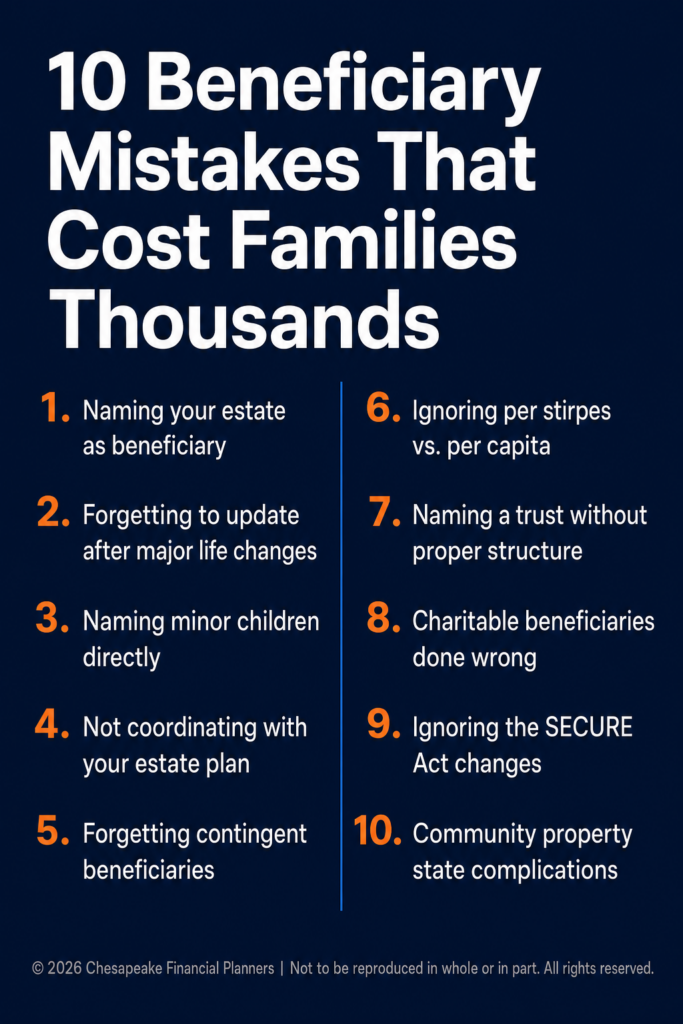
The most damaging mistakes share a theme: they send assets somewhere you never intended, often with a tax penalty attached. Five cause the most harm.
Naming your estate, or leaving the line blank, is the first. It forces the asset through probate and can strip a retirement account of its favorable distribution treatment, accelerating taxes for your heirs. Naming an individual or a properly structured trust avoids this entirely.
Failing to update after a life change is the most common of all. An ex-spouse left on an old 401(k), a deceased parent still listed, a former business partner never removed; each can redirect a large account away from the family you have now. After a marriage, divorce, birth, death, or estrangement, every form needs a look. Employer plans add a wrinkle worth knowing: under federal law, your current spouse is the default beneficiary of a 401(k), and naming someone else requires your spouse to sign a notarized waiver. The Department of Labor explains that "The Employee Retirement Income Security Act of 1974, or ERISA, protects the assets of millions of Americans so that funds placed in retirement plans during their working lives will be there when they retire," including rules on whether a spouse has a right to part of a benefit. Jeff Judge notes: "I've seen a client's ex-spouse receive a six-figure 401(k) payout because a beneficiary form was never updated after the divorce, and the court couldn't override it, because under ERISA the form controls regardless of what the will says."
Naming minor children directly backfires because minors cannot legally receive large sums. A court has to appoint a conservator, and the child typically gets full control at 18 or 21 with no guidance. A trust named as beneficiary, with staged distributions, keeps that money managed and protected. The remaining two high-damage mistakes, skipping contingent beneficiaries and mis-structuring a trust, get their own sections below because they trip up even careful families.
How do contingent beneficiaries and "per stirpes" actually work?
Contingent beneficiaries are your backups, and "per stirpes" decides where a deceased beneficiary's share goes, and getting both right prevents an account from falling into your estate. If your only named beneficiary dies before you or with you and you named no contingent, the asset reverts to your estate and lands in probate with accelerated taxes. Always name at least one contingent, and often a second level.
The per stirpes versus per capita choice matters most when a child predeceases you and leaves children of their own. The table makes the difference concrete, using three children where one has died leaving two grandchildren.
| Distribution method | What happens to the deceased child's share | Grandchildren's outcome |
|---|---|---|
| Per stirpes (by branch) | Passes down to that child's children | The two grandchildren split the 1/3 share |
| Per capita (by head) | Splits among the surviving named beneficiaries | The two surviving children get 1/2 each; grandchildren get nothing |
Most families want per stirpes so a deceased child's branch still inherits, but the default on many forms is not per stirpes. You have to specify it. This is exactly the kind of detail that looks trivial on the form and becomes a family rupture a generation later. Jeff Judge often tells clients that the cheapest estate planning he does is making sure the word "per stirpes" is on the form before it is ever needed.

How did the SECURE Act change beneficiary planning?
The SECURE Act changed beneficiary planning by ending the lifetime "stretch" for most non-spouse heirs, who now must empty an inherited IRA within ten years of the owner's death. The IRS confirms in Publication 590-B that all distributions must be made by the end of the 10th year after death, except for certain eligible designated beneficiaries. That compresses decades of tax-deferred growth and taxable withdrawals into a single decade, often during the heir's peak earning years.
A few heirs still qualify for the old lifetime stretch as eligible designated beneficiaries: a surviving spouse, a minor child of the owner, a disabled or chronically ill person, and anyone not more than ten years younger than the owner. The IRS beneficiary RMD rules spell out how each category is treated. For everyone else, the ten-year clock applies, and planning has to account for it.
This is also where naming a trust gets technical. A trust must meet IRS "see-through" requirements to pass the inherited account's distribution options to its beneficiaries; a poorly drafted one can force even faster payout and a bigger tax hit. With the 2026 federal estate exclusion at $15 million per person and the annual gift exclusion at $19,000 per recipient for 2026, most families are below the estate-tax line, so the real money is usually saved or lost on income-tax timing, which is exactly what the SECURE Act rewrote. Run the choice through a real process. The R.U.D.D.E.R. Method™ is Chesapeake Financial Planners' six-step planning process: Review and Recognize, Uncover and Understand, Design and Develop, Discuss and Decide, Execute and Empower, and Reassess and Refine, and beneficiary review lives in the first step, Review and Recognize.
Related Topics Worth Reading
Beneficiary planning is one thread in a larger estate plan. These related topics connect to it directly.
- How beneficiary designations fit alongside trusts and avoid probate. Probate Avoidance Strategies: 4 Ways to Skip the Courts
- When you need a trust versus a simple will. Should I Get a Trust or Is a Will Enough?
- The full estate planning picture, from documents to legacy strategy. What does a complete estate plan include and where do you start?
- How Roth conversions can ease the tax hit the SECURE Act creates for heirs. When does a Roth conversion make financial sense and how do you execute it?
- Maryland-specific estate and inheritance tax rules for local families. How do Maryland's estate tax and inheritance tax work together, and how do you plan around both?
Frequently Asked Questions
Do beneficiary designations override a will?
Yes, beneficiary designations override a will. The beneficiary named on a retirement account, life insurance policy, annuity, or transfer-on-death account inherits that asset directly, regardless of what your will says. This is why coordinating your beneficiary forms with your overall estate plan, and updating them after major life events, matters as much as drafting the will itself.
What happens if I don't name a beneficiary?
If you don't name a beneficiary, the asset typically passes to your estate and goes through probate, which is slower, public, and more expensive. For retirement accounts, naming your estate can also strip favorable distribution treatment and accelerate income taxes for your heirs. Naming an individual or a properly structured trust, plus a contingent beneficiary, avoids these problems entirely.
How often should I update my beneficiary designations?
You should review your beneficiary designations after every major life event, including marriage, divorce, birth, death, or estrangement, and at least once every three to five years otherwise. Forms filled out years ago often name people you no longer intend, such as an ex-spouse on an old 401(k). Request current forms from each institution and confirm they match your wishes in writing.
What is the 10-year rule for inherited IRAs?
The 10-year rule, created by the SECURE Act, requires most non-spouse beneficiaries to withdraw all funds from an inherited IRA by the end of the 10th year after the owner's death. Per IRS Publication 590-B, eligible designated beneficiaries such as spouses, minor children, and disabled individuals are exceptions. The rule compresses taxable withdrawals into a decade, so beneficiary and Roth conversion planning matter more than ever.
Should I name a trust as my IRA beneficiary?
You can name a trust as your IRA beneficiary, but it must meet IRS "see-through" requirements to preserve the inherited account's distribution options. A properly drafted trust protects minor or vulnerable heirs and controls how funds are paid out. A poorly drafted one can force faster distributions and higher taxes, so this is a step to take with an estate planning attorney, not a form to guess at.
Protecting your family from a $0 mistake
The cruelest part of a beneficiary mistake is how cheap it would have been to prevent and how expensive it is to fix after death, when nothing can be changed. The most common beneficiary designation mistakes all trace back to forms that were never reviewed, so the single most valuable thing you can do is inventory every account and confirm each beneficiary in writing. If you found this helpful and want a second set of eyes on your forms, our team at Chesapeake Financial Planners will help you inventory and coordinate them with your estate plan. Visit chesapeakefp.com to learn more.
Want to go deeper? Our Estate Document Locator walks through this step by step.
Disclosures
The information provided is for educational purposes only and should not be construed as investment advice. Investment strategies should be tailored to individual circumstances, risk tolerance, and goals. Past performance doesn't guarantee future results. Consult with qualified financial professionals regarding your specific situation.
Advisors associated with Chesapeake Financial Planners may be either (1) LPL Financial Registered Representatives offering securities through LPL Financial, Member FINRA and SIPC, and investment advisor representatives offering investment advice through Great Valley Advisor Group; or (2) solely investment advisor representatives offering investment advice through Great Valley Advisor Group and not affiliated with LPL Financial. Great Valley Advisor Group, and Chesapeake Financial Planners are separate entities from LPL Financial.


