

Am I Saving Enough to Retire by Age 60?
Last reviewed: July 2026
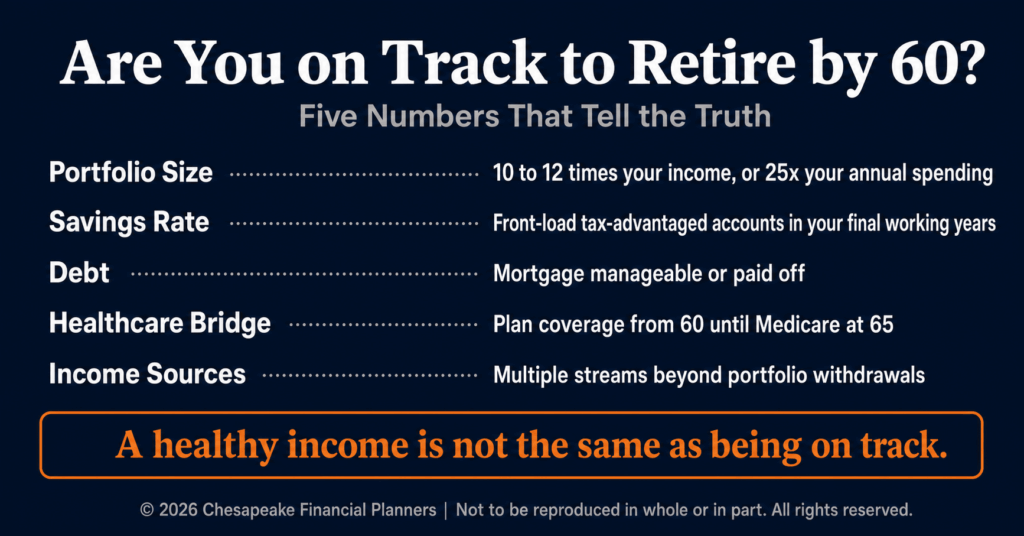
To retire by 60, most people need roughly 10 to 12 times their annual income saved by that age, a withdrawal plan that bridges five years before Medicare, and a portfolio built to survive a bad market in year one. The shorter your runway and the longer your expected lifespan, the more cushion you need. If you can fund 30-plus years of spending without leaning on Social Security until at least 62, you are likely on track to retire by 60.
Key Takeaways
- Retiring at 60 generally requires 10 to 12 times your annual income saved, with more needed for higher spending lifestyles.
- In 2026, the standard Medicare Part B premium is $202.90 per month, and Medicare does not start until age 65.
- You cannot claim Social Security before 62, so five years of retirement at 60 must be self-funded.
- Sequence-of-returns risk in the first years of retirement can permanently shrink a portfolio that looks fully funded on paper.
About the Author: Jeff Judge, CFP®, AEP®, ChFC®, CLU® is Managing Partner of Chesapeake Financial Planners in Forest Hill, Maryland. He has been helping families and business owners in Harford County and the Baltimore metro area navigate early retirement decisions since earning his CFP® certification in 2013, by using Chesapeake Financial Planners’ signature process, the R.U.D.D.E.R. method™. Jeff has watched more retirements get derailed by the five-year healthcare gap before Medicare than by any investment mistake.
Retiring at 60 is a real goal for plenty of high earners. The trouble is that most people confuse a healthy income with being on track. Those are not the same thing. Income tells you what you make. Being on track tells you whether what you keep will outlast you. Let's break down what it actually takes.
What Does Being On Track to Retire by 60 Actually Mean?
Being on track means you can fund your retirement spending for the rest of your life without running out of money, starting at 60. That is the whole test. Everything else is detail.
Most retirees spend between 70% and 90% of their pre-retirement income, though that range shifts based on lifestyle, location, and whether your mortgage is gone. A reasonable shortcut is the 25x rule: save 25 times your desired annual spending. Want $80,000 a year? Aim for roughly $2 million. That rule works because it loosely matches a 4% withdrawal rate, but it assumes a 30-year retirement, not the 35-plus years a 60-year-old might face.
Jeff often tells clients that the number on the statement matters less than the order of three things: when you stop working, when income sources turn on, and how the market behaves in your first two years retired. Get those wrong and a fully funded plan can still wobble.
This is where the R.U.D.D.E.R. Method™, Chesapeake Financial Planners' six-step planning process of Review and Recognize, Uncover and Understand, Design and Develop, Discuss and Decide, Execute and Empower, and Reassess and Refine, earns its keep. Early retirement has too many moving parts to leave to a rule of thumb.
How Much Money Do I Actually Need to Retire Comfortably?
What Savings Benchmarks Should I Hit to Retire at 60?
To retire by 60, aim for these retirement savings benchmarks by age: roughly 4 to 6 times your income by 45, 6 to 8 times by 50, 8 to 10 times by 55, and 10 to 12 times by 60. These are guidelines, not guarantees, and your personal situation can move the target meaningfully.
| Age | Target savings (multiple of income) |
|---|---|
| 45 | 4 to 6x |
| 50 | 6 to 8x |
| 55 | 8 to 10x |
| 60 | 10 to 12x (more for higher spending) |
Several factors can shift these numbers. A paid-off home, expected inheritance, business equity, or rental income can lower the multiple you need. Heavy debt, a long expected lifespan, or a travel-heavy retirement push it higher. Early retirement planning almost always demands the upper end of these ranges, because your money has to work longer with fewer income sources turned on.
One detail people miss: maxing tax-advantaged accounts matters more the closer you get. In 2026, the 401(k) employee contribution limit is $24,500, with an additional $8,000 catch-up for those age 50 and older. Front-loading those contributions in your final working years can close a surprising amount of ground.
What Should You Prioritize Financially in the 5 Years Before Retirement?
How Do I Cover Healthcare Before Medicare if I Retire at 60?
If you retire at 60, you must self-fund healthcare for five years until Medicare begins at 65. Your options are COBRA from your former employer, a spouse's plan, or an Affordable Care Act marketplace policy, and none of them are cheap. This is the single most underestimated cost in early retirement.
The Centers for Medicare & Medicaid Services confirms Medicare eligibility starts at 65 for most people. That leaves a real gap. Marketplace premiums for a couple in their early 60s can run well into five figures annually before subsidies. There is a planning lever here: marketplace subsidies are based on your taxable income, so a retiree living partly off cash or Roth assets can sometimes qualify for substantial help by keeping reported income low.
Jeff has watched this five-year window quietly cost clients $80,000 or more when they did not plan for it. The fix is rarely complicated, but it has to happen before you hand in your notice, not after.
How Much Should I Budget for Healthcare Costs in Retirement?
How do I plan for rising healthcare costs in retirement?
What Roadblocks Derail Retirement at 60?
The most common roadblocks to retiring at 60 are lifestyle inflation, tax inefficiency, the pre-Medicare healthcare gap, underestimating longevity, and sequence-of-returns risk. High earners are not immune to any of them. In fact, a strong income often masks the first one for years.
Lifestyle inflation is the quiet killer. As income climbs, spending climbs with it, and savings rates stay flat. Tax inefficiency is next: saving in the wrong account types or withdrawing without a sequence can hand the IRS tens of thousands you did not owe. Then comes longevity. Planning to 85 feels reasonable until you live to 95, and running short at 92 is a risk you cannot recover from.
Sequence-of-returns risk deserves its own line. If the market drops 30% the year you retire and you are pulling income from those same shrinking accounts, the damage can be permanent. The portfolio never fully recovers because you sold low to live on. This is why asset allocation should get more conservative as you approach 60, not less. A good retirement income planning strategy keeps a buffer of stable assets so you never have to sell stocks in a downturn just to pay the grocery bill.
Can I retire early without running out of money?
Frequently Asked Questions
How much do I need to retire at 60?
To retire at 60, most people target 10 to 12 times their annual income saved, or roughly 25 times their desired annual spending under the 4% rule. Someone wanting $80,000 a year would aim for about $2 million. Higher spending, longer lifespans, or heavy debt push that number up.
Can I collect Social Security if I retire at 60?
No, you cannot collect Social Security at 60. The earliest you can claim is age 62, and claiming that early permanently reduces your benefit. If you retire at 60, you must fund the gap years entirely from savings, and many planners suggest delaying Social Security past 62 to grow the benefit.
What is the biggest financial risk of retiring at 60?
The biggest risks are the five-year healthcare gap before Medicare and sequence-of-returns risk. Medicare does not start until 65, so you must self-fund coverage, and a market crash in your first retirement years can permanently shrink a portfolio because you are forced to sell assets at low prices to fund spending.
Is the 25x rule enough to retire early at 60?
The 25x rule is a useful starting point but often falls short for early retirement. It assumes a 30-year retirement, while a 60-year-old may need income for 35 years or more. Early retirees should generally build extra cushion above the 25x target to account for the longer runway and healthcare costs.
How much should I have saved by 55 to retire at 60?
By 55, aim for roughly 8 to 10 times your annual income saved if you plan to retire at 60. Maxing your 401(k) and catch-up contributions in these final working years can close meaningful ground. Your exact target depends on spending, debt, pension income, and other assets like real estate or business equity.
Where to Go From Here
If you want a clearer picture of where you actually stand, our guide on retirement readiness walks through the same benchmarks and healthcare gaps we model with clients every week. Download it at chesapeakefp.com and run the numbers against your own situation before your next 2 a.m. wake-up.
Disclosures
The information provided is for educational purposes only and should not be construed as investment advice. Investment strategies should be tailored to individual circumstances, risk tolerance, and goals. Past performance doesn't guarantee future results. Consult with qualified financial professionals regarding your specific situation.
Advisors associated with Chesapeake Financial Planners may be either (1) LPL Financial Registered Representatives offering securities through LPL Financial, Member FINRA and SIPC, and investment advisor representatives offering investment advice through Great Valley Advisor Group; or (2) solely investment advisor representatives offering investment advice through Great Valley Advisor Group and not affiliated with LPL Financial. Great Valley Advisor Group, and Chesapeake Financial Planners are separate entities from LPL Financial.


