

What Is ESG Investing and How Does It Work?
Last reviewed: July 2026
ESG investing is an approach that evaluates companies on environmental, social, and governance factors alongside traditional financial analysis before deciding what to buy or avoid. In practice, it works by screening, scoring, or weighting investments based on how a company manages climate risk, treats its workers and customers, and runs its boardroom. For high-net-worth investors, ESG investing offers a way to align a portfolio with personal values while still pursuing competitive long-term returns.
Key Takeaways
- ESG investing weighs environmental, social, and governance factors next to standard financial metrics when selecting investments.
- According to US SIF, sustainable investing assets under professional management in the US totaled roughly $6.5 trillion as of 2024.
- Five main strategies exist: negative screening, positive screening, integration, impact investing, and shareholder engagement.
- ESG ratings differ across providers, so relying on a single score is a common and avoidable mistake.
- Greenwashing and sector concentration are the two limitations most investors underestimate.
About the Author: Jeff Judge, CFP®, AEP®, ChFC®, CLU® is Managing Partner of Chesapeake Financial Planners in Forest Hill, Maryland. He has been helping families and business owners in Harford County and the Baltimore metro area navigate values-based investing since earning his CFP® certification in 2013, by using Chesapeake Financial Planners’ signature process, the R.U.D.D.E.R. method™. Jeff often reminds clients that ESG is not one thing, and the version that fits a tech executive worried about climate transition risk looks nothing like the version that fits a family that simply wants to avoid tobacco.
What Does ESG Investing Actually Mean?
ESG investing considers three categories of factors alongside financial analysis. Environmental criteria examine carbon emissions, energy efficiency, waste, water use, and how a company handles climate risk. Social criteria look at labor practices, workplace safety, diversity, customer treatment, data protection, and community relations. Governance criteria focus on board independence, executive pay, shareholder rights, audit quality, and internal controls.
Want to go deeper? Our How to Align Money with Your Values (Without Guilt) walks through this step by step.
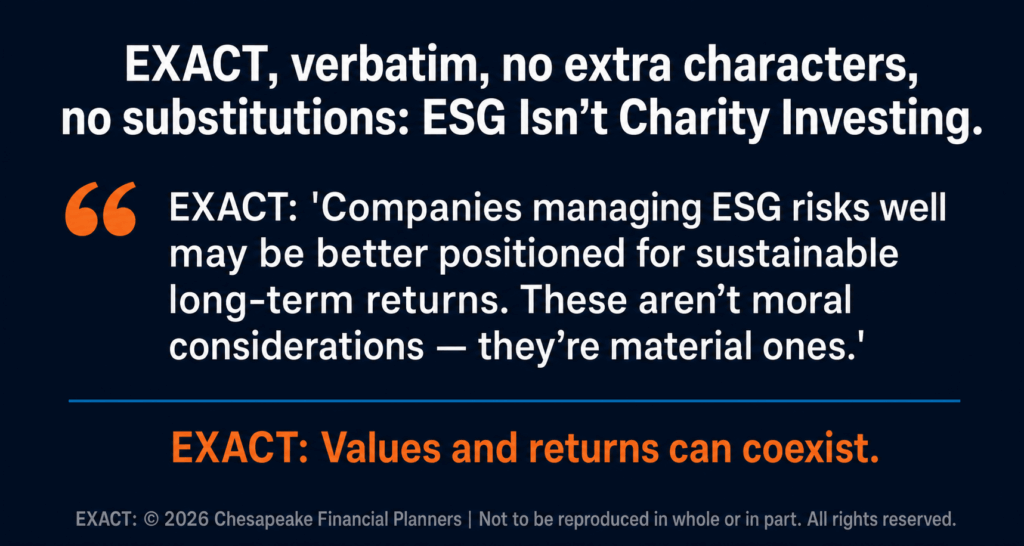
The key shift from older socially responsible investing is that modern ESG analysis treats these factors as financially material, not just moral preferences. A company that manages environmental and labor risk well may be better positioned to avoid the fines, lawsuits, and reputational damage that quietly erode shareholder value. According to the SEC, enforcement actions tied to misleading ESG disclosures have become a recurring theme, which tells you regulators now treat these claims as material too.
Jeff puts it plainly with clients: ESG is a risk lens before it is a values lens. The values part is real, but the durable case is that badly governed companies tend to surprise their owners in expensive ways.
What Are the Different Approaches to ESG Investing?
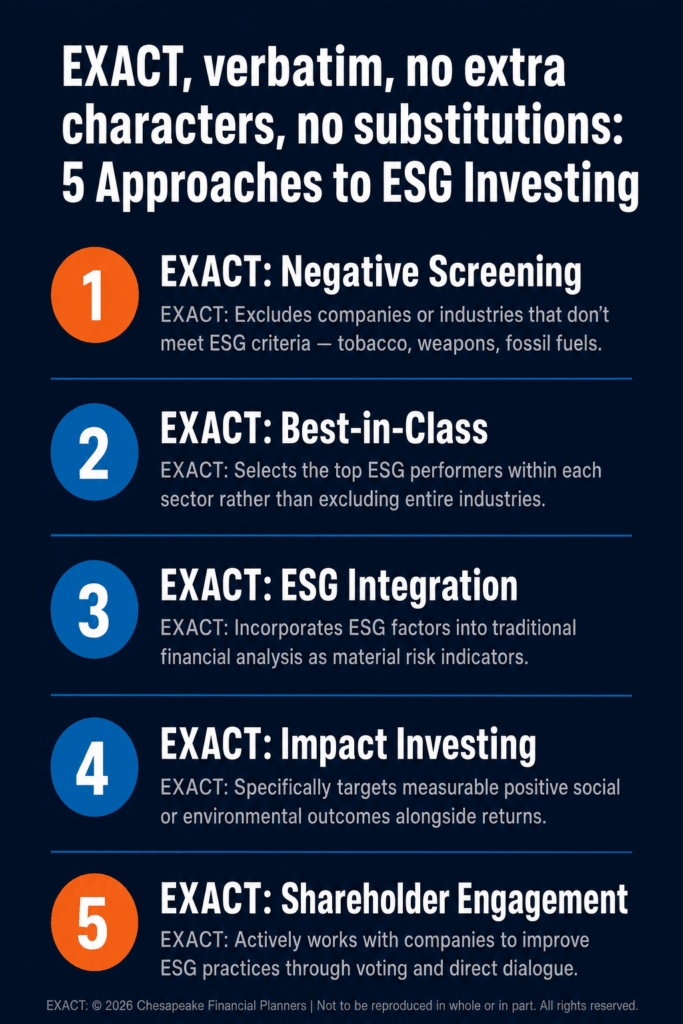
ESG investing is not a single method. Five distinct approaches exist, and most portfolios blend a few of them.
- Negative screening excludes companies or whole industries, such as tobacco, weapons, or fossil fuels, based on values criteria. This is the oldest approach.
- Positive (best-in-class) screening selects the leaders within each industry rather than excluding sectors entirely.
- ESG integration folds environmental, social, and governance data into ordinary financial analysis without excluding anything outright.
- Impact investing targets measurable social or environmental outcomes alongside returns, going beyond simply avoiding harm.
- Shareholder engagement uses proxy votes, resolutions, and direct dialogue to push companies toward better practices.
Choosing among these is where most of the real decisions live. A family that wants to avoid certain industries entirely needs negative screening. An investor who wants broad market exposure with a tilt toward better-run companies usually wants integration. According to Morningstar, the bulk of US sustainable fund assets sit in broad ESG-integration and screened index strategies rather than narrow thematic bets, which reflects how most investors actually implement this. Jeff Judge notes: "When a client says they want ESG, I ask whether they want to screen out industries entirely, tilt toward better-governed companies, or something else, because those are completely different portfolios and the word ESG alone doesn't tell me which one they actually mean."
This is a place where Chesapeake Financial Planners leans on the R.U.D.D.E.R. Method™, the firm's six-step planning process: Review and Recognize, Uncover and Understand, Design and Develop, Discuss and Decide, Execute and Empower, and Reassess and Refine. The "Uncover and Understand" step is where we pin down which of these five approaches a client actually wants, because the word "ESG" hides far more disagreement than agreement.
For investors holding How do I diversify a concentrated company stock position without a huge tax bill?, an ESG overlay can also become a useful framework for deciding what to diversify into.
Does ESG Investing Mean Accepting Lower Returns?
Not necessarily. The evidence on ESG performance is mixed rather than one-sided, which is itself an honest answer most marketing avoids. Well-governed companies that manage environmental and social risk can avoid costly crises, fines, labor disputes, and reputational damage. Operational efficiency often improves when a company cuts energy use and waste, and that lowers costs regardless of anyone's values.
That said, returns depend heavily on which ESG approach you use. A strict negative screen that excludes energy and materials will perform very differently from a broad ESG-integrated index fund. There is no single "ESG return." There is the return of the specific strategy you chose. Jeff has watched investors blame "ESG" for underperformance when the real cause was an aggressive sector exclusion they did not fully understand when they signed up.
If returns and risk are what worry you most, the broader question of Is my portfolio diversified enough to handle market volatility? usually matters more than the ESG label itself.
How Do You Build an ESG Portfolio?
Several implementation paths exist for an ESG portfolio. ESG mutual funds and ETFs offer professionally managed, diversified exposure, ranging from broad index funds with ESG screens to thematic funds focused on clean energy or workforce diversity. Direct stock portfolios allow fully customized values alignment but require more research and ongoing monitoring.
Many high-net-worth investors use a core-satellite structure: a broad ESG index fund forms the core, and concentrated positions in themes they care about most form the satellites. When constructing the portfolio, your specific priorities drive the design. Environmental investors emphasize climate, renewables, and resource efficiency. Socially focused investors prioritize labor practices and community impact. Governance-focused investors emphasize board independence and pay alignment.
One practical caution: actively managed ESG funds can generate more capital gains distributions than passive ESG index funds, so holding the tax-inefficient versions inside tax-advantaged accounts often makes sense. This is the same logic that drives ordinary How Do Investment Fees Impact My Long-Term Returns? decisions, and it deserves the same scrutiny.
How Is ESG Performance Measured, and Why Do Ratings Disagree?
ESG performance is measured by third-party rating agencies, and the inconsistency between them is the single most misunderstood part of this field. Unlike financial metrics with standardized definitions, ESG criteria vary by provider. MSCI, Sustainalytics, and others use different methodologies and sometimes reach opposite conclusions about the same company. According to MSCI, its ratings are designed to measure a company's resilience to financially material ESG risks, not the company's broad impact on the world, which is a distinction many investors miss entirely.
That gap matters. A fossil fuel company that manages its own operational emissions well can score highly on environmental criteria even though its core product drives emissions. The rating measures risk management, not impact. Do not rely on a single score. Decide which factors matter to you, then confirm whether a fund actually reflects those priorities.
What Are the Drawbacks and Limitations of ESG Investing?
ESG investing carries real limitations worth understanding before you commit capital. Strict screens that exclude entire industries create sector concentration, which can raise volatility relative to the broad market. Some ESG funds still carry higher fees, though that gap has narrowed considerably as the field matured. Greenwashing, where a company or fund overstates its ESG credentials, remains a genuine risk that marketing materials will never flag for you.
ESG priorities also shift over time. Issues that dominate today may fade, while currently overlooked risks may become central. That is why Chesapeake Financial Planners builds a "Reassess and Refine" step into the process rather than treating an ESG allocation as set-and-forget. Jeff's blunt take: the greatest ESG risk for most clients is paying a premium fee for a fund whose holdings barely differ from a cheap broad-market index.
Frequently Asked Questions
What is the difference between ESG investing and socially responsible investing?
Socially responsible investing traditionally focuses on excluding objectionable industries based on moral values, while ESG investing treats environmental, social, and governance factors as financially material risks and opportunities. ESG is broader and more analytical, considering how a company manages risk rather than simply avoiding certain sectors outright.
Does ESG investing produce lower returns than traditional investing?
Not inherently. Returns depend on which ESG approach you use, not the ESG label itself. A broad ESG-integrated index fund behaves very differently from a strict negative screen that excludes entire sectors. Research on ESG performance is mixed, so the strategy you choose matters far more than the general category.
How do I know if an ESG fund is actually sustainable?
Look past the marketing and examine the actual holdings, the screening methodology, and the rating provider the fund uses. Greenwashing is common, so confirm that the fund's portfolio reflects the specific environmental, social, or governance priorities it advertises. Reviewing the prospectus and underlying positions is the most reliable check.
What does ESG stand for in investing?
ESG stands for environmental, social, and governance. Environmental covers carbon emissions, energy use, and climate risk. Social covers labor practices, diversity, and community relations. Governance covers board independence, executive pay, shareholder rights, and internal controls. These three categories are weighed alongside traditional financial metrics when evaluating an investment.
Is ESG investing right for high-net-worth investors?
ESG investing can fit high-net-worth investors who want to align a portfolio with their values without abandoning competitive returns. Larger portfolios also allow more customization, such as direct stock ownership or a core-satellite structure. The right approach depends on whether your priority is avoiding certain industries, tilting toward better-run companies, or driving measurable impact.
Why do ESG ratings disagree across providers?
ESG ratings disagree because providers like MSCI and Sustainalytics use different methodologies, weight factors differently, and sometimes measure different things entirely. One provider may emphasize risk resilience while another emphasizes impact. Because there is no universal standard, the same company can receive very different scores depending on which agency you consult.
Where to Go From Here
ESG investing rewards clarity about what you actually want, whether that is avoiding specific industries, owning better-run companies, or driving measurable impact. Get that decision wrong and you may pay premium fees for a portfolio that barely differs from a cheap index fund. If you want a clearer picture of how ESG investing could fit your portfolio and values, our investment planning guide walks through the key decisions in depth. Download it at chesapeakefp.com.
Disclosures
The information provided is for educational purposes only and should not be construed as investment advice. Investment strategies should be tailored to individual circumstances, risk tolerance, and goals. Past performance doesn't guarantee future results. Consult with qualified financial professionals regarding your specific situation.
Socially Responsible Investing (SRI) / Environmental Social Governance (ESG) investing has certain risks based on the fact that the criteria excludes securities of certain issuers for non-financial reasons and, therefore, investors may forgo some market opportunities and the universe of investments available will be smaller.
Advisors associated with Chesapeake Financial Planners may be either (1) LPL Financial Registered Representatives offering securities through LPL Financial, Member FINRA and SIPC, and investment advisor representatives offering investment advice through Great Valley Advisor Group; or (2) solely investment advisor representatives offering investment advice through Great Valley Advisor Group and not affiliated with LPL Financial. Great Valley Advisor Group, and Chesapeake Financial Planners are separate entities from LPL Financial.


